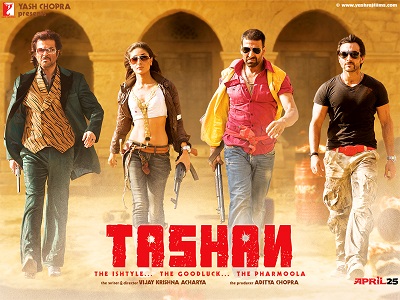
Tashan

tashan_poster

Tashan is not really a good film. I am at best indifferent to the cast. And yet I have a fondness for the movie that surprises me. Maybe it’s nostalgia for the total masala style, maybe the excellent work by the costume department, or the spectacular locations. But if you need to see a colourful movie that makes you throw popcorn at the screen and at your friends, this could be quite rewarding.

Vijay Krishna Acharya opens his film with Jimmy (Saif Ali Khan) in a car, underwater, and at gunpoint. How he got there takes up the first half. Most of the fun seeing this was the “surely they’re not…oh yes, they did!” moments and laughing at the shenanigans as the cast justify the next big set piece. There is a heavy use of flashbacks and characters speaking directly to the viewer so it heightens the unrealistic and fantastical mood, as do the songs. Jimmy and Pooja (Kareena Kapoor Khan) meet when Bhaiyyaji (Anil Kapoor) hires Jimmy as his English tutor. As Bhaiyyaji mangles every language he knows, Jimmy and Pooja fall in love. There is the matter of Pooja’s debt to Bhaiyajji, but there are also cases full of cash coming to the office every month. Bachchan Pande (Akshay Kumar), is an unhinged hitman hired by Bhaiyyaji. He is told to get Jimmy and Pooja and all manner of double crosses and shenanigans ensue. Who is what they seem, and who can you trust, especially when large sums of money are at stake? Things get complicated. And then everything blows up.

Saif Ali Khan used to be quite appealing when he was the second lead. As a leading man, he is inexplicable. It’s not that he doesn’t try to act, and it’s not just the porno moustache, it seems that his charisma has the depth of a teaspoon. And what is with the red belt he wears for the whole film? He is almost completely superfluous to the second half, yet he clearly refused to go home and just hung around whining until they promised him a big heroic Dhoom style action scene. Jimmy is not heroic though. He is self-serving most of the time, and a sleaze. He didn’t so much evolve as have a character transplant for a few minutes. I think one of the biggest issues is that the only person Saif seemed to have chemistry with was himself. He had a gleam in his eye when talking to himself or direct to camera, which was lacking in ensemble scenes.

Kareena has total commitment to the trout pout but Pooja is an interesting character who does more than pose. She does seem to have a polarising effect on the wardrobe team, or maybe it’s just their special way of showing love. Pooja is manipulative, and she has a clear goal in mind. Her romantic scenes with Jimmy have no spark to speak of, where her crackling chemistry with Bachchan is evident as is their knockabout friendship. Unlike Jimmy, Pooja has lots of layers to her character to reveal. Her contribution to the final fight scene is quite something, and I may have cheered out loud. Nice to see a lady causing the distress and staying ahead of the game.

I feel I ought to like Akshay Kumar more. But I have flashbacks to Tees Maar Khan (one of only two films I have walked out on) and I retrospectively dislike his films I may once have been more tolerant towards. And there is the established Youtube Poker rule that Akshay and a body of water will result in something hideously disturbing. But his Bachchan Pande is the saving grace of this film in so many ways. He is overwhelmingly self-confident, handy in a fight, and not overly complex intellectually or emotionally. And he has an excellent intro scene. Bachchan is also the one character with real principles, so I found myself caring more about what happened to him. Akshay gets lots of action scenes (by Peter Hein so you know, it’s pretty cool) as well as some discombobulated hick comedy, and it suits him down to the ground. And the shoe department agreed his grounding is important – he gets some excellent and flamboyant footwear.

God, I feel for the team that had to remove Anil Kapoor’s pelt. You know there would have been hedge trimmers first, then electric clippers, then waxing. I reckon we’re talking at least a full day of hard labour. My friend interviewed Anil a few years ago and told me ” One of my opening remarks was: “Anil, you have a lot of hair for your age. Is it hair weaving?” He pulled up his jacket like this and I quickly told him I got the drift…” I’m haunted by that anecdote. Anyway, his performance is fun and so over the top it all kind of makes sense. Unlike his outfits. Bhaiyyaji is determined to make it to the big league of dons and never averse to a bit of killing and mayhem along the way. His mangled Hinglish is hilarious and a bit sad as he worships Jimmy’s ability to speak like George Bush or Prince Charlie. Starting out as an urbane businessman he deteriorates into a snarling (shaved) beast, and Anil Kapoor goes all out.

The Vishal-Sekhar songs are what they need to be for a film, and the picturisations range from WTF to delicately lovely, making the most of their spectacular locations. Nothing can really explain “Dil Dance Maare” though. Kareena is more of a gyrate on the spot kind of dancer, and Saif does uncle stomping with a bit of flailing so I didn’t see much value added by Vaibhavi Merchant there, although the backing dancers earn their money.

Tashan is the kind of film that takes off and doesn’t stop until it stops. It’s high on visual impact and the pace never drags. See it if you need a rattling masala timepass, and don’t mind characters breaking laws of the land, laws of logic, and laws of physics. 3 ½ stars!

Kaashmora

kaashmora-poster

Written and directed by Gokul and starring Karthi in a double role, Kaashmora is a full on masala supernatural thriller with an amusing antihero, an evil villain, a beautiful princess, a mystic child, loads of characters with little to do and tonnes of cheesy one-liners. Much more fun than I expected, not as smart as I’d hoped, I still felt I got my money’s worth.

Kaashmora (Karthi) is a successful exorcist whose popularity is on the rise. He acquires a research assistant, Yamini (Sri Divya) who is secretly doing a thesis on fraudulent spiritualists. Eventually, and after many shenanigans, he arrives at a mysterious ruined palace which is haunted by a seriously evil spirit, Rajnayak (Karthi again). His family (including dad Vivek) who share the exorcism biz are also brought there, and they are given a hard deadline to achieve a task. Both Rajnayak and a mysterious child need Kaashmora to lift a curse and allow either a) Rajnayak to leave his confinement or b) long dead Princess Ratnamahadevi (Nayanthara) to finish him off once and for all. There’s not much Why but there is a whole lot of What! I think it’s best to just go see it and let it all roll. Or if you must spoil your own fun, read the usual painfully detailed summary a Wiki killjoy has already published.

Being a supernatural historical thingie, there is a lot of over the top design required from the palace and city through to the armour and other costumes. Overall I would say the design is great but the execution is a little lacking, and if you’re not as fond of dodgy CGI as I am, you may be in pain during some sequences. The old time city and palace are pleasingly epic in scale, and there is a nice commitment to eagles throughout. Ratnamahadevi has an excellent peacock bed, Rajnayak’s armour is hilarious and would probably get him killed or at least badly tangled up, and Kaashmora’s modern day exorcisms have the right blend of stock horror elements. The songs are colourful and their design and costuming ranges from totally unhinged to opulent and over the top. I was particularly taken by the Mad Max inspired Dhikku Dhikku Sir, although it was more “Furry Road” than Fury.

Often the device used to explain a far-fetched thing was not explained at all. Kaashmora is caught in part because of publicity about his Guinness Book of Records exorcism attempt (no, I did not know that was a category either) and naturally, we are to believe that the ghosts read the paper and watch the TV news. This was explained by a man who needn’t have been there except that there was no other way to explain that. So while I kind of liked the ideas, I wish Gokul had a better notion of how to link them together and how to keep moving without so many stops for “as you know Bob” exposition.

It’s not a terribly scary film, although there are a couple of moments that startled me a little. There’s a lot of violence but not so much gore. And despite Rajnayak being at best a sex pest and at worst a serial rapist, there was no depiction of violence or rape and all the ladies (and there were lots) he acquired gyrated around his enormous round bed and kept their spangly draperies firmly in place. Well, except his intended and unwilling bride, Ratnamahadevi, who had other ideas about their future.  Small mercies.

Sri Divya got a raw deal with her character. Yamini must be the worst at research ever. Just the worst. (I feel a bit Trumpesque making that statement.) She was supposed to be doing a thesis but had no idea how to actually do research, not even check Youtube for pertinent clips. And her character was completely pointless, adding nothing to the drama and doing little until a point when other solutions could easily have been written. I would have ditched Yamini completely and used the time to explain why Rajnayak stood around covered in bats.

Karthi is much more effective, and fun, as the slippery and smug Kaashmora than the one note Rajnayak. Kaashmora is serious about his business but his reactions and one liners ranged from droll to dad joke, making the most of Karthi’s comic timing. I was distracted by a continuity issue with a bit of disappearing crud on Rajnayak’s teeth which kept me a bit more interested in him than I might have been. But I was annoyed by the ending a little as it implied that Kaashmora would not learn anything from his near death experience and possibly worse, there might be plans for a sequel.

Nayanthara is both impressive and stunning as Ratnamahadevi. I wish more time had been given to her, not just because her multi-coloured hair looked great, but because I was more interested in her back story and her connection to the mystical child. Her outfits are very fairytale princess, but Ratna is both a warrior and a diplomat, using whatever tactics will be to her advantage. When Rajnayak was pawing at this woman he had coveted for so long, Nayanthara showed both disgust and the determination to seduce him and catch him off guard. And she imbued the final confrontation with a sense of the high stakes and her absolute fury at him. Does anyone know who played the child? She was quite impressive too.

Kaashmora is less grim than Arundhati, and less engaging than Magadheera, but it is good fun in a ripping yarn kind of way. It’s worth seeing on the big screen so you can at least be absorbed in the spectacle. And thanks go to Ajith who was credited with the subtitles – much appreciated!

Ozhimuri

ozhimuri-movie-poster

In some ways Ozhimuri was a hard film to place. Many of the plot summaries around made it sound like a fairly dry film about legal and social change in Kerala with the cessation of matrilineal inheritance. The posters tend to position it as a cute romance, which is not the focus, or push a love = violence angle which is unpalatable and also not really the point. Ozhimuri is not a heavy message film, nor is it a simple “boy with angry dad meets girl”. It’s a beautifully engaging story of three generations of family, the tensions and unexpected similarities between family members.

Director Madhupal uses a concise montage to set the scenes with images of females, human and divine, sitting at the feet of males, then older images that show the reverse. The titles use scenes at a big religious festival (My goodness! Those children must be terrified!), and meandering through beautiful countryside to embed the story in rural and traditional culture.

Meenakshi (Mallika) files for separation, citing harassment. Despite being described as a “dead dog” at the age of 55, she wants her independence. But she wants some property of means of support, having been made to sign hers over to her husband. Thanu (Lal) doesn’t seem to want his wife but will not relinquish any property. The legal argument then hinges on whether she is entitled to get alimony. His young female lawyer Balamani (Bhavana), who you might expect to support a woman seeking independence, joins the chorus of naysayers telling Sharath (Asif Ali) to persuade his parents to stay together. He tries to persuade Balamani of his father’s cruelty, and as they spend time together their own relationship deepens. Kali Pillai (Shweta Menon), is a strong influence on all aspects of Thanu’s life, and not in the usual doting ma and son way. Described as a queen, with the gait and power of an elephant, she is a strong if remote figure.

Madhupal uses flashbacks to great effect, both filling in the past and showing different perspectives on incidents. Things that seem black and white become ambiguous, and characters also become more complex and realistic. One of the most rewarding things about watching Ozhimuri was the way more is revealed, completely changing my view without ever being untrue to the characters.

Lal plays Thanu and Thanu’s dad Sivan. Thanu is a hard case but as things are revealed the influences driving his behaviour make him if not sympathetic then relatable. Sivan is a rumbly giant of a man, sentimental and simple. Lal plays Sivan with a twinkle in his eye and Thanu with a perpetual sour twist to his mouth. There is more than just anger driving Thanu. He has mother issues, and he hates and fears strong women. What we would call a street angel and house devil, Thanu is a doting father in his own way and has his father’s softness underneath his mother’s harshness. Lal is compelling throughout. I felt sad for jolly Sivan, and for the boy who would grow up without his warm hearted dad. Lal plays Thanu in such a way that he gained my empathy without resorting to trite sentimental tricks.

Meenakshi is the unsung hero of the film for my money. Mallika brings dignity and grace to Meenakshi, showing her as a woman who endures rather than fights, but who is strong and resilient in her non-confrontational way. She genuinely sees the good in people and tries to keep that in mind. She comes to know what she wants out of life and understands finally what her mother-in-law had tried to teach her. And so she acts. Everyone asks Meenakshi why she wants a divorce but nobody seems to want to really listen, they just want to tell her what she should do. She remains calm and obdurate, using her strength for herself for once. It’s hard to see a woman apparently defending her abuser, but as things progress Meenakshi becomes less of a victim and more a complex woman who made some choices then and is making different choices now. Mallika and Lal have a volatile chemistry that take their characters from domesticity to physical violence in a heartbeat, and they never break that connection or seem out of synch.

Shweta Menon is charismatic and arrogant as Kali Pillai. You can see in Thanu that the apple didn’t fall far from the tree. Even if he didn’t hold a grudge about his father, they would clash and they both had violent streaks. Kali is all about tough love, showing her concern for Meenakshi by constantly picking faults and telling her what to do. She doesn’t like seeing her son overturn the natural order of things and treat his wife like a slave and her pride is wounded by his lack of respect for her. But she never gives up on him really and still tries to protect him in her own way despite their estrangement.

The obvious option would be to have Balamani (Bhavana) represent Meenakshi and go all Girl Power, but instead she is representing Thanu. She is quite socially conservative and believes divorce is bad for families regardless of the situation at home. I liked Bhavana a lot, and she nailed the characterisation of a pretty young professional who is a bit tired of the boys club around her but doesn’t feel the need to rock the boat. Her down to earth conversations with her grandmother are both funny and sad as grandma explains the role of women. Hint – it has a lot to do with breeding. She and Sharath talk about their own families and future plans, and while sometimes it comes across as clunky exposition they help draw out the subtleties of the divorce case.

Asif Ali is extremely likeable as Sharath, the good son who sees his father as Bad and his mother as a victim. As things become less clear cut, he also has to confront his own resemblance to his father and what that might mean. He gets hit with some big truths and I loved that he never made a big deal out of it or insisted anyone choose sides. He absorbed the new knowledge, struggled a bit, then moved forward. He was open to Balamani’s ideas and treated her as a valued friend as well as an eventual lover and future wife. And hurrah for a film where people can have consensual sex and not be hit by a meteor or any other form of judgement.

This is just a gorgeous film to watch. I had some initial concerns because of the topic but I didn’t find the violence was sensationalised or dwelt on beyond what needed to be shown. The performances are all top notch and Madhupal and writer Jeyamohan provide an excellent visual and narrative structure.

For anyone who laments the lack of strong female characters in Indian films, see this. If you’re interested in a sympathetic but not apologetic portrait of family dysfunction, see this. If you like beautifully made films with realistic characters and great production values, see this. 5 stars!