Ae Dil Hai Mushkil


ae-dil-hai-mushkil

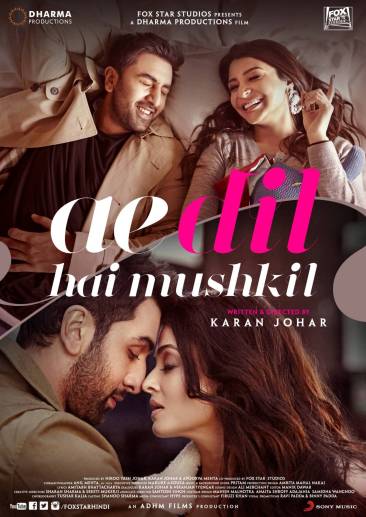
You know what you’re going to get with a Karan Johar film and his latest film Ae Dil Hai Mushkil doesn’t contain any surprises. As usual the film is all about unbelievably wealthy characters who look fabulous, live in amazing houses and agonise over simple human relationships the way only the truly idle rich can afford to do. It’s fluff, but beautifully filmed fluff that makes for a reasonable time-pass if you can ignore the few serious flaws that prevent the film from being a total success.

The film follows the antics of Ayan Sanger (Ranbir Kapoor) as he wastes his father’s money while studying an MBA in London and secretly dreaming of becoming a singer. One night he meets Alizeh Khan (Anushka Sharma) another rich kid who doesn’t even get a back story to explain her family wealth or her presence in London. Despite already having a girlfriend (Lisa Haydon), Ayan falls head over heels in love with Alizeh but unfortunately for Ayan, Alizeh is also already in a relationship (although unlike him she has no qualms about a quick one-night stand) and has no interest in anything other than friendship. Alizeh still has feeling for her ex – a DJ with a roving eye (Fawad Khan) and there is no room in her heart for anyone else.

It’s a wafer thin story and the theme of unrequited love is one that’s been told many times before, but that’s not the problem with the film. The biggest flaw here is Ranbir’s character Ayan who seems to be the worst possible reprise of almost every role Ranbir has played to date. Ayan is an overly emotional man-child with anger management issues who depends on his partner’s maturity and tolerance to solve all his problems for him. Like JJ in Rockstar, Ayan blames the object of his unrequited love for his issues and totally fails to see that only he can take responsibility for his own emotions. It’s hard to feel any empathy for such a self-centred character, particularly when he behaves like a five-year-old, bawling his eyes out when his girlfriend leaves him and pushing Alizeh around when she doesn’t fall into line. At least Alizeh pushes back, but this kind of violence without repercussions is just not acceptable and has no place in any film that purports to be a ‘romance’. Ranbir puts in a good performance, possibly no-one can pull off bratty man-child as well as he can, but his character here is too obnoxious for me and I seriously questioned Alizeh’s judgement when she decided that Ayan was her BFF.

My other big issue is the dreadful cliché used to resolve Ayan’s emotional immaturity at the end of the film. It’s such a let-down and a weak finale, especially when Ayan’s behaviour becomes even more appallingly self-centred and he is quite brutal in his treatment of Alizeh.  It’s disappointing as there are plenty of good points to the film too, but with the end such a let-down the overall feeling on leaving the cinema is one of dissatisfaction.

It’s not all bad though and the first half in particular has plenty to enjoy. Thankfully, apart from her poor friend choice, Anushka Sharma’s Alizeh is a more sympathetic character and appears charming and likeable, even in her loyalty to her philandering boyfriend. Her decision to marry DJ Ali despite her awareness of his indiscretions rings true to real life relationships, and the mistaken but frequent belief in marriage as a cure for infidelity. As if! Alas, Alizeh’s love for Ali seems much greater than Ali’s love for Alizeh and both Anushka Sharma and Fawad Khan are excellent in their portrayals of this mismatched couple in a seemingly doomed relationship.

What also works well is the friendship between Ayan and Alizeh, which sparkles off the screen in the first half. I love that they have a shared love of old cheesy Bollywood songs (after all, who doesn’t!) and that they re-enact them on the snowy slopes of Europe. As someone who has run around Golkonda in Hyderabad trailing a scarf and singing the songs from Magadheera, I have immediate rapport with anyone attempting the same thing, especially when they take the time to dress appropriately for the occasion! There are a few glimpses as flashbacks in the song below but this scene is definitely worth catching in the cinema and for me was totally worth the price of admission alone.

Anushka Sharma is the best thing about the film and her portrayal of Alizeh’s down to earth pragmatism and sheer common sense ensure she is the most relatable character on-screen. She looks great and gives Alizeh plenty of pep and personality to counteract frequently Ranbir’s snivelling Ayan. It’s not that Ranbir doesn’t put in a good performance – he does – but his character is nothing he hasn’t done before and in this instance his immaturity is particularly annoying when compared to the other characters in the film.

Also excellent is Aishwarya Rai Bachchan who appears in the second half as a divorced poet Saba Khan. Saba begins a love affair with Ayan just as his heart is broken by Alizeh’s marriage and the two have an interesting relationship.  Ayan is as callous and immature as ever, but hs a genuine affection for Saba, while she is mature enough to revel in a love affair that has no expectations. Aishwarya is stunningly beautiful and gracefully elegant as she swans around her amazing apartment in Vienna, again with no indication of how a supposedly struggling poet could afford to live somewhere quite so spectacular and expensively furnished. Of course there is her ex-husband (Shah Rukh Khan in a brief cameo) who is supposedly a successful artist, and is still in love with his ex-wife so perhaps he is happy to fund her wealthy lifestyle. The relationship between Ayan and Saba is much better realised than that of Ayan and Alizeh, and here the contrast between Saba’s maturity and Ayan’s self-centred youth makes for a more plausible relationship. Even the way it ends is well written and perfectly acted by Ranbir and Aishwarya, something that makes the final scenes even more disappointing in comparison. After all if K-Jo could write this part of the story so well, why not have such a satisfying conclusion to the main relationship too?

I wanted to like As Dil Hai Mushkil more as there are some very funny moments and clever situations in the first half that work really well. The songs are good, the sets spectacular and all the actors perform well. But no matter how much I enjoyed the friendship between Ayan and Alizeh, or the relationship between Ayan and Saba, it’s all overshadowed by the clichéd ending and the general unpleasantness of Ayan’s character. Worth watching for Aishwarya and Anushka and the wonderful re-enactment in the snow but be prepared for the banality of the ending and seen-it-all-before sameness of  Ranbir’s character.

Kodi (2016)

kodi-poster

Kodi is an interesting political thriller that sadly did not release in Australia with English subtitles. As the film is dialogue-heavy this meant that I missed most of the subtleties of the film, particularly annoying since the female characters seem to have more substantial roles than usual and the plot appears to be well-developed with unexpected twists. However the basic story is pretty easy to follow and the characters all clearly delineated ensuring Kodi is worth the trip to the cinema. It’s still completely baffling to me that in today’s global market the producers would choose to release Kodi overseas without subtitles, although it does follow the recent trend of not including subtitles on Tamil DVD releases either. Come on Kollywood – lift your game!

Dhanush plays a double role in the movie, portraying twin brothers, Kodi and Anbu. Despite being mute, their father (Karunaas) had political ambitions and was prominent in the local party as an activist and avid supporter of the local leader.  On his birth, Kodi was presented to the leader and from that point on it seems that his father transferred all his political ambition onto Kodi, dragging him around to various political events and giving him speeches to declare on his father’s behalf.

Initially Kodi seems relatively happy to follow the party line, but he is horrified when his father suicides right in front of him in order to highlight mercury poisoning at a local factory. Rather than lessen his passion for politics, this ensures Kodi grows into a hot-headed and passionate politician who craves social justice and presumably the power and prestige such a role would bring. As a young campaigner Kodi seems to have a fairly prominent role in the local party office, although there are grumblings from the older generation about the young upstart who seems to be taking a lead role. Along with the problems Kodi faces from his party, his girlfriend Rudhra (Trisha) is also a wannabe politician, except she’s firmly on the opposing side and the two seem to frequently clash in the public arena. Luckily for their romance, they seem to be able to put their opposing views aside once they are alone together and apart from the hassle of having to keep their relationship secret, Kodi and Rudhra happy together.

Anbu on the other hand is a gentler character who works as a teacher at a local college and is content to let his brother lead the charge for democracy. He finds romance with a local egg farmer Malathi (Anupama Parameswaram) although he isn’t above swapping roles with his more volatile brother when the occasion demands it. Dhanush keeps the two characters separate with ease, and not just because Kodi has a full beard and Anbu a moustache. Kodi is harsher, often appearing stern and forbidding, and only leading down his guard with Rudhra. He is argumentative, struts around combatively and is a typical mass hero when it comes to any fight.  Anbu on the other hand is softer, smiles more and even his posture indicates he’s a man who can be more easily pushed around. In his first double role, Dhanush effortlessly makes the two brothers separate individuals, perhaps even more so than real twins as Kodi appears more like an elder brother, and Anbu the younger.

Anbu  discovers more about the mercury factory which leads his brother to some unsettling revelations and as events unfold, Anbu ends up taking his brother’s place in politics. This is where the characterisation breaks down a little, as Anbu playing Kodi is really just the same as Kodi. It would have been even more effective if there had been some Anbu mannerisms left behind, although it’s possible that I missed some of this through not understanding the dialogue.

While Dhanush is superb as Kodi and Anbu, Trisha is just as good as a young and ambitious female politician. She has to battle against the prejudice of both her gender and her youth to win her place in the party and in doing so displays a ruthless streak that serves her well later in the film. Trisha is regal in sober saris that reflect her political ambitions, but lets her hair down in the romance scenes where she is softer and more likeable than in the rest of the film. There are also glimpses of the continuous rivalry between Kodi and Rudhra as they grew up together, with the childhood flashbacks proving more substance and clarity to the two characters. I love the interactions between the two – both in public as rival politicians and in private as their romance heats up. Writer/director R.S. Durai Senthilkumar has ensured that the female role is just as well-developed as that of the male protagonists, and in some ways Trisha has the more thought-provoking role with a complex and ambiguous character.

The story has a number of twists and turns with the machinations of the two political parties, the plots of the various members and the truth behind the mercury factory all having a part to play. I wish I had understood more of the dialogue as I missed the significance of Kodi and Anbu’s friend Bhagat Singh (Kaali Venkat) and I’m still not sure why Malathi disappeared from the story for most of the second half. This was a shame as Anupama was excellent, as were the rest of the supporting cast. S.A. Chandrasekhar was good in the role of Kodi’s party leader while Saranya Ponvannan was excellent playing the only role she ever seems to do nowadays (but then she does it so well!) as Kodi and Anbu’s long suffering mother. There are only a few songs in the film and these are mostly focused on the two romances, but Santhosh Narayanan’s music seems to fit well, although I did miss watching Dhanush dancing.

Like his previous films Ethir Neechal and Kaaki Sattai, R.S. Durai Senthilkumar concentrates on telling a good story rather than simply showcasing a star or indulging in mass action scenes. As a result, Kodi is an intelligent and engaging thriller, with excellent characterisations and clever twists in the plot. Dhanush does a fantastic job in a double role, keeping his presence somewhat understated so that the focus really is on the story and not the few fight scenes or dramatic speeches. I really do hope that this one releases on DVD with subtitles as it deserves to be seen by a wider audience and I’d love to finally understand all that dialogue.


Kaashmora

kaashmora-poster

Written and directed by Gokul and starring Karthi in a double role, Kaashmora is a full on masala supernatural thriller with an amusing antihero, an evil villain, a beautiful princess, a mystic child, loads of characters with little to do and tonnes of cheesy one-liners. Much more fun than I expected, not as smart as I’d hoped, I still felt I got my money’s worth.

Kaashmora (Karthi) is a successful exorcist whose popularity is on the rise. He acquires a research assistant, Yamini (Sri Divya) who is secretly doing a thesis on fraudulent spiritualists. Eventually, and after many shenanigans, he arrives at a mysterious ruined palace which is haunted by a seriously evil spirit, Rajnayak (Karthi again). His family (including dad Vivek) who share the exorcism biz are also brought there, and they are given a hard deadline to achieve a task. Both Rajnayak and a mysterious child need Kaashmora to lift a curse and allow either a) Rajnayak to leave his confinement or b) long dead Princess Ratnamahadevi (Nayanthara) to finish him off once and for all. There’s not much Why but there is a whole lot of What! I think it’s best to just go see it and let it all roll. Or if you must spoil your own fun, read the usual painfully detailed summary a Wiki killjoy has already published.

Being a supernatural historical thingie, there is a lot of over the top design required from the palace and city through to the armour and other costumes. Overall I would say the design is great but the execution is a little lacking, and if you’re not as fond of dodgy CGI as I am, you may be in pain during some sequences. The old time city and palace are pleasingly epic in scale, and there is a nice commitment to eagles throughout. Ratnamahadevi has an excellent peacock bed, Rajnayak’s armour is hilarious and would probably get him killed or at least badly tangled up, and Kaashmora’s modern day exorcisms have the right blend of stock horror elements. The songs are colourful and their design and costuming ranges from totally unhinged to opulent and over the top. I was particularly taken by the Mad Max inspired Dhikku Dhikku Sir, although it was more “Furry Road” than Fury.

Often the device used to explain a far-fetched thing was not explained at all. Kaashmora is caught in part because of publicity about his Guinness Book of Records exorcism attempt (no, I did not know that was a category either) and naturally, we are to believe that the ghosts read the paper and watch the TV news. This was explained by a man who needn’t have been there except that there was no other way to explain that. So while I kind of liked the ideas, I wish Gokul had a better notion of how to link them together and how to keep moving without so many stops for “as you know Bob” exposition.

It’s not a terribly scary film, although there are a couple of moments that startled me a little. There’s a lot of violence but not so much gore. And despite Rajnayak being at best a sex pest and at worst a serial rapist, there was no depiction of violence or rape and all the ladies (and there were lots) he acquired gyrated around his enormous round bed and kept their spangly draperies firmly in place. Well, except his intended and unwilling bride, Ratnamahadevi, who had other ideas about their future.  Small mercies.

Sri Divya got a raw deal with her character. Yamini must be the worst at research ever. Just the worst. (I feel a bit Trumpesque making that statement.) She was supposed to be doing a thesis but had no idea how to actually do research, not even check Youtube for pertinent clips. And her character was completely pointless, adding nothing to the drama and doing little until a point when other solutions could easily have been written. I would have ditched Yamini completely and used the time to explain why Rajnayak stood around covered in bats.

Karthi is much more effective, and fun, as the slippery and smug Kaashmora than the one note Rajnayak. Kaashmora is serious about his business but his reactions and one liners ranged from droll to dad joke, making the most of Karthi’s comic timing. I was distracted by a continuity issue with a bit of disappearing crud on Rajnayak’s teeth which kept me a bit more interested in him than I might have been. But I was annoyed by the ending a little as it implied that Kaashmora would not learn anything from his near death experience and possibly worse, there might be plans for a sequel.

Nayanthara is both impressive and stunning as Ratnamahadevi. I wish more time had been given to her, not just because her multi-coloured hair looked great, but because I was more interested in her back story and her connection to the mystical child. Her outfits are very fairytale princess, but Ratna is both a warrior and a diplomat, using whatever tactics will be to her advantage. When Rajnayak was pawing at this woman he had coveted for so long, Nayanthara showed both disgust and the determination to seduce him and catch him off guard. And she imbued the final confrontation with a sense of the high stakes and her absolute fury at him. Does anyone know who played the child? She was quite impressive too.

Kaashmora is less grim than Arundhati, and less engaging than Magadheera, but it is good fun in a ripping yarn kind of way. It’s worth seeing on the big screen so you can at least be absorbed in the spectacle. And thanks go to Ajith who was credited with the subtitles – much appreciated!