Manmarziyaan

Manmarziyaan

The performances from the three main actors are the reason to watch this romantic love triangle written by Kanika Dhillon and directed by Anurag Kashyap. Taapsee Pannu and Vicky Kaushal are the carefree couple indulging in their lovemaking whenever and wherever they can, while Abhishek Bachchan plays ‘the most patient man ever’ as Taapsee’s potential husband. The story doesn’t break new ground but the ever-present music and stunning locations make this a more watchable film than expected, even with its clichéd finale. And it’s good to have another female-centric film from Bollywood that doesn’t portray Rumi as a bad girl just because she indulges in pre-marital sex.

Taapsee Pannu’s Rumi initially appears manically impulsive which makes her rather more irritating than I suspect was intended. She’s also incredibly selfish, but then that applies to all the characters in this story, so her absorption with her own affairs sits easily beside the rest. But as the story unfolds, the complexities of her character become more apparent and Rumi’s ‘no apologies’ approach to life starts to make sense as her circumstances are revealed. She lives with her grandfather, aunt, uncle and cousin as her parents are dead, and she helps to run the family sports store. She used to play hockey at state level and still runs – for exercise, for enjoyment and also when she’s sad, upset or just plain angry.

Rumi is in love with Vicky (Vicky Kaushal), a free-wheeling DJ with spiky dyed hair and a collection of The Doors t-shirts. Vicky hops over balconies to have sex with Rumi behind her family’s back, although it’s pretty much an open secret in the neighbourhood since the lovers take a haphazard approach to concealing their activity. This is an entirely new side to Vicky Kaushal and he nails the man-child aspect of his irresponsible character with complete enthusiasm. He’s totally into Rumi and the two have an intensely passionate affair that all comes crashing down when Rumi’s aunt finds them together in the bedroom. Naturally the only solution is marriage, and rather surprisingly Rumi agrees. Perhaps she too has had enough of the sneaking around and she wants Vicky to finally ‘put a ring on it’. What moves the film forward here is Rumi’s family’s acceptance of Vicky as a husband if that’s what she wants. They may not totally approve, but there are refreshingly no demands to only marry the man of their choice. Rumi also takes a pragmatic view of the entire idea although her immaturity is on show when she declares that she will marry anyone the family chooses if Vicky fails to appear.

Although Rumi has absolute faith that her lover will agree to getting married, for Vicky that’s a step too far. He’s not ready for marriage, but he does at least admit his reluctance to an astonished and devastated Rumi. At this point the family contacts Kakaji (Saurabh Sachdeva), a marriage broker who has also been contracted to find a bride for Robbie (Abhishek Bachchan ), an NRI living in London who is back in India to search for a wife. Robbie might tie his turban on arrival in the airport to appease his rather traditional family, but is determined follow his own path as he searches for his life-partner. He falls in love almost immediately with Rumi’s picture despite the best efforts of Kakaji to provide a range of options. With Vicky’s refusal to commit, Rumi agrees to marry her family’s choice, but despite the wedding preparations, Vicky still isn’t able to let Rumi go and continually makes promises he just cannot seem to keep.

One of the areas that works well in the film is the depiction of Vicky’s commitment issues. There’s never any doubt that he is head over heels in love with Rumi, but his irresponsible nature doesn’t allow him any thought for the future. There’s an excellent scene where the two lovers run away together, only for Rumi to stop the car and ask Vicky where are they going and how will they survive. When he can’t answer, she knows that for all his passion in the bedroom, Vicky really isn’t husband material. Vicky’s father also has some harsh words for his son that ring true, telling him that he sees Rumi as a possession that he cannot bear to lose leading Vicky to make countless promises and break them over and over again. When we were discussing the film, a friend asked me why Rumi believed Vicky when it was so obvious that he wasn’t going to follow through? And that is the other part of the film that works for me. Rumi obviously loves Vicky and doesn’t want to lose him. So, she is prepared to do anything, say anything and believe him yet again when he says he will come and marry her. It’s a common scenario for women who believe they can change the men they fall in love with, and it takes maturity and experience to know that it’s simply not true. I could very much relate to Rumi’s attempts to hold on to the love she desperately wants to keep, despite being let down time after time after time.

Taapsee Pannu really is excellent here and after the initial overdone manic enthusiasm she settles down into a wonderful performance of a woman who is torn between her heart and her head. Her best scene for me was when she runs down to the river on her honeymoon and simply sobs, heartbroken and mourning the love she has lost. It’s a very powerful moment that’s followed up beautifully by her indifference to Robbie and her need to get drunk to sleep with him. Even when the story lags and the dialogue becomes repetitive, Taapsee is always engaging and convincing in her role.

What doesn’t work is Robbie’s insistence on marrying Rumi when he knows all about her relationship with Vicky. For all his talk about finding a life partner, his actions don’t appear to follow his words and his willingness to put up with Rumi’s bitchiness and indifference seems unlikely. Abhishek plays the sensible, sober and responsible Robbie well, but his character is simply too patient and understanding until towards the end of the film where he finally loses his calm façade.

The first half of the film has plenty of energy and sparkle that’s driven by Taapsee Pannu and Vicky Kaushal. Much also comes from Amit Trivedi’s fantastic soundtrack which is embedded in the very heart of the film and is used to good effect. Anurag Kashyap has added in twins who dance behind Rumi in a few of the songs and they are absolutely brilliant, adding yet more colour and vibrancy to the first half. Amritsar too is becomes part of the story as the city is beautifully filmed, and technically the film is excellent. Look out too for the gorgeous tea cups used by Rumi throughout the film and the thought that has gone into dressing Rumi and Vicky’s respective rooms.

Unfortunately, Manmarziyan loses steam in the second half and becomes rather repetitive although scenes between Vicky and Rumi still have an impact. The ending too is rather disappointing and tame after all the fireworks and energy at the beginning, and also much too predictable. This is a film to watch for the characterisations and the clever staging of a number of scenes rather than for the screenplay, which does tend to drag at times. But with such outstanding performances from the three leads Manmarziyan is still a step up from an average love story and definitely worth a watch.
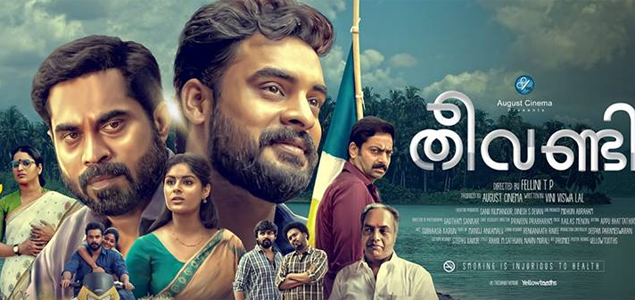
Theevandi (2018)

TheevandiSmoking is not something you see very often in Australia since there are laws that prohibit lighting up in most public spaces. As a result, a film that’s all about smoking seems a really strange topic to me, especially one that seems to treat the subject matter so lightly. It’s also quite ironic that the story ensures there are statutory warning notices displayed on the screen almost constantly, and in addition to the smoking and drinking warnings, there are also warnings about not wearing a motorcycle helmet, not wearing a seat belt and a declaration at the start advising that violence against women is a crime. However, Tovino Thomas makes this meandering story worth watching as he transforms from a clean-shaven school boy to a bearded and chain-smoking adult with an interest in local politics. Not a must-see drama, but a pleasant excursion in good company that benefits from a strong central cast and a generally upbeat approach.

The film starts with a birth, but the baby doesn’t breathe until his uncle blows a puff of smoke into the baby’s face – not a recommended way to start a child breathing! After this medical miracle, young Bineesh (Maheen) grows up as a normal village kid, although the local shopkeeper (Jaffer Idukki) is used to him buying cigarettes for his uncle Sugunan (Sudheesh) and using the change to buy sweets and snacks. This makes the teenage Bineesh (Tovino Thomas) the ideal person to send for cigarettes when the group of school friends decides to try smoking one day after school. While the others cough and splutter, Bineesh has no problems, since after all, his first breath was full of cigarette smoke. Oddly, while the students are having their first experience of smoking, their cigarettes are blurred out, I guess in some sort of censorship decision. It must be the school uniform that’s the issue, since the same actors are shown moments later without any blurring when they are supposedly older, but it still makes very little sense.

Tovino Thomas makes a convincing teenager, mainly due to his posture and body language, but he really hits his stride as the adult Bineesh. By this stage his smoking has become a chain habit that earns him the nickname of Theevandi, after the old-fashioned smoky steam trains. Bineesh hangs around the village with his friends, and doesn’t appear to have any gainful employment, although he seems to have a reasonably ready supply of cash to keep buying cigarettes. I was expecting some of the usual family rows with Bineesh being forced by his father to find a job, but his family seem happy to let him drift, although there is an undercurrent of concern about his smoking.

There’s a glimmer of hope on the horizon though as Bineesh is in love with Devi (Samyuktha Menon) who has promised to marry him only if he gives up his disgusting and smelly habit. But Bineesh doesn’t take her seriously and only pays lip-service to the idea, with his nonchalance and lack of commitment eventually resulting in a breakdown of their relationship. Samyuktha Menon is very good here and she gets the balance between heady romance and responsible common-sense just right. She’s the one who climbs up ladders in the middle of the night to speak to Bineesh, but she’s also the one with a job and a much clearer idea of where she wants to go and how to get there. Devi is a strong character who has the determination not only to stand up to her parents, but also to turn her back on Bineesh when he lies and hides his habit from her.

Bineesh is an interesting character and Tovino is excellent in this portrayal of a young man who his happy to drift until he works out what he wants from life – although he’s pretty clear that he wants Devi to be a part of it. As long as he can continue smoking , which is really his only other passion. To be fair, he’s probably more passionate about smoking than Devi, and certainly shows more emotion when faced with circumstances that force him to give up cigarettes. Despite this imbalance, the relationship between Devi and Bineesh is charming and sweet, with a realistic approach to the conflict between them. Oddly, although there is a warning at the start of the film, it’s Devi who slaps Bineesh every time she sees him smoking, and not surprisingly this isn’t a strategy that succeeds.

Writer Vini Vishwa Lal brings in a political angle with Vijith (Saiju Kurup) who is married to Bineesh’s sister. Vijith is active in the local party and Bineesh and his friends become involved as a result. One of the leading party members is Devi’s father Madhu (Suraaj Venjatammoodu), who generally disapproves of Bineesh and isn’t keen at all on the proposed marriage with his daughter. Adding fuel to the fire, Madhu becomes involved in a struggle with Vijith for the leadership after the party leader Balachandran (Shammi Thilakan) meets with an accident. After arguments and posturing on both sides, the leadership contest comes down to a bet that Bineesh will stop smoking until after a major protest organised by the party. But with Madhu and his supporter Libash (Vijilesh Karayad) determined to win at all costs, Bineesh’s struggle to overcome his addiction becomes a more public battle that he seems unlikely to win.

This is an interesting story that could have made more of Bineesh’s struggle to stop smoking. His initial attempts appear realistically half-hearted and the lengths he goes to in order to hide his smoking from Devi ring true, but the latter half of the film fails to show just how difficult it is to break the habit. Although Tovino Thomas gives a good portrayal of a man driven to the brink by his cravings, director Fellini T.P. takes the easy way out and gives Bineesh no choice other than to break his addiction. The methods employed by Vijith aren’t likely to be useful to anyone genuinely looking for a way to stop smoking and that to my mind seems to be a lost opportunity. The political bun-fighting also seems rather contrived and isn’t helped by Surabhi Lakshmi overacting as the corrupt party secretary. In fact, overall the political thread is weak without any real focus for this part of the story and it’s difficult to know if Fellini was trying to send a message about corruption, or just play the situation for some laughs. The best parts of the film are undoubtably those that focus on Bimeesh’s struggle and the song Oru Theeppettikkum Venda is a perfect example of how well Tovino Thomas portrays this inner conflict.

What also works well are the relationships , particularly between those between Bineesh and his friends, family and Devi. Tovino Thomas makes his character work and despite the vagueness of the screenplay, he keeps his part in the story focused and engaging. The support cast too are generally good and Suraaj Venjatammoodu, Saiju Kurup and Sudheesh excel in their supporting roles. The music from Kailas Menon is lovely and although the songs in the second half are less effective, those in the first half fit well into the narrative. Gautham Sankar does a great job behind the camera and the film looks beautiful with scenes set on an island appearing lush and colourful. This is a thought-provoking concept for a film, but Vini Vishwa Lal and Fellini T.P. seem to have run out of steam half way through, resulting in a film that doesn’t quite succeed as a whole. Nonetheless, it’s worth watching for Tovino Thomas and Samyuktha Menon, and it may perhaps convince people that smoking really can be injurious to your health.

Autograph (2010)

AutographAfter watching Srijit Mukherji’s excellent Chotuskone, I was inspired to track down some of his other films and where better to start than with his 2010 début, Autograph. This is another film within a film but this time new director Shubhobrata Mitra (Indraneil Sengupta) is out to remake Satyajit Ray’s famous Nayak and wants Bengali superstar Arun Chatterjee (Prosenjit Chatterjee) to play the lead role. The film story and the real-life story cleverly intertwine and both mirror the plot of Nayak although it’s the inter-personal relationships that are the main driver of the film.  While Autograph is not as polished as Chotuskone, it’s an interesting choice of subject and a fantastic début film for Srijit Mukerji.

Satyajit Ray’s Nayak is a classic of Bengali cinema where a famous film actor pours out his life story, including his insecurities and mistakes, to a young journalist on a train. While Srijit Mukerji describes Autograph as a tribute to the famous director, within the film aspiring writer/director Shubhobrata Mitra (aka Shubho) explains more simply that he is remaking Nayak (with further inspiration from Ingmar Bergman’s Wild Strawberries!) and updating it for a modern audience. As Autograph begins, after two years of unsuccessful approaches to Arun’s agent Ashu (Pijush Ganguly) Shubho has finally managed to secure a meeting with the famous actor. We know straight away that Shubho is a good guy because he gives money to a street beggar when his car stops on the way to the interview, ensuring that the audience are behind the attempts of this ‘underdog’ to secure Arun as the lead in his film.

What Shubho doesn’t know is that Arun has seen a TV interview with successful producer Manoj Sarkar (Biswajit Chakraborty) declaring that a star was not necessary for a successful film. Arun is determined to show that even with a first-time director his stardom will ensure a hit film, even if he has to take over and direct the film himself. However, Shubho has a vision and he isn’t willing to compromise on his screenplay, which makes Arun look more favourably on Shubho’s proposal. Arun also agrees to produce the film and with Shubho properly humble and eager to work with an experienced team, it looks as if his big break has finally arrived.

Shubho needs a strong actor to take on the role of the young female journalist played by Sharmila Tagore in the original film and decides on his partner Srinandita (Nandana Sen), a theatre actor for the part.  Srin though isn’t keen, citing her inexperience and her relationship with Shubho as reasons not to take on the role. In reality she doesn’t want to work with one of her idols and is intimidated by the thought of working alongside such a big star.  Despite his apparent vanity and pride (check out the massive portraits everywhere in his house), Arun is a total professional who quickly puts Srin at ease and helps her with her performance. Real and reel life start to overlap as Arun takes Srin out to dinner and starts to confess his own insecurities and regrets, just as his character does in Shubho’s film.

But as the friendship is developing between Arun and Srin, Shubho becomes more and more arrogant and egotistical as the shoot progresses. He criticises the crew, is appallingly rude to everyone and berates Srin for her poor performance as Arun helps her practice her lines. He manages to stop short of criticising his leading man but only because he knows which side of his bread is buttered. For Shubho, this film is his chance to finally make it in the industry and he’s prepared to sacrifice his friends, Srin and everyone else to make his dream come true.

While the rapport between Arun and Srin works well and is believably shown as a friendship that gradually becomes deeper, Shubho’s transformation happens rather too quickly to be realistic. His treatment of Srin seems somewhat plausible but the change from mild mannered director to arrogant brat seems rather more unlikely, given his initial modesty and precarious status as a newcomer reliant on Arun for everything. His transformation though is complete when he refuses to give the same beggar any money and he finally betrays both Arun and Srin in his attempts to make his film a success.

Prosenjit Chatterjee is excellent here and his portrayal of the charming superstar of Bengali cinema is enthralling and completely believable. His initial arrogance and rather cynical view of the film industry is well balanced by Nandana Sen’s enthusiastic Srinandita while the gradual mellowing of his character is beautifully done. The developing friendship allows Prosenjit’s character to slowly reveal his own insecurities and poor decisions throughout his career – one of which is shown in flashback to his days on the stage with his mentor, played by the late Dilip Roy. The friendship seems a natural progression too and Arun never comes across as sleazy or opportunistic, which given that he is dealing with a new actor who initially sees him through a veil of hero-worship is fairly significant in a film that touches on sexual harassment within the industry. Nandana Sen is also excellent and brings a naiveté and innocence to her role which ensures Arun’s fascination with Srin appears genuine. She is convincing as a theatre actor reluctantly thrown into the spotlight and her refusal to compromise on her values seems appropriate for a new and inexperienced actor.

Srijit Mukherji is less successful in his description of the relationship between Shubho and Srin, particularly in the romantic scenes, which seem rather overdone. This may be because they occur during a song, which also feels out of place and disruptive to the story, but the idyllic nature of their relationship here doesn’t gel with the more mundane reality of their day-to-day lives. However, the later arguments are much better and Indraneil Sengupta does an excellent job in depicting the single-minded obsession driving Shubho. To be fair I suspect that such dogged determination is essential when making a film, especially for a new director, and this aspect of Shubho’s character comes across perfectly in a number of well written scenes. Overall Indraneil is convincing in his role as a egocentric filmmaker and while the transformation may be rather too quick, he does a good job with both aspects of Shubho’s personality.

Debajyoti Mishra provides the music, and Anupam Roy the lyrics for the songs, most of which are catchy even if they don’t all sit well within the narrative. Soumik Hadlar ensures the film looks good although there are one or two moments where excessive camera movement is distracting from the main action. The finale is excellent, poignant and memorable, and a fitting end to a film that has so effectively intertwined the characters’ lives. This may not be a perfect film but there are moments where it comes close, and for the most part it’s simply very good. For a début film it’s outstanding and a clear indication that Srijit Mukherji was on the road to becoming a film-maker of significance. Highly recommended. 4 stars.