Gods of Dharmapuri (2019)

Director/writer/actor Anish Kuruvilla’s latest, Gods of Dharmapuri (G.o.D), is a ten part series currently available with English subtitles on Zee5. (You can sign up for a free trial – just remember to cancel before the billing date). The action is set in a remote mining settlement, opening with the arrival of Pratap Reddy, his wife, and kids. But this is not a heartwarming underdog story, or a Kaala Patthar-esque industrial relations primer. Think more like Animal Farm as the new arrival starts his climb to the top of the muck heap.

A taciturn and surly man, I’d love to tell you Pratap has a heart of gold but he is driven by ego not empathy. After becoming a spokeman for the miners, he forms a political alliance with Ranga Rao (John Kottoly) and opposes D.N Reddy (L.B Sriram), the incumbent member and dictator. The men of the community accept Pratap as their leader, and D.N Reddy loses the blind obedience he had commanded. But Pratap moves further away from being a voice for workers like him and resents being a tool of the party. He asks what has the power – the hammer or the arm that wields it. Raj Deepak Shetty imposes himself on every frame, looming like a dark cloud. He may not say much but his rage and hunger are palpable. He doesn’t have relationships so much as he gathers retainers and servants.

Pratap has two sons. Venu (Satyadev Kancharana in an impressively nuanced performance) is the eldest and a clean cut good guy who likes to keep his hands clean. Other people do the dirty work and then he agonises over it. Ravi (Karthik Rathnam) is 80% penis and 20% hair. He loves movies, sex, booze, and his hairdo. Subtlety is not his thing and Rathnam goes all in to portray that. The brothers are so different and they are perpetually in disagreement over how to handle problems. But they love each other and are each other’s most reliable friends. The boys always assume they are in the right because they have the power to punish anyone who insults them.  And Venu certainly wants to win at any cost, despite preferring to manipulate rather than go full machete. He was going to get out, but Ravi caused a problem and suddenly Venu couldn’t escape. He asks Pratap how much longer they have to keep stopping him from acting on his rage and digging them into a deeper hole. You can see the dynasty shaping itself as they jostle for position.

The wives are always on the fringe of things, listening and quietly organising and sharing resources. The husbands all turn a blind eye, trading their wives bodies to sleazy managers for job security. When Saroja (Sruthi Jayan) is raped by a supervisor she suffers in silence. The rape was horrible, but that wasn’t the only sexual violence in her life. And women have to pay for men’s crimes with their own bodies time and time again. Saroja was deprived of a much wanted baby because of Pratap’s pride and entitlement. Acutely aware that one day her family will pay for their actions, she tries to shake some sense into the boys but Pratap dominates their lives. Sruthi Jayan is effortlessly expressive, and the moral burden Saroja carries is etched on her face. It’s not all gloom, and she does have a loving and warm relationship with Venu. Maybe because he was the best bet for breaking the cycle of violence and scheming.

Divya Mathews (Samyukta Hornad) is the young reporter, a professional woman sent to do a story about the family dynasty. She doesn’t wear a saree and  she has sex with Venu, her interviewee, so we know she is Modern. I understood why her character was needed but there was something a bit off, and a sizeable mismatch between her career and the scale of the stories local politics could sustain. I also felt that her taking a cheap shot at Venu’s wife Swapna (Chandini Chowdary) was a misstep by the writers. She had plenty of grievances without resorting to petty and uncharacteristic jealousy. And for a reporter, maybe a bit more fact checking and insight into motives would have helped establish her career and credibility as a character. Or finding a different boss.

Writer/director Anish Kuruvilla also stars as Rao, a slimy rural Rupert Murdoch who manipulates the news he publishes to get the political results he wants. It might be a good indicator that I hate this character with the fire of a thousand suns. Media and politics in bed together is no surprise, but Rao has no real convictions. He just wants what is advantageous to him, and presumably for the bigger shark somewhere in the shadows.

The significant supporting characters are relatively few in number, which made the story’s world feel too small for the stakes we were meant to believe in. However I really enjoyed getting to know more about the various That Guys who enabled Pratap’s rise. Chalapathi (Jagadeesh Prathap Bhandari) is a relative of some sort, and he remains steadfastly with Pratap. Chinappa and Seenaiah are the peanut gallery, freeloading when they can and passing commentary on everyone. I didn’t mind their shenanigans as they gave a cynical fly on the wall perspective. Some supporters became disenchanted with Pratap’s tactics, some like Raghu were resigned to staying with the horse they had picked, most would go wherever the wind took them. One of my favourite scenes is when a woman insists on her right to vote. Seeing her stand up to male indifference and dismissal and claim her name and her democratic right was beautiful, and it anchored the story back to the the little people who had no control over the poltical wheeling and dealing.

I liked that the episodes are not uniform in length, but seemed to stop and start where it made sense to do so. While there are some stylised visuals they mesh well with the beats of the story.  For classic mass fans, there is a significant gold tooth and a significant horseshoe. Many of the male actors looked a lot happier from episode 5 onwards when the tight fitting retro wigs were left in the past.  I was very unimpressed by the prosthetics team. A scene that should have packed a visceral punch was ridiculous due to the amateurish crafting of dismembered bits and pieces. Depicting sexual violence is often problematic with a tendency to voyeursim or sensationalising the act. I was both horrified by what was happening on screen and impressed at the restrained direction that left no doubt but also left a lot to the imagination.

The subtitles are mostly good, and the saltiness of the language is appropriate to the setting and characters. There are a couple of episodes where it felt like a different person was writing the subs and sometimes the translations were too literal. Are fish smilies a thing? I want to know. Not enough to really research it myself, but still. The original soundtrack is excellent and yet sometimes too fresh and modern, not always suited to the rural recent past.

If you like your dramas to come with a kick in the head, this is highly recommended.

Bombay

Bombay is the second of Mani Ratnam’s ‘terrorist trilogy’, and is the one that I find the most disturbing. I remember the news reports from the real-life events that happened in Bombay in 1992 which are recreated here in authentic detail, and I find the violence here more confronting and realistic, despite a rather romanticised ending. In Bombay, Mani Ratnam juxtaposes a ‘forbidden’ romance between a Hindu man and a Muslim woman with the Bombay riots to create a compelling and disturbing look at the religious divide in India. The film shows how prejudice can drive extreme acts of hatred but also includes the counter ideals of selflessness and acceptance with an almost fairy-tale spin on good and evil. It’s another stunning film from Mani Ratnam that still makes an impact to-day and along with A.R. Rahman’s soundtrack deserves all the awards and recognition that it has achieved over the years since its 1995 release.

The story starts with Shekhar (Arvind Swami) returning home to visit his family in a river-side village in Tamil Nadu. Just as Shekhar arrives he sees Shaila Banu (Manisha Koirala) and instantly he falls in love. Luckily the attraction is mutual and despite their different religions, a romance begins to grow between the two. Shekhar has been studying journalism in Bombay, which gives him a city sophistication and an intolerance for his father’s prejudiced views. Narayanan Pillai (Nassar) is a devout Hindu whose worst fear seems to be that his son will marry a bride from the North of India, since he is unable to imagine the horror of a daughter-in-law from a different religion. Shaila’s family is just as appalled by the thought of Shekhar and her father Basheer (Kitty) quickly arranges a marriage for his wayward daughter when he finds out about the affair. The clandestine nature of the romance allows for some beautiful camera work from Rajiv Menon and we also get the beautiful Kannalanae as Shaila spots Shekhar at a wedding.

I’ve read that Mani Ratnam wanted these scenes to be beautiful as a contrast to events in the second half, and I find it interesting that his idea of beauty is in the wind and rain that are a constant presence in the village. For me, accustomed to the weather in Ireland, I’d thought that this was supposed to represent the cold attitude of the two families to the romance until I read Baradwaj Rangan’s interview with Mani Ratnam. In Ireland, wind and rain is always cold and miserable, but since visiting Tamil Nadu I can appreciate why gusts of wind and showers of rain would be beautiful in a hot and often dry landscape. Despite knowing this, I still feel chilled when I see the wind whipping Shaila’s veil and skirt around, while the crashing waves and constant rain strike me as cold and gloomy even though I can appreciate the beauty of the landscape.

At the same time, coming from Northern Ireland, where it was just as taboo for a Catholic and a Protestant to start a relationship, I can really relate to the problem faced by Shekhar and Shaila; another reason why I find this film so confronting. The attitudes and expectations of society resonate closely to my own experiences growing up surrounded by religious intolerance and I am always thankful that my own family had a more progressive attitude. It does mean that I can understand their predicament here, and to some extent why their families are so worried as well. Beyond their own antipathy to the relationship there is the worry that society will condemn both Shaila and Shekhar, leading to ostracism and a continual risk to their safety.

With their families at loggerheads, Shekhar and Shaila elope to Bombay. They quickly get married and before long have two twin boys Kabir Narayan (Master Harsha) and Kamal Basheer (Master Hriday). The boys are named for their respective grandfathers but are brought up in both religions, while Shekhar and Shaila are easily accepted in their neighbourhood despite their ‘mixed’ marriage. But when the Babri Masjid is demolished and riots break out across Bombay, the boys are lost in the city alone. They are caught by a gang of men who terrorise the children, pouring petrol over them and starting to set them alight in a shocking scene full of religious intolerance and hatred. These are two young boys with no idea what religion is, let alone the differences between Hindus and Muslims, and with their brutalisation, Mani Ratnam exposes the full horror of the riots and the absolute inhumanity of the rioters.

While relations between the communities in Bombay are breaking down, Narayanan and Basheer have gradually turned their enmity into a guarded tolerance, so when both travel to Bombay in the wake of the December riots, they are able to live with Shekhar and Shaila without too much trouble. As the violence continues in the city, their relationship continues to improve as they realise the extremism and intolerance doesn’t reflect either of their own beliefs.

Some of the most powerful scenes here show Shekhar interviewing the religious and political leaders and asking them when the riots will stop, but no-one seems able or even willing to try and bring peace. As riots again grip the city and neighbourhoods are set on fire, the family is torn apart once more with Shekhar and Shaila left to tour the hospitals and mortuaries in their search for Kabir and Kamal. Meanwhile the boys find kindness from unlikely places as Bombay slowly begins to return to normal.

The film has graphic scenes of the violence and does not spare the audience any of the horror associated with the riots and the aftermath. The scene of bodies in the morgue is particularly bleak, even though Mani Ratnam doesn’t explicitly show grieving families – he doesn’t need to. The anguish and despair come through clearly as Shekhar staggers through room after room of bodies, men women and children, Hindu and Muslim, all mixed together, in a terrible reminder that this is the real cost of the riots. Although some of the scenes here do feel rather contrived, such as when Shekhar confronts two of his friends who are fighting on opposite sides, many more appear authentic, painting a picture of neighbour against neighbour with the main casualties being the innocent bystanders. When the police enter the picture (including Prakash Raj as Inspector Kumar) the level of violence seems to jump yet again, and the images of Kabir and Kamal hiding from the authorities are powerful reminders of the political aspects to these events.

The romance is beautifully told with plenty of symbolism in the images of sheets of rain separating Shekhar from his family, and Shaila losing her abaya as she runs towards Shekhar and freedom. The second half is brutally realistic but still has beautiful scenes of the family together and the developing relationship between Narayanan and Basheer. Rajiv Menon’s cinematography is excellent and A.R. Rahman’s soundtrack perfectly complements the visuals while Raju Sundaram and Prabhu Deva ensure that the dance numbers are equally spectacular.

Arvind Swami is excellent in a role that requires him to switch from a love-struck young man to a desperate and terrified one as he searches the streets for his children. His emotions are clear and easy to read, particularly in the second half when he begins to realise the political manipulations that are behind the riots. His fear and desperation as he searches for his children are frighteningly realistic while his disgust at the politicians, religious leaders and the rioters themselves also comes across well. Manisha Koirala too is wonderful in her role, and brings plenty of emotion to her character at every stage. Although she looks fragile, her character has plenty of determination and a fierce capacity to fight back when necessary. I love her performance here as she conveys so much without words, letting her expression say everything instead. The support cast are all good too, and Nassar and Kitty steal the show whenever they are on screen together. Their initial animosity and then gradual acceptance help to ground the film and stop it becoming too overly emotional as well as providing some mild comedy that also helps to lighten the atmosphere.

Overall, Bombay is a beautifully made film that takes on both a societal issue and a horrific subject to make strong and compelling political and social statements. Mani Ratnam does hammer home the manipulation message rather forcefully, and the final scenes are a little too simplistic, especially after all the drama that has come before, but despite these few issues, the film still delivers a powerful message that continues to resonate, even all these years later. It’s a disturbing film but that’s what makes it such essential viewing. Highly recommended. 4 ½ stars.

Kaithi (2019)

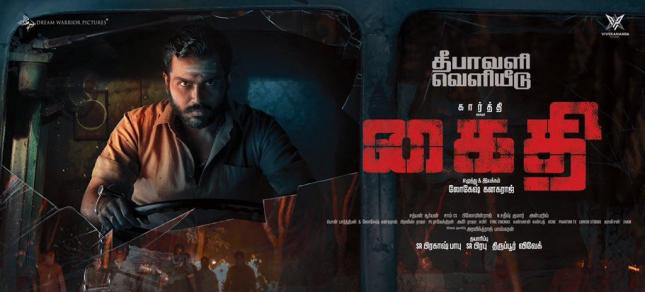
Kaithi was recommended to me as a must-see by many people but the film didn’t release in Australia until this weekend. Word of mouth has been so good that the cinema was full despite reaching Melbourne a week late. And after all the hype – is the film worth it? A resounding yes! Kaithi is a tense action thriller that doesn’t miss a beat, while all the cast are simply terrific, including Karthi in a role that sees one of his best performances. No songs, no dances and no romance track, just all out action, intelligently plotted drama and even a dash of comedy all ensuring that Lokesh Kanagaraj’s latest film is one not to be missed.

The film opens quietly, introducing a young girl in an orphanage who is told to expect an important visitor on the following day. We’re left in the dark as to who she is, and who the important visitor will be, but not for too long. Dilli (Karthi) is a paroled prisoner who is on his way to see his daughter for the very first time. Flashes of his daughter’s restless night as she waits impatiently for morning are interspersed with the action of the rest of the film, adding a strong emotional thread to the narrative as well as upping the stakes for Dilli as he battles his way through the various obstacles in his path. Importantly these scenes add some space around the high-impact action sequences and give us a reason to invest in the outcome of Dilli’s struggles. After introducing Dilli’s daughter the film shifts into fast-paced action with the introduction of numerous characters and the basic story all given in quick succession, which makes these small interludes a clever way to accentuate the action without breaking the overall level of tension in the film.

The action starts with Inspector Bejoy (Narain) and his team capturing a lorry load of drugs and other smuggled goods, although Bejoy is injured in the raid. For some political reason the raid has been kept secret, so Bejoy and his men stash the drugs under the police station while throwing the smugglers into the cells above. The team head off to the Chief Commissioner’s retirement bash along with all the senior officers, leaving a few junior police and recent transferee Napoleon (George Maryan) from Tirunelveli at the station. The action then switches to the gangster hideout where Anbu (Arjun Das) is plotting how to get the drugs back and also ensure that the police never know that they have his brother and gang leader Adaikalam (Harish Uthaman) in custody. The smugglers plan to drug the police officers at the retirement party and while they are incapacitated, break into the police station and grab the drugs and Adaikalam. All of which would work except for Bejoy and his decision to co-opt Dilli to drive the truck carrying the drugged police officers to hospital.

The events all occur over the course of one night which adds to the suspense and increases tension as Dilli and Bejoy battle to save the police officers, stop the gangsters getting to the stash of drugs and prevent Anbu from freeing Adaikalam. Along the way there are double agents on both sides, a group of students who end up barricaded in the police station along with Napoleon and the owner of the truck, Kamatchi (Deena) who is dragged along against his will. The action is a mix of the road trip across rough terrain to get medical attention with periodic attempts by the gangsters to stop Dilli and Bejoy by any means possible, and a siege of the police station by Anbu and his men, all anchored by the strong presence of Dilli who will do anything it takes to ensure he can get to the orphanage and meet his daughter.

The action sequences are well choregraphed by Anbariv who uses a mixture of one-on-one fights, inventive ambushes and stunts with the lorry to add novelty and interest to the film. Sathyan Sooryan’s cinematography makes the most of the night setting, highlighting the cabin of the truck where Bejoy, Dilli and Kamatchi are literal lights in the darkness of the war against drugs as the gangsters circle around in the darkness of the forest. Car headlights, torches and burning carts provide background lighting for the fight scenes with Dilli in the truck, while the police station, boarded up by Napoleon and the students is lit by moonlight as they attempt to keep the smugglers out.

Each member of the cast is fantastic, starting with Arjun Das as the erratic and bloodthirsty leader of the smuggling gang. He creates an atmosphere of violence simply by snarling at the camera and is a plausibly dangerous villain. Although Harish Uthaman has limited screen time, he is suitably menacing, particularly as he emerges from the gloom of the police cell to threaten the engineering students who have devised inventive methods for preventing his escape. George Maryan is outstanding as the ageing constable, fresh in from the country who ends up the sole defender of the police station and pulls the students into the fight. He is steady as a rock, perhaps because he doesn’t quite understand the magnitude of the force arrayed against him, but his attitude and strength of character are brilliantly written into the story and along with the students his fight against the gangsters is just as compelling and thrilling as that of Bejoy and Dilli.


I loved Narain in Anjathey and he is excellent here as a police officer pushed to the limits by circumstance and desperate to do the right thing. He gets across the internal conflicts that result when he pulls Dilli and Kamatchi into the volatile situation with the gang, and he is also excellent at portraying Bejoy’s helplessness from his broken arm which prevents him driving the lorry himself. It’s a well nuanced performance despite the straight forward character arc, and Narain excels in the brief conversations with Dilli that expose his innermost struggles. Deena too is well cast in a role that adds some humour to the story, but he’s also effective as a voice of the common man who tries to do the right thing despite being terrified by the violence that erupts all around him.

I really like Karthi and have seen most of his films including the excellent Naan Mahaan Alla, Madras and Theeran Adhigaaram Ondru, and in Kaithi he produces another scorching performance to add to the list. As a prisoner, Dilli has learned to keep his eyes down and his mouth shut making Karthi’s slow deliberate movements and measured dialogue a perfect fit for the character. His obvious enjoyment of biryani, eaten while Bejoy is trying to load up the lorry with the drugged police officers is a satisfying nod to freedom and the simple joy of good food eaten leisurely. He’s also excellent when describing to Kamatchi how he ended up in prison, but it’s in the action sequences where he really excels providing a convincing portrayal of a man willing to risk everything to reach his daughter. He gets the emotions just right too, never dipping into maudlin or overly dramatic sentimentality, but still showing the mix of fear, elation and trepidation that would naturally be present in any father going to meet his 10-year-old daughter for the first time. The character is written quite simply, but Karthi adds plenty of depth and intensity that contrasts perfectly with Narain’s more desperate Bejoy.


There are no songs but C.S. Sam’s background music fits the narrative well and helps to drive the action forward. The two different tracks to the story work well with each other to keep the tension level high, especially when it always seems that the defenders will be overwhelmed by the gangsters, and the finale is just as over-the-top and Rambo-esque as befits the indestructible character of Dilli. The film doesn’t feel overlong despite the almost 2½ hour running time but instead stays thrilling and almost claustrophobic with the one-night timeframe and race against time to save everyone. With brilliant performances, a simple but well plotted storyline and plenty of action sequences, Kaithi is an excellent thriller and highly recommended for fans of the genre.