Raees

raees-movie-poster

Raees (Shah Rukh Khan in case you haven’t worked that out) grows up working for the local bootleggers, learning the business from the inside out. His mother (Sheeba Chaddha) tells him that no business is beneath them, and no religion is greater than business, as long as they don’t harm anyone. Raees hates being poor, and hates being treated unfairly. He wants respect, money, success. He’s the kind of guy who will exploit the tiniest gap to create something you could drive a fully laden truck through. The man trying to stop him is the eccentric and equally driven Superintendent Majmudar (the excellent Nawazuddin Siddiqui).

The film is directed like it was the 70s, the story is set in the 80s/90s, but only the technology dates things. Seeing Raees threatening someone over the phone was something else when that phone was a dinky red racing car one. The Fatehpura neighbourhood is a lively backdrop, teeming with people going about their day in the narrow streets. The songs suit the film and tend to advance the story more often than not (the Not being Zaalima). I wasn’t convinced by Sunny Leone as Laila but that sequence is quite gripping.


I think they did a good job of harnessing Shah Rukh’s uncle dancing tendencies and enigmatic walking powers, and I am rarely averse to colour and movement. Overall Rahul Dholakia directs with good pace and attention to the emotional arcs, but he throws everything into his story and that is to the eventual detriment of the film. There are too many subplots unravelling towards the end and the energy fizzles out.

Raees has strong ethics in business and personal life. You can argue the toss about selling illegal booze, but he only sells quality gear not the adulterated hooch that killed people when he was a kid. The experiences in his youth have a clear influence on shaping the adult and I felt Raees was believable even if his fight skills were more suited to a Bond. The audience applauded his shenanigans – the chai glass and the press entourage got the loudest cheers – and they seemed to appreciate Raees as the guy who was doing one wrong thing but was otherwise a hero. He is the Angry Young Man who wants to give his family a secure future and help the people who have helped him. His lifelong friendship with Sadiq (Mohammed Zeeshan Ayyub) adds another layer of humanity, exposing some of Raees less heroic moments. Shah Rukh’s performance is solid but occasionally is too much like vintage Raj or Rahul, although Raees shows more intent than would usually accompany the up-close décolletage inspection. He’s charismatic, nerdy, and impulsive, but also calculating. One question though – Does SRK have an eyedrops sponsorship? First Dear Zindagi, now Raees…

Raees is an anti-hero who knows when he has committed a serious crime and it doesn’t always sit easily with him. I watched an old interview with actor Michael Caine and he was asked about how he could bring himself to play an evil character and make him seem so human. He said the man wasn’t a monster to himself, so he could play him with characteristics of both a decent guy and a cold blooded villain. I think that is what works with Shah Rukh’s portrayal. He looks at ease in Raees skin whether he is praying at his mother’s grave, being carried through the streets in triumph, or going on a brutally efficient killing spree. He shows unusual self-awareness for a filmi hero and a degree of struggle with the consequences of his path. People may see him as a god but he knows he isn’t.

Nawazuddin Siddiqui is Majmudar, that most problematic of policeman – the one who wants to get his man.  His epic entrance at the best and tackiest party ever was a perfect set-up for what was to come. Majmudar has a fascination with Raees. He is determined to shut him down but he quite enjoys Raees spirit. I liked how Nawazuddin would smirk, showing a hint of exasperation and a gleam of genuine appreciation when Raees bested him. That and all the sarcastic one liners. Majmudar spent time tapping Raees’ calls, using the helpfully labelled Phone Tapping Centre from the Central Props Department, and seems almost wistful when he overhears a personal call. But then he is still cold and calculating in his pursuit. Raees was the opponent he needed in order to be that cop who never gives up even when the system is against him. Nawazuddin steals all the scenes as Majmudar permeates Raees’ life and he is a strong and unyielding presence that exasperates the pragmatic businessman. Raees and Majmudar treat each other with respect and as much honesty as is possible, and are the most morally articulate characters. They’re both smart, neither has to be a fool or do anything out of character just to move the plot along, and both actors are terrific in their scenes together.

Mahira Khan gives a good and largely understated performance as Aasiya, Raees’ wife. There is no sizzling chemistry but they show a comfortable joy in each other’s company that speaks to a longstanding relationship between neighbourhood sweethearts. In a scene when Raees came home covered in blood, Aasiya gives him a searching look. His reaction of self-disgust and culpability is what reassures her. She knows his line of business and she believes in her husband. Despite being in the domestic background, it is obvious that Aasiya is respected and liked in the community and she steps up in public when needed. True, she appears to have a baby without a pregnancy but frankly I’ve seen stranger things in Hindi films.

Sadiq (Mohammed Zeeshan Ayyub) rounds out the important people in Raees life and his performance is endearing and realistic. Friends since childhood, Sadiq is the only one apart from Aasiya that can see Raees as just a bloke. They keep some of their cute childhood mannerisms, retell old stories, and they look out for each other no matter what. Even when Raees flies off the handle, Sadiq is there to try and talk him down or remind him of what’s important. It mustn’t be easy to carve out your own space when SRK is going the full Rahul, but this friendship works.

The cat and mouse between Raees and Majmudar dominates, but there are some excellent character actors in support. Atul Kulkarni is charming and vile as the calculating Jairaj Seth who won’t easily let his former employee best him. Narendra Jha is Musa Bhai, the enigmatic Mumbai based don who helps Raees set up on his own.

Raees is at best morally ambiguous, and the ending may not be what you expect, but I enjoyed the film. Rahul Dholakia directs with a vintage masala flavour, but unfortunately messes up the formula so it gets a bit diluted towards the end. It’s an uneven ride but worth it for the excellence of Nawazuddin and SRK and the retro cops and robbers style.

Lion (2016)

lion-movie-posterIn an “only in the movies” story, little Saroo is separated from his big brother at a railway station near Khandwa, Madhya Pradesh. He accidentally takes a train that lands him in Kolkata, hundreds of kilometres from home. Living on the streets he evades some very unpleasant people and situations before being taken in to an orphanage. He is adopted through an organisation called ISSA and placed with a middle class Anglo family in Hobart, Tasmania. When Saroo moves to Melbourne for uni he starts to admit to himself that he really wants to know who he is. He can’t forget his family, especially his mum and older brother Guddu, and knows they must have been looking for him all these years. His friends suggest using Google Earth to try and find landmarks he remembered. It’s a struggle as Saroo deals with his feelings of betraying his adoptive parents, his complex relationship with adopted brother Mantosh, his whiny girlfriend Lucy (Rooney Mara), and the sheer time and energy to do the work. But he never completely gives up, and he does find his way.


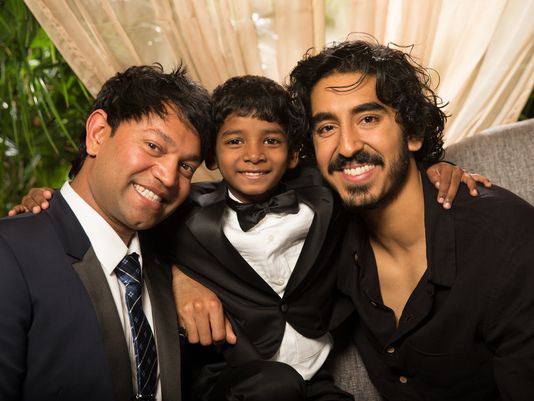
Lion is based on Saroo Brierley’s autobiography, The Long Road Home. I was fortunate enough to attend a preview introduced by Saroo and his mum Sue. They had input into the screenplay adaptation, and both said they were pleased with the results. Garth Davis uses landscape beautifully to reflect Saroo’s journey and to ground his memories. The scenery in Tasmania is pristine and lovingly shot, with a sense of order and calm. In contrast, Kolkata swirls with movement and energy as little Saroo (Sunny Pawar) darts through crowds and runs his heart out in search of home. The film is as manipulative as can be, but it’s the kind of emotional push and pull that made me want to buy into it. He’s a good kid, and you want him to be happy.

Sunny Pawar is that rarest of creatures – an Indian child actor I don’t want to slap. Apart from being ridiculously cute he conveys emotions with clarity and a sense of genuine feeling. Saroo couldn’t speak to anyone much about what had happened as he was a little kid, only spoke Hindi, was illiterate, and had no idea how to find his home. He was selected by Mrs Sood (Deepti Naval) as a good candidate for overseas adoption and before long, he had a new home.

Twenty years later, Dev Patel is Saroo. He has great hair, and a good Aussie accent. I’ve not been completely convinced by some of his past work but I felt he really inhabited Saroo and was just brimming with energy and life. He had a typically Australian slightly inarticulate, good natured, blokey feel about his character but could also show great depth of emotions. Patel’s scenes with Divian Ladwa who plays grown up Mantosh were full of love and disappointment and rivalry, being mean in ways you know will hit hardest, always internally comparing this brother to long lost Guddu. He had a strong connection with Nicole Kidman and David Wenham as his parents, and a relaxed playful rapport with the ensemble of his friends. The latter section of the film drags a bit as Saroo wallows in his angst, but it does make the payoff all the more sweet.

Sue’s dedication to having an adopted family made me slightly uncomfortable in the film, but not when I heard her speak in person. Possibly it was the tight close-ups of Nicole Kidman and her fierce emoting that made it seem too much. You know when you inadvertently see a display of intense emotion that was not meant for you, you just want to look away and give that person back their privacy. David Wenham has long been a favourite actor of mine. I would probably watch him watching paint dry, and find it fascinating. He plays John as a typical dad with a big heart and a few bad jokes, trying to keep his family of diverse and strong personalities together and happy through their ups and downs.

The casting really is excellent and I think it shows their commitment to getting things right. The Indian cast features some excellent character actors including Nawazuddin Siddiqui, Tannishtha Chatterjee, and Deepti Naval in small but impactful roles, with Priyanka Bose as Saroo’s birth mum Kamla. Melbourne girl Pallavi Sharda and local soapie actor Sachin Joab play a couple of Saroo’s uni mates. Abhishek Bharate delivers a good performance as Guddu, with a cocky swagger and a warm smile that made him so unforgettable for his little brother. Rooney Mara is stitched up with a fairly insipid role as Saroo’s girlfriend. Her character Lucy just doesn’t have the same complexity and depth as the others and she comes across as more of a plot device than a person.

I think Lion is going to be interpreted quite differently depending on your perspective. Many Australian viewers would have no idea who Deepti Naval or Nawazzudin Siddiqui is, so there’s that. I may have been the only person in the theatre to whoop when Prabhu Deva appeared on the telly in the background of a scene! And I doubt the 1980s approach to intercultural adoption, which was heavy on assimilation, will sit well with everyone. I was adopted as were several of my friends, and we all had diverse experiences and have made our choices about finding birth parents, so this resonates strongly with me. Sue is clear that she wants Saroo to tell her all about himself and what happened before the adoption, so it isn’t a case of ignoring his personal history. It’s more that there seemed to be no acknowledgement of his existing language or culture, only his misfortune of being a lost boy. Because the film jumps from the start to the end of Saroo’s personal journey, there is a whole other story in the middle that we don’t see. Saroo mentioned he might be working on a prequel so perhaps there will be a companion piece to come. Whatever your views, Saroo seems to have turned out to be a very generous and grounded young man who both his families are proud of.

See Lion for a beautiful story of identity and home and family, for the unashamed tugging at your heartstrings, for the excellent performances. Take some tissues because at least one of the Saroos will probably make you cry!

lion-all-the-saroos

Khaidi No 150

khaidi-no-150-poster


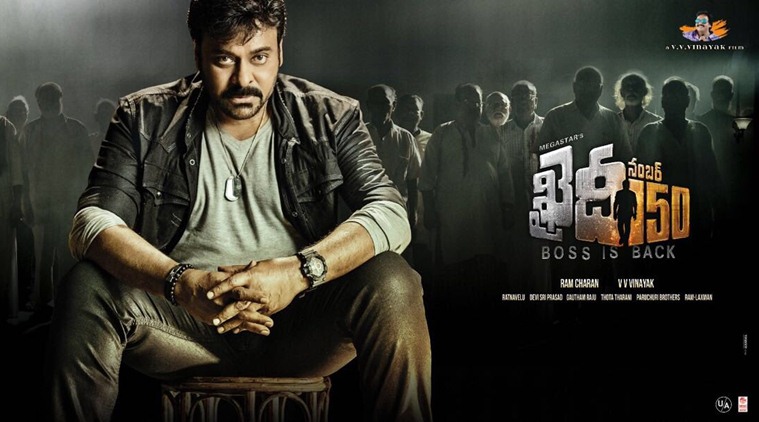
I thought the original film (Kaththi) was mediocre so I had low expectations. And I was honestly happy at seeing Big Chiru on screen, my first ever Megastar FDFS, and the bonus of subtitles. The audience went nuts when Chiru’s foot first appeared. Apparently I am not the only one who takes a keen interest in Mega Footwear. And the screaming and paper throwing erupted at the start of every song and every fight. It felt so good to be among my people.

The story goes like this. Escaped convict Seenu (Chiranjeevi) witnesses an attempted hit on a stranger, Sankar (Chiranjeevi). He takes Sankar to hospital but swaps over their ID so he can remain free, assuming that the police will let the other man go once they realise the error. Seenu then impersonates Sankar, and acquires a nursing home full of old men from the village of Neeru. As he understand their story, and gets to watch a handy documentary on Sankar’s crusade against the evil corporates, Seenu takes up the fight as his own.

In many ways this is a perfect comeback vehicle for Chiranjeevi. The dual role and the breadth of the action means no matter what his fans want from him, they’re likely to get it. He delivers action, big speeches, garish outfits, and some of his trademark dance moves (the veena step!), all with minor modification to suit a gentleman of a certain age. And most of that is done in the initial prologue section. The dual role means he can play both mass and class aspects of the standard hero, and even asks Lakshmi (Kajal) which she prefers before telling her his name. Sankar wears brainy glasses (HOT. Just saying) where Seenu has a more flamboyant style. There are references both in the script and the background music to his previous films, some of them drawing roars of appreciation from a very vocal crowd. He has a sidekick (Ali), an enemy (Tarun Arora), a frenemy (Brahmanandam as Doberman), and many comedy uncles and familiar actors as supports, dependants, and thugs. He also has an irrelevant love interest. See? Everything!

I was wondering how they would deal with the age gap between Chiru and Kajal and the answer is that Seenu thinks Lakshmi is a childhood sweetheart, but then realises they just look alike. So I decided that young at heart Seenu always thinks of himself as that twenty-something dude about town rather than thinking we’d believe they were actually the same age. I really should be on the payroll to find far-fetched solutions to ill-conceived plot devices…And the fight scenes are grand and full of energy, even though Chiru has long since left his limber acrobatic years behind. The songs also work to cover over the years because they are more a platform for people to worship the Megastar not a display of romance. The lyrics are mostly about how great he is, the choreo is very peacock-esque as he and the backing dudes strut their stuff, and the ladies just wiggle when in shot.

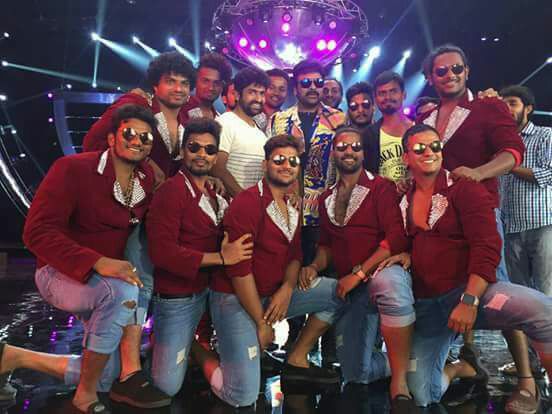
“Ammadu lets do Kummudu” is probably the worst song I will hear this year but as soon as it was over I would have hit replay if I could have. It has all the visuals I could ask for – prancing, colourful outfits, bedazzled Mega-shoes, and a guest appearance by Charan. Father and son look so chuffed to be dancing together. The backing dancer costumes are a wonder throughout. From drapey chiffon to see through plastic jackets, you name it, they had to wear it.

Kajal’s character is irrelevant, and she can hardly dance, so I really paid little attention to her. However. In every song picturisation she wears extremely sensible walking shoes regardless of her dress. So I was mildly diverted and wondered if it was due to her height compared to Chiru, perhaps she had an injury and couldn’t wear the usual ugly strappy sandals, was it some kind of statement. I don’t know. I doubt that this is what she wants to be remembered for but it really is the most interesting thing about Lakshmi.

Farmer suicide is a real issue given pretty superficial treatment by V.V Vinayak, although I appreciate he tried to show the effects of the ever shortening media cycle on long running issues. But the main components of the story felt off kilter. Farming life was overly romanticised, described as a necessary fate, and condemned as too harsh, often in the same grand speech. The speech that got a really big response was one about people being forced out of their villages and having to take crappy jobs in the big cities to earn some money. But the film seemed adamant that people should stay on the land, which I think is a bit simplistic as country kids may want or need to pursue other careers and they should have those opportunities. Sankar was supposed to be a man of principle but didn’t hesitate for a nanosecond when offered a deal to let some thugs kill Seenu if they got him out of jail. It was OK to throw in a tasteless joke that Doberman (Brahmi) had raped 100 women. And Ali in drag is never necessary to any movie ever. And the Megastar presence really dominates so that the reliable and accomplished guys like Nasser had little opportunity to make much of their roles. Or maybe I just wasn’t paying attention to anyone but Chiru!

khaidi-no-150-dancers

There are also some genuinely funny moments. I think my favourite was  when Posani Krishna Murali’s men all pretended to pick up phone calls as he was blustering and wandered off looking busy rather than face Seenu. Or maybe when Brahmi lost his religion during a huge fight scene. I also liked the thinking behind one fight scene that progressed through corporate thugs, oiled up baldy muscle men who looked like an angry pack of Maltesers, and finally the bad hair gang.

Lest you think I am completely superficial and only looked at the shoes, there was an interesting moment regarding justice in this film world. The judge (played by Naga Babu) says that if a single person kills that is murder, but if society kills it’s a revolution. It’s a problematic statement once you get thinking about the mob and riots but it did mean someone notionally good avoided jail time, and the person they killed was bad news anyway. No biggie.

Will Khaidi No 150 make a fan of anyone who isn’t? Probably not. Does any of that matter if you are a fan? No way!

Pssst  – Make sure you stay for the end credits for some glimpses of the famous visitors on set, and Lawrence closely monitoring a dance and giving someone the stinkeye.