Sweta Naagu

Sweta Naagu was initially mentioned in a comment (thanks mm) and the idea of a film featuring a specially trained white snake was intriguing. Sadly though, it’s a fairly average snake movie that suffers from a surfeit of ideas which all muddle together to make a rather dull film. There are however a few good snakey moments and a rather memorable snake dance so it is worth adding in to the Nag Panchami Film Fesssstival.

The film starts with Madhumati (Soundarya) handing in her thesis on snakes to her professor. I have to say she wouldn’t get very far with her thesis at my university – where are the three bound copies with the title on the side – hm? At any rate Dr Parthasarathi seems very impressed by her work as she has investigated snakes as, well, snakes, rather than as mystical powerful beings.

Madhumati is very much the scientist, pouring scorn on her mother as she celebrates the Nagachaturthi festival and is dismissive of her mother’s ideals and beliefs. So naturally Madhumati is appalled when she sees a TV interview with Dr Parthasarathi, where he discusses his belief in the divinity of snakes. Shocked, she confronts him and demands an explanation. The best he can come up with though is a ‘personal versus professional opinion’ argument which is really rather weak. He does become more decisive later on, but the initial impression isn’t one of a confident and scholarly ophiologist. Instead he comes across as patronising and smug, and to add to his general ineptness, he can’t draw snakes!

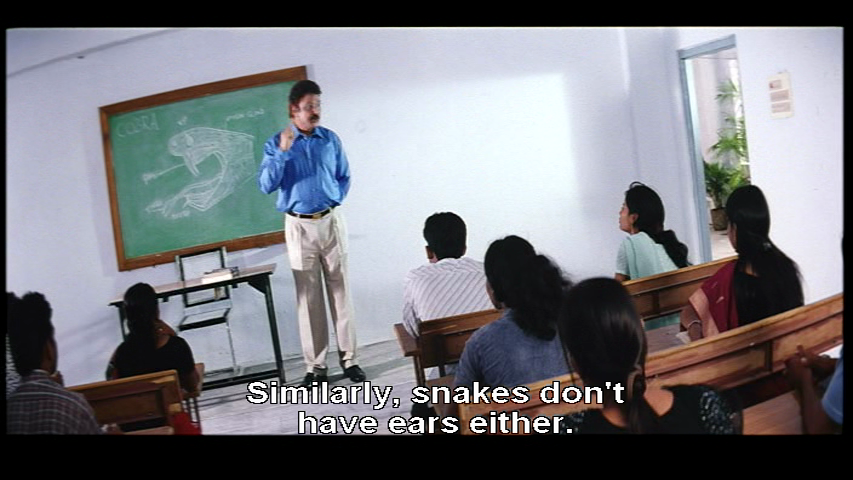
Madhumati says that she will believe in the divinity of snakes only if she has hard evidence. So her professor tells her about the sacred texts called the Nagashastras which contain all the evidence she wants, although how he knows this is rather questionable since these Nagashastras are hidden somewhere in the Kollimalai forests and no-one who went looking has ever returned. Madhumati is on a quest though, and determines that she will be the one to find the Nagashastras and maybe get a better grade in her thesis as a result.

Once in the forest Madhumati is immediately and rather fortuitously captured by the tribe that have the Nagashastras in their keeping. They are snake worshippers and have a chief who believes in the power of animal print fabric.

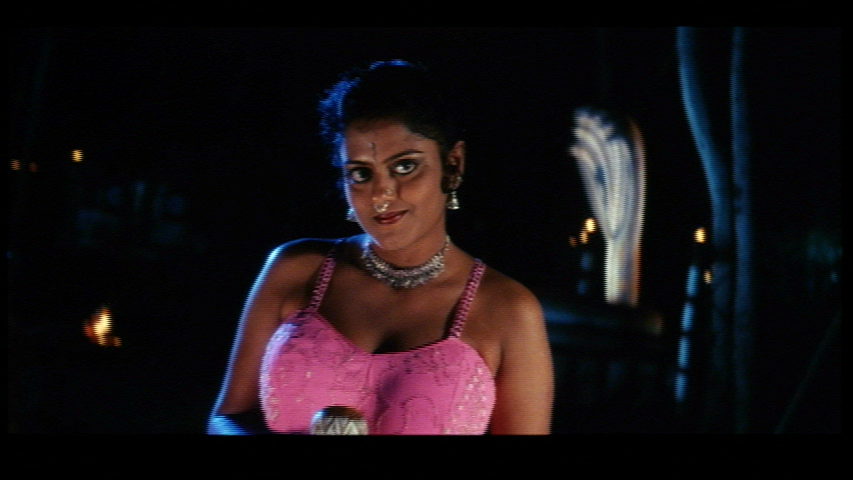
The sacred texts are guarded by a snake which for some reason seems to approve of Madhumati despite her attempts to get her hands on the texts and her often stated belief that snakes are just reptiles. The guardian snake appears to Madhumati in human form to warn her that it is in her best interests to leave as soon as possible. We know from jenni’s excellent guide as soon as Madhumati opens the door that Vaasukhi is a snake since she has the required less clothing and oodles of eye make-up. However, just in case we were a bit slow to catch on (like Madhumati) the hair is a bit of a give away.
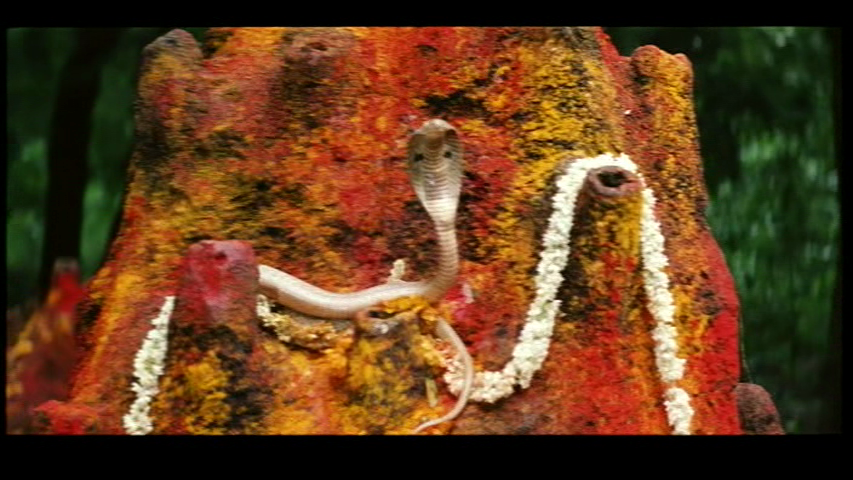
With this sign of favour from the local goddess, Madhumati is able to stay and continue her attempts to steal the Nagashastras. As a bit of a diversion, there is a strange tradition in the village that for any man to marry a woman he has to be able to beat her in a wrestling match. This gives us the only fight scenes in the film which are between local girl Chevandi and her suitors. Chief among these is Singam who finally does succumb to her kicks and body slams, recovering in time to be able to get married. This involves a ceremony at the Nagashetram where we first get to see the white snake as it blesses the happy couple.
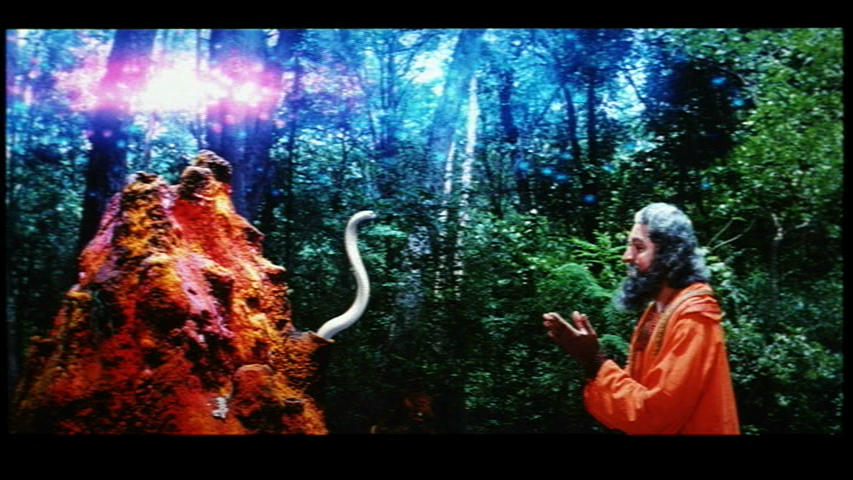
After the party a swami shows up and determines to prove to Madhumati that her belief in practicality and facts is misplaced despite her total rejection of him. He brings the white snake to him with his powers and Madhumati is suitably impressed. However as she steps out of his sacred circle, the snake suddenly turns and spits blue venom at her, which sets a small tree on fire. This rather disturbs her, although it seems to be more the personal attack that she is shocked by rather than incendiary venom. We learn by flashback that in a previous life, Madhumati killed a snake and the white snake now wants revenge. The swami gives her a sacred thread to protect her from utter calamity, which sounds rather useful until, as events unfold, we realise that perhaps his idea of utter calamity isn’t quite the same as Madhumati’s.

After trying to set her on fire, the snake next tries to woo Madhumati and turns up in a dream sequence/snake dance ‘item number’ as a Freddie Mercury clone in tight white singlet and red track-pants before changing into gold lame and black pleather. We know he is the snake as he has blue contact lenses and iridescent clothing as, but he’s just not very snake-like otherwise. The backing dancers however show great dedication to the art of the snake dance and are actually pretty good if not totally co-ordinated.

Before the dream sequence can lead to anything untoward, Madhumati is called back to the city. Here, the snake starts to truly plot revenge, appearing to her in the guise of her fiancée and popping up in unlikely places around the house. Since this leads to Madhumati crying and yelling ‘snake!’ every few minutes her family eventually take her to see a psychiatrist. His useful diagnosis is that she will be fine if she gets married and has something else to think about. Can it get any more ridiculous? Yes – at this point the white snake gate crashes the engagement and ends up killing Madhumati’s pet dog, while Pravin’s family disown him for allying himself with a woman who doesn’t believe in the divinity of snakes. As a final stroke of genius, the professor organises a conference where Madhumati can tell the world about her experiences and reveal the true nature of snakes – as spelt out below.

Snake are however vindictive, vengeful and able to impersonate anyone, so the white snake is able to totally derail the conference. There is then no other option but for Madhumati and her family to head back to the forest and find the helpful swami to solve the problem once and for all.
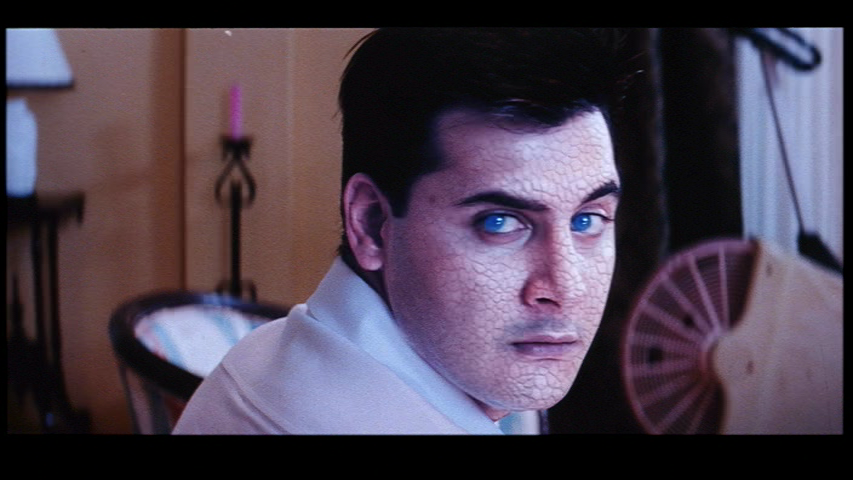
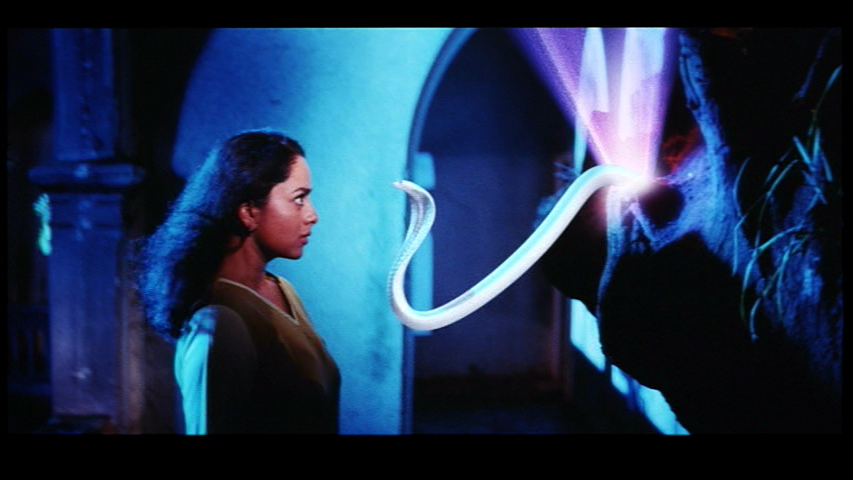
There are just too many ideas in here and as a result the plot gets messy and confusing. Writer Lalla Devi seems to want to add in as many snake film clichés as possible and it just doesn’t work. If the film had stuck to either a single reason for snake revenge or a science vs. divinity plot it might have made more sense, but the combination just doesn’t have a clear path to follow.

Soundarya is the best thing about the film, and she really works hard to make her character as convincing as possible. Abbas plays the role of Soundarya’s fiancée Pravin and is good when he actually has something to do. But his character has only a very small role and he tends to be overshadowed by Soundarya when they are on screen together. Jaya Prakash is fine as the village chief and seems to enjoy his role while Sarath Babu does what he can with the rather stupid professor.

There are some good lines in the film about science and divinity but they get obscured by the muddle of a plot. Also annoying and totally unnecessary is a comedy track involving the family cook and a thief who stole the cook’s money. This does at least provide a reason for Madhumati to have an escort to the forest but otherwise is just distracting. There is also a comedy scene with Brahmi during the snake conference which again doesn’t add anything to the plot and could very easily have been skipped. The side story with the romance between Chevandi and Singam is one which does work relatively well, but gets cut short, again to accommodate yet more unfunny comedy. The romance between Madhumati and Pravin is also skipped over very quickly and more detail of their relationship would have helped to explain why he was willing to defy his family over her. If only they’d concentrated more on the human relationships of the main characters and less on the comedy side-kicks this would have been a much more engaging film.

The effects generally work and the final face off between the white snake and the village snake goddess is a reasonable conclusion, although it’s still just a bit dull. The white snake is unusual though and it’s a nice change to have a snake seeking revenge as a man. Sweta Naagu gets 2 ½ stars, mainly for Soundarya and the white cobra.

Ishqiya (2010)

Ishqiya has a top cast and with the writing and directing team of Abhishek Chaubey and Vishal Bharadwaj, the story and script are top quality as well. This is Abhishek Chaubey’s first directorial venture although he worked with Vishal Bharadwaj on a number of his films as assistant, most recently Kaminey and Omkara. The screenplay here shows many of the same elegantly clever twists and turns, and there is plenty of snappy action. All of the actors make the most of their roles with some excellent performances, and it all adds up to a great film.

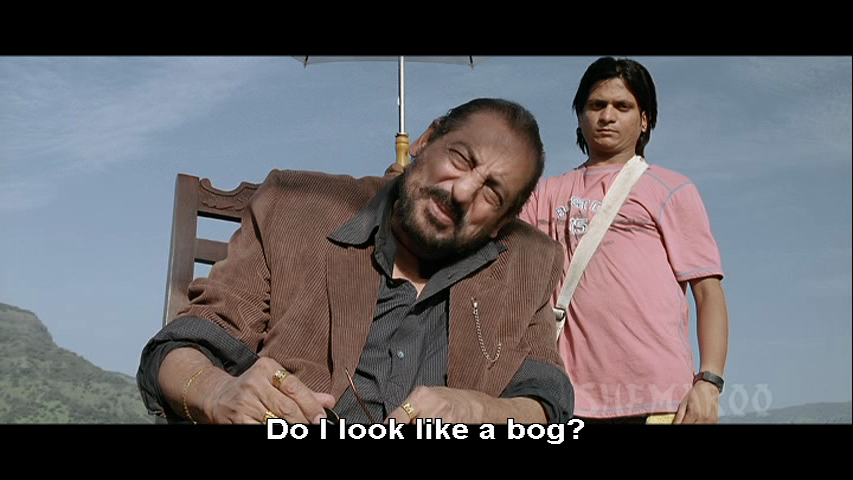
The film tells the story of two thieves, Khalujaan and Babban who are on the run after stealing from their boss Mushtaq. Khalujaan and Babban are uncle and nephew, and there is the added complication that Mushtaq is Khalujaan’s brother in law.  Khalujaan tries to rely on this connection to escape Mushtaq’s murderous plans for revenge but it seems that just being family isn’t enough – not when you’ve stolen from Mushtaq at any rate. After being caught by Mushtaq and his merry band of thugs near the start of the film, the pair manage to escape by means of some witty repartee and good team work. There is an interesting subtitle error here. I am quite sure that Mushtaq says kutta and really does mean ‘dog’, although possibly bog makes just as much sense.

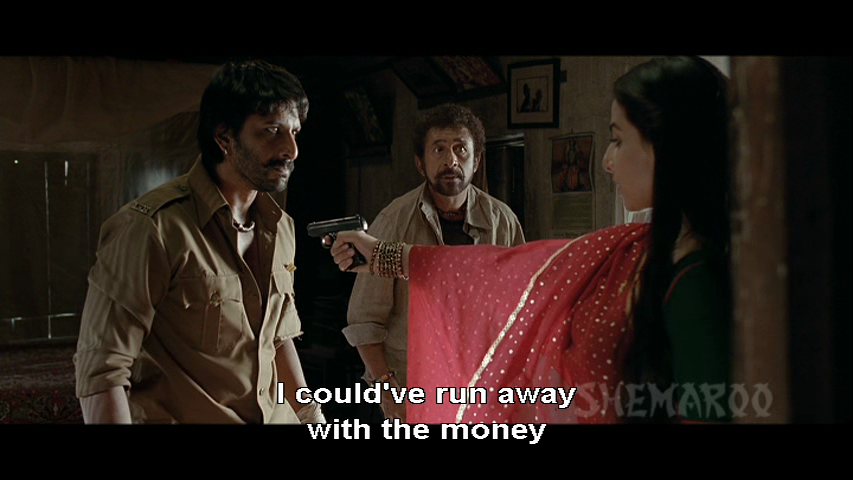
Since they can’t find anyone willing to risk the wrath of Mushtaq and take them in, they end up planning an escape toNepal. When they end up at the border town of Gorakhpur, they decide to seek help from an old accomplice Vidyadhar Verma. However on arriving at Verma’s house, they find out that he has been killed in a tragic accident, and end up dealing with his widow Krishna instead. This creates an interesting dynamic as Krishna plays the two men against each other while she plots to use them for her own ends. Meanwhile Mushtaq turns up yet again, and in a final attempt to get enough money to pay for their freedom, Khalujaan and Babban join forces withKrishnato kidnap a local business tycoon. They plan to use the ransom money to pay off Mushtaq, but Krishna has other ideas and their kidnapping ends up with some unexpected results.

The film opens with Krishna and her husband at home and in bed as he teases and cajoles her while she tries to get him to surrender to the police. Although the couple have been kept apart by Verma’s kidnapping schemes they seem to be very much in love and Krishna obviously misses her husband while he is away on his various criminal activities. Abhishek Chaubey has cleverly drawn Krishna and Verma’s relationship in detail in just a few minutes in these opening scenes and this attention to detail in the characterisation is carried out throughout the film. For example, when we first meet Khalujaan and Babban they are celebrating their escape from Mushtaq with the loot, and just from the way they are dressed and the way they dance and celebrate, we have a lot of information about their respective characters.

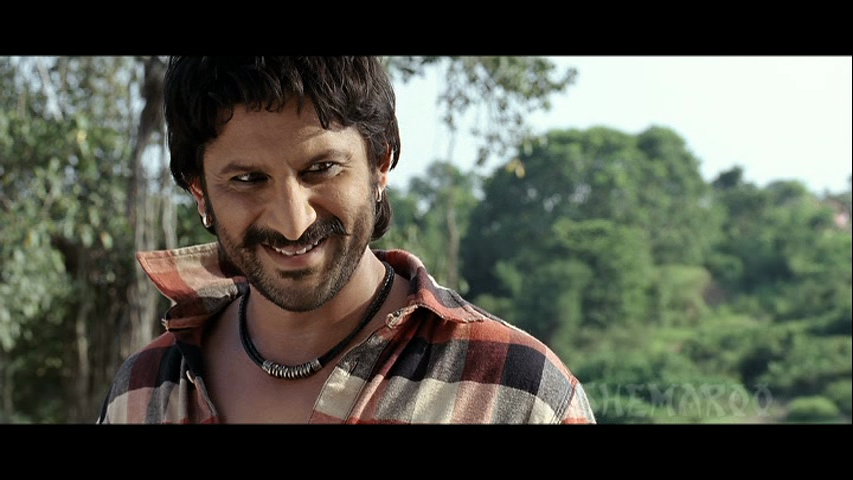
The more sensible and level-headed of the two is Khalujaan, ably played by Naseeruddin Shah. He’s older, although not necessarily wiser, especially if he has had a bit too much to drink. Despite his criminal tendencies he is a romantic at heart and on meeting Krishna he praises her singing, helps her with the cooking and indulges in idealistic fantasies of the two of them together. After their first meeting he has a good look at himself in the mirror and realising that he looks his age, resorts to using some of Krishna’s kohl to darken his hair and beard to make himself look more attractive to her. It’s all so very human and natural and is just one of the ways that Abhishek Chaubey brings his characters to life. Khalujaan is also more focused on the goal of getting away with the loot, while Babban (Arshad Warsi) votes for killing Mushtaq and getting on with spending the money and enjoying life.

As Khalujaan romances Krishna from afar, Babban eyes her speculatively from almost their first meeting. He’s much more direct and it’s very telling that his first visit in Gorakhpur is the brothel. He is all male, hot-blooded and very ready and willing for action. Despite knowing that his uncle has fallen in love with Krishna, he makes a play for her too. However, even with his ‘love them and leave them’ attitude he ends up under her spell, and falls in love for probably the first time in his life. His betrayal by Krishna seems to cut much deeper than with his uncle, perhaps because this is his first love.

With his kohl rimmed eyes and knowing looks Arshad Warsi revels in the character of Babban. To some extent he revisits a little of his lovable rogue character of Circuit from the Munna Bhai series, but Babban is much more cynical and a harder persona. He has no qualms about accusing Krishna of stealing their money, or using violence to force her to reveal her plans later on. But at the same time his heartbreak when he realises he has been betrayed is very real and he genuinely seems to take an interest in Nandu (Alok Kumar), a local boy he meets at Krishna’s house.

The two men are very easily seduced and led by the enigmatic Krishna. Vidya Balan does an excellent job of portraying Krishna as a woman of many faces. She starts off as the woman in love but with her husband’s death she seems to change and becomes aloof and mysterious, at least until she meets up with Khalujaan and Babban and seems to come to life again. She knows exactly what she wants and how to achieve it, and will allow nothing to stop her reaching her goal.Krishna is a very strong female character, even if she does turn a little crazy and vengeful at the end, and it’s great to see Vidya Balan in a role which suits her skills as an actress. She doesn’t have too much dialogue and in many scenes conveys most of her emotions through her expressions alone, which she does very well.

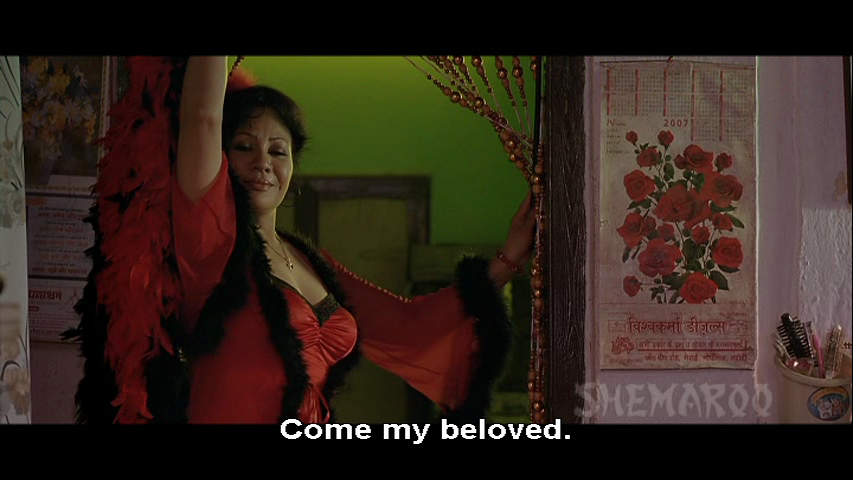
The interactions between the three leads are the crux of the film, but the other characters all have their place. Salman Shahid is coldly efficient as the omnipresent Mushtaq who has the knack of turning up at the right place every time. Rajesh Sharma as businessman Kamalkant Kakkad and Gauri Malla as his mistress Mamta have some comedic scenes together, particularly when Babban and Krishna first see them indulging in a little role playing to the wonderful Aa Jaane Jaan from Intaquam. (Another film about a woman out for revenge and Mamta nods to the Helen connection with all those feathers.)

There are some beautifully shot scenes of village life in the film and the cinematography by Mohana Krishna Agapu makes the most of the local countryside. While there aren’t any big song and dance numbers, the songs by Vishal Bhardwaj and Gulzar are excellent and fit well into the film. As well as the film soundtrack, Babban has a tendency to burst into song when he’s happy, and there are some fun renditions of songs from Chak De India and Om Shanti Om. There are so many great moments in this film, both comedic and some very good drama as well. With all the twists and turns the film never drags and Abhishek Chaubey even manages to add in a couple of explosions to add to the mayhem. A very well made film with excellent performances from the three leads – I’m definitely looking forward to the sequel. 4 ½ stars.

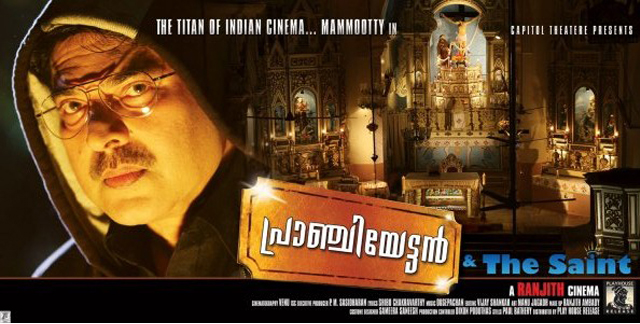
Pranchiyettan and the Saint

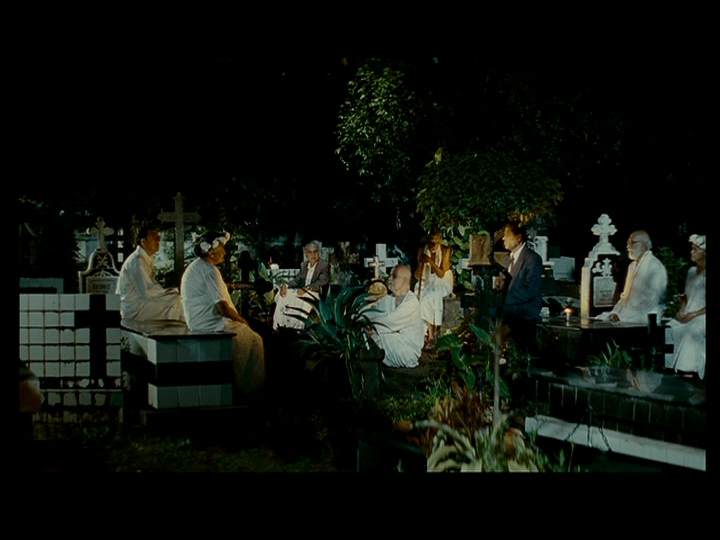
Pranchiyettan and the Saint was one of a number of Mammootty films recommended to me after I watched Kutty Srank. It sounded quite different and since the film won a number of awards it quickly moved to the top of the pile. It’s a quirky film about the attempts of successful rice merchant Chirammal Enashu Francis (Mammootty) to get rid of his nickname and command more respect within his community. The film opens with Pranchiyettan paying his respects to his ancestors who appear as ghosts in the churchyard. Leading on with the spiritual theme, the icon of St Francis comes to life when Pranchiyettan goes into the church to pray and the subsequent story is told as a series of flashbacks as Pranchiyettan explains the circumstances around his visit to the church that night.

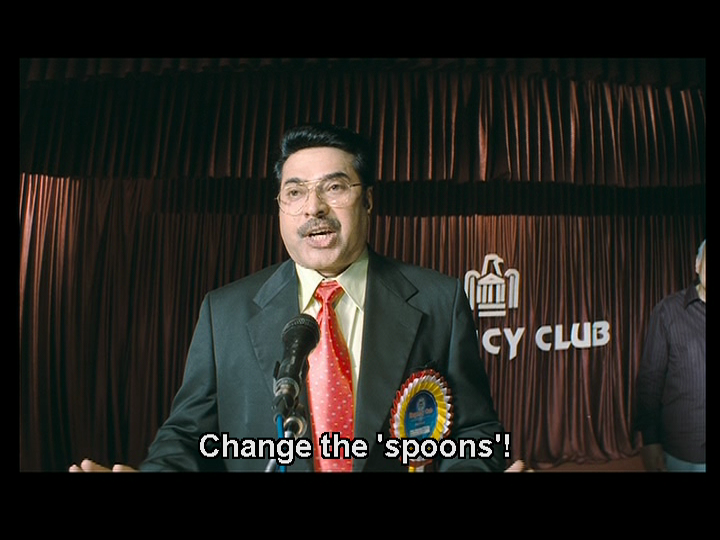
The first half of the film deals with Pranchiyettan’s attempts to become more recognised. In this he is ably abetted by Vasu Menon (Innocent) whose schemes inadvertently fail when reality doesn’t quite manage to live up to his vision. First there is a local club election which Pranchiyettan loses to his childhood rival Dr Jose. Next there is a welcoming ceremony for a celebrity which Pranchiyettan has sponsored, but again he is pushed out of the limelight and forced to take a back seat – literally. Finally he decides to try and buy a Padma Sri award and bribes some local politicians. But as may be expected, they take his money and run, leaving him in exactly the same position as before.

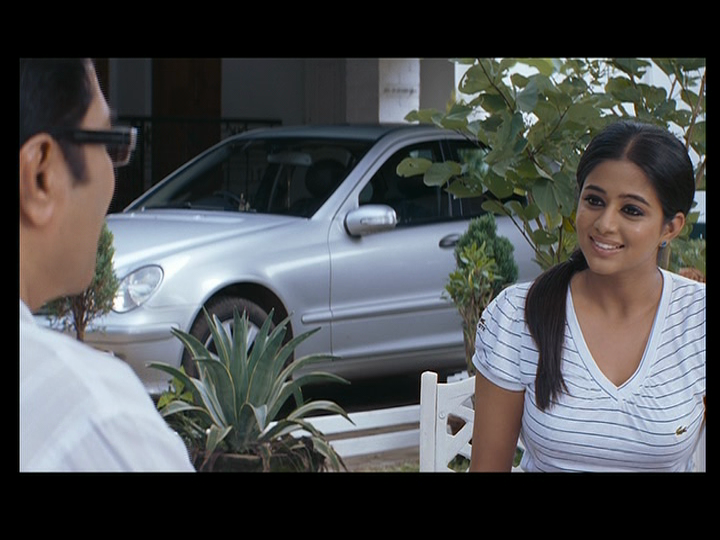
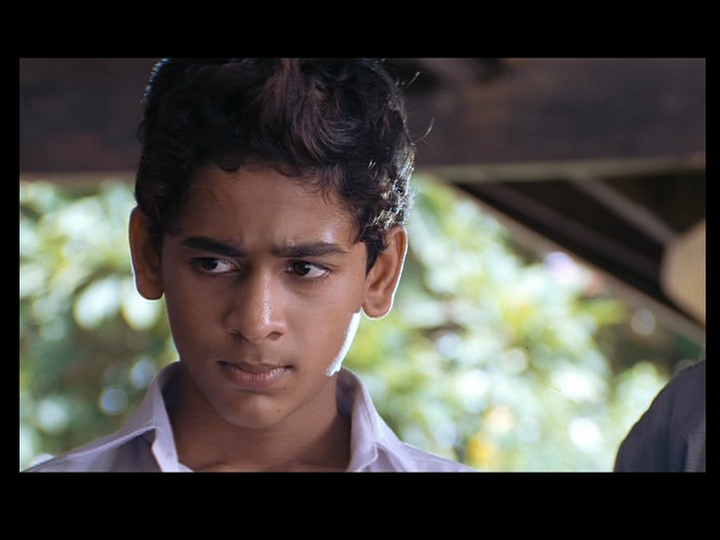
The film takes a lighter turn in the second half when Pranchiyettan meets a real life Padmashree (Priyamani). Although her name is the same as the award, Pappy is a feisty interior decorator with problems of her own. She gives Pranchiyettan a painting and ends up decorating his house so that there is an appropriate place to hang it. Finally Pranchiyettan tries to help his old schoolmaster achieve his goal of a 100% pass rate for his students by helping a young boy Pauli to graduate. In the course of this endeavour he starts to realise what is really important and seems to be on track to find contentment at last.

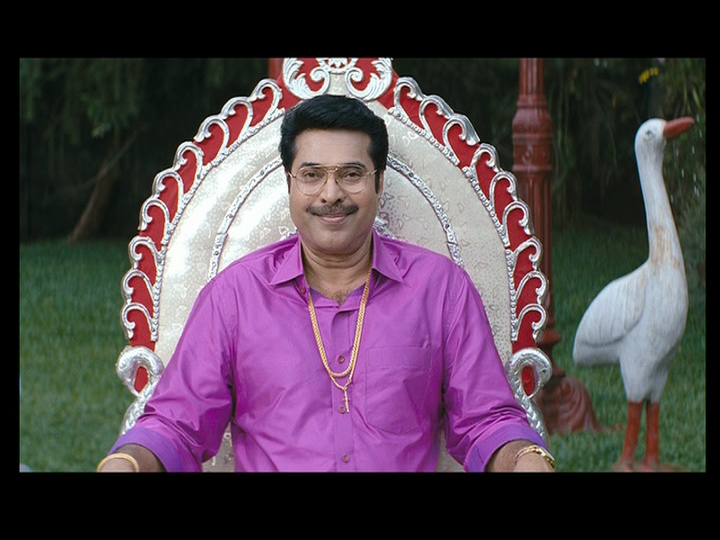
The film focuses more on relationships and characters rather than following a plot driven narrative. In fact it is more of a collection of stories although there is a progression of sorts with each sequence of events.  Mammootty is excellent as the nice guy who just can’t get a break. From his school days onwards he never had the sneaky gene that would have allowed him to fight back against people like the wily Dr Jose. He has remained true to his schoolyard love and seems stuck in the same mindset that he had as a student. He feels inadequate which he puts down to never finishing his schooling and tries to compensate with other achievements and public recognition. It seems doomed to failure, since his lack of confidence means he relies on other people’s ideas which don’t really seem to reflect his personality.

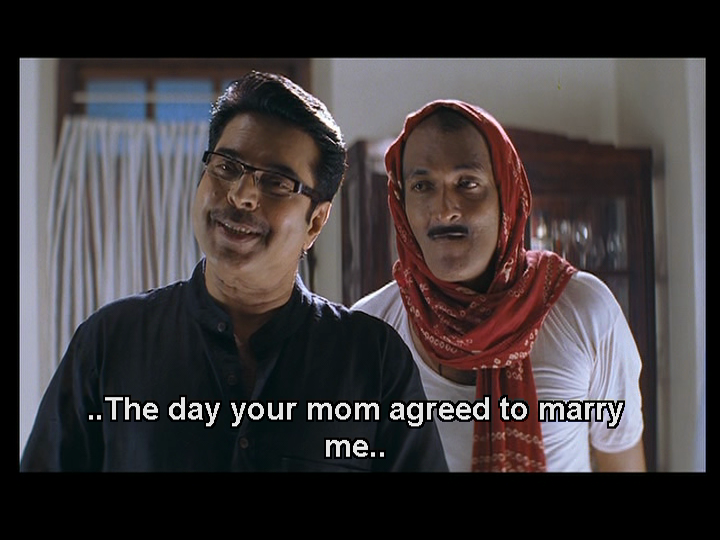
Innocent does a good job with the character of the ever helpful friend who comes up with more and more schemes to try and get Pranchiyettan the recognition he craves. There is plenty comedy between the two in their expressions and mannerisms as much as in the dialogue, and Ranjith has made their relationship feel very natural just like an old and good friendship should be. During the course of the various schemes Ranjith pokes gentle fun at exclusive clubs, corrupt politicians and the self-grandiose behaviour of dignitaries at reception functions. It’s all very ordinary and down to earth which makes Pranchiyettan a very appealing character.

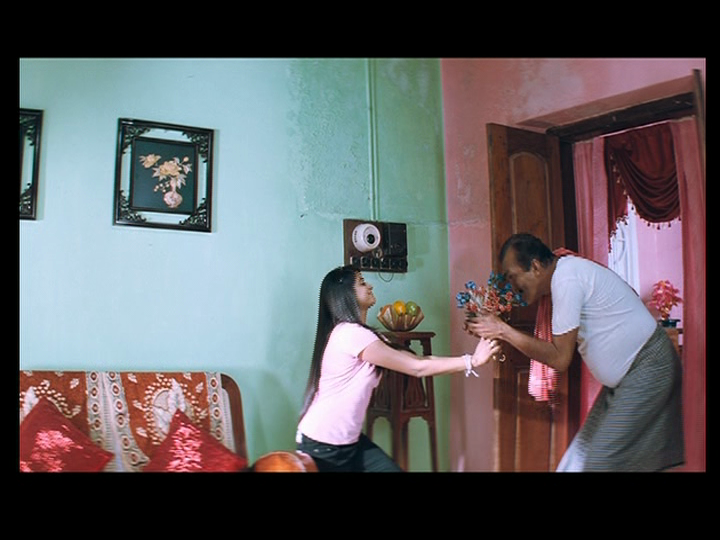
Priyamani is lovely as the interior decorator Pappy. Her character has drive and purpose which makes her much more than just a romance interest. The only song in the film is pictured on Pappy and her conversion of Pranchiyettan’s home and it’s a refreshing change of pace in the film. She also upgrades his wardrobe at the same time and even gets him a new pair of glasses. I love these little attentions to detail and the very natural way that Ranjith allows his characters to interact. The final story with Pauli is marred a little by the inclusion of some comedy with a hapless tutor played (Jagathy Sreekumar). This really isn’t needed as the story already has plenty of much more subtle humour, and the actual drama of Pauli’s story is much more engaging.

My favourite character though is Pranchiyettan’s cook Ayyappan, played by Sasi Kalinga. He has a wonderfully expressive face and the humour from his character is very droll. Again it is the everyday normality of the characters and their actions which appeals and both Ayyappan and Supran (Tini Tom) as Pranchiyettan’s driver are used to very good effect. They play well off each other and Pranchiyettan to give a really believable dynamic. The other support actors are all very good in their smaller roles. Siddique appears only briefly as Dr Jose where he takes every opportunity to have a dig at Pranchiyettan. But he has affection for his old friend which comes across in some of the later scenes. Khushboo is perfect as Dr Omana, the wife of Dr Jose, and Sivaji Guruvayoor has a small role as the headmaster of Pauli’s school. The idea of St Francis as the confessor figure to whom Pranchiyettan spills out his problems is a clever idea and helps to link the different stories together.

The film relies heavily on Mammootty’s performance and without his presence I don’t think this film would have worked quite as well as it does.  But an excellent performance from him and the rest of the cast do make this an film very worth watching.  3 ½ stars.

Temple says:

If you’re one of those who believe all South Indian films are noisy, gory and lacking subtlety, this might be the film to set you straight. It’s a gentle character study with parallels to the life of St Francis of Assisi, who also plays a supporting role. St Francis was the son of a wealthy man, and became drawn to God and the Church following an illness.  Several of his attempts to promote the Church went awry as he didn’t really think things through. St Francis failed when he tried to make things happen, but seemed to succeed when he simply lived his values of acceptance, charity and humility. Mammootty gives CE Francis aka Pranchiyettan aka Pranchi a sadness that helps make his needy attention seeking more sympathetic. Ari Pranchi is the son of a successful man, and he also fails when he tries to force things to happen. When he follows his true heart the results are different, and this opens his life up. Despite the apparent mismatch between Priyamani and Mammootty, their romance is appealing as it plays more as a trusting affection and partnership. I really like Priyamani and while not all of her films have been great, I have enjoyed every performance of hers I’ve seen. Pappy learns to trust the solid businessman who can see a solution to her unsolvable problem but who isn’t too proud to take her advice in the areas she knows best. Their scenes are fun and heartwarming as Mammootty shows the awkward stirrings of flirtatiousness contrasting with the confident sass of Priyamani. And you know she transforms his home from tasselled pink brothel curtains to sleek monochrome modern lines. I mourned the loss of colour for a moment, but only as a viewer – living in the icecream coloured house would have done my head in and may have contributed to Mammootty’s sour expression at times. I hope she left some of the statues and icons of St Francis though. The story with Pauli was designed to show Pranchi’s generosity, but I could have done without all the ‘comedy’. Those scenes actually had the effect of making Pauli seem like an incorrigible little git and not worth the effort. But saints have more patience for such things. And the message, which is not subtle, is a nice one. Don’t stress about rewards and titles – live with generosity of spirit and help out where you can.

It’s a slight story in many respects but the structure of the narrative, the iconography and saintly presence, and the character development  make it engaging and memorable. Add great performances by Mammootty, Priyamani and supporting artists like Sasi Kalinga and I think it’s a winner. 4 stars!