Alluda Majaka

E.V.V Satyanarayana’s Alluda Majaka could have been an excellent film. There’s peak mullet Chiranjeevi, Ramya Krishna and Rambha so you know the dancing is taken care of, a big budget and adventurous designers. But the story by Posani Krishna Murali is uneven and the comedy interludes are sexist and sleazy even by 90s mass standards. However, look for gold and avert your eyes from the dirt and there are some rewards for your time.

The film opens with Seetharam (Chiranjeevi) being taken to his village in police custody so he can attend a religious festival. Then he’s off straight into a big chase and escape from the police, and it is vintage Chiru. But oh those horse stunts churn my stomach, and the infamous horse sliding under a truck stunt doubly so, even with the hopefully fake horse in one shot. But there is a glass bus. Who knew?

Then Seetharam forcibly marries Pappi (Ramya Krishnan) who is at her wedding ready to get hitched to someone else. And then he is back off to jail again. A lawyer (Giribabu) arrives and promptly shoots Seetharam and then himself in the arm, setting his client up for that crime too. The laywer needs to know why Seetharam has ruined a young girl’s life by marrying her against her will and right before he went back to jail. This triggers a long flashback.

Seetharam’s father was the village president and seemed to be benevolent and practical, much loved by the people. Pappi (Ramya) and Bobby (Rambha) arrive in the village to stay with their mother Vasundhara (Lakshmi) and uncle. They stir up all kinds of trouble and see themselves as above the law and certainly above the people. That does not sit well with Seetharam. Another rogue joins the fray when Peddaiah (Kota Srinivasa Rao) arrives with the plan to get one of the rich girls married to his NRI son Chinna (played by the may as well have been non-existent for all the impression he made Siva). Chinna falls for Seetharam’s dialogueless sister Malliswari (Ooha) and they are engaged. Vasundhara wants the groom for Pappi, Seetharam is delighted his sister will be married, and Peddaiah is determined to find a bride based on dowry and gain for himself. When Chinna goes back to the US for a few months, Vasundhara and Peddaiah pull out all the stops to break up the engagement. It is on for young and old and the unmarried young women are the pawns in the game. By the time we stagger to the conclusion, it’s a straight up battle involving an explosives factory and a jetty and if that doesn’t scream Masala Death Trap I don’t know what does.

I am uncomfortable with the value this film places on women being pure and subservient, but the strong women in the story are so horrible I can’t stand them either. It would have been more interesting if they were less insane and more simply independent. Lakshmi as Vasundhara is the true villain here. She is smart, manipulative, and greedy. But what is her greatest crime? Not wanting to live with her husband – the lawyer Sivaramakrishna who is defending Seetharam. Pappi and Bobby are brats and completely lack common sense or empathy. But. Do they deserve to be humiliated by having their bathing suits ripped off them mid swim? Does Pappi deserve to be married against her will to a man who has been sentenced to death? Does Bobby deserve to be humiliated by the accusation that she’d had accidental sex with her brother-in-law?

Does anyone deserve the outfits they wear in the songs?

Much of the comedy is sleazy and gross. Apart from trying to get Ramya and Rambha in compromising positions to teach them a lesson, one track includes Brahmi in drag and a long build up to a tacky rape joke. Then there’s the farcical nuptial night with power outage that leaves the three women uncertain if they’re the one who had relations with Seetharam. And that’s a whole other line of enquiry I prefer not to pursue. I read a review that mentioned Rambha had once said that Chiranjeevi had made the director drop some of the really vulgar scenes planned. My reaction was “Yay for Chiru!” and then a mind boggling moment as I pondered what had been too much considering what had been left in.

Things I did like include that nobody thought Pappi should have to live in a forced marriage (although killing the groom is not cool). Also when Malliswari fell pregnant to her absent fiancé most people, with one notable exception, nobody tried to punish her (except the baddies but that was not on moral grounds). And Vasundhara was a terrible person but she was well written as a villain and had a little bit more going on than most of the men on Team Bad. I quite liked the use of a rainbow slinky as gangster accessory too but that might be a sign I was running out of patience with everything else. And of course, there’s the reason I watched this in the first place. The decor. No!

CHIRU!!!

Thankfully Chiranjeevi is in great form despite the lamentable material. He fights, he speechifies, he emotes so vigorously even his hair is furious, he defies laws of physics and gravity, and he dances like there’s no tomorrow. And he does it all so well. The fight choreo is complex and includes loads of acrobatics which Chiru nails. And he gets to drive lots of different forms of transport which I feel Chiranjeevi enjoyed. He looks quite content trundling around on his tractor, then so devil may care on a jet ski.

Although the stunt dummies lack his panache. As usual Chiru dances like he’s having the time of his life strutting his stuff in some truly eye-searing looks. In an unfortunate plot diversion, Chiru also plays the Mega rich Mr Toyota. Rich, weird, and foreign, he’s a comedy uncle on heat. I’m not sure how his disguise as Mr Toyota was in any way convincing and I am not at all persuaded the film needed him despite the additional scope it gave to the costume team. It is such a shame this film is an over long and undigestable turkey because there is so much peak Megastar stuff.

2 stars. Only for Mega-completists.

Game Over

Game Over

I’m not usually a fan of horror movies, and prefer to watch anything scary at home where I can take a break or turn the lights up. However Game Over sounded a bit different from the usual horror film, and it turned out to be a good decision to go and watch it on screen. There are plenty of the usual horror film tropes; the stalker who breathes as if he has terminal bronchitis, excessive violence towards women and a few jump scares, but there is also a lot here that is different. Game Over isn’t an easy film to watch, nor to classify, but it does have a number of themes which encourage a deeper level of thought than a run-of-the-mill slasher flick. What exactly is going on is never 100% clear, and the audience is free to make their own interpretation of what occurs on screen – and that’s the main reason why I liked this film more than I expected. For me the final message was one of empowerment and overcoming fears, but I can see that this won’t be the case for everyone. Regardless, Taapsee Pannu and Vinodhini Vaidyanathan are excellent and if you are a fan of the genre this is definitely one to add to your list of must-watch films.

The first half is mostly setting up the events for the second part of the film. The opening scenes are immediately terrifying and horrific, showing a young woman’s violent death by a stalker who invades her house. The audience sees everything via the stalker’s viewpoint, ensuring that he (presumably) is never seen, although his breathing is loud and laboured. The film then moves on to introduce Swapna (Taapsee Pannu), a video game developer who lives in a large house with her maid, Kalamma (Vinodhini Vaidyanathan). It’s clear that Swapna has a lot of problems. Her house has a guard outside, she seems hyper-vigilant and she has security cameras everywhere. She’s also terrified of the dark and has a number of odd habits, preferring to sleep on her sofa and asking her maid not to move anything from its usual spot. Via a number of flashback’s we gradually learn that Swapna was seriously assaulted on New Year’s Eve a year ago and has PTSD as a result. After a very convincing breakdown at the door to a dark storeroom prompts a return to her psychiatrist (Anish Kuruvilla), Swapna discovers that she is likely to become more anxious and depressed as the anniversary of her assault approaches. She doesn’t want to follow her specialist’s advice to seek outside support during this time and after a sequence of events challenges her fragile mental state even further, she finally tries to take her own life. But this simply leaves her confined to a wheelchair with her legs in casts as the anniversary date comes around.

During the first half, good writing and convincing behaviour from Taapsee Pannu powerfully illustrate the effect of the assault on Swapna. The combination of Swapna’s mannerisms, repetitive habits and fear of the dark show the extent of her mental disturbance and inability to return to normal life. It’s all very realistic and unfortunately accurately represents the reality that many women are living with. One particular scene that hit home for me was Swapna’s reaction when Kalamma tries to reassure her that her attacker is behind bars. Her response is one I’ve heard repeated in real life, persuasive evidence for me that writers Ashwin Saravanan and Kaavya Ramkumar have done their homework here. Also excellent is the use of remembered conversations to illustrate how not to respond to someone who has suffered a serious assault. But even here the writers leave it open to the audience to decide if these are true memories of victim blaming from her family or instead, Swapna’s own feelings of guilt and remorse surfacing, despite none of it being her fault.

The second half of the film switches gears after a sentimental scene explains memorial tattoos, and a TV news item revisits the unsolved murder seen in the opening scenes. Suddenly Swapna is under attack in her own home and the question becomes one of survival given the odds stacked against her. Here there are the typical horror themes, odd noises, heavy breathing and a faceless serial killer with a sword and apparent grudge against women.  Some of this is genuinely terrifying, particularly since most of the suspense is built up by what isn’t seen, rather than by what is. However once the premise of the second half is revealed, the film does veer more into typical slasher territory, albeit with some good jump scares, but there is an overall drop in the level of tension.

Ashwin Saravanan has crafted a different style of horror film that deals with psychological disturbances and Swapna’s own fears, ultimately becoming an allegory about fighting personal demons and coming to terms with the effects of violent crime. I love the ambiguity that swirls around almost every frame of the film, ensuring it’s difficult to decide just what is real, and what is only in Swapna’s head. Keeping the action mainly to one room in Swapna’s house accentuates the claustrophobic feeling of helplessness, just as everything Swapna does is a clear attempt to have some kind of control over at least one aspect of her life. Taapsee Pannu is good at looking grim and she’s convincing in her doggedly determined efforts to fight off a serial killer in the later half of the film. Where she really excels though is in the portrayal of a young woman with a fragile mental state, particularly realistic with regards to the circumstances that have led to her careful and carefully ordered existence. Vinodhini Vaidyanathan is the perfect contrast. She’s down to earth and pragmatic, but still empathetic and more than just Swapna’s domestic help. Vinodhini adds realism that helps ground the film and includes reactions that perfectly suit her character in each situation. The contrast between the two characters helps give the film some depth, especially since so little background is given while Kalamma’s support for Swapna is a key component in making the story more interesting.

This isn’t a film where there are songs or diversions from the main storyline, and at just over 100 minutes there is little wasted space. The diversion to explain the significance of the first murder is a bit of a stretch, but not a totally impossible one, and I didn’t mind the touch of sentimentality after such a bleak first half of the film. It was good to see Anish Kuruvilla briefly onscreen exuding the quiet confidence that we’d all like to see in a psychiatrist, and Sanchana Natarajan, Ramya Subramanian and Parvathi T are all good in their brief support roles. Although none of the ideas here are totally new in themselves, the combination all together isn’t one I’ve seen before, and the almost entirely female cast is also something of a novelty in Indian cinema. I was also impressed by the film releasing in Tamil and Telugu (I watched the Tamil version) and also in a dubbed Hindi version which hopefully will avoid the watered-down remake that seems to inevitably follow every successful SI film. Game Over is more than a horror film, and not just a psychological thriller either, but rather something in between. Scary, empowering and almost hopeful by the end, this is a film that has a lot to say despite the minimal dialogue.

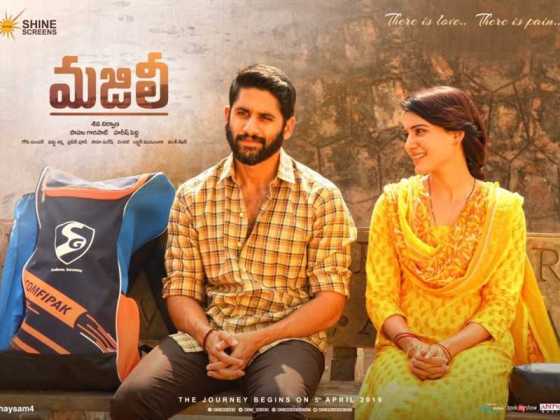
Majili

Majili

Shiva Nirvana’s Majili is a romance that feels oddly dated where the characters make some very strange choices, and the plot harks back to attitudes that might have seemed plausible 30 years ago. Naga Chaitanya plays a cricket player whose life is destroyed when he loses the girl of his dreams, while Samantha is the woman waiting patiently for him to notice her. The film is helped considerably by good performances from the main leads, but it’s the support cast of Posani Krishna Murali, Suhas and Rao Ramesh, who end up making the film more interesting than the story would suggest.

The film begins with Poorna (Naga Chaitanya) as a miserably grumpy cricket umpire who spends his night getting drunk in a specific hotel room. The story behind his descent into the bottle is told in flashback when he was a younger wannabe cricket player, and his father had just given him a year to work at making it into a career. Shortly after landing a place on the Vizag Railways team, Poorna meets Anshu (Divyansha Kaushik), the daughter of a navy officer based in the town and the two start a relationship. It’s a patchy affair right from the start as there is little chemistry between the couple and their social divide makes their meetings awkward and clumsy. That might have worked, except there doesn’t seem to be any reason for Anshu to prefer Poorna over anyone in her own social circle, and after he puts her into a situation where she is almost raped, Anshu’s continued desire to be with Poorna seems even less likely. Although Chaitanya tries his best, this is just another typical love story, with the usual parental opposition and a bad guy in the form of Bhushan (Subbaraju). Divyansha Kaushik is bland and unobjectionable, but the romance is all just too unlikely to make any impression, and the finale that ends with Poorna in a hotel room seems completely implausible and a whimpering end to a supposedly grandiose love affair.

Poorna’s subsequent descent into alcoholism and heartache-induced torpor is also overly extreme for such a lacklustre romance. He wallows in his misery and seems unable to find anything worthwhile to do with his time other than mourn the loss of his ‘one true love’. However, at some point in the intervening years he somehow manages to get married to Sravani (Samantha Akkineni) who puts up with his idleness, drunkenness and morose personality with completely unlikely composure. The story tries to make us believe that she always loved Poorna and is happy simply to be his wife, despite the cold shoulder treatment she receives and his total lack of support – either emotional or financial. In fact, it’s Sravani who supports the family with her job as a railway clerk since Poorna’s father (Rao Ramesh) has retired and Poorna is too busy being miserable.

Thankfully, despite her irritatingly subservient attitude, Samantha breathes life and energy into the film. Her interactions with her father (Posani Kirshna Murali) and Porna’s father (Rao Ramesh) are the perfect mixture of funny and sad, and here at last is the spark that was so sadly missing in the first half. Although Sravani’s attitude to her husband quickly becomes wearing, Samantha somehow manages to keep her character from being completely irritating and despite wanting to shake some sense into her, I felt that her rationale was at least constant and made sense from her character’s point of view. Poorna on the other hand was just a waste of space who didn’t take any of the many opportunities he had to turn his life around. The final piece in the puzzle that leads to Poorna’s redemption is lazy and poorly done, although again it’s Sravani who has the best of the generally weak dialogue and ends up as the only one who acts according to her established persona.

Posani Krishna Murali is brilliant as Sravani’s father and his comedy keeps the film from being totally subsumed in weepy tragedy. Rao Ramesh is also unfailingly sensible and brings some much-needed common sense, as does Suhas who shines in a small role as one of Poorna’s long-suffering friends. Subbaraju is totally wasted in the role of a small-town thug with a political agenda who has no significant part to play other than to be the ‘bad guy’ for Poorna to fight at regular intervals. This would have been a much better film without the usual Telugu commercial elements – removing the dull romance, repetitive fight scenes and glamourous song sequences and adding more of Sravani, her family and her story would have made for a more interesting film. Some explanation for Sravani’s ridiculously self-sacrificing attitude would have helped too other than the wishy-washy enduring love that is used.

Overall, Majili is disappointing. The story isn’t plausible and never comes together to form a coherent whole. The bittiness of the plot transfers to the characters, who also don’t always act in keeping with their role. There simply isn’t enough of the good parts – Samantha, Posani Krishna Murali – but instead far too much insipid romance. Gopi Sundar’s songs though are generally good and Vishnu Sharma’s cinematography captures the claustrophobic feel of the family well in the latter half of the film. I wanted to like this, I like Chaitanya and Samantha and perhaps as their first film together I expected a little too much. Worth watching for Samantha, the support cast and Chaitanya in the second half.