Magalir Mattum (2017)

Bramma’s female centric film has a lot going for it, from the fantastic cast to the gentle mood of nostalgia and friendships that transcend time. But if you’re expecting a robust feminist statement, look elsewhere.

Warning: SPOILERS AHEAD!

Prabhavati (Jyothika) arrives on the scene like a hero. She rides a motorbike, wears jeans and t-shirts, calls all the shots with her film crew, abbreviates her elders’ names and speaks casually to all. This is how we know she is a modern, empowered woman. She has a close relationship with her soon to be mother-in-law Gomatha a.k.a Goms (Urvashi). Prabha comes to know that Goms had a couple of very close friends at school but when one of the girls was expelled, the trio went their separate ways and haven’t seen each other in close to 40 years. She decides to use Facebook to track down the ladies, and get the gang back together. Rani (Bhanupriya) is married to a chauvinistic politician (Nasser) and describes herself as a glorified servant, looking after the family in return for food, lodging, and a little bit of affection. Subbu (Saranya Ponavannan) is married to a drunk (Livingston) and stuck at home with his ailing mother, cleaning bedpans and listening to endless complaints. Prabha coerces them all into taking a road trip for just 3 days, time to be themselves.
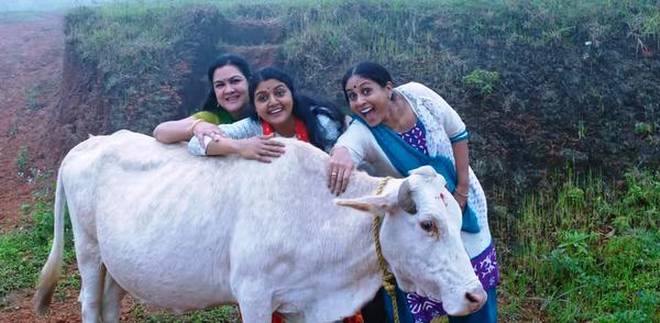
Bramma uses flashbacks to the friends’ college days and the three young actresses who play Rani, Goma and Subbu are delightful. The dynamic between the women hasn’t really changed, even though their circumstances and lives have forced them into different shapes. They quickly fall back into Rani being the firecracker, Subbu being daring, and Gomathi being timid but refusing to be left out. The links between timelines serve to remind the ladies who they used to be as well as showing the audience.

Prabhavaty eggs them on, wanting these women to live for themselves and stop holding back, to have the freedom she has. She is effusively informal, persuasive, and persistent. I had a bit of a chuckle at her being “like a hero” as, like many male stars, she is only about 10 years younger than her screen mother. I like Jyothika and she looks great and delivers a well-modulated performance as part of the ensemble.

Prabha says “men aren’t the problem, the system is the problem” which neatly overlooks that “the system” is largely constructed and maintained by men for their own benefit. But baby steps. Mainstream Tamil films tend to congregate at the rapey and misogynistic end of the spectrum so this is quite a departure and I’m grateful to the heavy duty star cast for getting this off the ground. Maybe that is the real feminist statement – Jyothika’s continuing film career that doesn’t require her to play Suriya’s mother!

Rani (Bhanupriya) is living a life of determined fortitude. Through the flashbacks we see Rani was the leader, always getting in trouble and loving it. Her husband (Nasser) and son Karthik (Pavel Naganeethan) see her as a fixture, nothing you need to consult or consider. When their ward is designated a ladies ward, Karthik’s political ambition is thwarted and his dad cautions him against letting his wife step out of the house to run for office. They put Rani up as their candidate as they are so confident she will never have an opinion of her own. It’s such a sad waste of Rani’s sharp mind and good heart. She blossoms on the trip away, but is resigned to going back to the status quo. But does she? There are signs that at least her kids learn to see Rani as a human being, and she does take the wheel again. Bhanupriya is elegant but also mischievous and I really wanted to see more of Rani’s story.

Subbu (Saranya) projects a polished and controlled exterior. Her life behind the veneer of her beauty channel set is far less appealing. Her husband drinks constantly, and sprawls around the house singing old love songs until he bursts into pathetic tears in a never ending cycle. While Subbu is immaculate, the house is verging on squalid and there is no sign of pride in her surroundings. Subbu eventually reveals the reason for her disillusionment and anger, and there is nothing that can really fix that. It’s just heartbreak after heartbreak as the women reveal the decisions made for them and how they live with the aftermath. One of the highlights is a sequence where all the ladies tell their story of first love, with the results ranging from tragic to wryly amusing. Saranya plays Subbu as outspoken but with an increasingly warm twinkle in her eye as she casts off the grinding routine. She and Bhanupriya dance and joke around, fire up at each other and then gang up on Urvashi.

Gomatha’s life is not explored as thoroughly as the others, and Urvashi doesn’t have the same complexity of material to work with. Goma was less well off than her friends and struggled to keep up appearances at college. She was more conservative but would follow Rani and Subbu into the fire. She loves her son who works overseas, and worries about her life after the wedding when Prabha will go to live with him. The rapport between Prabha and Goms seems a little forced initially as Urvashi overreacts constantly, but she eases off once the ensemble is in place.

The supporting cast is excellent but the roles are sketches with minimal detail or depth. The men are either jerks or SNAGs, nothing much in between. I was delighted to see Maddy as Suri, Prabha’s fiancé. I quite like slightly unkempt and stubbly Maddy and liked that Suri wasn’t a manscaped picture of perfection. He’s a nice bloke who appreciates Prabhavati, and that is perfect. Nasser, (who Goms describes as looking like an eagle with diarrhoea), and Pavel Naganeethan are very effective at being horrid, and Livingston as Subbu’s husband Mangalamurthy is the kind of man who is nice but such a deadweight that he has the same effect as a total bastard.

Bramma gets a bit bogged down in a sub plot, and doesn’t really carry all the good ideas through into action. But the film looks great, the acting is generally top notch, and it’s a rarity to see female friendships celebrated on screen.

See this to enjoy the presence and fine acting of some wonderful female actors, and for the emotional resonance of their friendship and shared memories.

Vivegam

Vivegam

What is it with Siva and bad opening sequences? Vedalam started off with a dodgy assassination, and Siva tries to do something similar here with equally disastrous results. Vivegram sees Ajith’s character take out two generic bad guys in a forest somewhere in Serbia with plenty of improbable action sequences and pre-placed explosives. The dubbing is bad, the set-up too over the top to be believable and the final moments are absurd. Unlike Vedalam however, Vivegam (Prudence) doesn’t morph into a decent action film after the first act. Instead Siva continues with a series of fast-paced fight sequences, loud declarative speeches delivered through gritted teeth and incredibly loud music. Which isn’t to say that its bad, just that Vivegam is a completely mass film produced solely for Thala fans where logic and story take a very big second place to showcasing Ajith as an all-out action hero.

The plot here revolves around a secret government agency somewhere in Europe, where everyone apparently speaks Tamil. There may have been some disclaimer about this in the opening credits, but since these weren’t subtitled I can’t tell and to be honest, it’s not the most implausible part of the film. The Counter Terrorism Squad have a very flash looking control room with lots of cool holographics, but nothing that a competent 007 hasn’t achieved before with a laptop and pen drive. Bizarrely a number of agents sit around calling out incredibly obvious observations from street surveillance cameras and wireless earpieces while it seems that any basic blocking tactic shuts off their contact with the outside world. Technologically advanced they may be, but little thought seems to have gone into the HQ apart from making it look snazzy.

Ajith is Ajay Kumar (aka AK), an agent who is presumed by his bosses to be dead, but who remerges to upset the agency when he takes out the head of the Russian mafia and the chief of Europol in the action at the start of the film.

The agency thinks that AJ has gone rogue and brings in his old colleagues to help hunt him down. Chief of these is Aryan (Vivek Oberoi) who is better than expected in a role that requires him to constantly extol the praises of his nemesis as he tries to track him down. Also on AK’s old team are Sean (Aarav Chowdhary), Rachael (Amila Terzimehic) and Mike (Serge Crozon-Cazin), who join in the hunt for their old partner.

However, all is not as it seems, and a flashback sequence traces the group’s last mission where they were trying to neutralise a weapon that was used to trigger earthquakes. A top hacker Natasha (Akshara Haasan) holds the key and the team, along with almost everyone else in Eastern Europe, are attempting to find her to gain control of the weapons. The action here involves a gang fight in an apartment block, where the bad guys get flung out of windows and down stairwells, and a couple of sniper attacks where we learn how it is actually possible to shoot through bullet proof glass. But while each individual fight scene is good, they just keep coming with faceless villains that last less than a second before being shot, blown up or defenestrated depending on location.

There is also a total lack of logic – when AK is left for dead on the snow-covered mountains of Europe, it’s just plausible that he might manage to survive and keep training, but his acquisition of tons of explosives and automatic weapons is amazing given that he doesn’t appear to have any backing.  His ability to drive halfway across Europe in a few hours is just as miraculous, as his amazing talent in avoiding being shot despite being one man against literally thousands of bullets. But then, he is a suviva!

Kajal Aggarwal shows up as Yazhini, AK’s long-suffering wife who runs a restaurant and musical school somewhere in Europe. Again, the staff all speak excellent Tamil, to the extent of being able to sing Tamil songs, while Yazhini seems to have no problem with her husband vanishing for a few months on various missions. At least Siva gives his female cast something to do – Akshara Haasan is excellent as the hacker who ends up out of her depth and Yazhini is way more vengeful than expected, but there isn’t a lot of chemistry between her and Ajith which lets the romance side of the story down.

The problem I have with Vivegam is that it never comes together as a complete story. Everything is peripheral to ensuring Ajith is front and centre all the time. All the action revolves around him, the speeches are all either Ajith declaring ‘never give up’ or his opponents discussing how amazingly wonderful he is. Everything comes so fast that it’s hard to keep track of which particular group Ajith is fighting next and the loud soundtrack and frenetic pace end up leaving the audience behind.

It’s a shame as there is a lot that is good here too. Ajith is excellent and carries the weight of the film well. Vivek Oberoi gets to do plenty of strutting around and pontificating in a grand manner (which suits him well!) and both Kajal Aggarwal and Akshara Haasan are good in their respective roles. The music from Anirudh is excellent and there is a good mix of heavy and light tones, or there would have been if the volume had been just a tad lower! The fight sequences are all beautifully sequenced too, with slow-mo bullets and some clever ideas, but there is just so much of everything that the screenplay gets a bit lost in all the sound and fury.

Vivegam is what happens when Siva tries to make a Hollywood style action film, keeping a mass approach and sacrificing screenplay for effects. Sure, it’s great to see Thala dodge bullets and smash villains into the ground but a little more light and shade to his character would have made for a more approachable story. One for fans.

Velaiilla Pattadhari (VIP) 2

VIP Poster

Sequels are always tricky. Returning to a popular character or scenario is fraught with unfavourable comparisons, and finding a new story that works while retaining the aspects that made the original film so popular is another minefield to cross. There are a few sequels that turn out better than the original film but they are the exception, and sadly VIP 2 isn’t one of them. However, while it may not be the best sequel ever made, it’s certainly not the worst and as an all-round entertainer, it fares reasonably well. Most of the success is due to Dhanush who carries the film over some occasionally rough ground, but Kajol makes a better than average adversary while the presence of many of the original cast (including Harry Potter) ensure good continuity with the first film.

After dealing with Arun in VIP, the sequel opens with Raghuvaran (Dhanush) still working for Ramkumar (M.J. Shriram) at Anitha Constructions and winning the Engineer of the Year award. This brings him to the attention of Vasundhara Parameshwar (Kajol) who runs the biggest engineering firm in South India. Raghuvaran’s dismissal of her offer of employment rankles, but not as much as his admonishment to be less arrogant when Anitha Constructions wins a big contract over Vasundhara. A self-made woman who has clawed her way up from the bottom, Vasundhara makes it her mission in life to squash Raghuvaran like the bug she perceives him to be, but of course it’s not going to be as simple as she believes.

All the elements are there from the previous film, Raghuvaran’s beloved cycle, his dedication to the memory of his mother, and his unfortunate tendency to drink too much when faced with a problem. What doesn’t work quite so well is the change in Shalini (Amala Paul) from a sensible romantic interest to a shrewish and nagging wife. Supposedly this is due to giving up her job and taking over all the household chores, which to be perfectly honest is enough to drive anyone to grumpiness, but the constant bickering wears thin very fast. Worst still, Shalini’s nagging is supposed to be funny, but it’s just as irritating to the audience as to Raghuvaran’s family.

Kajol is a huge improvement over Arun and his father as the villain of the piece. Her entrance is more typical of a hero as the first glimpse is of her stylish and very pointed stiletto hitting the ground as she arrives at the Engineering awards ceremony. In fact, the crowd reaction was just as loud and enthusiastic for Vasundhara’s entrance as it was for Raghuvaran’s first appearance on screen. Kajol totally owns the role and her arrogance and confidence are a perfect balance to Raghuvaran and Ramkumar’s humility and attention to detail. And yet she’s not evil or out to destroy the poor of society, simply determined to push though her own ideas and methods regardless of anyone standing in her way. However, after a great start, her repeated attempts to get the better of Raghuvaran start to seem petty and churlish rather than decisive and it seems unlikely that someone who had the strength and ability to run a successful company would be quite as petulant and narrow-minded. Still, Kajol is stunning as she sweeps around in her tailored suits and stylish sunglasses, while her menacing dialogues are surprisingly effective.

Raghuvan’s father (Samuthirakani) is a more supportive figure this time round, but his brother Karthik (Hrishkesh) barely gets to say a word and most of the VIP boys suffer the same fate. Without any substantial input, they become a faceless mass without any of the charm or appeal that allowed a connection to develop to these characters in the original film. The film is significantly more focused on Dhanush, who has the acting chops to carry it off, but at the expense of a more coherent storyline. The plot wanders as story and screenplay writers Dhanush and Soundarya Rajinikanth try to include as many of the characters as possible from VIP 1, but run out of things for them all to do. Saravana Subbiah pops up as an unscrupulous developer while Vivek reprises his role as Raghuvaran’s side-kick Azhagusundaram. While both are fine in their roles, the characters seem to be added in, one for comedy and one to have a reason for the fight scenes, rather than have a true background and reason to be in the script. The final confrontation between Raghuvaran and Vasundhara is also a little disappointing although otherwise the chemistry between Dhanush and Kajol is excellent and the atmosphere between the two crackles at each meeting.

Sean Roldan’s music is perfectly fine but the songs don’t have the same anthemic qualities as Anirudh’s previous tunes, a fact underscored every time the original theme for Raghuvaran plays in the background. However, the choreography is slicker than in the first film and the fight scenes are also of a high quality.

If this was a stand-alone film, I would have rated it as a good action movie with an interesting concept and two excellent characters in Raghuvaran and Vasundhara. The addition of a strong and powerful female character works well here, and Dhanush emphasizes gender equality a number of times throughout the film, although it doesn’t quite gel with his wife having stopped work to look after the family home. The problem is that this is a sequel, and while the original elements are cleverly arranged to form the foundation of the film, too much feels to be added simply because it was part of the first film, while VIP2 doesn’t have a strong enough identity to pull away and succeed without that original scaffolding being firmly in place. It is however much better than I expected and both Dhanush and Kajol turn in strong performances under Soundarya’s direction to make VIP2 more than just a film for fans, but one that’s unlikely to reach quite the same cult status as the original movie.