Dhada

It seems to have been a very long time since the last Telugu film release here in Melbourne, so we were quite delighted to hear that Dhada was showing this weekend. Despite the negative reports, we headed in to the city for another ‘adventure without subtitles’.

The film opens with a parkour chase sequence across, over, around, through and between various buildings, bridges and major highways. It’s very well done with great cinematography and editing, and is an excellent introduction to Vishwa (Naga Chaitanya). He’s just graduating from college in some unspecified city which we think might be supposed to be in the USA, or possibly Russia. It’s hard to tell from the accents of the English speaking cast who seem to be mainly of Eastern European origin but since the cops are wearing US style cardboard badges and US flags we’re going to go with the States.
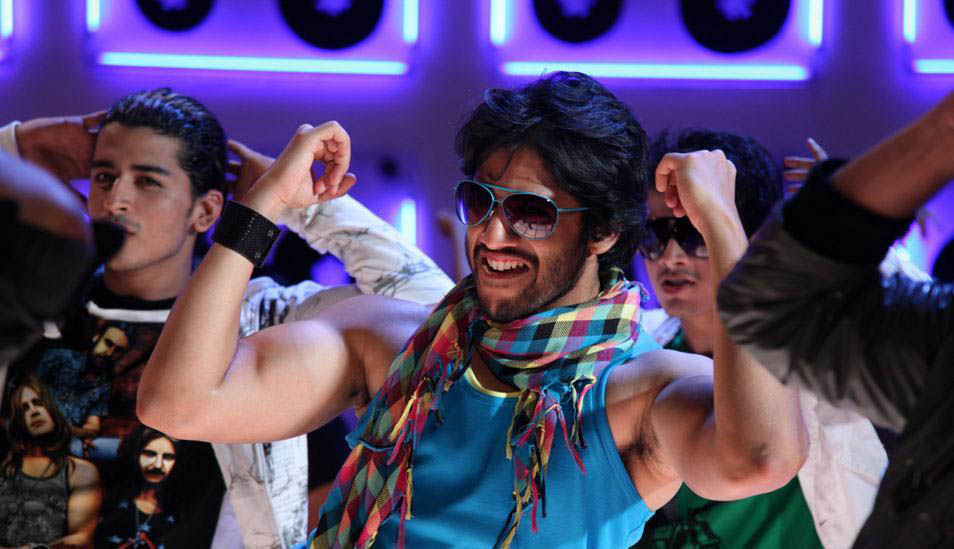
Vishwa lives with his elder brother Rajiv and Rajiv’s wife Preethi.  He fancies himself as a modern day hero, and cannot help rescuing a tearful girl running from a pack of thugs. In the course of the rescue he manages to set free another 99 girls who were rather conveniently loaded in trucks in the same car park. This doesn’t endear him to local mafia don RD (a wonderfully over the top Rahul Dev), who was just about to close a deal selling the girls (all 100 medically certified virgins) on to white slaver Kelly Dorjee (almost his equal in the over the top evil stakes).

Around the same time Vishwa has spotted, and instantly fallen in love with, Ria the daughter of a millionaire (Mukesh Rishi) who doesn’t have any time for her. She spends her days on a chaise longue in the wine cellar surrounded by bad polystyrene replicas of classical sculpture, either watching old 8mm film of herself and her mother or developing pictures she has taken of parents and their children, and generally feeling sorry for herself. The mother was played by the excellent Satya Krishnan and it was such a shame she only had a tiny role.

Vishwa has a classy idea of a date which involves taking Ria out on the back of a motorbike, stealing a bottle of wine along the way (drinking and driving and no helmets– tsk tsk!), to a a bare knuckle fight (which judging by the spectators’ apparel seems to occur some time in the early part of last century) and finally to a club based in a ship. Strangely they seem to travel back in time again when a bunch of 1930’s styled shoe shine boys arrive aboard the Titanic styled set to join in the song and dance number, the seriously catchy ‘Telugu Bengali English Marathi’. It was an odd blend, especially with the random and bored looking audience including one beaming Sikh guy. Vishwa and Ria do lots of flirting before he drops her back to her dull party, and her fiancé, two minutes before her stated deadline. Ah yes – the fly in the ointment is that Ria’s father has promised her to Amit, a local businessman with a commitment to shimmery suits, who isn’t impressed at all with Vishwa.
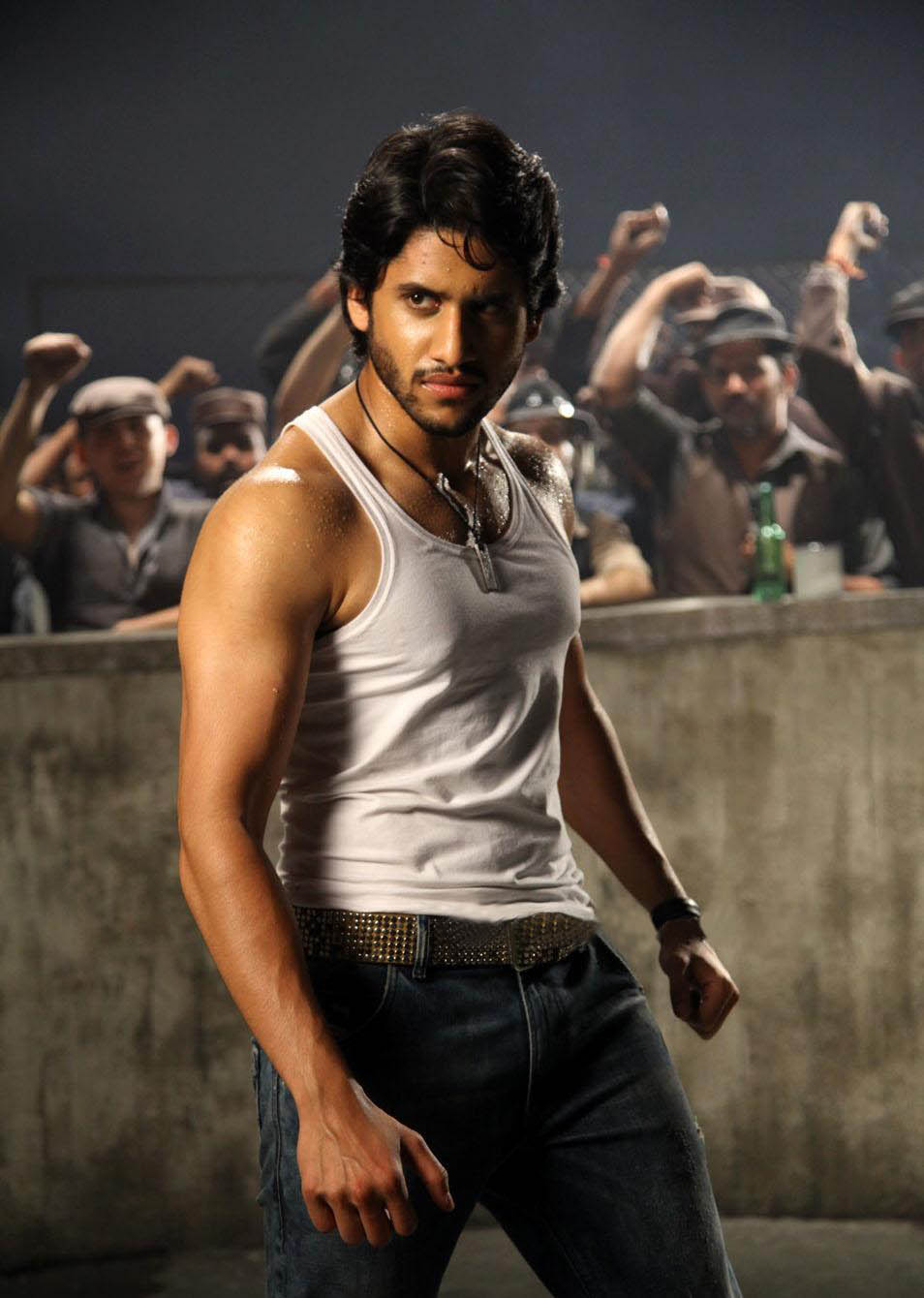
There are more chases and excellent fight scenes as RD’s younger brother closes in on Vishwa seeking revenge for their lost millions in the white slave trade. There is the obligatory twist in the tale as Rajiv reveals his entanglement in the mafia web. There is an excellent flashback scene to the two boys growing up, and we learn that Vishwa has always protected his big brother, sometimes in spectacular fashion.  Ria becomes a hostage and Kajal was good at being unconscious. It’s all up to Vishwa to save the day – can you ever doubt that he will? Would a man lacking self confidence wear so much pink?
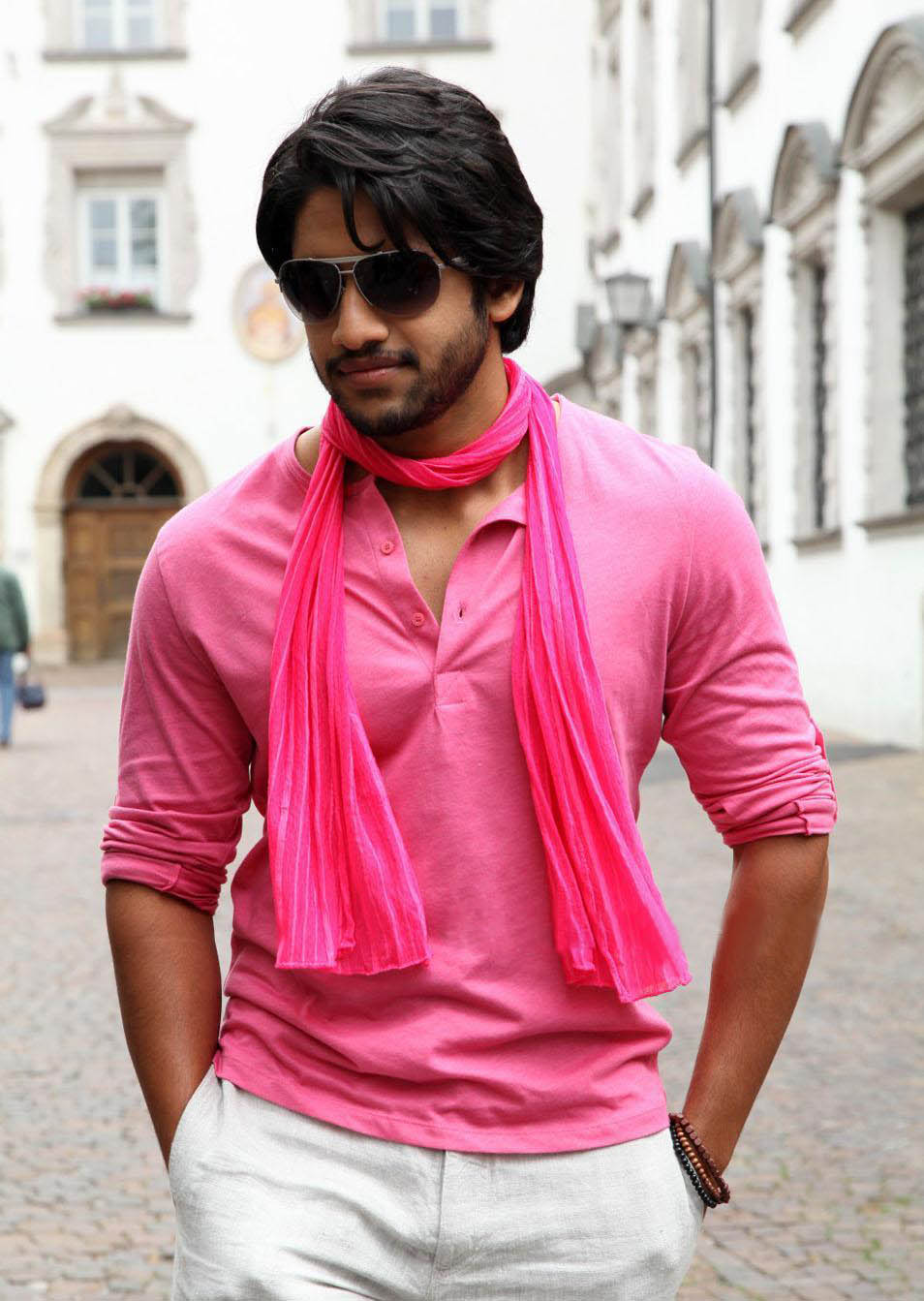
The film looks fantastic and the direction is confident and visually accomplished. The styling is good and both Chaitanya and Kajal look the part. Except one of the hairdressers seems to have a grudge against Kajal and gave her an absolutely terrible fringe. In fact, we suspect we have seen that wig before, when it appeared as The Wig in Shakti. She looks much better in her emo rock-chick look, or Aishwarya Rai wannabe avatar, although losing the blue contacts would have been even better. Vishwa’s fantasy versions of Ria in one song also included Foreman Ria (in hard hat and high-vis overalls), Police Ria and Skanky Carwash Ria so her wardrobe team were kept busy. Chaitanya has a wonderful collection of slightly sparkling superhero and James Bond T-shirts which we were delighted to see he felt were entirely appropriate for day wear.
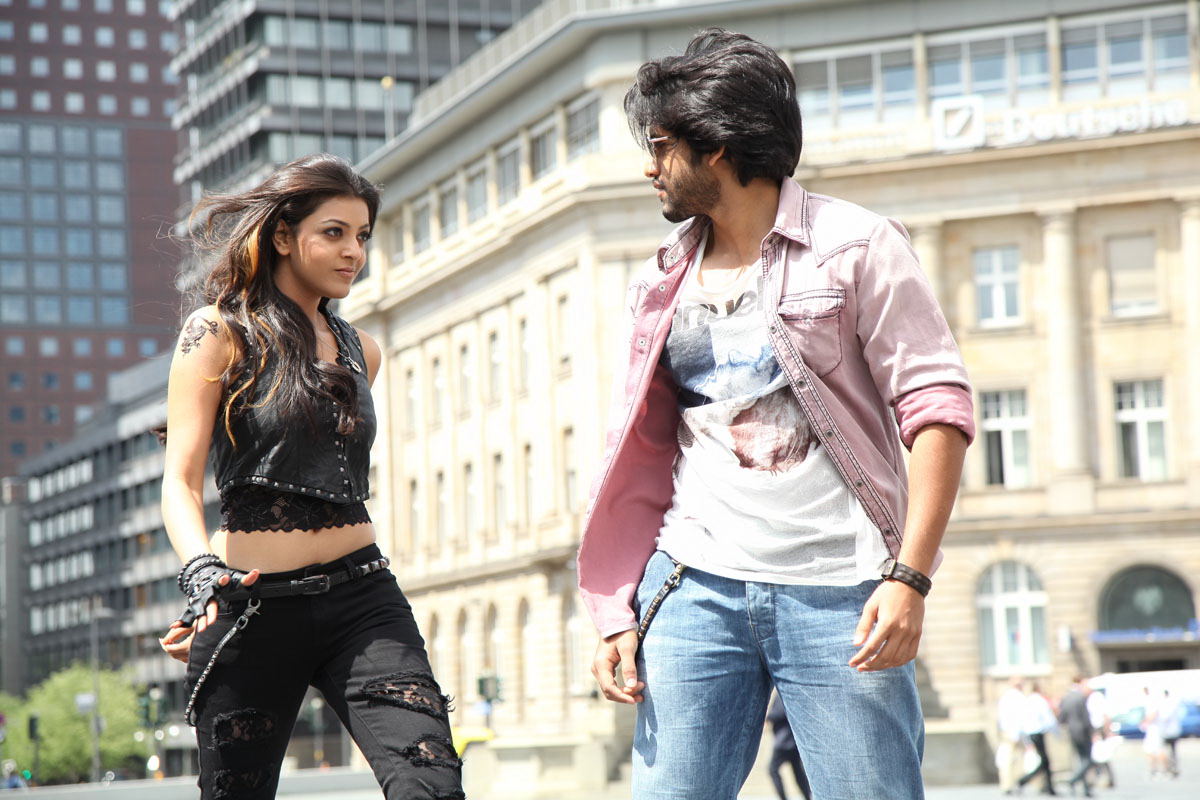
Chaitanya has developed as an actor, and it’s obvious he has worked hard and really improved his dancing. He handled the demanding action sequences well, and the multiple camera angles and slo-mo replays meant he had to deliver in those scenes or they wouldn’t have worked at all. He does look rather embarrassed by a few of his outfits, but by the time we get to the lilac satin band-leader costume he seems to have become resigned to his fate. The lurid checked lunghi in the final song doesn’t faze him at all but he seems to suffer from Thrust Reluctance.

He’s also committed to the wet look throughout the film, indulging in a number of activities guaranteed to keep him slightly soggy.

Rahul Dev is excellent as the evil RD and his execution of a rival involving a prosthetic leg was rather special. Although Kelly Dorjee doesn’t turn up quite as often he makes up for it by some inspired sneering behind his ever present sunglasses.

But that’s all the good stuff.  The story is weak and the white slave trade link pathetic. The comedy with Brahmi, Ali and various others all falls very flat and mainly involves racist and sexist jokes. It’s all unnecessary and not even remotely funny. Venu Madhav is mildly amusing but totally unnecessary as is MS Narayana. The pace of the first half is too slow as time is spent on laborious set-ups and establishing characters who lacked substance or who disappeared. There were silly errors; in the Super 8 film of baby Ria and her mother, there is someone in shot using a digital video camera. And don’t get us started on Hair Continuity – it was all over the place (literally).

Chaitanya is more amusing in some lighter moments than any of the ‘comedians’ and those scenes suited the masala action style of the film much better. Dhada is style over substance. But it’s worth a watch for the well executed fight scenes and nicely picturised songs from a reasonably appealing soundtrack. Not a great film, but not a terrible one. And if you take nothing else away from Dhada, the phrase ‘Smoking is injurious to health’ became even more ominous.
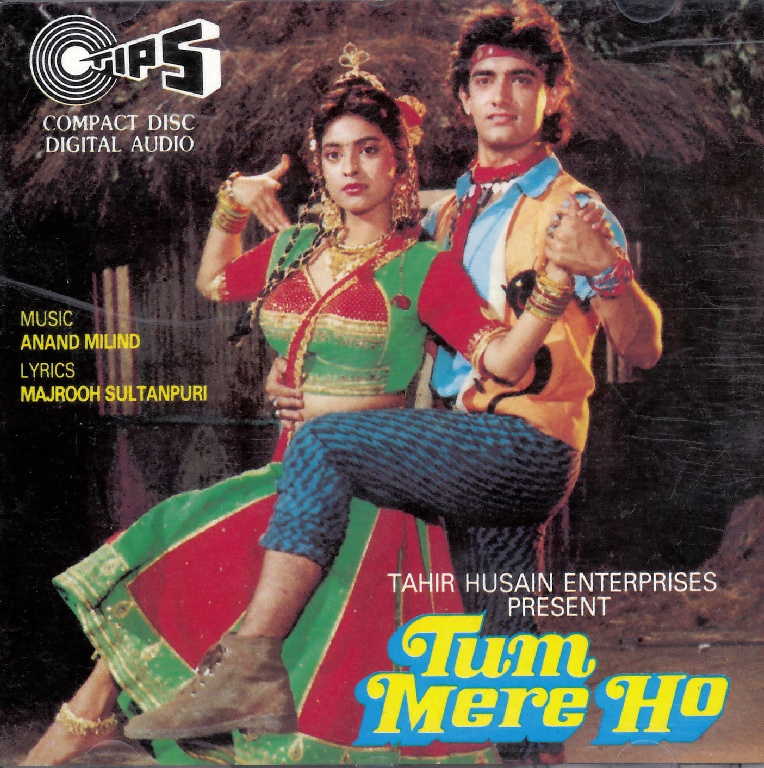
Tum Mere Ho (1990)

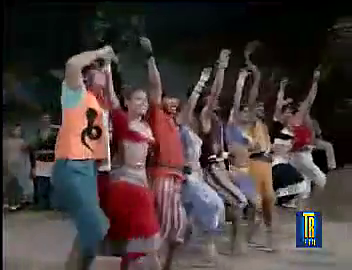
Aamir Khan, Juhi Chawla and snakes? Sounds like an excellent Nag Panchami Film Fesssstival subject. The film is pretty terrible, but is almost always So Bad It’s Good, and the songs are quite pleasing in both snakey choreography and energy. It may have lost something in translation due to the dodgy quality youtube version with no subs that I watched, but I doubt it.

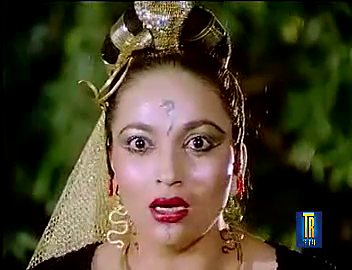
It seems of late that Aamir has distanced himself from his pre-Lagaan career. But I say let him be known for his heroic role as Shiva the hairy-chested snake charmer who saves his lady love Paro (oh so young and pretty Juhi) from a crazed Snake Queen (Kalpana Iyer).

The film opens with Thakur Chaudhary attempting to steal a Naag Mani by using a very flawed contraption. In the process, he kills a snake and draws the ire of the Snake Queen on his own household.


She declares that as he killed her child, she will kill his. And off she goes and bites the young lad as he sleeps.

The weeping parents, with the Snake Queen laughing at their grief, put their son’s corpse on a little raft arrangement, and he is sent off on the currents of the river. Of course he washes up at the feet of the one man who can reverse a death by snake bite. The child lives and grows up to become Shiva (Aamir). He learns to use magical powers that involve him waving a bone and a skull around, and doing lots of fist clenching emoting.


He has his uncle, his snakes, a daft sidekick, and is being pursued by the village skank belle. He also has a waistcoat with a snake motif for special occasions.

Everything a boy needs!

Shiva goes into the village for some reason, possibly to deliver a snake, and sees Paro at the fair. He impresses her with his snake, and she is immediately full of dreams of love as well as thoughts of garam garam jalebis and thandi thandi kulfi.


My Hindi vocabulary is small and selective so I may not have captured all the nuances of her romantic fantasy. Paro is the daughter of local bigwig Chaudhary Charanjit Singh and is out of Shiva’s league.

No one wants these youngsters to get together and this leads into not entirely boring Romeo and Juliet territory. I was concerned the snake theme may dissipate, but Shiva uses snakes as part of his courtship ritual which was an interesting approach. Paro can’t stop thinking about him, his snake, and possibly those jalebis and so love blooms.

They’re so young! So pretty! He’s in a floral blouse!

Romance blossoms despite Paro’s father arranging attacks on Shiva using black sorcery, beatings and guns.


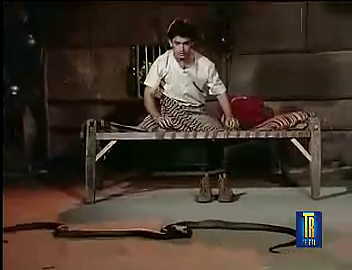
Of course, merely locking Shiva in his room cannot keep them apart, not while clever snake Naga Raj is there to unlock the door.

Shiva’s people want to keep him away from Paro too as they can see she is trouble for their boy.

Shiva and Paro scamper around the forest looking like the poster children for young love and carefree premarital fumbling.

Until the revelation that Paro has been married since she was 3 years old to some unseen Rajput scion. Guess who that boy was? Sigh. Shiva has to perform at her wedding (oh the tragedy!) before Paro is sent to live a widow’s (I’m guessing the widow bit as she wore white, no sindoor, and cried non-stop so it was quite funereal anyway) life at her in-laws and mopes around a lot.

Note: Re the village belle –  Despite her clothing usually erring on the correct side of the fabric to flesh ratio for a snake, she does fail other snake tests and is a Fake Snake.

Anyway Paro’s change of address propels Shiva back to his family home and into Snake Queen territory. He does a lot of pining and trying to lure Paro out with his snake music, which is just asking for trouble.

Naga Raj saves his human from the Snake Queen which made me wonder about the Snake Code and what did a snake have to do for other snakes to turn against it, and did they have to show just cause if they were opposing a more powerful creature?  And also, what were her responsibilities towards lesser snakes? Was she justified in attacking them? It raised so many questions.

I did like this song where the Snake Queen impersonates Juhi, but is caught out by her excessive accessories (compared to the pristine white of the real Paro). She misses a couple of easy bites. I really had to question this whole selective bite placement thing that filmi snakes seem to have.

It emerges that the uncle snake charmer knows Shiva’s real identity. Shiva’s father rejects the idea as some attempt at magic although I wondered if that was really to protect his son given that the vengeful snake was likely to still be around. All unaware of this peril, Shiva and Paro return to the forest and I think they sort of get married. Wedding rituals in the snake charmer village seemed quite straightforward, and there was a robust approach to courtship. Basically, if you can catch your person and subdue them, you’re as good as married.

Having set Naga Raj to wait outside (after a bit of a chat about the privacy required on one’s wedding night), Aamir and Juhi are alone. He does lots of nuzzling and she looks like she has passed out. But the Snake Queen takes the opportunity to attack.


Can Shiva’s magical powers save Paro? Will there be flying snakes? Will it involve a ritual both very silly and slightly icky? Will someone go up in a ball of flames? Will people just learn how to get along? What do you think? (If you really have to know, I can’t help you thanks to Shemaroo – who don’t care enough to release decent quality DVDs but will stop you watching this on youtube. Sigh)

This is not a good film but I was entertained enough and don’t regret the time spent. I can’t say that for every film I see! Tahir Hussain hasn’t created a masterpiece but he has made a pretty solid snake revenge romance. The soundtrack by Anand-Milind is pleasant, and there is some nicely energetic dancing. And you know, Aamir, Juhi and those snakes. 2 ½ stars!

Punnami Naagu (1980)

Punnami Naagu is almost two films in one. It’s as though someone took a deck of cards marked ‘happy animal friends’ and shuffled it with the deck marked ‘a nagin stole my soul’ and voila!  It was an excellent opportunity to apply the principles in Jenni’s Field Guide.  Apologies for the crappy screencaps – the DVD picture is really grainy. And I didn’t have subtitles so I may have made the whole story up.

A local snake charmer uses his snake coercing powers to kill a priest after he had stopped the snake charmer raping a girl. The priest seems to make some dying invocation or curse, and leaves his young son an orphan.

The priest’s son is adopted by the landlord, and I think god sends an elephant to look after him. The elephant is very maternal, making sure Raju eats and washes regularly. It’s all very family friendly and sweet. When Raju moves in with the landlord, naturally his elephant moves in to the luxurious mansion too, and they grow accustomed to the good life. I would have had seizures looking at that decor, but apparently elephants rise above such things.

Meanwhile the snake charmer is in less happy circumstances, and his son Naagulu is growing up unaware of the curse that will take over his life. The father is feeding Naagulu snake venom in his food to help him become immune to snake bites, and he is being trained to take up the family business. It is lucky he is immune as his snake handling is a bit cavalier – I’m pretty sure they could fang you through a hessian sack. Nevertheless.

Naagulu’s heavily pregnant aunt has an animal helper of her own – a very useful monkey that assists with laundry and has exceptional empathy and communication skills along with basic midwifery knowledge. When little Laxmi is born, all the main players are set for the drama which is to unfold.

It’s a standard boy woos girl story, as Raju and Laxmi flirt and fight and make up, all under the watchful and slightly exasperated gaze of their animal friends who also help to patch up fights and carry messages. There is dodgy dancing, Narasimha Raju has an exceedingly voluminous coiff, the elephant and monkey are smarter than the humans, and that storyline is all quite cutesy. Laxmi (Rati Agnihotri) is bright and confident, their courtship is energetic and they get all the upbeat songs. Raju’s costumes are entertaining even without a story to go along with – Could his collars have been any bigger, his pants any higher? It’s kind of fun, especially a song and dance involving the couple wearing each other’s clothes. Laxmi does not fit any of the clothing or eyeliner indicators, so I suspected the snake thing skipped her side of the family.

But. The dark side of the film starts to emerge.

Chiranjeevi as grown up Naagulu is unaware that he is slowly becoming more snake than human. There are some annoying comedy snake charmers on the scene, and they perform with a troupe which includes a spectacularly flexible snake dancer in a bejewelled bodysuit. Naagulu berates the performers for using the gift as entertainment. He may not know why,  but he cannot control his response to the snake music. It was easy to pick the real snake here, bedazzled Fake Snake notwithstanding.

As his hormones kick in, the lust aspect of the snake character takes over when the moon is full. So it’s a bad idea when Naagulu falls for Raju’s sister Menaka after saving her from a rampaging roaring bovine. I applaud the enthusiasm if not the ability of whoever did the voiceover for the animal – I have never heard a cow go “Grrrr-aaaaaargh” nor have I heard one oink like a pig so I was very impressed. Menaka manages to be quite saucy even when barely conscious and Naagulu was smitten.

This can’t end well, what with Naagulu being lethal and all. He lures young ladies to a lonely spot, where it is always night and swirling with mysterious mists, and the venom contained in his bodily fluids is fatal to them. They are mesmerised by his snake gaze (blue contact lenses – tick!) and don’t seem to notice his odd mannerisms that echo some snake behaviours. In his human state he has no recollection of these interludes.

Back in Raju’s storyline, Naagulu’s father repeatedly stomps on a baby snake and the local snake deity eyes him with a vengeful glare. Duelling snakes ensue as Naagulu’s dad tries to kill Raju with his snake, and the deity pursues the snake charmer with eventual success.  Naagulu’s dad delivers a deathbed monologue which seems to include telling his son that he can never marry as he will poison any woman he sleeps with. This revelation came a bit late for poor Menaka.

Naagulu inherits a book that seems to explain his condition, but now he knows what he is there is no one to help him. Naagulu is devastated by what is happening to his body. His eyes change to those blue contacts, his skin is shedding, and he seems to be in agony as he sees these familiar but totally inhuman changes. And that’s what makes this a bit more interesting than I expected. It’s a strong performance in what started out looking like a fairly silly film. There is more to Naagulu than just the killing and being venomous, and Chiranjeevi shows the transition from carefree boy falling in love to tormented soul.

A new school teacher arrives in the village, and takes a photo of Naagulu that later proves his undoing. He offers to guide her to the village but the sun sets and his cobra nature asserts itself. When Raju sees the significant photo he confronts Naagulu. There is no real outcome, just a scuffle and then everything goes back to normal. I was struck by another snake indicator – venom. During the fight, Chiru bit a chunk out of a tree, which then appeared to ooze blue ink. Both he and Narasimha Raju looked a bit taken aback by that, as was I. Another thing the book clearly neglected to mention was hunting technique. Naagulu keeps trying to bite Raju’s neck, when I suspect a nip at the fingers that were pushing at his face might have been just as lethal.

Despite the rising body count, Raju and Laxmi are still flirting madly and Raju doesn’t seem to be too concerned about all the deaths. But then Naagulu is drawn to his cousin Laxmi and it all becomes much more dangerous.

Luckily Laxmi’s monkey Anji has a reliable mongoose supply and the peril is averted.

This scene was so strange – on the one hand very silly with a mongoose being thrown at Chiru’s face repeatedly as he emoted fiercely, but also a strong defining point in the character’s transition from troubled man to snake.

Naagulu makes an unsuccessful attempt at assaulting a blind girl – she couldn’t see his mesmerising gaze so escaped. Raju and a mob of villagers with flaming torches (led by the elephant) are soon on his trail. Naagulu reveals he cannot control the snake and has become a monster even to himself. Raju cannot help but feel sorry for him and tries to help. But what monster ever gets a happy ever after? And seriously, could Raju’s collars be ANY bigger?

Rajasekhar’s film gave  a bit more food for thought than I was expecting. The Raju-Laxmi romance was sunny and a good contrast to the Naagulu story. The animals seemed fairly un-stressed, with the exception of the spring loaded mongoose and the sacrificial snake, and their antics were highly entertaining if predictable.  It’s a strange mix but overall, I really enjoyed the characters, the unusual story, and the general WTFery. The only thing missing was a Chiru snake dance. 3 stars!