Dookudu

Another Adventure Without Subtitles! Dookudu is the much awaited release for ‘Prince’ Mahesh Babu and we knew it would be huge. We arrived early for the 8.30pm show, which gave us the opportunity to watch the staff deal with the problem of getting the first show crowd out through the 700 or so people crowding into the small foyer. Once people emerged, the waiting audience clapped and cheered them like they were rockstars, and it was a very festive atmosphere. As one lady said  – why come to the cinema unless you’re going to have a good time?

It was about 10pm before the film finally started, not that anyone was complaining. There was plenty of cheering, accompanied by the sounds of tearing newspaper, as everyone got ready for Mahesh’s appearance.  There was discussion about whether there might be the odd flash of elbow (Yes there was, and even a glimpse of princely tummy) and just how many shirts can Mahesh Babu wear and still manage to fight? (There is apparently no limit to what Mahesh can do, or how many shirts he can wear.)

The film starts with politician Shankar Narayan (Prakash Raj) who is so well loved by the people that we know he’s heading for a gruesome end. Sure enough he’s attacked and left for dead by his rivals who include Kota Srinivasa Rao, Sayaji Shinde and various other Telugu film baddies. Somehow Shankar survives, in a coma and hidden in a secret location, and he finally comes round some years later to a changed world. His son Ajay (Mahesh) is a policeman rather than a politician as his father had planned, a number of his friends and colleagues are dead and the family have moved out of their old house. However the doctor instructs Ajay not to shock or distress his father in any way, for example by telling him the truth, as this will be bad.

Mahesh is introduced in full throttle action hero style, complete with title song. He takes on a room full of bad guys with nothing but his comic timing, guns and a whole lot of biffo.  Ajay is a super cop – invincible and fearless. He is also quite prepared to play outside the legal system if that is what it takes. After one such scene we did have a quick discussion about the omnipresent singlet under all the layers of shirts, and whether it was actually bulletproof. Whatever the reason, the bad guys consistently fail in their efforts to eliminate our hero, while he has no such issues dealing with them. Mahesh can convincingly portray a furious rage in a very low key acting style, and he is also more than capable of bantering dialogue with the comedy uncles. It’s a role tailor made for him, and while he wears his police uniform a little on the baggy side the character is a perfect fit.

Ajay does a deal with Brahmi who’s taken over their house and in the process convinces him that he’s taking part in a reality TV show which forms a large part of the comedy in the film. Ajay pretends to be a politician and keeps his life as a policeman secret from his father, while all the time plotting revenge on his fathers attackers. It’s no wonder Ajay is always on a short fuse – he must be exhausted from all the pretending. And the killing.

Ajay finds out through another investigation that mafia boss Nayak (Sonu Sood) was involved in the assault on Shankar. It looks at first as if Sonu is about to reprise his role in Ek Niranjan as the stylish and psychotic villain, but sadly his wardrobe fails to deliver. Despite the nice cravats and the random and occasional application of grey to his hair and moustache, Nayak is a subdued and fully clothed villain who just loves his little brother a bit too much.  We enjoyed the Sheila ki Jawani dance break and we think Sonu did too, but it was shortlived. Most of the posturing is left to his faithful sidekicks played by Ajay and Subbaraju. That’s fine with us since they’re both Cinema Chaat favourites and we did enjoy watching the satin shirted Subbaraju try to mime to his boss that Mahesh was really an undercover policeman. Oh for a pen when you need one…

Along the way, Ajay takes his gang of trusty colleagues to Turkey, apparently just so he can say ‘Operation Istanbul’ as there is no other discernible reason for the location. He meets Prashanthi (Samantha), a fashion designer and, unknown to him, daughter of his clownish boss (Nasser). While Ajay and Prashanthi have the usual confusions before falling in love there is no substance to Samantha’s role and she’s soon side lined. There is little chemistry between Samantha and Mahesh, maybe because they spend hardly any time together on screen. Samantha looks beautiful, and wears whatever the costume department have dreamed up. That seems to be her sole purpose in the film as she doesn’t actually do anything.
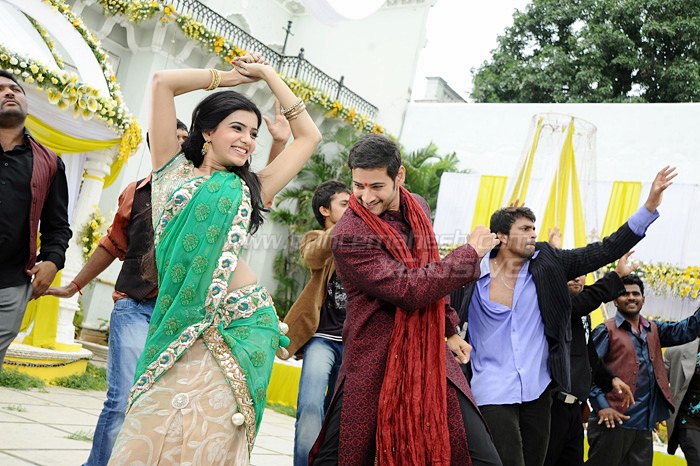
There was more comedy with M S Narayana and one very funny skit where he took off a number of films including Magadheera and Robot. A little comedy can go a long way, but here it was integrated into the main story and with Mahesh adding to the comedy dialogue there were parts that were very funny, even to us non-Telugu speakers. The rest of the audience were roaring with laughter throughout the speeches. Master Bharath put in an appearance too. Was he necessary? Probably not. And yes there were some unfortunate stereotypes masquerading as comedy, but for the most it was entertaining.
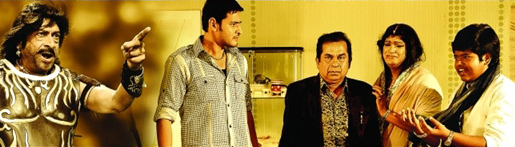
The supporting cast was very strong, if largely underutilised. Shafi, Tanikella Bharani and Sudha had little to do, and Satya Krishnan was given maybe one line of dialogue. It’s a big budget film when you can hire some of the best and then not do anything with them!


The action sequences are excellent, and it’s hard to go wrong with a good impaling. Sreenu Vaitla has come up with several ways of illustrating the ‘eye for an eye’ concept, all of them extremely gory. The camera work and special effects were great and added impact on top of the already impressive stunts. We enjoyed the flashes of lightning when Ajay was beating Nayak to a pulp, and the changes of tempo in the film speed that underpinned the dramatic tension.

The song picturisations were less successful, and the songs by S.S Thaman are not so memorable on their own. Mahesh can dance reasonably well so it was disappointing not to see more use being made of his skills, and we wondered who decided it was a good idea to give him Abhishek Bachchan’s choreography. Chulbuli Chulbuli was spectacular with plenty of feathers and some enthusiastic backing dancers, although clearly ‘inspired’ by Kilimanjaro. The nightclub song lacked a good item girl but made very good use of the male backing dancers, grinning madly in satin pants and ruffles,  and had a giant guitar shaped light-up floor so that was pleasing. We must also congratulate the set designer for the impressive selection of chandeliers and lamps, especially the chandelier in the hospital ward.

Dookudu has a charismatic hero in a strong if silly storyline, and it is a technically excellent film in the mass entertainment style. It might not be the greatest film ever made, but it was  really fun to watch, especially with the awesome Melbourne audience.
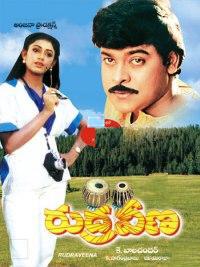
Rudraveena

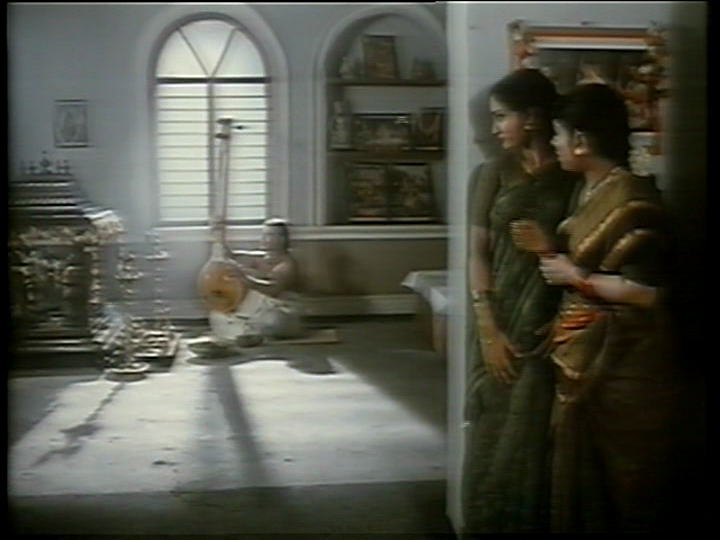
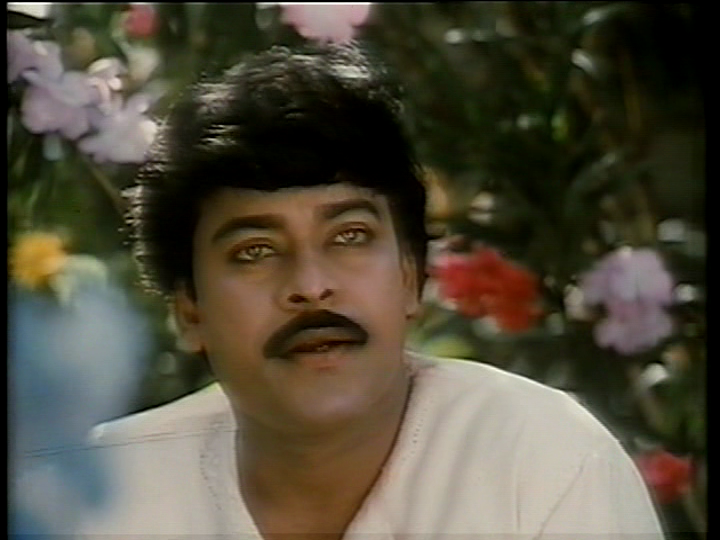
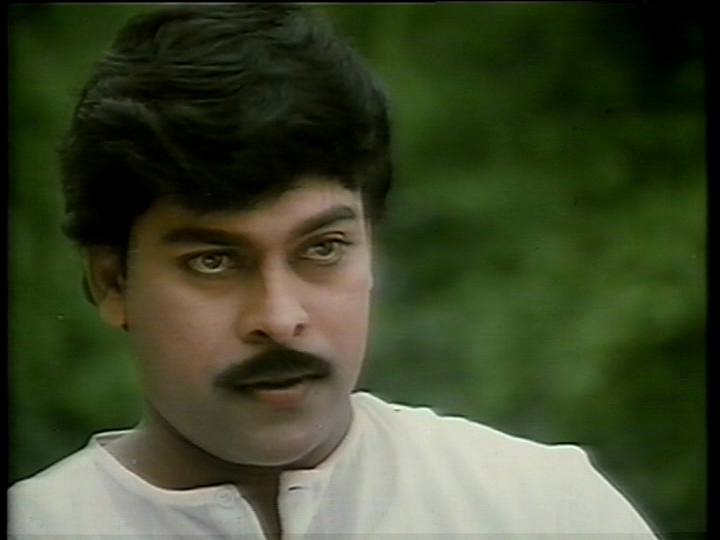
Rudraveena is a quiet contemplative film, written and directed by K Balachander, about the responsibility of the individual in matters of caste and society. Chiranjeevi must have felt strongly about making this film as he produced it. I only wish someone would release a decent quality DVD with subtitles as it is just beautiful, and I know I must have missed a lot by not understanding the dialogues. Having said that, the things I don’t fully understand are more the cultural and social aspects, and that is usually not spelt out anyway. I am torn between wanting to write about every little detail and not saying anything about the story so you can discover it for yourself. I really do love Rudraveena and think it is one of Chiranjeevi’s best performances in an engaging and intelligent story.

A man throws a banana towards a blind woman begging, and she accidentally knocks it away. A young Brahmin boy watches her struggle to find the fruit, but does nothing as he cannot touch her or the food that she has touched. He is troubled by her situation, but doesn’t act. Eventually someone does come to her aid, and he also gives the boy a lecture on the futility of mouthing a mantra if you do not act in accordance with the values contained in the prayers. This incident infuses the story, told in an extended flashback as Suryam (Chiranjeevi) shows a visiting minister around the apparently perfect village.

Suryam is that boy all grown up – the son of famed musician Bilahari Sastry (Gemini Ganesan). Suryam is a gregarious fellow, interested in what people do and how they live. He loves music and expresses his feelings through song, seeing it as a way of sharing and giving happiness.

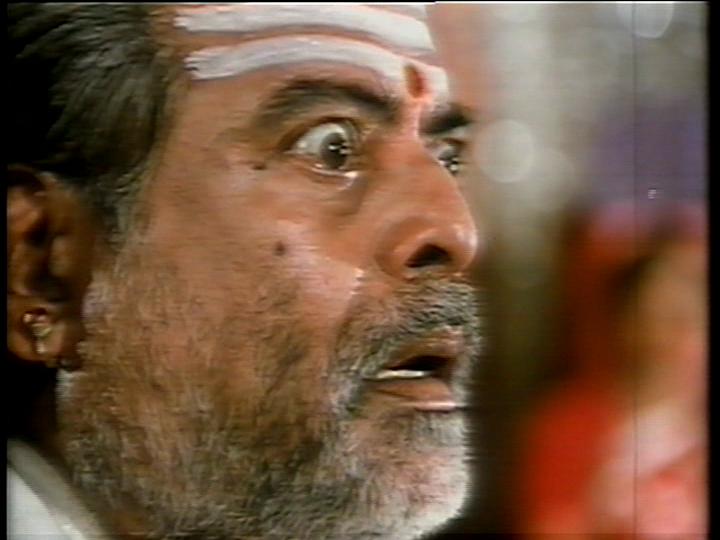
Music in the Sastry home is ceremonial, devotional and not for fun or for the people. The father is very traditional and conservative, living in strict adherence to caste rules. Bilahari Sastry raises his voice in song to drown out the pleas of someone needing help, and would rather be on time for a concert than help a dying commoner. And he pulls this face a lot:

He is a difficult man, but not a total monster. It’s obvious he has done the best he could after his wife died, and he misses her guidance or support.  There is already tension in the family purely because of the different personality types and this is heightened when Suryam meets Lalita (Shobana).

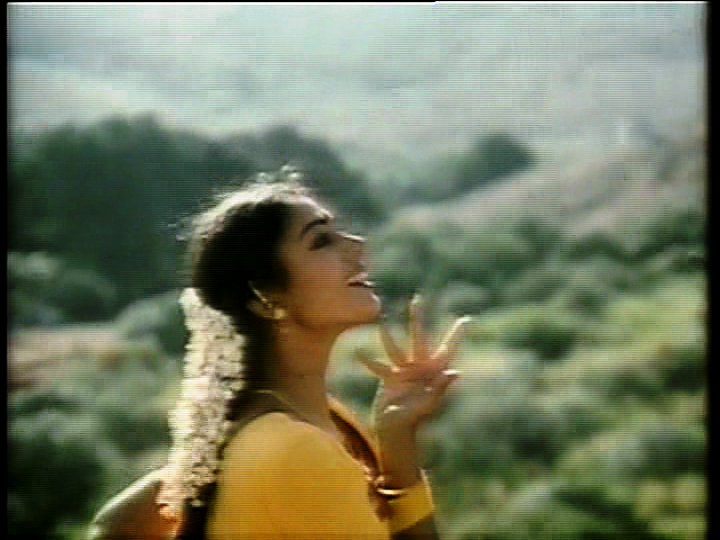
He sees her dancing on a hillside opposite a temple, ogled by men from their sacred vantage point. I think Lalita makes a point about men worshipping goddesses when women are excluded, and whatever she said it makes an impression. Suryam has a statue placed on the hilltop and is surprised to see the villagers lined up for pooja within shouting distance of a temple that didn’t include them.

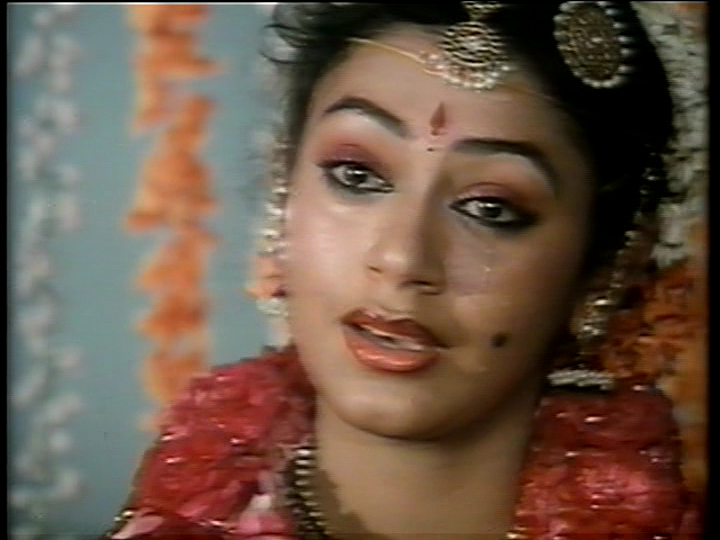
Shobana has good chemistry with Chiranjeevi and although I know there is an age difference, it isn’t obvious and they look great.  Lalita isn’t a pushover to be impressed by the Brahmin boy and he doesn’t act entitled. Having the lower castes represented by the beautiful Lalita could have easily fallen more into the fairytale romance but thanks to some good writing and the excellent performance by Shobhana, Lalita is strong and individual.

Their shared love of music is another form of communication and bonding that helps this seem like a potential life partnership rather than a fluffy instant romance. Illaiyaraja’s songs are set into the narrative so they are part of the story, and the minimal dancing is in character for Lalita and Suryam so it all flows beautifully. The music is a real highlight of Rudraveena.

Their flirtation is fun as Lalita keeps Suryam guessing, which he kind of  enjoys,  and they do all those little things that are only really funny for people in the giddy stage of love. She’s not all cool and calm though, as she changes her sari five times before he arrives to visit. Lalita refuses to be cowed by Sastry’s disapproval and is clearly confident in her relationship with Suryam.

Lalita’s family are the opposite of the Sastrys. When Suryam arrives he is greeted with hugs and an extemporaneous welcome song introducing each family member and what they were doing. It’s an attractive environment for a boy who feels stifled at home.

Not that home life is all grim. Suryam confides a little in his sister-in-law about his love and she mocks him gently even as she is pleased to think he might soon marry. Prasad Babu gives an appealing performance as Suryam’s mute brother.

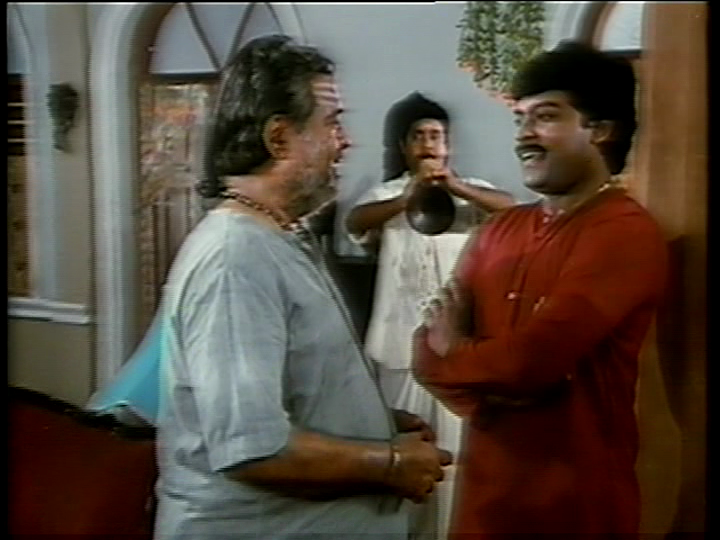
He is an observer of the tension in the house, and he uses music to force communication or at least momentary harmony. He is also a kind of moral compass, miming to his father that donning the trappings of religion doesn’t make you close to god if you don’t also do the right thing.

Bilahari will not tolerate what he sees as Suryam’s rebelliousness. As punishment, he takes on another student and promotes him to favoured disciple status. This guy is a fraud who pretends to be pious and dedicated but really he just wants to marry daughter Sandhya (the beautiful Devilalita). That relationship is quite nice, but the character is there more to be a contrast with Suryam who is outwardly not the ideal son but is a good and honourable man. Of course, Bilahari learns of his error eventually but he is a proud man and the damage has been done.

After yet another disagreement Suryam leaves the family home, but he doesn’t just marry Lalita and live happily ever after. Their wedding is interrupted by drunken louts out to cause him trouble, including an uncharacteristically nasty and dramatic Brahmi.

Suryam stops the ceremony rather than allow Lalita to be insulted further. He takes on a challenge to reform the village before he can marry and Lalita supports him despite her heartache. I think she is sympathetic partly because she wants to be certain that Suryam is sorted before they start a life together.

I liked that Lalita was active in the reforms, showing that a young low caste woman could be a leader too. Suryam sees that people don’t always have the motivation or resources they need, and he can help. It’s not as preachy as it sounds as he is a doer not just a talker, and is as likely to be driving a tractor as making a speech. It’s clear that he feels his position requires him to do something to raise people up rather than keeping them down. And I think there’s also a bit of wanting to show his father who was right.

Yes it is a little heavy handed at times but the romance and more fun elements provide the necessary balance.  The ending made me a little angry at Sastry jumping on the bandwagon, but you cannot get a clearer message than this:

Rudraveena says people can create change by doing something in their own community, and it doesn’t have to be on a grand scale to achieve a great result. I like that philosophy and it is as fresh and pertinent today as it was in 1988. All that thought provoking material, and a sweet love story to boot. And really, if you can resist Chiranjeevi in this role I just don’t know what’s wrong with you. 5 stars!

Khaidi

Khaidi is apparently based on the Stallone film First Blood, and while that sort of helped as I watched without subtitles, the context is completely different. Where First Blood was John Rambo dealing with post traumatic stress and using his lethal skills against the former employer that had made him a killer, A Kodandarami Reddy makes Khaidi a personal drama that charts the path of a man on his own mission of vengeance. Also – the added songs and dancing were very pleasing.

The film starts with Suryam (Chiranjeevi) being picked up by the police as he is walking towards a crossroads. He refuses to tell the police anything, not even his name. He is a mysterious and silent stranger in black, and there is a disquieting fury in his eyes. When Suryam is threatened with having his moustache shaved off, he has flashbacks to some earlier torture which sets him off and he fights his way to freedom.

He is taken in by Dr Sujatha, who patches him up and tells him he needs a lawyer but it’s obvious from his expression that he intends on sorting out his problems without involving the legal system. I’m not sure if they knew each other before she found him unconscious on the street, but there is an element of sexual tension or curiosity in some of their scenes. I did enjoy Chiru’s quick peek under the blanket to see if he was decent before he tried to storm off (silently – he hasn’t spoken a word to this point).

Sujatha passes him off to nosy neighbour girl Rosie as a relative who had been in an accident, and it seems he may have found safety. She does discover he is a wanted man, and based on something in her own past (I guess) decides to trust her own judgement about him.

Finally, Suryam speaks and his story starts to emerge, partly through this surprising interlude:

Suryam is a poor boy who is pursued by, and falls for, Madhulatha (Madhavi) and based on that clip, I’m not surprised she was a bit keen.

Her wealthy landlord father is unimpressed but she refuses to consider any other man. Madhu is used to getting what she wants, and will not back down despite the consequences to Suryam or herself. She seems to be her father’s daughter as he also refuses to compromise and in true filmi fashion he decides to ruin Suryam’s family.

Suryam has witnessed his family home taken away, his father murdered, his farm sabotaged, his sister attempted suicide and was finished off by the bad guys,  and he was implicated in her death. Any one of these things might tip someone over the edge, but all of them? He is a time bomb. He has lost everything, and without the security of family and home, there is nothing to restrain him. Pursued by police and by the landlord’s men, Suryam is in a deadly cat-and-mouse game.

This was a very successful film for Chiranjeevi and by all accounts launched him into action hero territory. He is excellent as both the ordinary boy and angry man. Chiru is adept at using his eyes to express strong emotion and he switches from sorrow to implacable rage in an instant. There are lighter moments within the story although the focus is firmly on the trajectory of Suryam towards his revenge. I was highly amused by a scene where a local Romeo was sleazing on to Suryam’s sister, offering her a sari. Chiru forces the guy to change into the sari and sends him off with a flea in his ear.

The final showdown is insane and kept me on the edge of my seat as Chiru takes on the law, a band of axe wielding ‘tribal’ folk, trees that stand in his way, thugs with evil designs on Madhu, a (fibreglass) horse and eventually the bad guys all while using a range of weapons including knives, arrows, bees and guns and having survived gunshots, being set on fire and shot out of a cannon (OK I made up that last one). Whew! And I recognised much of that action sequence from Charan’s debut film, Chirutha. So why are people talking about him starring in a remake of Khaidi when…never mind. Enjoy Chiru in action mode:


Madhu was a fairly annoying character and Madhavi had little to do apart from rant and pout. She looked lovely and seems to be well suited to the more aggressive roles as she has a strong physical presence. There were some positives.  As she was going to storm off after a spat Madhu shrieks and points at two snakes, then I think Suryam says something like ‘they’re too busy shagging to bother biting you…look!’ and we have this:

Awesome. A random snake dance that has NOTHING to do with anything other than the costume designer wanting to get Chiru into a pair of silver bike shorts. Bravo! Although I did realise that there may be some connection to the Jeetendra Effect as he starred in the Hindi version of this film.

I did give Madhu some reluctant applause late in the piece when she escaped her house using the old sari-as-a-rope trick. But I took it back minutes later for a lame snake wrestling scene. The woman has played a snake quite well so I expected better from her in that department. But then I cheered again when she managed to outrun several men on horses, all while keeping her wedding sari decorously tied. I think Madhavi did the best she could with a role that was ultimately just to be both the hero’s trial and his reward.

I was more interested in Sumalata as the independent and intelligent Sujatha. She stands up to her neighbour who is a police officer, and has a strong sense of justice. She seemed to be a more complete person than the rather sketchy Madhu and I found myself wondering more about how she fit into the story and I’m sure subtitles would have helped explain that. I also liked her very glam 70s house with cuckoo clock sound doorbell.

The story is predictable, as little except the body count and method of despatch is left to guess at, but there is still some suspense largely due to the intense performance from Chiranjeevi. There’s also a hefty dose of WTFery but you know, I really liked the commitment to making it memorable. If you like your films action packed and your heroes invincible, this is well worth seeing. 3 ½ stars.