Mouna Guru (2011)

mouna-guru

Santha Kumar’s 2011 debut film Mouna Guru focuses on a young student and how his life falls apart when he inadvertently becomes involved with a group of corrupt cops. The basic story is simple, but Santha Kumar layers detail upon detail to make an intricate plot with plenty of twists and unexpected diversions. Perhaps the most unexpected is that one of the major characters is a pregnant police officer brilliantly played by Uma Riaz Khan, but the whole film is full of quirky characters that fit perfectly into the screenplay. With an engaging screenplay, great performances and realistic settings, Mouna Guru is definitely one of the better crime dramas I’ve watched recently and one definitely well worth tracking down.

The film starts in Madurai where college student Karunakaran (Arulnidhi) lives with his mother (Sujatha Sivakumar). Karunakaran is generally quiet and studious but socially inept, which means that he is often in trouble when someone challenges his rather literal and single-minded view of the world. After a few clashes his University asks him to leave, but luckily for Karunakaran his brother Amal arranges for him to complete his degree in Chennai. At the same time his mother also moves to Chennai to look after Amal’s new baby which solves the problem of leaving Karunakaran to fend for himself. However, with his mother and his wife’s sister Aarthi (Iniya) also staying in their flat, Amal needs to make other arrangements for Karunakaran. There is a free room in the College hostel but while this solves the problem for Amal and his wife it further isolates Karunakaran from his family. This turns out to be an issue later on when Karunakaran disappears and his family accept everything they are told, even though most of it is blatantly untrue.

Initially things seem to go well, but Karunakaran’s quiet and solitary nature soon sets him up to be bullied by the more popular class members, while his family pushes him further away. His sister-in-law is unwelcoming, his brother too busy and his mother only has time for the new baby. His only consolation is Aarthi who seems to be able to appreciate his (rather deeply hidden) good points. And these are hard to spot – Karunakaran is gruff and uncommunicative; he often appears angry and definitely has none of the usual social graces. However, there is a good side to Karunakaran. The opening song shows him feeding monkeys and rescuing snakes, while he appears to have keen sense of right and wrong that drives him to seek social justice.  He advises Aarthi to follow her dreams and work among the poor if that is what she really wants to do, while his own goal is to enjoy his job rather than make pots of money.  With all his idiosyncrasies, Karunakaran is a dreamer at heart and Arulnidhi does an excellent job of bringing such a complex character to life.

Aarthi is Karunakaran’s complete opposite. She’s friendly, approachable and seems to be doing well in her medical studies. However she’s drawn to Karunakaran and the idealist she sees behind the prickly façade, and slowly the two fall in love – much to Karunakaran’s mother’s displeasure.

Meanwhile corrupt police officers ACP Marimuthu (John Vijay), Inspector Rajendran (Madhu), Sub-Inspector Selvam (Balakrishnan) and Head Constable Perumalsamy (Krishnamurthy) are witnesses to a car crash, but rather than help the victim they steal a large quantity of money and finish the driver off into the bargain. Later ACP Marimuthu receives a blackmail call and eventually the four fix on Karunakaran as the student responsible. Even after they discover that Karunakaran was simply in the wrong place at the wrong time, his prospects are bleak as ACP Marimuthu and co-conspirators are determined to silence him and any other potential witnesses.

Luckily for Karunakaran, Inspector Palaniammal (Uma Riaz Khan) is investigating the murder of a prostitute and ends up entangled in Karunakaran’s case. Palaniammal suspects that there is more going on than first impressions would suggest and she works tirelessly to get to the bottom of the case despite her pregnancy and the negative attitude from ACP Marimuthu and other members of the team. Palaniammal is a strong character with a very definite sense of right and wrong – basically the sort of police officer you’d want investigating your case if you were incorrectly accused of a crime. Uma Riaz Khan is excellent as she bulldozes her way through all opposition, compelling respect without ever raising her voice and just generally being a majorly awesome police officer.

There are only three songs in the film and they fit well into the narrative. This is perhaps the most traditional of the three as it develops the romance between Karunakaran and Aarthi. It’s a lovely song by Thaman and suits the mood of this part of the film perfectly.

Every character and each interaction are important in developing the story and while it’s not immediately apparent exactly how everything fits together, it all becomes clear as events unfold. Although there are a number of coincidences, none seems completely unlikely, (except perhaps Aarthi’s discovering Karunakaran after he has gone missing) and mostly the film feels realistic. None of the characters here are anything out of the ordinary and their reactions are natural and seem perfectly reasonable given the circumstances. There are no big fight scenes either – Karunakaran only fights back when someone else attacks him, and his methods are rough and ready rather than filmi stylish. The glimpses of college life and the realities of a mental asylum also appear authentic and I love the conversation between the warden and a student about his choice of hairstyle. Another favourite character is Babu, one of the inmates of the mental asylum who is perfectly played by Murugadoss to evoke pity one moment and then laughter the next. It’s an accomplished performance even though he only appears towards the end of the film but I appreciated every moment.

Mouna Guru keeps the twists coming right up to the very end. Karunakaran switches between quietly passive and accepting to explosively fighting back and it’s almost impossible to determine which way he will go at any given point, which ensures that every scene ends up surprising in one way or another. Although the police officers are all fairly standardly corrupt, their individual reactions to the developing situation are all quite different and each emerges as an individual persona as a result. I also love the way all the pieces of the story interlock, finally all coming together like a giant jigsaw puzzle while the final climax keeps changing just as you think it’s all over. Well worth watching for the excellent performances and multi-layered story that feels scarily possible. 4 stars.
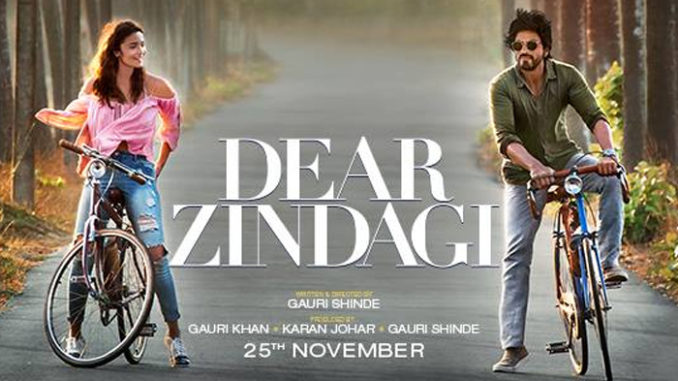
Dear Zindagi

dear-zindagi-poster

Gauri Shinde follows up English Vinglish with another heroine-centric film. The amazing Alia Bhatt is ably supported by a very fanciable Shah Rukh Khan, and I loved seeing some more realistic modern relationships in the story. But it’s a bit heavy-handed and there are a few things that left me vaguely dissatisfied.

This is Alia’s movie. She is Kaira, an up and coming cinematographer who lives alone in Mumbai, and pretty much does as she pleases. Kaira takes herself and her work very seriously, but she is fun in a bratty way. She has a closeknit group of friends – the smart one, the ditsy one, the chubby guy and the gay one. And that’s one of the issues. Her friends mean so much to her and yet we barely get to know them. Her relationship with her maid Alka is better developed. Kaira has issues with emotional intimacy and trust, and is destructive in her romantic relationships. That holding back may be why her friends are so shadowy, and there is a question about how much attention she really pays them. Her life is thrown into chaos when building management decide they will only let married couples and families live in the complex, and she is evicted for being single. She breaks up with nice but boring Sid (Angad Bedi), is jilted by not so nice but not boring Raghuvendra (Kunal Kapoor), and lands up at her family home in Goa where she meets Rumi (Ali Zafar). She’s in a bad place emotionally and career-wise; stressed, cranky, and not sleeping, she is a ball of nervous energy. Alia delivers the rapid play of emotions with honesty and commitment to Kaira in all her messiness.

In a clunky filmi coincidence, Kaira happens to be shooting a promo video at a hotel hosting a mental health awareness event. Dr Jehangir “Jug” Khan (Shah Rukh Khan) is the only speaker that makes sense to Kaira. He says that people are always prepared to talk about a physical ailment, but not their mental health, and surely the brain is just another part of the body.  She decides to go see him because she can’t sleep and no medicine has been able to help her. Jug does sometimes sound like an inspirational quote calendar (and I suspect Gauri Shinde watches too much Doctor Phil), but he gets through to Kaira largely by allowing her to discover her own answers. When Jug hears the opening he needs to set the next stage up he does it through conversation and prompting Kaira to articulate her feelings, not by telling her what to think. Shah Rukh gives the appearance of being present and spontaneous, and he and Alia have great chemistry. The inevitable transference scene was handled gracefully and was true to both Kaira and Jug’s characters. And who wouldn’t succumb to transference with Shah Rukh as their therapist?

I loved that the big name star didn’t show up until late in the first half and that he simply disappeared when his work was done, leaving to Kaira to continue on her way. It’s a gutsy move by Gauri Shinde and also by Shah Rukh to trust the story. Frankly I could watch Shah Rukh play kabaddi with the ocean for 2 ½ hours and would listen to him read the phone book (there’s an app idea for the insomniacs!) but I really do think he delivers a good and generous performance here.

It’s unusual to see a mainstream Indian film that doesn’t portray mothers as saints. When Kaira finally blows her top at the family and declares she is in therapy because of them, it’s the catalyst for some self-reflection for everyone. Except her little brother Kiddo (Rohit Saraf), a golden boy who has his own style of managing the parentals. It’s big, when you start to see your parents as human beings. She also struggles with her inner voice judging her for past dalliances. She calls herself a slut (some of the movie audience agreed, sadly) but Jug says as long as you understand yourself and know why you do what you do, then baseless judgement by others is irrelevant. How refreshing to have the nominal hero really not give a rats about who a young lady may have slept with, instead caring that she was able to articulate what she was looking for in a potential partner. And I like that Kaira does this without becoming sweet or saintly – she is still herself, just a bit more resilient and positive. So ladies, try those chairs out and make sure you get one that’s right for you!

I feel I should be able to say more about the support cast but they had little to do and even less material to work with. The romantic interests played by Angad Bedi, Kunal Kapoor and Ali Zafar are all OK-ish guys who Kaira liked for a time, but there is nothing to any of their characters. Her relationship with Rumi (Ali Zafar) is a little more interesting because she starts to ask for what she wants. Rohit Saraf looked and sounded perfect as Kaira’s little brother but he only got a couple of lines so I half wondered why the character was there. Ira Dubey and Yashaswini Dayama play the sensible friend and the ditsy friend, and Raj Bhansali is the gay friend who inadvertently plants the idea of seeing a therapist. They’re all good, but Gauri Shinde doesn’t develop their characters or give them scope to do it themselves.

I liked the visual design for Kaira and Jug’s worlds. Hers is full of colour and movement and herself while his is more restful and neutral, although both live in a state of work in progress. I felt that they actually inhabited these rooms and the spaces were shaped by the character, not just by the set dressers.

Amit Trivedi does what he always does. And seriously – stop with the banjoes. They do not make the music of love. I did laugh a lot at the cheesefest that is the title song. Alia got sent to take her inner Manic Pixie Dream Girl for a good run in the park, hugging trees, flying kites, marvelling at the ocean. The only things missing were a puppy and a mime.

Dear Zindagi is well worth seeing, but you may find your patience is tested…by the audience*! I loved Alia and Shah Rukh, and they rescue the film from some underdone writing and heavy handed message moments.


*A note on the audience. Judging by the fidgeting and volume of conversations it seems the desi boys of Melbourne were not so comfortable when they had to listen to a woman talking about herself, but were all rapt attention when it was Shah Rukh’s turn. A mate in London said some of the dialogues set off the homophobes in the crowd, and there was a little of that here too. A line about a character coming out was greeted with a bit of muttering and shushing while a tired old joke confusing Lebanese/Lesbian had most of the audience in stitches as they kind of missed the point of why that line was being trotted out. And a special shoutout to the lady who sat near me, texting for the whole film and then reading the messages to her husband.

5 Centimetres per Second

5-centimeters-per-second-poster

Shinkai Makoto’s 5 Centimetres per Second (or Byōsoku Go Senchimētoru) deals with themes of love, isolation and separation. With 3 episodes spanning over 20 years from the late 90s, and at just over one hour running time, he tells the story of the love of a lifetime in a spare, elegant, and quite melancholy manner.

The film is stylised and has a strong manga influence in its construction and framing. Longer passages of action are interspersed with single frame shots that speak for the characters inner thoughts, or condense a series of events. The kids are largely alone and set against a larger world, small figures running through their school and town that seems frozen – there are trains and things but little sign of human activity. Takaki says when he dreams of Akari he always sees her alone. The story is mostly told from his perspective, although he is the least emotionally articulate, and Akari is elusive although more expressive.

Cherry Blossom (episode 1) introduces Takaki and Akari. They have been close friends for years, both transferred to their current school when their parents relocated to town for work. A few years later Akari’s parents moved away and the pair have communicated by letter since. Yes, this is a pre email and social media long distance love.

His family are planning to move again, this time to the other side of the country, and Takaki wants to see Akari one last time. He plans a train trip but is delayed by blizzards, and in all the waiting around he can’t avoid confronting his fears that Akari won’t be there but he can’t even contemplate not continuing with the journey.

Of course Akari did wait. They see each other for what may be the last time. They talk, they share their first kiss, and it is sweet and sad.

Cosmonaut (episode 2) is set a few years later when Takaki is settled in his new school. There is another girl, Kanae Sumida, who likes him. He seems oblivious though, and treats her as a friend. Sumida falls for him at first sight but also seems genuinely interested in understanding him, and Takaki is honest with her about his fears and doubts which just makes him all the more appealing and different from other boys. Kanae realises that while she loves him he doesn’t really see her, he’s always looking for something in the distance. If only she knew his dreams were full of Akari, even if he didn’t always recognise her. She resigns herself to a one sided love, and decides not to tell him.

In the final, and titular, episode Akari and Takaki have long since lost track of each other. It’s 2008 and he is living alone, working hard, not doing much else. She is planning her wedding for the coming New Year. He realises that he has lost his enthusiasm for life and had forgotten his fascination with its possibilities and mystery. His girlfriend Risa broke up with him because she knew there was something else he was yearning for, and she wasn’t part of it. So he quits his job and emerges from his tiny drab apartment in time to see the cherry blossoms again. He walks by the spot he and Akari had wanted to visit to see the sakura all those years ago, and passes by a woman who looks very familiar.

I know people who hated the open ending but I think it suits the melancholy tone. This story isn’t really boy meets girls, boy loses girl, boy finds girls again. It’s about how time, distance, the minutiae of life can take us down a different path. Kids who couldn’t overrule their parents moving towns, growing up to realise that if you love someone they are under no obligation to feel the same, deciding what matters to you. We drift, maybe a little faster than 5 centimetres per second, and get caught up in currents and cross winds. I think Takaki just accepted that he needed to stop obsessing over what he had lost and what he had never found, and went out to see what was in store for him. I’m not convinced about the singalong ballad at the end… And what do I think the ending means? Does it mean he finds Akari and they get back together? No idea. Sometimes I think maybe they have and sometimes I think he has just come to terms with where he is in life and so can walk forward with a smile.

At just over one hour, there is a lot going on in this deceptively simple film. While the characters are presented without much detail or background, they reveal more about themselves through their interactions, in Akari’s letters, in Kanae’s inner monologues. I felt connected to them and could relate to some of their dilemmas. I like how this story leaves some things up to interpretation and doesn’t tie everything up too neatly. And I also liked that it is OK for Takaki or Kanae or Risa to be sad because of one another but that it doesn’t necessarily follow that any of them are bad people. Sometimes things just don’t turn out the way you dreamed.

Shinkai is a great story teller who can illuminate complex emotions or philosophy with a handful of frames. His “Voices of a Distant Star” is one of my favourite films ever, and I liked that this story picked up some of the same themes and developed them. The visual style is strong and with the minimal dialogues it works beautifully to create the mood and show another layer to the story.

See if it you like a bittersweet and oh so chaste love story, or just want to immerse yourself in a beautiful piece of art. 4 ½ stars! (Yes, I did take off a half for the ballad)