Oru Mexican Aparatha

Oru Mexican Aparatha

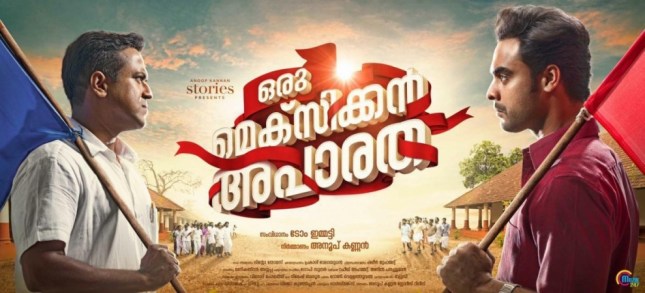
I don’t know much about Indian politics and even less about Indian politics in the seventies, but that didn’t stop me enjoying Tom Emmatty’s directorial debut, Oru Mexican Aparatha. In fact, the political agenda of both groups involved in this college based drama seemed mostly irrelevant, as the film is more about the clash of personalities rather than any large differences in manifesto or ideology, despite the mainly Communist theme. What stands out about the film are the strong performances from Tovino Thomas, Roopesh Peethambaran and Neeraj Madhav, who rise above a somewhat patchy screenplay to deliver a passionate tale of student elections at Maharaja College in Kerala.

The film starts with a flashback to the seventies and the time of Emergency when students were among those involved in protests against the government. The government responded with lethal force resulting in the death of Kochaniyan (Tovino Thomas), leader of the student political party SFY. The flashback is overly dramatic and a little hard to understand for someone who doesn’t know the history, but it is an effective way to introduce the idea of revolution and the passion associated with student ideals.

Back in the present day, SFY has all but been eliminated from Maharaja college as KSQ, led by charismatic leader Roopesh (Roopesh Peethambaran), holds sway. KSQ are a more conservative party and they have numerous petty ordinances including bans on long hair and wearing lungi’s on campus that they use to let the party faithful throw their weight around. Mostly though, KSQ just want to hold on to power and keep their status as big frogs in a rather small pond. Roopesh and his friends decide who will compete in the annual college cultural festival, which is a major source of discontent in the college and seems to be the spark that will start a new revolution.

Paul (also Tovino Thomas) is a first year who shares a shabby hostel room with his friends Subhash (Neeraj Madhav) and Jomy (Vishnu Govindhan). He’s reasonably apolitical but notionally belongs to the SFY party, mainly due to Subhash’s dedication to the Communist cause. Subhash is a committed party member and is determined to bring SFY back to power in the college, despite a general lack of support and an obvious uphill struggle.  His main manifesto appears to be a protest against the bullying tactics of Roopesh and the members of KSQ rather than a strong socialist agenda and apart from a few pictures of Che Guevara and a tendency to brandish red flags the group as a whole initially appear to have only a glancing acquaintance with communism. Paul and his friends are concerned with the usual college activities and their opposition to KSQ seems more to do with Sharks and Jets style rivalry rather than any serious political leanings.

Subhash on the other hand is a socialist and is committed to the communist party which gives him some legitimacy in his fight against KSQ. His strong political beliefs start to affect the other members of the group, especially when they are pushed around by Roopesh and his cadre. Once college elections are announced, what started off as a push-back against a group of bullies escalates into a full-blooded revolution as the walls of the University ring with chants of ‘Vote for Change’ and blue starts to make way for red around campus.

The first half of the film meanders, sometimes rather aimlessly, as the different characters are introduced. For the most part the friends spend their time drinking, chasing after girls, getting up to the usual college mischief whenever the opportunity presents and then drinking some more. Paul is chilled and laid back, and cares more about his budding romance with Anu (Gayathri Suresh) than changing the world, or even just his small corner in Kerala while Jomy is just trying to cope with studying in general. For a political drama it takes a long time for the politics to be introduced and many of the scenes revolve around the friends sitting and drinking but discussing anything of significance. The romance between Paul and Anu also seems rather pointless, while the inevitable break-up is bland and also serves no purpose. I was expecting a spark of some kind to set off political leanings in the group, but neither the romance, nor the break-up achieve anything other than dissatisfaction with the poorly realised character of Anu. Tom Emmatty seems to have an aversion to writing female characters since the few that do appear have little to do and even less impact on the story, to the point where their non-participation is noticeable and impacts negatively on the story. Perhaps making Maharaja college single-sex rather than co-ed would have been a better decision since the focus is all on the male characters anyway.

The second half is much better when the fight between KSQ and SFY begins in earnest and the candidates for the elections are decided. Roopesh Peethambaran is excellent as the scheming leader of KSQ who will stoop to any lengths to hold onto power. His facial expressions are perfect and capture his fleeting thoughts as he plots and plans in response to SFY’s attempts to gain voters, while ensuring that he does display some good qualities and an inner strength that explain his hold on power in the college. Tovino Thomas is suitably charismatic as he runs for college president and his transformation from apolitical student to passionate believer in SFY is very well done. It’s another stellar performance from Tovino after his excellent work in Guppy and it’s impressive just how different he appears here.  Neeraj Madhav is just as good as the idealistic leader of SFY who has to put aside his own political ambitions for the good of the party. Again he gets every nuance just right, and his indecision as he puts his friend in danger is realistic and convincing. Together these three along with Manu, Vishnu Govindan and Jino John bring campus politics alive and infuse the film with the spirit of the revolution so that the lack of response from the college authorities and even the local police doesn’t even register until the final credits start to roll. What it lacks in the beginning, the film more than makes up for in the final scenes with impressive performances from the main leads and excellent dialogues that reverberate with the fervour of revolution.

The story and screenplay of Oru Mexican Aparatha may not be consistent but the three main leads are, and it’s their passion in their respective roles that makes the film so exciting in the second half. More emphasis on the politics and less on the usual college escapades and drinking in the hostel would have made for a more even storyline but the drama of the second half and excellent characterisations make the film well worth watching. One to enjoy as a different take on college life and a reminder that a revolution can start anywhere.
Iraivi (2016)

Iraivi

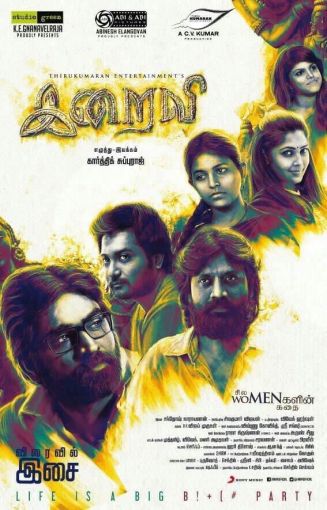
Karthik Subbaraj’s third film is rather darker than his previous two, with less comedy and a serious theme about women who have to endure the poor decisions of weak men. It’s a film where the female characters are defined by the men, and the story is told through male eyes although the women generally are stronger and less flawed than their husbands. While the relationships are the core of the film, there is an overlying story that involves theft, murder and deception and although it’s another excellent film from Karthik, I kept thinking throughout that this would have been more powerful if he had shown more of the women’s viewpoint. However, highlighting the flaws in his male characters and ensuring that they don’t appear heroic is in itself a departure from the norm in Indian cinema, as is focusing on the plight of the women trapped in realistically troubled relationships. In Iraivi, Karthik has made another film that is not easy to define but one which will hopefully start conversations and make audiences think a little harder about the definition of abuse.

The film starts and ends with the women, even beginning and finishing with the same image of a hand outstretched in the rain. The rain is used throughout as a metaphor for freedom, with each of the women expressing a wish to stand in the rain and get ‘drenched’. In the images and dialogue shown over the opening credits, Ponni (Anjali) is a schoolgirl, with the acknowledged somewhat old-fashioned dream of making a good marriage and living the rest of her life in domestic bliss. Vazhini (Kamalinee Mukherjee) is shown to be a strong and confident woman who has defied her family to marry the man she loves while Meenakshi (Vadivukkarasi) is upset by her husband’s demeaning attitude towards her, which has been an unceasing constant throughout their life together.

When we next see Yazhini and Meenakshi, each has been changed by the men around them, while we get to see Ponni’s transformation during the story. Meenakshi has had some kind of fall and/or stroke. She is reaction-less in a bed in hospital and her two sons, Arul (S.J. Surya) and Jagan (Bobby Simha) blame their father Dass (Radha Ravi). He admits to being the cause of his wife’s hospitalisation, but despite the fact that she never moves and never speaks, Meenakshi has become their focus for any of the problems Arul and Jagan face. No matter that she cannot communicate, she is still their mother and that bond is as strong as always.

Yazhini is married to Arul, a film director whose last film is being held hostage by his producer after the two had a falling out. Arul is living in limbo until he can secure his film’s release and has become an alcoholic as a result. He gets into fights in bars when drunk but is not physically abusive to his wife and daughter, but instead subjects them to his mood swings and depression, and the general uncertainty of living with an alcoholic. S.J. Surya is excellent in his portrayal of a weak and selfish man who cannot cope with his loss and has become bitter and completely self-absorbed in his misery. Kamalini too is very good in a role that captures well how many women become trapped by their circumstances. She threatens Arul with divorce but at the same time still loves her husband and tries very hard to be as supportive as she can. However, Arul’s alcoholism and refusal to move beyond his own self-pity makes it difficult for Yazhini to see any other recourse other than to leave, taking their daughter with her. The dialogues between the two are excellent, and the sense of frustration and despair from both Arul and Yazhini underpins every scene. As the story unfolds, it’s Yazhini who emerges as the winner, able to change and adapt she moves on with her life while Arul is stuck in the same self-destructive pattern. Even after going to rehab, his selfish nature has not changed and everything is still about getting his film released – even losing his wife isn’t enough of a jolt to dislodge him from the familiar rut of self-pity and single-minded focus on his film above all else.

Michael (Vijay Sethupathi) grown up with Arul and Jagan and considers them as family with Arul as his best friend. He is in love with a young widow Malar (Pooja Dewariya) but she has no interest in anything other than a physical relationship and rejects his proposals of marriage. Malar is an interesting character – she is a woman who knows what she wants and is not bothered about societies perception of her behaviour, but I felt that there was something rather contrived about her character and despite Pooja’s best efforts, Malar didn’t quite ring true for me compared to the other characters.

When Michael’s parents arrange a marriage with Ponni he callously informs her on their wedding night that he has been forced into the marriage and can never be the man of her dreams. Her female relatives advise her that this is usually the case, but that Michael will change with marriage, however when Ponni tries to engage with Michael he shuts her out at every opportunity. In almost every scene with Michael or Ponni there are background details or snippets of dialogue which seem to foreshadow their relationship. When it seems that Ponni’s preganancy might be the turning point in their relationship, Michael is arrested and sent to prison, leaving Ponni to deliver and bring up her baby by herself. It’s again brilliantly written to illustrate the effect on Ponni as the happy-go-lucky school girl is transformed into a weary and accepting mother, managing to cope as best she can. Anjali is fantastic throughout and the dialogue again is perfectly written to illustrate the difficulties of women in what is a fairly typical relationship, no matter where in the world or whatever the cultural background. Vijay Sethupathi is on top form too as a man who is easily led by his friends and finds it difficult to admit to mistakes, even though at heart he isn’t a bad person.

The third character in the story is less successful, and Bobby Simha never quite manages to make his Jagan as believable as the other two. Jagan is jealous of Michael as he loves Ponni himself and decides to do something about it when he sees her distress when Michael goes to jail. Ponni’s reaction is certainly not what I expected in a film, but it is what could happen in real life, whereas Jegan’s monologues about the oppression of women and the evils of society seem more filmi and contrived than likely to occur in reality. However, Jagan does give an interesting contrast to the other two men, and is a more typical film character while providing the overlying story of artefact theft and deception against which the various relationships are all developed.

The story meanders about haphazardly while establishing the main characters and displaying their motivations. There are repeated themes and foreshadowing of events to come, but the final outcome is difficult to predict and the twists along the way are unexpected and genuinely surprising. What stands out are the individual performances from S.J Surya, Vijay Sethupathi, Kamalinee Murkharjee and Anjali, all of whom are superb. There is able support from all the other actors including a restrained appearance from Karunakaran as Arul’s friend Ramesh. The background music from Santhosh Narayanan is effective and the songs good, although in general these don’t add anything to the film. Sivakumar Vijayan’s cinematography is outstanding, often using the lighting to heighten the drama while ensuring that every scene is perfectly arranged for maximum impact.

Karthik has payed exquisite attention to detail, and the set-up and execution of every scene is beautifully planned to deliver maximum impact. On repeated watching, the small details start to emerge and the links between events become clearer. It’s a film that actually becomes better the second and third time around and I suspect that every time I watch Iraivi there will be another detail I missed the first time. It’s not perfect however; the film is long and some of the diversions taken don’t add anything worthwhile to the story, while despite starting off well, the female characters start to lose some of their definition and eventually only react to the actions of the men. It’s still an intriguing film and one I highly recommend for a different look at relationships between men and women. 4½ stars.


Raman Raghav 2.0

Anurag Kashyap’s Raman Raghav 2.0 takes us into a cat and mouse game between coked up cop Raghavan (Vicky Kaushal) and self-possessed serial killer Ramana. There are no heroes here, in a Mumbai that is more like a jungle peopled by predators and those who so easily become their prey.

Anurag Kashyap has never struck me as a wallflower, and his style is as much a feature of the film as his actors. There is a lot of technique out on display and the stylised effects actually do work pretty well with the action and narrative. When Ramana describes his thinking there are often sound effects like rain, or static, that make it seem like a genuine recollection but also that his imagination is his reality.  Kashyap supposedly employed guerrilla filming tactics to shoot his story out in the city, and very occasionally you see an extra execute a nice double take. The colours, the lighting, the ambient noise, it all says Mumbai and reminded me that every mega-city is a collection of villages. There is a real tension in some of the chase scenes that is as much “will they make it down that street in one piece” as it is about the story. I get why he used the chapter structure to string together disparate scenes and save on explanation, but they are a bit annoying and really don’t add anything other than exposition. I was more invested in following the characters than being hit over the head with the intent of the next section.

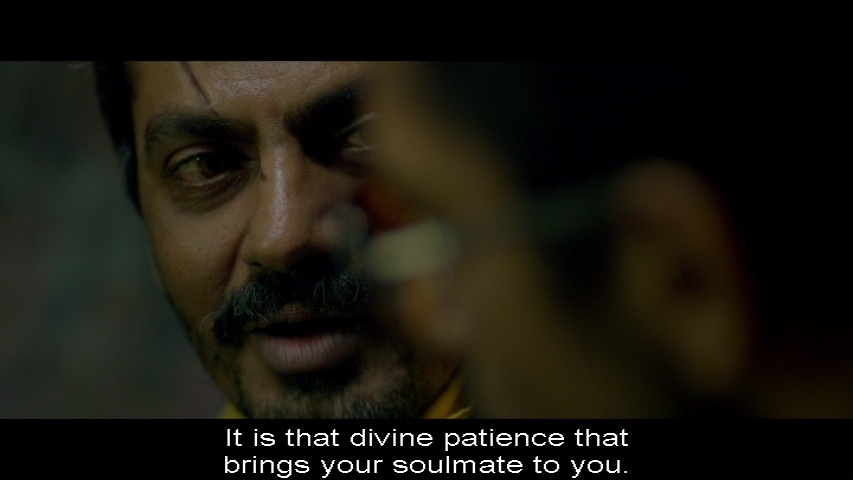
Nawazuddin Siddiqui is that terrifying movie bogeyman – a mild mannered, unremarkable, serial killer. His performance gives Ramana a menace and intelligence that helps gloss over some of the less plausible moments. Scenes that appear to be him reacting to something can later be seen as a rehearsal or test for how to get the desired reaction. He has a casual brutality driven by a rigorous inner logic, with a touch of religious mania. He seems to be guided by cats more than is good for a sane man. Ramana’s Mumbai is part forest and little shacks, not many people around him at times, and part concrete jungle. He is matter of fact and almost seems to expect people to agree with him that they must be punished. When he tracks down his sister and finds her recollection of events not to his liking, he cannot let that go by. His scenes with Raghavan are particularly mesmerising as Nawaz the actor and Ramana the character each play with the onlookers emotions and logic. His final scene with Raghavan was sick and creepy and yet held a sweetness that implied redemption had once been possible, perhaps. Kashyap should be thanking his lucky stars he got Siddiqui to star as I can’t imagine another contemporary actor being so prepared to show such unapologetic darkness, and making it look exquisite.

Vicky Kaushal is the coked up cop Raghavan. He disregards Ramana’s hints that they have seen each other before and leaves him as a harmless nut job to be scared off. He is on his own downward spiral, and there is no end in sight. Raghavan doesn’t seem to have a single honest or healthy relationship in his life. Like Ramana he believes he knows best and that whatever he does is somehow sanctioned. Raghavan is a nasty piece of work but I never felt drawn into his inner world the way I was with Ramana. Vicky Kaushal relied more on external expression of his turmoil – the sniffing and irritability that went with his habit – than showing the demons driving him. I rarely felt much connection with Raghavan as a person. I could easily detest him but I couldn’t really invest in his fairly predictable journey.

His sort of girlfriend Simmy (Sobhita Dhulipala) tolerates his behaviour although I really don’t know why. He makes it clear she is there for sex not forever, and he certainly doesn’t care about any consequences of their relationship, but she doesn’t seem to take his aggression and threats seriously. Sobhita is convincing with her party girl ennui and casual acceptance of Raghavan’s violent side. If only Simmy also had better attention to self-preservation. Some of the women in the film exhibit what could be called non-traditional values, and I couldn’t help but notice that none of them comes through unscathed. It’s a high body count film so that is not inconsistent, but I wondered why female sexuality had to be the trigger for punishment so often. I spent a fair amount of my viewing time urging the women in it to RUN.

The rest of the supporting cast play the friends, family, cops and robbers of this world. They’re all good but very much pushed aside by the two lead characters. I particularly liked Amruta Subhash as Ramana’s sister Lakshmi, and Mukesh Chhabra as the wishy washy loan shark.

Raj Sampath’s score is driving and percussive for the most, underpinning the tempo of the city and the chase. The songs are obligatory rather than necessary but do speak to the characters inner state. And there are some nice touches as when the romantic music wells as Ramana explains to Raghavan that he is his soulmate. It’s a twisted but seemingly genuine love at first sight.

Whenever Nawazuddin is on screen I felt a chill. Unfortunately too much directorial faffing around to try and look cool drained the film of tension, and Vicky Kaushal wasn’t able to overcome either a compelling co-star or an underwritten role. 3 stars.