Jai Chiranjeeva

K Vijaya Bhaskar’s film is a rightfully neglected effort from the latter part of Chiranjeevi’s pre-hiatus career. While Chiru’s Megastar presence is always compelling, he can’t compensate for the desultory direction and derivative screenplay. On the upside, Arbaaz Khan makes Bhoomika look like a brilliant actor so she must be happy.

Pasupathi (Arbaaz Khan), obviously EVIL, steals a cargo ship to go to Mumbai. His henchman (Rahul Dev) is waiting there (again, obvious signs of EVIL). Pasupathi demonstrates a new fancy gun with computerised target tracking, and when Ramkoti (Jayaprakash Reddy) seems mildly disbelieving he shoots a child playing some distance away in the park. EVIL.

Meanwhile 40 something year old virgin Sathyanarayan Murthy (Chiranjeevi) comes to the big smoke to stay with his relatives. Some unfunny mistaken identity shenanigans result in sexual harassment, but it’s OK because he is filthy rich. Even a comedy fall from the roof involves heroics and mild sexual harassment (stopping a robbery, encouraging a couple to get it on, copping a feel of the one who will be One of The Ones). He continually crosses paths with Shailaja (Sameera Reddy) and of course sparks of all types fly. Sometimes literally.

After a big night Sathyanarayan passes out drunk and has a long flashback to the death of his much loved niece, Lavanya. She was a pushy little minx and, sadly, also the child murdered in Pasupathi’s gun demonstration. When Sathya learns that the doctor lied to him about Lavanya’s cause of death and colluded with the gang to prevent a police enquiry, things become more dangerous for everyone. Back in the present day, the doctor’s daughter Neelima (Bhoomika) becomes involved as she seeks justice for her dad who was killed to prevent further blabbing. She ends up in a fake marriage with Sathya so he can get a visa for the USA to go kill Pasupathy.

The film should be improbable but suspenseful, but almost everyone, including Sathya, seems go off task far too easily. For someone bent on revenge and believing he is on a mission from god, Sathya is easily distracted. There is always the opportunity to bust a move or rehabilitate a child beggar by telling her not to beg anymore because it just isn’t nice for a girl to do that. Chiru has to perform every style from slapstick to smack down and he is good, as he always is. But it’s more like a series of skits so the dramatic tension is lost, and Chiru has nothing to get his teeth into except the scenery. The songs by Mani Sharma are diverting and Chiranjeevi looks like he is having fun with the choreo. The action scenes are tailored to suit him and, despite being copied badly from films like the Bond and Die Hard franchises via Jackie Chan, they are a highlight. While it’s obvious he’d been living in a good paddock and wasn’t his svelte 80s self, he really goes for it.

However the attitudes are a bit 80s and it’s very vexing. Venu Madhav chases prostitutes and rejects one who is too dark. That was supposed to be funny. Shailu’s parents say they stopped her studying because she behaved like a boy – i.e. did what she liked. Shailu decides to stage a party and make Sathya pay for his insulting behaviour. Simple country lad Sathya has to be styled up as a parody of Chiru just to get in. Luckily pub = dancing. But his (drunk) song combines bhangra beats with a warning of how drinking and partying is not for nice young ladies and they should be careful not to make their parents cry with their modern ways. Neelu’s family pressure her to leave her father’s death alone and not cause embarrassment by looking for the truth.

The two girls are the only ones with a real sense of purpose. I quite liked Sameera Reddy. Shailu was not the most realistic character but Sameera has a robust energy that stood up well against Chiranjeevi’s presence and her dodgy wardrobe. She wasn’t afraid to go for it in the dances either. I didn’t necessarily agree with her decision making but I thought Shailu was articulate about what she wanted and where she drew the line. Bhoomika used both of her expressions, and despite having the potentially more substantial role she didn’t really make much of it. Neelu was tortured, threatened, kidnapped, her poor puppy Dandy was the victim of a Fatal Attraction bunny boiler scenario, and yet I barely remember anything about her. I have better recall of her bedroom furnishings, right down to the Australia shaped souvenir on her bedside table. Neelu has reservations but is won over by Sathya’s “revenge is better than happiness” speech. Plus he promised to only kill bad people. Shailu finds out Sathya intends to marry Neelu to get a USA visa but agrees because she loves him…and makes them have a church wedding as a Hindu ceremony is only for realsies. Points for actually having the discussion I guess.

Pasupathi likes to believe he is the puppet master but while all of his plans seems grandiose, the execution kind of fizzles out. I mean, it takes a miracle from god and Lavanya but eventually Sathya notices the building sized portrait of Pasupathi on the side of a skyscraper over the road and deduces that might be the top secret HQ he has been searching for. A bomb that took several minutes to describe and would supposedly vaporise a building only set fire to a small section of the car park. If I had been Arbaaz’s school careers counsellor I like to think I would have steered him away from “acting”. But since the rest of the baddies are played for cartoonish laughs, he does kind of fit in.

Among the many interruptions to the big comeuppance there is a long comedy interlude with Brahmi. I kept shouting reminders they should be off doing revenge-y things but nobody seemed to care. Even on the way to find the baddies they had to stop for a dance break at a wedding. MS Narayana has a running gag appearance that does nothing but isn’t offensively awful. Sunil is Ramkoti’s useless son and while I find him likeable as an actor I kind of wished the death threats had come to fruition. Even Tanikella Bharani annoyed me with his turn as a travel agent. My Comedy Uncle Intolerance has not waned.

I don’t hate the film as there are enough bits and bobs that make it mildly entertaining, plus there’s Chiru. But I wouldn’t recommend it to anyone but a Chiranjeevi completist. Watch the songs, you’ve seen the rest in one form or another. 2 ¾ stars!
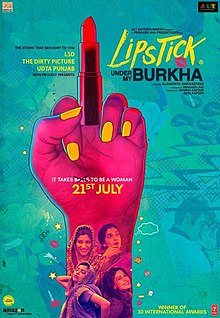
Lipstick Under My Burkha

Lipstick Under My Burkha

Alankrita Shrivastava’s Lipstick Under my Burka is a fascinating look at the lives and dreams of four different women living in a community in Bhopal. The film has been successful in a number of film festivals (including a sell-out show here in Melbourne) and has also recently released in India after some initial censorship problems. This is not the usual filmi view of Indian women as perfect mothers, wives or romantic partners, but rather a warts-and-all exposé of the realities of life as a woman in India today with all the restrictions, society taboos and in some cases the violence they face every day. These are real women and the film shows us their real lives. It’s the combination of that reality with powerful performances and a major dash of empathy that make the film a must-see, and one that stays with you long after the end credits roll.

The four main characters all live in the same housing block in Bhopal and although their lives connect only peripherally for most of the film, each is struggling with their own problems that eventually bring them all together by the end.

Usha (Ratna Pathak Shah), commonly known as Buaji is the widowed matriarch of a large family and has been called Aunt for so long she’s almost forgotten her real name. Her family own the building and it’s Usha’s who’s called on to deal with any problems, but despite her control over the family property, Usha has little control over her own life. This leads her to keep secret the few things she does have for herself. She secretly reads romantic novels, hidden from her family behind the pages of a magazine, and one of these books, Lipstick Dreams, becomes the background narration to the film. She also keeps her swimming lessons with the hunky instructor Jaspal (Jagat Singh Solanki) to herself, pretending that she is attending religious meetings instead, and the combination of frustrations, romantic dreams and a handy object of desire eventually leads her to racy phone sex, which she also has to keep hidden.

Rehana Abidi (Plabita Borthakur) is perhaps the most conventional character and is the owner of the burkha mentioned in the title. The film starts with Rehana stealing bright red lipstick by hiding it under her burkha. She applies this as soon as she gets to college, also shedding her traditional dress for jeans and a skimpy top, and changing her behaviour to suit. Rehana struggles to conform to the expectations dictated by her traditional family, leading her to hide her desire to become a singer, her western-style clothes and her pictures of Western popstars from her parents. The burkha is a symbol of more than just her perceived oppression too, as it’s also the shield behind which Rehana hides when she is shop-lifting and it allows her to pass almost unnoticed through the streets at night. Unfortunately, Rehana’s rebellion leads her to some dodgy choices, and she puts herself at risk when she becomes involved with an older man Dhruv (Shashank Arora), but for the most part her attitude is as expected for a young woman trying to escape her conventionally traditional family, and her motivation is relatively easy to discern.

Konkona Sen Sharma plays a more complex character and she does an excellent job with the role. Shireen is ostensibly a stay-at-home mom with three children and a slew of abortions behind her. Her husband Rahim (Sushant Singh) is based in Dubai and when he is home is only interested in asserting his ‘right’ to Shireen’s body, raping her most nights when he is home and refusing to wear a condom, despite the risk to her health. Shireen though also has a secret. She’s a very successful door-to-door saleswoman who is about to be promoted in her company, but she isn’t able to tell her husband as she knows he will not approve. Things become even more complicated when she finds out that her husband is keeping secrets too, but she seems trapped by her three children and society’s rigid belief in a woman’s place.

The final character is Leela (Aahana Kumra) who is Hindu and works as a beautician. Her mother is keen for Leela to marry well and has arranged her marriage with Manoj (Vaibbhav Tatwawdi) but Leela is in love with Arshad (Vikrant Massey) a Muslim photographer and wants to run away to Delhi with him. Leela uses sex as a bargaining tool to ensure that Arshad stays with her, but despite her modern views and her willingness to use her body to get what she wants, she’s still bound by convention and reluctant to run away without a man by her side.

The film follows these four women as they live their lives and dream their dreams, but finally their secrets are revealed with disastrous consequences.

What works well is the matter of fact manner with which Alankrita Shrivastava approaches her subject matter. The woman’s lives are shown authentically without glossing over any of the harsh realities of life in a small community. The women’s dreams and desires are mostly all relatable, as are many of their problems, making it easy to be sympathetic to their circumstances and hope that their situations improve. There are a few sex scenes but these are never voyeuristic, rather they are sensitively shot without any gratuitous nudity. Leela’s quick hurried couplings in various handy rooms and Rehana’s inexperienced fumblings are juxtaposed with Shireen’s attempts to ward off her abusive husband and Usha’s romantic fantasies in the bathroom.

While the women don’t interact much with each other there are a few moments where a couple of the characters come together, which serve to build a gradual sense of unity that becomes more apparent by the end. The actors too are all fabulous in their roles, ensuring the characters remain authentic while generating understanding and empathy. There is some excellent comedy too that stops the film from being simply a litany of abuses against the women.

The only real flaw for me in the film is in its portrayal of the male characters. These are almost uniformly one- dimensional with few redeeming features and, with one or two exceptions, only appear on-screen to abuse or threaten the women.  Rehana’s authoritarian father and Shireen’s abusive husband are the most caricatured, but even Dhruv and Rahim are mostly self-serving with little thought for their female partners. This is in stark contrast to the women who have plenty of light and shade, and it’s a pity that Alankrita Shrivastava didn’t bring this diversity into her male characters too.  The ending is also rather abrupt, and while I have no issue with leaving the final outcome hanging, the final scene had a few elements that didn’t quite fit with the rest of the film.

Regardless of the shortcomings with the male characters, the central theme is one of shame. The shame that the women are afraid of if their secret is revealed and the shame their families keep insisting the women have brought to them. When in reality all the shame here likes in the intolerant society and regressive views of the men. As far as showing the lives of the women involved goes, the film succeeds beautifully and indeed, the points raised are universal and hopefully will start conversations and increase awareness in many communities. This was simply an excellent film and one I highly recommend watching for a novel view of Indian women.

Lipstick Under My Burkha

Velaiilla Pattadhari (VIP) 2

VIP Poster

Sequels are always tricky. Returning to a popular character or scenario is fraught with unfavourable comparisons, and finding a new story that works while retaining the aspects that made the original film so popular is another minefield to cross. There are a few sequels that turn out better than the original film but they are the exception, and sadly VIP 2 isn’t one of them. However, while it may not be the best sequel ever made, it’s certainly not the worst and as an all-round entertainer, it fares reasonably well. Most of the success is due to Dhanush who carries the film over some occasionally rough ground, but Kajol makes a better than average adversary while the presence of many of the original cast (including Harry Potter) ensure good continuity with the first film.

After dealing with Arun in VIP, the sequel opens with Raghuvaran (Dhanush) still working for Ramkumar (M.J. Shriram) at Anitha Constructions and winning the Engineer of the Year award. This brings him to the attention of Vasundhara Parameshwar (Kajol) who runs the biggest engineering firm in South India. Raghuvaran’s dismissal of her offer of employment rankles, but not as much as his admonishment to be less arrogant when Anitha Constructions wins a big contract over Vasundhara. A self-made woman who has clawed her way up from the bottom, Vasundhara makes it her mission in life to squash Raghuvaran like the bug she perceives him to be, but of course it’s not going to be as simple as she believes.

All the elements are there from the previous film, Raghuvaran’s beloved cycle, his dedication to the memory of his mother, and his unfortunate tendency to drink too much when faced with a problem. What doesn’t work quite so well is the change in Shalini (Amala Paul) from a sensible romantic interest to a shrewish and nagging wife. Supposedly this is due to giving up her job and taking over all the household chores, which to be perfectly honest is enough to drive anyone to grumpiness, but the constant bickering wears thin very fast. Worst still, Shalini’s nagging is supposed to be funny, but it’s just as irritating to the audience as to Raghuvaran’s family.

Kajol is a huge improvement over Arun and his father as the villain of the piece. Her entrance is more typical of a hero as the first glimpse is of her stylish and very pointed stiletto hitting the ground as she arrives at the Engineering awards ceremony. In fact, the crowd reaction was just as loud and enthusiastic for Vasundhara’s entrance as it was for Raghuvaran’s first appearance on screen. Kajol totally owns the role and her arrogance and confidence are a perfect balance to Raghuvaran and Ramkumar’s humility and attention to detail. And yet she’s not evil or out to destroy the poor of society, simply determined to push though her own ideas and methods regardless of anyone standing in her way. However, after a great start, her repeated attempts to get the better of Raghuvaran start to seem petty and churlish rather than decisive and it seems unlikely that someone who had the strength and ability to run a successful company would be quite as petulant and narrow-minded. Still, Kajol is stunning as she sweeps around in her tailored suits and stylish sunglasses, while her menacing dialogues are surprisingly effective.

Raghuvan’s father (Samuthirakani) is a more supportive figure this time round, but his brother Karthik (Hrishkesh) barely gets to say a word and most of the VIP boys suffer the same fate. Without any substantial input, they become a faceless mass without any of the charm or appeal that allowed a connection to develop to these characters in the original film. The film is significantly more focused on Dhanush, who has the acting chops to carry it off, but at the expense of a more coherent storyline. The plot wanders as story and screenplay writers Dhanush and Soundarya Rajinikanth try to include as many of the characters as possible from VIP 1, but run out of things for them all to do. Saravana Subbiah pops up as an unscrupulous developer while Vivek reprises his role as Raghuvaran’s side-kick Azhagusundaram. While both are fine in their roles, the characters seem to be added in, one for comedy and one to have a reason for the fight scenes, rather than have a true background and reason to be in the script. The final confrontation between Raghuvaran and Vasundhara is also a little disappointing although otherwise the chemistry between Dhanush and Kajol is excellent and the atmosphere between the two crackles at each meeting.

Sean Roldan’s music is perfectly fine but the songs don’t have the same anthemic qualities as Anirudh’s previous tunes, a fact underscored every time the original theme for Raghuvaran plays in the background. However, the choreography is slicker than in the first film and the fight scenes are also of a high quality.

If this was a stand-alone film, I would have rated it as a good action movie with an interesting concept and two excellent characters in Raghuvaran and Vasundhara. The addition of a strong and powerful female character works well here, and Dhanush emphasizes gender equality a number of times throughout the film, although it doesn’t quite gel with his wife having stopped work to look after the family home. The problem is that this is a sequel, and while the original elements are cleverly arranged to form the foundation of the film, too much feels to be added simply because it was part of the first film, while VIP2 doesn’t have a strong enough identity to pull away and succeed without that original scaffolding being firmly in place. It is however much better than I expected and both Dhanush and Kajol turn in strong performances under Soundarya’s direction to make VIP2 more than just a film for fans, but one that’s unlikely to reach quite the same cult status as the original movie.