Pinky Beauty Parlour

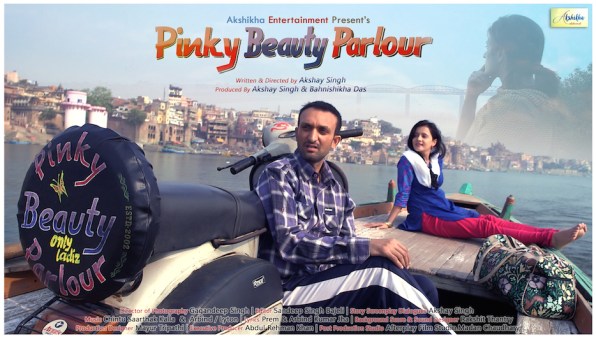
Pinky Beauty ParlourAs we are told in Pinky Beauty Parlour, ‘beauty is in the eye of the beholder’, but we all have very different ideas of what makes someone beautiful. In the UK (at least until a few years ago and we all were made more aware of skin cancers), people felt that being brown and tanned was more attractive, while pale complexions were thought to be unhealthy. So I always find it strange that the opposite applies in India, where skin bleaching agents are hugely popular and I’ve seen many women apply turmeric paste to make themselves look paler. Whatever the reason for this obsession with paler skin, the idea that fair = lovely seems to be deeply entrenched in India and that’s the subject Akshay Singh tackles in his first film as writer/director. The cost to society of this odd belief is the main focus of the film, although police brutality and the struggle for women to have their independence also get some coverage. That makes it sound like a very dark and disturbing film, but in fact, it’s just the opposite. Pinky Beauty Parlour is more of a murder-mystery/ comedy and has been successfully shown at numerous film festivals including Cannes, Mumbai and Ottawa and this week was shown as part of the Indian Film Festival of Melbourne.

Growing up in Benares, Bulbul (Khushboo Gupta) and her younger sister Pinky (Sulagna Panigrahi) have always looked very different, and people frequently comment that they don’t look like sisters. Bulbul takes after her father, and is more dark-complexioned while Pinky is fair, like her mother. Despite their differences the sisters have a good relationship, but it’s notable that when their parents die, Bulbul sends Pinky off to work in a beauty salon in Delhi.

Bulbul runs the Pinky Beauty Parlour where she has a number of staff including odd job man Khanna (Abhay Joshi) and driver Dulal (Akshay Singh). Things are generally going well until one of the beauticians tells Bulbul she can no longer carry out home visits when her possessive boyfriend insists that she stop. At the same time one of Bubul’s most annoying clients decides to sue the beauty parlour for failing to make her beautiful despite numerous facials and treatments. The court scenes are hilarious but also ensure that Bulbul is seen as a sensible and rational woman, completely different to her demanding clientele.

Pinky is called home from Delhi to take on the client home visits and help out in the salon, but shortly after her arrival a dead body is found on the premises. Police officers Jata Shankar Singh (Vishwanath Chatterjee) and Sami Akhtar (Jogi Malang) waste no time in declaring the death to be suspicious and soon everyone is under investigation for murder.

The film shows events leading up to the death in flashback as the police interrogate everyone involved. Chief among their suspects is Dulal, but the more the police look for answers, the more secrets and questions they find. As the investigation gets steadily more complicated it seems more and more unlikely that Jata and Sami will find out what really happened one night in the beauty parlour.

Pinky Beauty Parlour is a good mix of drama and black comedy in this murder mystery with a difference. The characters are all beautifully portrayed and are a good mix of different personalities, but all with typical ‘small-town’ features. Bulbul is a sensible business women, but is hampered by her darker skin which continually sees her treated as less than her sister. Pinky is beautiful, and knows it, but is upset by her sister’s treatment of her, not really understanding the resentment that lies behind her sister’s actions. Both Khushboo Gupta and Sulagna Panigrahi are excellent and make the most of their excellent dialogue to further develop their relationship during the flashback sequences. Akshay Singh is simply brilliant as Dulal whose timid appearance and quiet demeanour initially make him an unlikely candidate for the murderer while the revelations of his unexpected depths are funny but also rather poignant given the events that follow. Vishwanath Chatterjee and Jogi Malang add plenty of comedy as the bumbling police officers on the trail of the murderer, but while their methods of interrogation (including one memorable scene with a radish) are very funny, their casual acceptance that torture is the way to get answers is another issue highlighted by the film.

The music too is good and the songs fit well into the film without disrupting the narrative. Gagandeep Singh’s cinematography ensures that Benares looks amazingly beautiful in the shots taken across the Ganges, but that when seen closer up, the view isn’t quite as pleasant. It all adds up to a well-balanced film where every small piece seems to fit perfectly in its pre-ordained place.

The overall message of the film is that discriminating against those of have a darker complexion is not only a source of great harm but is also a behaviour that makes no sense. No-one is less attractive simply because they have a darker skin tone and the news stories shown at the end highlight the ultimate cost of such prejudice. However, despite the important message, the film isn’t judgemental or moralistic in any way, but is instead entertaining and funny which makes the harsh reality of the final frames even more shocking. Akshay Singh and co-producer Bahnishikha Das are to be commended on blending entertainment with their statement on one of society’s ills that rarely gets a mention in cinema. Pinky Beauty Parlour definitely deserves a full theatrical release which hopefully will happen soon. But until then, catch it if you can on the festival circuit for an engaging film that intelligently mixes drama and comedy while shining a light on a more serious society issue.

Nene Raju Nene Mantri


Radha Jogendra (Rana Daggubati) narrates his story to a film crew as he awaits execution. He was once a simple money lender with a shrewd mind and a moral compass provided by his wife Radha (Kajal). After a couple of years of marriage Radha finally fell pregnant and the happy couple were over the moon. Sadly Radha lost the baby and her ability to conceive again after being attacked for accidentally infringing on the imaginary rights of the village leader’s wife. Yes, I know. Jogendra decides if he was the village head nobody would insult Radha again. So he schemes his way into the role. Then he eyes off the MLA position. Then a ministry. Then the CM gig. He always justifies his ambition as his means of giving Radha the best in life, but he is playing the game for the sake of power too. Can he keep outwitting his opponents? Where will he draw the line? And what does Radha make of it all?

Teja’s “Nene Raju Nene Mantri” is set in the murky world of politics but has all the flair and improbability of a cowboy film. It is great fun if you can ignore the death toll, and I always like a decent comeuppance.

Jogendra (Rana) adores his wife, but everyone else is expendable or interchangeable. He is deceptively simple looking, but his mind is subtle and calculating. Rana dominates his scenes and not just because he is twice the size of anyone else in the film. He is fully at home as the morally dubious but highly effective Jogendra and delivers his one-liners and proverbs with great relish. The action scenes are often brutal but then he switches to a convincing warmth and playfulness in his scenes with Kajal. There’s more complexity to Jogendra than I was expecting, and a lot more of the mass hero hijinks than I expected too. I laughed a lot at Jogendra’s amazing aptitude for killing, and his ability to stay on task.

The wardrobe team came up with a good look for Rana. Well, once I got over my confusion at seeing him in a shirt. There’s lots of monochromatic linens, a slightly modernised traditional look, and a fairly subtle way to emphasise his physique without it looking like his clothes were painted on. What else…Oh yes, there is a hulk-out shirt ripping moment, just to prove the gym sessions haven’t ended.

Radha (Kajal) is on the surface too saintly. But I really liked her chemistry with Rana, and some of her less sweet moments saved Radha for me. I loved when she fired up and told Jogendra she’d forgive so many of his mistakes (like shagging Devika Rani) but not the thing he just said. Or when he chided her for acting childish and she said it was because they didn’t have a child, and they both looked stricken. I didn’t like that everyone except Jogendra saw Radha’s value relative to her having a baby. She had no purpose or context in the script other than “wife”, so I was impressed with Kajal for bringing a bit more to the table. She showed Radha’s growing discomfort with her husband’s actions and her inner conflict because she knew he did it all for her. The wardrobe team dressed her in beautiful sarees that increased in opulence but always suited Radha, and Kajal looked comfortable in her skin. However. Radha was the perfect wife who would sacrifice anything for husband but that final sacrifice was just DUMB. The method struck me as quite improbable. Having said that, I still felt intensely sad when the cortege visited surrounding villages.

Devika Rani (Catherine Tresa) is a badly dressed avatar of media whoredom. Her painfully high silver wedge sandals and the almost there skirts were hideous. I guess the wardrobe team can’t love all their cast members equally. While it is good that Devika Rani was shown to be a confident woman I was concerned that none of her social media strategies were sound. Never hire anyone who says their plan is to send everything viral. And her character made little sense. But it does speak to the thinking around campaigning and media manipulation, with clicktivism and slacktivism getting a passing nod even if I am not sure that is what Teja was aiming at. Her major achievement in the film might have been that she had zero chemistry with Rana. What was probably supposed to be a titillating scene was just awkward and cold, with Rana looking like he was resigned to an invasive medical procedure. Catherine has some convincing moments in solo scenes, but as soon as Rana or Kajal shows up her lack of acting skill is all too evident.

The villains are unfortunately quite familiar types from everyday life. The cop who takes bribes (Ajay), the gangster turned politician (Padeep Rawat), career politicians with no objective beyond lining their pockets (Tanikella Bharani, Ashutosh Rana, Posani Krishna Murali). All of these performances were solid, and there was some genuine menace and just nastiness in their interactions with Jogendra. Rana looked like he was having the time of his life threatening Ajay. Ashutosh Rana’s character didn’t know if he was coming or going sometimes, with a wry use of proverbs to explain how proverb-spouting Jogendra could beat him. I quite liked the one that went “if the cat is blind a mouse can hit it with a stick”. A convenient morality permeates the film. If Jogendra kills someone (or a hundred someones), don’t take it to heart. They were all bad so he was doing a good thing. Well, except for one. Navdeep wasn’t given much to do as Shiva but he managed to make an impression as one of the only people who held Jogendra morally accountable.

Anoop Ruben’s soundtrack tends towards the anthemic, which suits the purposeful journey Jogendra is on. They didn’t make Kajal and Rana dance which is also a blessing. There was a bit of convulsive twitching in one song but then lots of walking (him) and a bit of frolicking (her). Good decision dance team! I loved the special appearance by dance master Shiva Shankar. There is some dodgy VFX but realistic effects could have been overwhelming in the gory bits. And there is a sound effect for everything. There’s nothing new or outstanding in the direction but I feel the pace was pretty well managed until the finale which was a little drawn out. The dialogues contain proverbs and local sayings and I think the subtitlers did a good job of conveying some of the flavour.

It’s an engaging story with Rana and Kajal coming up with the goods and a decent support cast. I should be more concerned about the body count, the gender roles, the apathy surrounding politics, the problem solving preferences of a sociopathic charmer. But I was highly entertained and amused by the machinations and mayhem. Because he is Jogendra.

Mukti Bhawan (Hotel Salvation)

I’d be having a stern word with whoever came up with this blurb “Forget The Best Exotic Marigold Hotel; India’s new must-visit accommodation for the elderly is Hotel Salvation. Take a visit in this award-winning debut.

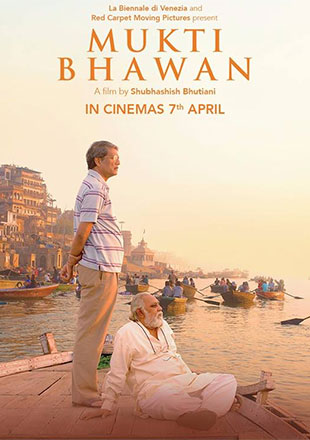
Shubhashish Bhutiani’s Mukti Bhawan (Hotel Salvation) is a beautifully made contemplative story of family, guilt, love, and finally death.

Dayanand (Lalit Behl) is from that blissful generation of men who don’t need to think about whether they are interrupting or are they being too demanding. Everything revolves around him. When he decides his time has come, there is no way to rationalise or compromise with him. Dayanand sulks and insists he will go to Varanasi alone because he is ready and therefore it is his time and that is where he will die. His son Rajiv (Adil Hussain) reluctantly commits to going with his father on what might be his last journey. They travel to Varanasi, and check in at the ramshackle Mukti Bhawan where people await their death by the holy Ganges. The efficient owner Mishraji (Anil K Rastogi) tells them he only allows a stay of 15 days and Dayanand is sure that will be enough. As it happens, Mishraji has a loophole whereby residents can change their names every 15 days. But he assures Rajiv the time is indeed close, although he can’t divulge any more details.

Lalit Behl is by turns childlike, childish, arrogant, demanding, apologetic and affectionate. Dayanand is not used to showing weakness in front of his family, but seems less uptight with his peers at the Hotel Salvation. Daya immediately immerses himself in the daily rituals and starts making friends with the other residents. He is there to actively prepare for his death and welcomes the process. He joins in writing obituaries and practicing yoga, and is addicted to a TV soap they watch every night. He finds community in the house. He is occasionally over the top but only when Daya is in a heightened state, and I thought every note rang true for the grumpy patriarch.

Vimlaji (Navnindra Behl) has genuinely prepared to go but can still enjoy every day she spends on earth. She says she will go when God calls, and has been waiting for 18 years. She is vivacious, the kind of lady you’d have tea and a natter with on a long train trip, but has a calm focus on her task of letting go. I liked her acceptance without finding her passively fatalistic. Vimla’s rapport with Daya is lovely, and I read somewhere the actors are married in real life which may be a factor in the warm familiarity and physical ease around each other.

Rajiv is awkward and appalled by what he sees as squalor and backward thinking, and wants his dad to either come home or go to a hospital. Rajiv is almost like a child again, hanging around on the fringes of adult conversation and not quite being able to participate. He wants to be there to do the right thing, but he doesn’t want to be there at all. He is intimidated by his father, and calls from his wife and demanding boss don’t help matters. Adil Hussain is lugubrious, tetchy, and a little fragile as Rajiv. He is in a rut at work and at home, and his father’s death plans are highly inconvenient. He doesn’t see the value in what Daya is doing, thinking of it as taking him away from work. But he starts to open up and shows that his frustration is driven by love and a maybe a bit of an inferiority complex. His scenes with Lalit Behl are emotionally complex yet very contained. There are few grand gestures or raised voices, and the acting is perfectly aligned.

Rajiv’s wife Lata (Geetanjali Kulkarni) struggles with a demanding old father-in-law and an absentee husband. Rajiv and Lata aren’t wishing for Dayanand to die but they do wish they could get some idea of how long this phase will last. When Dayanand performs the cow donation ritual, it is life and death to him, but to the family it is just an interruption. Lata wants life to be normal, unexceptional, and organised. She seems brusque but when people need her affection it is there. Her scenes with Rajiv run from shockingly direct conversation to wordless empathy and she is the bedrock of the family.

There is often a point in family crises where you’re damned if you do and damned if you don’t. Everyone has their idea on what is right and what everyone else should be doing. That tension is drawn out very well, mostly through the character of Sunita (Palomi Ghosh). She is a bright and warm girl, and has a cheeky rapport with her granddad. Daya is less strict and demanding of her and Rajiv quietly absorbs the difference in how his family interact with each other and with him. When Sunita comes to visit, Dayanand and Vimlaji sneak a bhang lassi with her because it’s Varanasi and of course they should. The three of them giggle through the day and each takes comfort in the camaraderie. When Daya hints that she might not be happy with her upcoming engagement Rajiv brushes it off. Later he confronts Dayanand about why he was made to do what was expected rather than follow his passion. Rajiv is more like his dad than he realises.

Tajdar Junaid’s soundtrack complements ambient sound of prayers and TV and kids playing. Bhutiani and his crew largely eschewed the more sensationalised Varanasi cremation clichés and instead dwell on the daily rituals, the bustle of the narrow back streets, the changing light, and the overwhelming feeling that life is a cycle. Mukti Bawan is somewhat similar in content (if not in tone) to Piku, with a dominant patriarch on a journey only he comprehends and a family who don’t quite realise they are being given precious time to say goodbye.