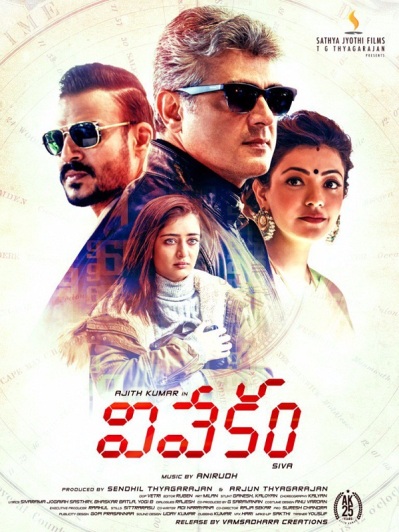
Vivegam

Vivegam

What is it with Siva and bad opening sequences? Vedalam started off with a dodgy assassination, and Siva tries to do something similar here with equally disastrous results. Vivegram sees Ajith’s character take out two generic bad guys in a forest somewhere in Serbia with plenty of improbable action sequences and pre-placed explosives. The dubbing is bad, the set-up too over the top to be believable and the final moments are absurd. Unlike Vedalam however, Vivegam (Prudence) doesn’t morph into a decent action film after the first act. Instead Siva continues with a series of fast-paced fight sequences, loud declarative speeches delivered through gritted teeth and incredibly loud music. Which isn’t to say that its bad, just that Vivegam is a completely mass film produced solely for Thala fans where logic and story take a very big second place to showcasing Ajith as an all-out action hero.

The plot here revolves around a secret government agency somewhere in Europe, where everyone apparently speaks Tamil. There may have been some disclaimer about this in the opening credits, but since these weren’t subtitled I can’t tell and to be honest, it’s not the most implausible part of the film. The Counter Terrorism Squad have a very flash looking control room with lots of cool holographics, but nothing that a competent 007 hasn’t achieved before with a laptop and pen drive. Bizarrely a number of agents sit around calling out incredibly obvious observations from street surveillance cameras and wireless earpieces while it seems that any basic blocking tactic shuts off their contact with the outside world. Technologically advanced they may be, but little thought seems to have gone into the HQ apart from making it look snazzy.

Ajith is Ajay Kumar (aka AK), an agent who is presumed by his bosses to be dead, but who remerges to upset the agency when he takes out the head of the Russian mafia and the chief of Europol in the action at the start of the film.

The agency thinks that AJ has gone rogue and brings in his old colleagues to help hunt him down. Chief of these is Aryan (Vivek Oberoi) who is better than expected in a role that requires him to constantly extol the praises of his nemesis as he tries to track him down. Also on AK’s old team are Sean (Aarav Chowdhary), Rachael (Amila Terzimehic) and Mike (Serge Crozon-Cazin), who join in the hunt for their old partner.

However, all is not as it seems, and a flashback sequence traces the group’s last mission where they were trying to neutralise a weapon that was used to trigger earthquakes. A top hacker Natasha (Akshara Haasan) holds the key and the team, along with almost everyone else in Eastern Europe, are attempting to find her to gain control of the weapons. The action here involves a gang fight in an apartment block, where the bad guys get flung out of windows and down stairwells, and a couple of sniper attacks where we learn how it is actually possible to shoot through bullet proof glass. But while each individual fight scene is good, they just keep coming with faceless villains that last less than a second before being shot, blown up or defenestrated depending on location.

There is also a total lack of logic – when AK is left for dead on the snow-covered mountains of Europe, it’s just plausible that he might manage to survive and keep training, but his acquisition of tons of explosives and automatic weapons is amazing given that he doesn’t appear to have any backing.  His ability to drive halfway across Europe in a few hours is just as miraculous, as his amazing talent in avoiding being shot despite being one man against literally thousands of bullets. But then, he is a suviva!

Kajal Aggarwal shows up as Yazhini, AK’s long-suffering wife who runs a restaurant and musical school somewhere in Europe. Again, the staff all speak excellent Tamil, to the extent of being able to sing Tamil songs, while Yazhini seems to have no problem with her husband vanishing for a few months on various missions. At least Siva gives his female cast something to do – Akshara Haasan is excellent as the hacker who ends up out of her depth and Yazhini is way more vengeful than expected, but there isn’t a lot of chemistry between her and Ajith which lets the romance side of the story down.

The problem I have with Vivegam is that it never comes together as a complete story. Everything is peripheral to ensuring Ajith is front and centre all the time. All the action revolves around him, the speeches are all either Ajith declaring ‘never give up’ or his opponents discussing how amazingly wonderful he is. Everything comes so fast that it’s hard to keep track of which particular group Ajith is fighting next and the loud soundtrack and frenetic pace end up leaving the audience behind.

It’s a shame as there is a lot that is good here too. Ajith is excellent and carries the weight of the film well. Vivek Oberoi gets to do plenty of strutting around and pontificating in a grand manner (which suits him well!) and both Kajal Aggarwal and Akshara Haasan are good in their respective roles. The music from Anirudh is excellent and there is a good mix of heavy and light tones, or there would have been if the volume had been just a tad lower! The fight sequences are all beautifully sequenced too, with slow-mo bullets and some clever ideas, but there is just so much of everything that the screenplay gets a bit lost in all the sound and fury.

Vivegam is what happens when Siva tries to make a Hollywood style action film, keeping a mass approach and sacrificing screenplay for effects. Sure, it’s great to see Thala dodge bullets and smash villains into the ground but a little more light and shade to his character would have made for a more approachable story. One for fans.

What Would Chiru Do?

Sometimes when things becomes challenging and I am running low on inspiration, I turn to Chiranjeevi for Mega Life Advice. For example:


When mornings get off to a bad start. What would Chiru do?

He’d kick its arse!

When people keep drawing arbitrary lines in the sand that serve no purpose other than to be annoying. What would Chiru do?

He’d kick their arse!

When people are being offensive and discriminatory, have terrible hair styles, and are preventing the big dance finale. What would Chiru do?

He’d kick their arse!

When someone mistakenly attacks after a misunderstanding due to poor communication. What would Chiru do?

He’d engage them in robust debate, kick their arse just a bit, then extend the hand of friendship so we can all move forward without rancour.

And if anyone is unwise enough to instigate a danceoff, what would Chiru do?

Kick all their arses!

Happy birthday Chiranjeevi! May you have many more kick-arse years to come!

Railway Children (2016)

Montage

Railway Children is a docudrama from writer/director Prithvi Konanur that is partly inspired from the book Rescuing Railway Children by Lalita Iyer and Malcolm Harper. The subject matter isn’t pretty – the film looks at the fate of young runaways in India who end up living on or near the railway station, but the story is told using a documentary style and the kids are simply awesome, making Railway Children an excellent film with a message of hope at the end. Railway Children was shown in Melbourne as part of the Indian Film Festival and has been shown at various other festivals including Mumbai International Film Festival and Zlin Film Festival in the Czech Republic.

The film starts with Raju (Pari) hiding from ticket inspectors on a train as he makes his way to Bangalore without a ticket. Arriving at the railway station, he’s immediately singled out by various people who prey on the new arrivals. First is ‘the Mongoose’ who works for an NGO that tries to reunite the children with their parents. However Raju suspects her motives and when she goes to buy him food is then picked up by Solution (Yash Shetty) who runs a gang of children based at the station. The children sleep in concrete pipes and spend their days collecting discarded water bottles which are then refilled and sold by more of Solution’s gang. The older and more trusted children such as Pappu (Syed Pervez) sell water, while Jollu (Manohara) is instructed to show Raju where to find water bottles and anything else that Solution can use.

Like most of the children, Jollu is addicted to glue-sniffing and he forces Raju to inhale the fumes too. The kids call the glue ‘solution’ and (presumably this is where Solution got his nickname), they buy it at the end of the day after Solution has paid them their wages for their work. Initially Solution seems to be a petty criminal who looks after the children by feeding them and giving them shelter, but selling them glue is just one of the ways he keeps the children under control. Solution is also a paedophile, and he drags the children off individually to abuse them whenever he feels they need disciplining. He also threatens to sell them to the beedi makers, where they will be kept in a factory all day and die from the chemicals, a threat that along with refusing to give them ‘solution’ keeps everyone in line.

Raju is smarter than the average kid though, and he has managed to run away with some money which he hides as soon as possible. He also regularly calls home to his girlfriend Usha, asking her to run away to Bangalore as he feels the freedom there is worth the rough living. Despite the harshness of the life, it seems to be better than Raju’s experiences at home and he starts to make the most of what he has. Although Jollu initially shows Raju the ropes, Raju quickly realises that they won’t make any money by selling bottles to Solution, and with the aid of Karthik (Karthik) and Jollu he sets up a scheme to sell water himself. However, his success is short-lived when Pappu finds out what he is doing, and Raju and Jollu eventually end up in the care of the Mongoose (Divya) in the NGO shelter.

According to the website, most of the characters are played by non-actors and Pari is actually a rescue child being looked after by an NGO. Given this background, Pari’s performance is outstanding, particularly in the way emotions such as helplessness and hope are portrayed. Manohara too is excellent as Jollu, and his scenes where he enacts the violence and despair of an addict being deprived of his fix are very well done. Yash Shetty is also good in an interesting role that explores the contradictions of the railway gangs. There is the predatory nature of using the children to make money, but Solution is telling the truth when he explains to Raju that the NGO will simply give him back to his parents, and his descriptions of the government homes seem chillingly true. Solution does provide the kids with an alternative and although much of what he does is self-serving, he does give them food, water and shelter and protect them from the other predators around the station. There is another thread to the story which adds an unusual twist at the end. I don’t want to reveal too much, but one of the highlights of the film for me was Divya’s reaction when she learns the truth about Raju – this was unexpected as I really thought she would be intolerant of the situation given her usually dour demeanour, but her compassion and understanding did bring a tear to my eye!


Life for these children is difficult and dangerous. As well as the predators like Solution, there is violence from other gangs, drug addiction, the ever-present danger of the trains and the risk of being caught by the police or social workers. The stories they tell of their home lives explain why many prefer to live rough rather than return home, and there is some happiness in the shared camaraderie of the gang. The documentary style of the film keeps it simple and works well to distance the film from the emotional impact of many of the scenes, although they still make a considerable and lasting impression. Railway Children is a fascinating look at an underside of Indian society and despite the bleakness of the children’s lives it does end with hope that there can be a different outcome.