Tumhari Sulu

Suresh Triveni’s film is a lovely, warm, very funny, domestic story about an ordinary middle class housewife who has dreams that take her on an unconventional path. It’s generally a kind and well considered film although it goes off the rails a little towards the end.

Sulochana or Sulu (Vidya Balan) was never academic but she is energetic and curious. She is mocked by her stitched up sisters and father for her trail of hobbies and her relentless participation in school sports events like the lemon and spoon race. Her husband Ashok (Manav Kaul) is the lone voice of sanity at his eccentric workplace but he is soon displaced by a grasping grandson. He has a playful side which he sometimes uses at Sulu’s expense. But they have great rapport and laugh at the same dumb jokes, sing the same old songs. Even if they argue before sleeping they’ll wake up in each other’s arms.

Sulu wins a radio competition and goes to the station to collect. Her morning journey is intercut with a song including guys doing parkour. Her seamless navigation of obstacles is different but equally unique. She sees another competition but this time the winner will be an RJ. Nobody is very interested in helping her but she is politely insistent. The station staff seem equally appalled and enchanted by her unselfconscious repartee and lack of embarrassment at what they see as kitsch or suburban. They decide to let her audition, assisted by people’s poet Pankaj Rai Baaghi (Vijay Maurya). Sulu finds the cheesy lines and the breathy sexy delivery a bit too hilarious and she and RJ Albeli Anjali (RJ Malishka) lose it several times. But station boss Maria sees potential in Sulu. She goes home, full of spark and with a free pressure cooker to give her sister.

As luck has it, Maria decides to give Sulu the job as payback for Pankaj storming out in a hissy fit. Sulu gets the late night agony aunt/love song dedications gig after demonstrating how she would (sexily) berate her husband for his self-pity. Sulu does things her way – proudly wearing her sarees and speaking the way she feels comfortable. Pankaj tries to coach her but he is all cheesy insincerity while Sulu comes from the heart with genuine empathy, a wink, and a laugh.

It seems the greatest tragedy that can befall a man is having his wife get a better job than he has. Ashok is a little snakey about her new job but he wants to support Sulu. His job may be in doubt but his love for Sulu seems solid. But her family mock her, assuming it’s one of her wild ideas again, and Ashok isn’t sure she will make it or stick with it. While Ashok and Pranav get used to getting themselves up and out the door, Sulu’s sisters are adamant that she is on the slippery slope to who knows and she must give up her job. When they say that she’d come running to them if anything goes wrong she agrees saying they’re family after all.

I really loved the way Sulu articulated her feelings, and Vidya’s characterisation is lovely. I laughed with her, and sometimes at her which made me feel a little guilty about being a judgemental snob. The writing is so good and I would catch my own judgement being reflected back by other characters, raising questions about my reaction. And it’s funny, not preachy. Sulu has second thoughts, but Maria says never look down while you are climbing up. She seems to be where she is meant to be and pretty soon everyone is dancing madly to Hawa Hawaii.

The changing dynamic between Sulu and Ashok plays out through domestic responsibility and commitments. He is under pressure at work and transfers that pressure on to Sulu but she is more determined and happier in her work. When she tells him it is OK to quit – as he wants to – and once she gets a pay increase they can set up their own business 50/50 – as he had offered her before – he cracks the sads. He is trying but not coping with the change in breadwinner status. And Sulu is so happy despite knowing that she is not able to be as hands on a mum and housewife as she had been before. Ayushmann Khurrana makes a fun special appearance as himself, highlighting how her world has expanded beyond her own household. Manav Kaul and Vidya Balan are utterly delightful. Their conversations, whether flirty of fiery have a ring of truth and it’s easy to believe they’re an established couple. I had some frustrations with Ashok’s inability to support Sulu when her family went on the attack, but he is an introvert and the pacifist in the marriage so it wasn’t unexpected.

Unfortunately for reasons I cannot fathom, Triveni comes unstuck towards the end of the movie. It’s a pity because the songs, which could have been an unwelcome interruption, are used to perfection. The music is just okay but the lyrics and visuals amplify and extend the drama. He manufactures an incident involving Pranav that tips everyone into overacting crisis mode. As a result Sulu realises she can’t have it all if she has to do it all and be responsible for it all, all by herself. And that is all fair and reasonable and many women come to the same realisation. But in place of the beautifully organic story and character development, things end with another wave of the Happily Ever After wand.

I loved the story, except for the wobble at the end. This is a film that takes you right into the characters world, and the performances bring it to life. 4 stars!
Majili

Majili

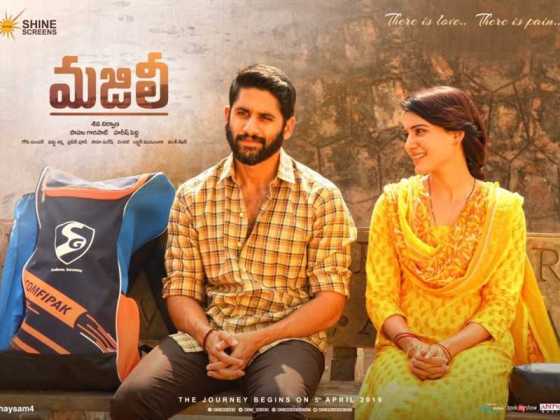
Shiva Nirvana’s Majili is a romance that feels oddly dated where the characters make some very strange choices, and the plot harks back to attitudes that might have seemed plausible 30 years ago. Naga Chaitanya plays a cricket player whose life is destroyed when he loses the girl of his dreams, while Samantha is the woman waiting patiently for him to notice her. The film is helped considerably by good performances from the main leads, but it’s the support cast of Posani Krishna Murali, Suhas and Rao Ramesh, who end up making the film more interesting than the story would suggest.

The film begins with Poorna (Naga Chaitanya) as a miserably grumpy cricket umpire who spends his night getting drunk in a specific hotel room. The story behind his descent into the bottle is told in flashback when he was a younger wannabe cricket player, and his father had just given him a year to work at making it into a career. Shortly after landing a place on the Vizag Railways team, Poorna meets Anshu (Divyansha Kaushik), the daughter of a navy officer based in the town and the two start a relationship. It’s a patchy affair right from the start as there is little chemistry between the couple and their social divide makes their meetings awkward and clumsy. That might have worked, except there doesn’t seem to be any reason for Anshu to prefer Poorna over anyone in her own social circle, and after he puts her into a situation where she is almost raped, Anshu’s continued desire to be with Poorna seems even less likely. Although Chaitanya tries his best, this is just another typical love story, with the usual parental opposition and a bad guy in the form of Bhushan (Subbaraju). Divyansha Kaushik is bland and unobjectionable, but the romance is all just too unlikely to make any impression, and the finale that ends with Poorna in a hotel room seems completely implausible and a whimpering end to a supposedly grandiose love affair.

Poorna’s subsequent descent into alcoholism and heartache-induced torpor is also overly extreme for such a lacklustre romance. He wallows in his misery and seems unable to find anything worthwhile to do with his time other than mourn the loss of his ‘one true love’. However, at some point in the intervening years he somehow manages to get married to Sravani (Samantha Akkineni) who puts up with his idleness, drunkenness and morose personality with completely unlikely composure. The story tries to make us believe that she always loved Poorna and is happy simply to be his wife, despite the cold shoulder treatment she receives and his total lack of support – either emotional or financial. In fact, it’s Sravani who supports the family with her job as a railway clerk since Poorna’s father (Rao Ramesh) has retired and Poorna is too busy being miserable.

Thankfully, despite her irritatingly subservient attitude, Samantha breathes life and energy into the film. Her interactions with her father (Posani Kirshna Murali) and Porna’s father (Rao Ramesh) are the perfect mixture of funny and sad, and here at last is the spark that was so sadly missing in the first half. Although Sravani’s attitude to her husband quickly becomes wearing, Samantha somehow manages to keep her character from being completely irritating and despite wanting to shake some sense into her, I felt that her rationale was at least constant and made sense from her character’s point of view. Poorna on the other hand was just a waste of space who didn’t take any of the many opportunities he had to turn his life around. The final piece in the puzzle that leads to Poorna’s redemption is lazy and poorly done, although again it’s Sravani who has the best of the generally weak dialogue and ends up as the only one who acts according to her established persona.

Posani Krishna Murali is brilliant as Sravani’s father and his comedy keeps the film from being totally subsumed in weepy tragedy. Rao Ramesh is also unfailingly sensible and brings some much-needed common sense, as does Suhas who shines in a small role as one of Poorna’s long-suffering friends. Subbaraju is totally wasted in the role of a small-town thug with a political agenda who has no significant part to play other than to be the ‘bad guy’ for Poorna to fight at regular intervals. This would have been a much better film without the usual Telugu commercial elements – removing the dull romance, repetitive fight scenes and glamourous song sequences and adding more of Sravani, her family and her story would have made for a more interesting film. Some explanation for Sravani’s ridiculously self-sacrificing attitude would have helped too other than the wishy-washy enduring love that is used.

Overall, Majili is disappointing. The story isn’t plausible and never comes together to form a coherent whole. The bittiness of the plot transfers to the characters, who also don’t always act in keeping with their role. There simply isn’t enough of the good parts – Samantha, Posani Krishna Murali – but instead far too much insipid romance. Gopi Sundar’s songs though are generally good and Vishnu Sharma’s cinematography captures the claustrophobic feel of the family well in the latter half of the film. I wanted to like this, I like Chaitanya and Samantha and perhaps as their first film together I expected a little too much. Worth watching for Samantha, the support cast and Chaitanya in the second half.

Super Deluxe

Super Deluxe

Thiagarajan Kumararaja’s Super Deluxe is a significant step up from his previous film Aaranya Kaandam, aided by a sumptuous colour palette from P.S. Vinod and Nirav Shah, and the presence of a number of top actors from the South. Included are the likes of Vijay Sethupathi, Samantha, Fahadh Faasil, Ramya Krishnan and Mysskin but the newcomers are just as good and hold their own against the established stars. It’s an interesting story too, although after a good start the middle section does wander and become rather self-indulgent before ending with a stronger finale. It’s still a compelling watch, not just to discover what happens in the various threads, but also to spot influences, note the repeated motif’s and ultimately try to figure out just what Thiagarajan Kumararaja is trying to say. Super Deluxe isn’t for the faint-hearted – the language is strong and there are a number of confronting themes, but the juxtaposition of topical issues and out-and-out fantasy is intriguing even with a close to 3 hour run time.

The film consists of a number of different threads which don’t interconnect as such, but instead superficially intersect and occasionally influence each other. The first involves a cheating wife Vaembu (Samantha) and what happens when her husband Mugilan (Fahadh Faasil) discovers her infidelity when her lover has the bad taste to die during their lovemaking session. Next there are a group of schoolboys who arrange an elaborate plan to bunk school and watch porn movies. Their problems start when one of the four recognises his mother Leela (Ramya Krishnan) in the movie and the ripples from his subsequent actions have far-ranging consequences. Part of this sparks an existential crisis for Leela’s husband Dhanasekaran (Mysskin) who has become a faith healer after surviving the tsunami by holding on to a statue of Jesus. The other boys end up in trouble when they try to raise the funds to buy a new TV and end up in a truly out of this world experience. And then there is the story of Shilpa (Vijay Sethupathi), a transgender woman trying to reunite with the wife and young son she left behind many years before. It’s a fascinating blend of narratives and some of the stories work better than others. Or perhaps it’s more that some parts of each story are simply brilliant (and brilliantly simple), but then at times Thiagarajan Kumararaja and his co-writers seem to get carried away and try just that little too hard to be edgy and confrontational.

As well as a lot of swearing, there is a lot of sex in this film. Vaembu is first seen in bed with her lover, the teenage boys are obsessed with sex (although that’s not surprising) and there’s a creepy cop (Bagavathi Perumal) whose rapacious tendencies provide an important plot point in two of the stories. One of these is nasty but effective, while the other is too drawn out and staged to be convincing. In those parts where the film is subtle and suggests rather than shows, it is more chillingly real and packs more of a punch compared to the more filmi scenes with Vaembu, Mugilan and SI Berlin. Perhaps it’s a consequence of too many writers (Mysskin, Nalan Kumarasamy, Neelan K. Sekar and Thiagarajan Kumararaja are all credited with the screenplay), but Vaembu and Mugilan’s story is the least successful for me, despite fine performances from the two actors. Their relationship just doesn’t ring true and the characters are an odd mix of modern and traditional that doesn’t seem plausible. However, I appreciate that the fallen woman gets a shot at redemption and isn’t permanently tainted by her infidelity. Something which is also the case with Leela who is proud of her film achievements and sees no reason to disavow her presence in a porn movie. It is refreshingly different even if at times there is a feeling that some of the dialogue has been written by grubby little boys sitting and sniggering at the mere mention of sex. That may be more to do with the subtitles though as I have read a number of comments that some concepts weren’t translated accurately, particularly in respect to Ramya Krishnan’s character.

The most successful thread is that of Shilpa, and despite all the issues around a cis male actor playing a trans woman, Vijay Sethupathi is much more here than just a man in a wig. The issues here feel true to life, shocking as they are, as Shilpa tries to navigate a brief visit to her son’s school and faces prejudice and abuse at almost every turn. Ashwanth Ashokkumar is outstanding as her son Rasukutty and although Gayathrie has very little screen-time as the abandoned wife, she makes a strong impact as her facial expressions say so much more than any dialogue could possibly manage. Vijay transforms himself yet again and adds many layers and nuances to his character, alternating between comedy and tragedy but still providing a sense of the underlying weakness that drove Shilpa to abandon her family.

The first half has a lot of well-written comedy but immediately after the interval the film shifts into more serious territory. The pace is also more uneven in the second half, and the labyrinthine feeling of diving down a rabbit hole, so well done in the first half, falters as the frenetic pace slows. There is still a lot going on though, and with the richness of the visuals the film at times becomes almost overwhelming. There are close-ups of ants running up and down a door frame for example – the implication initially seems fairly straight forward, but is it really? There are so many questions and possible explanations for even the simplest shot and it seems that every single part of the set could have a secondary meaning. This is a film that I think does need multiple viewings, and I’m sure that I will see more detail each time.

There are plenty of film references here too – to both Indian and Western films and probably a lot more cultural references that completely passed me by. Despite the variability in the second half this is definitely a film that I’d recommend for the sumptuous visuals, excellent performances and intricate story. Thiagarajan Kumararaja has built a complex world that tries to encompass the natural, unnatural and everything in between. The best part about Super Deluxe is that he so very nearly succeeds.