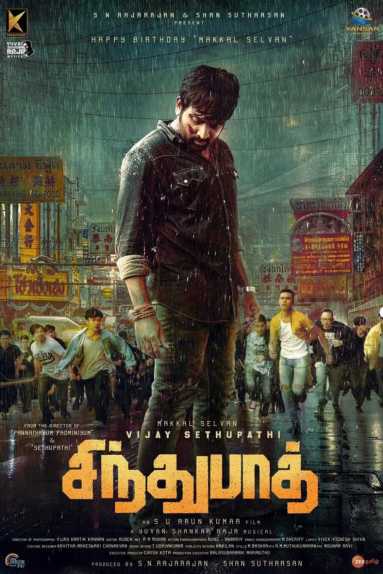
Sindhubaadh


Sindhubaadh

S.U. Arun Kumar previously teamed up with Vijay Sethupathi for the excellent Pannaiyarum Padminiyum and police-drama Sethupathi, both of which had well developed and slightly off-beat stories with an interesting array of characters. It’s disappointing then, that in Sindhubaadh, he’s come up with a disjointed story and characters who don’t seem to know exactly who they are supposed to be. Thankfully, Vijay Sethupathi is excellent and his presence, along with a strong performance from his son Surya Vijay Sethupathi is enough to keep the first half of the film engaging, but things go rather more pear-shaped in the second half.

Vijay Sethupathi is Thiru, a petty street thief who is hearing impaired. He lives with his adopted son Super (Surya Vijay Sethupathi), although the actual story behind their relationship is shrouded in various tales they spin Thiru’s uncle (George Maryan). Thiru’s lack of hearing allows him to sidestep his uncle’s attempts to sell their house to grab some fast cash and their tussles provide some of the comedy in the first half. Thiru is a pretty laid-back guy who doesn’t seem to have too many problems with his deafness and seems happy to continue on his slightly crooked path through life. Super is a perfect side-kick and his high spirits offset Thiru’s more relaxed approach to life.

Meanwhile Venba (Anjali) has returned from Malaysia where she’s been working in a rubber plantation to pay off family debt. Her family are trying to arrange her marriage but Venba’s loud strident voice puts off potential suitors. For the hearing impaired Thiru though, she’s the one person he can hear easily and he instantly falls in love with her voice. But Venba isn’t interested in marrying a thief, leading Thiru to try and change her mind by the tried and trusted method of stalking and harassment. And, as only ever happens in the world of movies, this tactic works – and now it’s Venba’s family who aren’t impressed with the prospect of a thief for a son-in-law. By this stage though Venba is quite prepared to sacrifice her family for a man she despised only a song or so ago, and she returns to Malaysia just to finish up her job there, promising to be back in a couple of days.

Unfortunately for Venba, the corrupt owners of the rubber plantation where she was employed are involved with a much larger criminal gang. When she arrives back in the country she’s sold to a consortium who are involved in the skin trade, with a more literal meaning than usual. Venba manages to get word to Thiru who sets off for foreign shores using the name Sindhubaadh in his fake passport with Super in tow. But this is where the story starts to break down. There are way too many coincidences that are used to patch over the gaping plot holes as Thiru crosses Thailand and into Cambodia in the search for Venba. Along the way, Thiru just happens to meet people who can both speak Tamil and point him in the right direction, including Vivek Prasanna who is trying to buy back his daughter from the same gang. There’s also a Tamil speaking police-man and the chief villain, Ling (Linga) coincidentally is a Tamilian adopted into the Thai gang.

Ling is a typical caricature of a bad guy who has a big build up as a vicious and remorseless killer, but ultimately ends up fairly ineffectual, resorting to screaming threats and petulant displays of bad temper. The mullet really doesn’t help either. Also strange is Thiru’s sudden emergence as a mass-style hero who can easily vanquish the thugs who stand between him and Venba. He’s a one-man army as he develops sophisticated traps, kills his opponents with a quick twist of the neck and survives everything that is thrown at him. At one point, Super throws a stone at a 4WD which flies through the window, hits the driver and causes the entire car to flip over. And that’s not even the most ridiculous part of that entire scene. It’s just all too much of a change from the easy-going persona of the first half and the continual coincidences just make the story even more ridiculous.

There are some good points though. Despite the clichéd romantic plotline, Anjali and Vijay have excellent chemistry together, and Anjali is good as the capable but loud Venba. It’s unfortunate that she has less to do in the second half, but she excels at looking terrified and at least she does get a chance to fight back. The best relationship though is that of Thiru and Super, and there is a wonderfully joyful camaraderie that shines out of everything they do together. Their father/son dynamic translates well into the story and Surya is developing into a fine actor. His comedic timing in particular is fantastic here, and his cheeky grin perfectly suits his character. In reality it’s this dynamic and the scenes between father and son that keeps the film from total disintegration in the second half.

Another plus point is a brief but well written scene with a prostitute who was one of the women seen working with Venba earlier in the film. She has information for Thiru and unexpectedly S.U. Arun Kumar treats their interaction sensitively with reactions from Thiru that are much more in keeping with his earlier persona. Sadly, it doesn’t last, and we’re quickly back to the mayhem and slaughter, but it does show that there are some good ideas here despite the lack of overall cohesion.

I really wanted to like this film. There is the makings of a decent story hidden under all the unnecessary travels across SE Asia, poorly utilised hearing impairment and extravagant Thai gangster plot. Vijay, Surya and Anjali are all excellent and make their characters engaging despite the inconsistencies in behaviour. It’s also encouraging to see a film about people trafficking that isn’t voyeuristic but gets across the horror of being treated like a commodity and the fear that prevents escape, even if that’s mostly subsumed under the action adventure. Technically too, the film has been well put together and the subtitles by Aarthi are clearly visible and grammatically correct.  What lets the film down is the screenplay which just doesn’t come together once the story leaves India and all the extra threads to the story that mainly just add confusion. Sindhubaadh ends up as a formulaic mass action film that isn’t terrible but doesn’t have any of the magic expected from the pairing of Arun Kumar and Vijay Sethupathi. Worth watching once for the father and son relationship that genuinely lights up the screen.
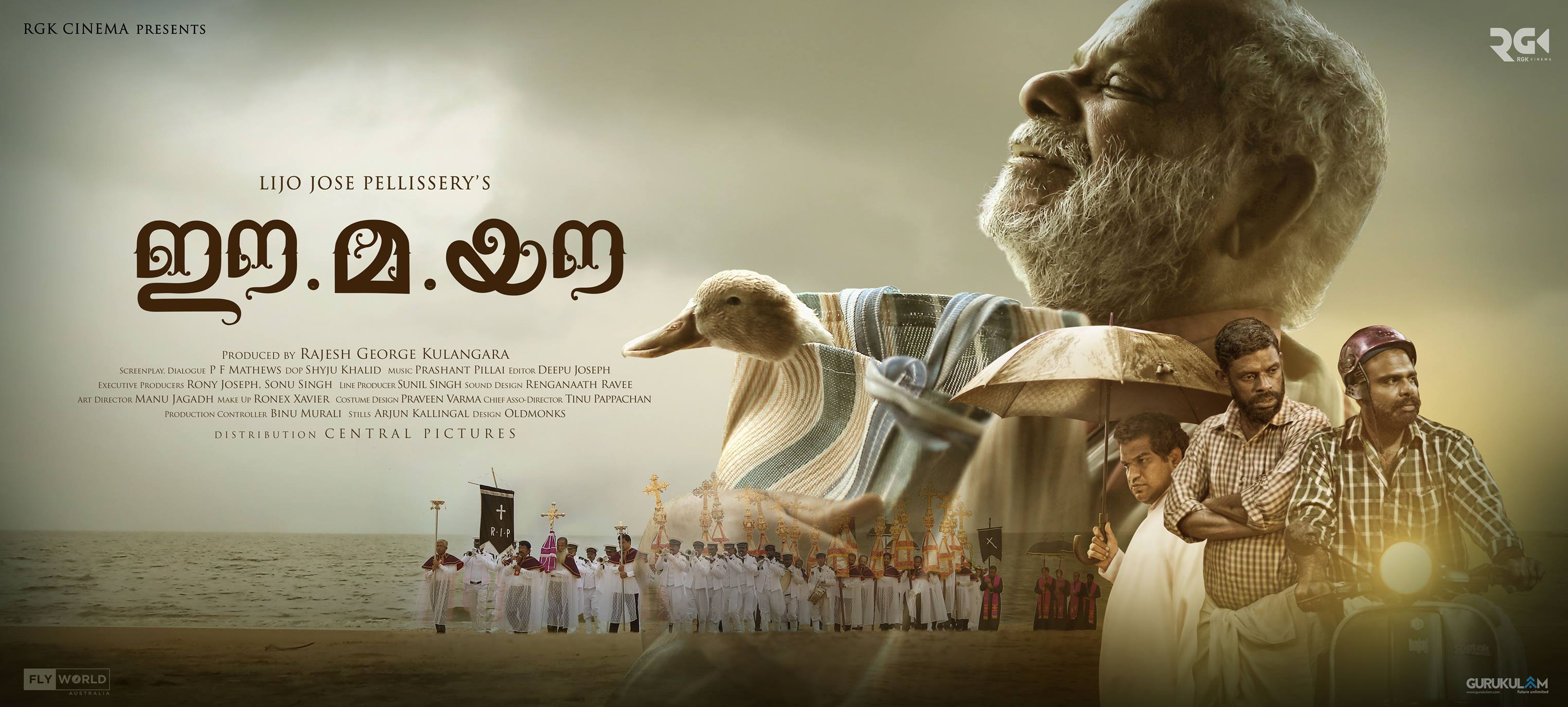
 

Ee. Ma. Yau.

Lijo Jose Pellissery’s award winning film from last year is a fascinating story of a death and funeral in a small community in Kerala. Although the story sounds sombre there are plenty of comedy moments along with piercingly accurate observations of human behaviour as the family gathers to mourn and bury Vavachan (Kainakary Thankaraj). Chemban Vinod Jose is fantastic as Eeshi, Vavachan’s son, but it’s the minor characters including Eeshi’s mother and his seemingly unflappable friends and neighbours that make Ee. Ma. Yau. such an exceptional film.

My subtitles translate the title to R.I.P., but google suggests that it’s a reference to Eesho, Mariyam, Yauseppe (Jesus, Mary and Joseph), a funeral prayer in Kerala. The opening credits feature a funeral procession that slowly wends its way across the screen with a backdrop of the ocean on a sunny day. This kind of celebration with a band and an array of church officials is what Vavachan tells his son he wants for his funeral as he reminisces about his own father’s demise while drinking a few glasses of arrack. It seems to be a normal conversation, and potentially one which Eeshi has heard before as he agrees to providing his father with a magnificent and impressive funeral without ever considering that he may need to deliver sooner rather than later. 

The film begins earlier as Vavachan arrives back in the village with a duck, several bottles of booze and a bundle of money that’s basically worthless after demonetisation. He looks serene and at peace on the bus with his duck, but on arrival back at the village first he fights with another villager Chavaro (Kunjunju) and then at home argues with his wife Pennamma (Pauly Valsan) who is unimpressed by Vavachan’s long absence. Along with her daughter Nissa (Krishna P.) and daughter-in-law Sabeth (Arya Salim) Pennamma conspires to add ‘medicine’ to her husband’s stash of alcohol and the duck curry, to make him stay at home. But as Vavachan sings, dances and drinks, he suddenly falls, hits his head and is gone before anyone can react to the sudden crash.

Eeshi has no money, so the sudden burden of his father’s fabulous funeral is a huge problem, which he resolves in time-honoured fashion by selling his wife’s jewellery. His father’s last words resonate in his ears as he arranges for a coffin far beyond what he can actually afford, although it also comes with a free suit and even a beautician thrown in for good measure. Although his friend and neighbour Ayyappan (Vinayakan) tries to rein in Eeshi’s attempts to create his father’s perfect funeral, it’s ultimately lack of funds, a suspicious priest and the inclement weather that combine to give a completely different ceremony than Vavachan had described.

There are so many wonderful characters here, each with their own quirks that together paint a colourful picture of life in the village. Pennamma seems to be a typical housewife as she discusses her husband’s failings while cooking his dinner, but once Vavachan dies she transforms instantly into the chief mourner, wailing incessantly over his body with her cries getting louder and more strident whenever anyone arrives at the house. She has an uncanny ability to know when someone is near and start crying just in time! Every visitor is then subjected to her pointed comments and snide remarks, all made under the guise of talking to her husband’s corpse that ensures Pennamma can pay out every insult (real or imagined) she has endured over the years. Pauly Valsan is excellent here and her Pennamma is a compellingly accurate portrayal of a widow making the most of her brief time in the spotlight. P.F. Mathews screenplay is keenly observational and he captures equally realistic reactions from the other members of the family and various other villagers who come to mourn Vavachan’s passing, or just call in to see what is going on. As Eeshi is out trying to organise the funeral, Sabeth is mostly worried about the appearance she will present to visitors now that her husband has pawned her jewellery. Nissa on the other hand is trying to fend off her rather too amorous boyfriend who wants to take advantage of the upset and keeps trying to get Nissa alone.

More and more issues arise as Eeshi tries to organise the funeral. First of all the doctor isn’t available to come and certify the death, and then the nurse is made suspicious by the strong smell of alcohol and the injury to Vavachan’s head. Chavaro causes problems by suggesting that Vavachan’s death was not natural, and Father Zazcharia Parappurath (Dileesh Pothan) takes his concerns seriously. The priest is a wannabe detective and immediately starts to ask questions and investigate the circumstances of Vavachan’s death while berating the local police officer for his inaction. At the same time, a journalist repeatedly calls Eeshi to get details of the funeral, which Eeshi cannot give as the priest has not confirmed the time. Adding the final straw, Vavachan’s prolonged absences are explained at the most inopportune moment, just before the torrential rain hits.

What I really enjoyed about this film are these minor characters and small vignettes as each plays their role in the funeral. The priest’s investigations, Chowro’s troublemaking, the one neighbour who stays with the body and seems unperturbed no matter what happens, the police officer reluctant to venture out and become involved, even the government worker called out to mend the power line are all realistically drawn and relatable to real life. The situation may eventually end up fairly extreme, but on the way there, Lijo Jose Pellissery touches on many typical reactions and conversations that occur in most funeral’s, whether in India or anywhere around the world.

What also stands out is the sense of community that comes through strongly as Eeshi’s neighbours all pull together  – whether it’s trying to find the doctor to certify the death, getting Vavachan ready for his funeral or putting a tarpaulin up to shield the body from the rain, everyone pitches in to help. But while most of the activity revolves around Vavachan’s death and funeral with all the associated comedy, there are touching and poignant scenes involving a grave digger, who has an epiphany of sorts on the beach along with a scruffy stray dog. Here is the compassion and spirituality that is missing from Vavachan’s funeral, and even more markedly, missing from Father Parappurath’s attitude towards the dead. Although the film is about a funeral, for the most part it’s not sad, excepting when the gravedigger himself dies and is buried in the grave he was digging just hours before.

I love the realism in this film that’s cleverly enhanced by the touch of fantasy that brings disparate elements together to create an engaging whole. The attention to detail is perfect while Shyju Khalid’s camerawork captures the miserable weather, grieving family and curious villagers beautifully. The comedy is well written and funny without ever becoming patronising and the variation of light and shade in both the story and characters seems perfectly balanced. Ee Ma Yau is at heart a simple story, but there is so much more going on here and despite being set in a small fishing village the  characterisations and symbolism could apply to almost anywhere. Add in the wonderful sounds of nature, sharp observations and excellent script, and Ee Ma Yau really is a wonderfully engaging film. 5 stars.


Hichki

Siddharth P Malhotra directed and co-wrote this adaptation of an autobiography by Brad Cohen. While there are absolutely no surprises in this classic underdog story, the film made some changes to the book including making the lead a woman.

Rani Mukherjee delivers a rock solid performance as Naina Mathur, a part time animator who wants to be a teacher. She also has Tourette’s Syndrome. I have reservations about casting non-disabled actors in roles where the character has a disability, and I am all for real representation. But in the Hindi film industry where being visibly different (old, fat, dark, pale, disabled etc) is often the trigger for some very unfunny shenanigans, this film does a pretty good job of portraying Naina as a woman with a neurological condition and a rich and satisfying life, not as a sideshow. I read the director and Rani did quite a bit of work on getting her portrayal of the symptoms right. So is this at least some kind of progress? I tend to think so in this context but of course it is far from the end goal of inclusion and real diversity. It seems so long since Marlee Matlin won her Oscar and yet. Here we are.

Naina wants to be a teacher because she once had a teacher who inspired her, made school a place of acceptance, and helped her accept herself. She wants to be that teacher for other kids and to show that she was herself worthy. St Notker’s needs a teacher for their terrible 9F class, the slum kids nobody wants at the fancy private school. They are desperate and Naina is determined.

Naina lives at home with her brother and mother, in a happy middle class household. Her father left the family, partly because of his own issues at having a disabled child. I love her mum and brother. They seem so affectionate and relaxed. They get her, even though they know she is doing it tough and they can’t fully understand her, they make sure they are there for her.

Naina meets each stupid comment or startled reaction head on and with practiced charm. She has both vocal and motor tics, and Rani modulates the timing and severity to show the effect of stress or high emotion. Her anxiety before interviews, the techniques she uses to minimise or delay her tics, her habitual façade of good humour are all tied to Naina’s life and challenges, not just an acting improv challenge. Rani’s expressions were subtle but conveyed the stress she felt when a tic was imminent and the toll people’s judgements took. When she was in full flight with her class, her tics flowed into the back and forth of their chatter and subsided or became part of her own jokey delivery. Naina’s relationship with her dad (Sachin) is strained as he is ableist and patronising where she just wants to be treated the same as her brother. Their conversations have a grinding banality with none of her customary humour or energy.

The kids were painted much more broadly. There are boys who refuse to trust outsiders, bright girls who could do so much with their lives, the quiet one, the hip hop dude, the nerd who is great at maths thanks to his gambling sideline. All the usual pranks and hijinks ensued. I did appreciate that when middle class Naina took a picturesque stroll through the slum where the kids lived, she saw supportive parents and families who wanted their kids to do well. They may not have turned up at Parent Teacher meetings but it was not for lack of interest. Sure it’s cheesy but I am quite tired of the misery porn genre and I liked that Malhotra didn’t make all of his kids have terrible lives full of dramatic suffering. Class and group dynamics can do as much to hold kids back as outright abuse can. There’s a bit of magical thinking around how disadvantaged children can overcome setbacks by working hard and being positive, but generally the logic was pretty sound if the delivery is a little sugar coated.

Every hero needs a villain, and the honours go to Neeraj Kabi as Mr Wadia. He is a protector of the status quo, a gatekeeper against the influx of undeserving poor. He hates everything Naina stands for, but despite this is one of the few teachers at the school who will actually speak to her. He constantly tries to get her kids expelled and his students, the golden children of 9A, follow his lead. I’d like to make his final speech compulsory viewing for all actors who have to deliver a big emotional capitulation. He nails the emotion but doesn’t get stuck in the cheese.

Although the story was super predictable, the film played with my expectations in a few ways. I had a giggle at Naina’s mum being played by Supriya Pilgaonkar who is maybe 10 years older than Rani, which surely reinforces Rani as a genuine box office Hero. And although Naina’s dad and her student Aatish did have some character development and growth, they weren’t given the red carpet treatment just for catching up to the rest of the world. Instead when it came time for a tangible recognition of excellence, it was the girls who were rewarded for their capability and persistence. I was particularly fond of fiery little Oru (Sparsh Khanchandani) and shy unless he was rapping Ashwin (Benjamin Yangal). The soundtrack by Jasleen Royal is integrated into the drama with just a few montages to hammer the message home. Songs that involve the students tend to have a more improvised and frenetic beat where other songs suit Naina’s introspection and exploration. It’s a shame to have Rani and no big dance number but it just wouldn’t have worked within the film. So it’s just as well they did a promo track to add some colour and movement and hit you over the head with that message again!

I am always keen to see films with great female characters who have agency. I wasn’t blown away by the tried and true story but I was delighted by Rani. It’s also nice to see a film that is gently subversive in a mild and family friendly way. 3 ½ stars!