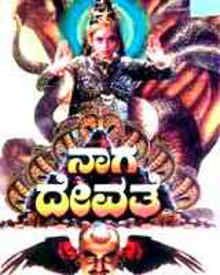
Nagadevathe (2000)

nagadevathe-poster

Sai Prakash’s 2000 film Nagadevathe is snakecentric, packed with special effects, and Soundarya and Prema are more than capable of shouldering the lead roles. The film is available on Youtube in Kannada, Tamil and Telugu so you can choose your own adventure without subtitles, and it has also been dubbed into Hindi under the title Naag Shakti.

The story as I believe it to be goes something like this. Gauri is regarded as a bad luck omen in her village, possibly just because she is barren. She and her husband offer hospitality to Shiva and Parvati who are pretending to be travellers. The gods tell Gauri why she is infertile – she accidentally killed a clutch of snake eggs and has been cursed. But they tell her how to stop them from continuing to punish her. Soon after, Gauri discovers she is pregnant. A difficult labour nearly ends badly but a glowing mystical snake appears and turns into Nagamma (Soundarya), who ensures a safe birth. There is a backstory involving a man who foolishly kills a snake and is cursed, his household goods transforming to snake mounds. He and his family do penance and after giving the deceased snake a proper funeral, his home is restored. Nagamma moves in to the termite hill to keep an eye on them or something. A shrine is built around the main snake mound and over time, more and more people come to pay their respects to the snake goddess. Nagalakshmi is born to be a devotee of Nagamma, and they have quite a warm and personal bond right from Nagalakshmi’s birth. Grown up Nagalakshmi (Prema) meets Shivaji (Sai Kumar) and love blossoms. There is some kind of conflict between their families and I couldn’t work out if it was an old feud, the rich boy poor girl thing, or just garden variety mother (deliberately turning her son into an evil possessed snake) issues. Nagamma tries to protect her favourite humans, and they could all benefit from some better decision making. Things get worse before they can get better, and the effects team are kept busy with magical healings, snake assists, helpful talking parrots, attack vultures, heaven, hell and the kitchen sink.

I enjoy the snake film genre for a few reasons. Often the female characters are more prominent and powerful or more nuanced, or both, and that makes me happy. There is usually a pervading sense of right in the film’s world as the snakes are able to enact justice that is missing for the masses. Snakes may act out of common sense or compassion, unlike many non-magical humans. Snakes are alert to every opportunity to get their groove on, with varying degrees of success along the scale from Jeetendra to Sri Devi. And the outfits are frequently a bit special. On many levels, from the very shallow to only slightly less shallow, Nagadevathe delivers.

I think Soundarya is lovely and in this film she maintains an air of benevolent authority in even the most trying times. Given that she often only has her face to act with (the rest of her having been replaced by a giant CGI snake), she does very well.

In one scene reminiscent of Ammoru, Nagalakshmi has summoned guests to eat at a special pooja. They are turned back by the Evil In-Laws but Nagamma calls on her sister deities to come along. She gets the undivided attention of the effects and saree teams as she personifies water, wind, earth, fire and more.

I admit to some disappointment that despite a most excellent spangly body suit, the obligatory “nagin assailed by been-wielding baddies” scene resulted in a disappointing dance. More like she was rolling around on the floor looking for a lost (blue) contact lense at times.

I liked Prema a lot in Devi, and her performance is solid. She has a flirty but down to earth tone with Sai Kumar, and a nice rapport with Soundarya. Prema is tall and elegant looking but has an energy that lends equally well to comedy and romantic shenanigans. Nagalakshmi has the strength and faith to stay on task and Prema really showed the power and intensity of her determination as well as her softer side. I could see why the snakes would want to chip in at her wedding. She was a good friend and fundamentally nice without being a pushover. Nagalakshmi knows what’s what and once she finds out the truth of her situation she takes steps to protect her loved ones and engage some divine assistance to sort out the problem. I recalled musing on the toxicity of Chiru’s bodly fluids in Punnami Nagu, and Shivaji also appears to have a lethal, um, bite. I have never been so glad to see so many silly interruptions of a wedding night.

Sai Kumar is Shivaji. He seems so nice and yet… When his snake nature dominates he is predatory and poisonous. Now I was confused as to how a snake goddess could be unaware her favourite disciple was marrying a serial killer faux snake, but maybe there are cosmic rules about that kind of snake-by-venomous-inoculation. Shivaji was unaware of his snakey activities and oblivious to the black magic worshipping going on around him. Nagalakshmi was often in peril and I was quite worn out from yelling at the screen for her husband to either wake up to himself or to get away from her. I’m more used to seeing Sai Kumar as a villain or an elder statesman so seeing him as a romantic lead was novel. Even if the effects team did seem to take too much pleasure in distorting his face into a snakelike mask.

The support cast includes stalwarts Babu Mohan, Tanikella Bharani, and other familiar faces doing familiar shtick. I couldn’t put names to all the faces but I was largely able to place which characters were Good and which were Not Good.

I did get a little confused at times since without the benefit of subtitles, I rely on the visual cues. Thankfully the signs are generally clear and umabiguous. Nagamma’s arch enemy is an evil mystic who favours an eagle motif and prances about in a shiny red outfit with a fluttering black cape. I liked that his cape was attached to the sleeves of his onesie as that helped ensure some vigorous and character appropriate flapping. The effects team worked themselves into a lather of laser eyes, snake shaped shadows, nasty afflictions, sparkly things, space monsters and of course giant multi-headed cosmic snakes.

Some key scenes are very similar to ones from Devi (1999) or even Ammoru (1995). Although this time around Prema was not the cosmic snake, and Soundarya was the powerful goddess. The story is laden with a bit of everything and the commitment to the theme is unquestionable. I can’t say the commitment to logic is equal.

See this if you like to see competent actresses take centre stage and if you enjoy a bit of a spectacle en route to a good comeuppance. 3 ½ stars!
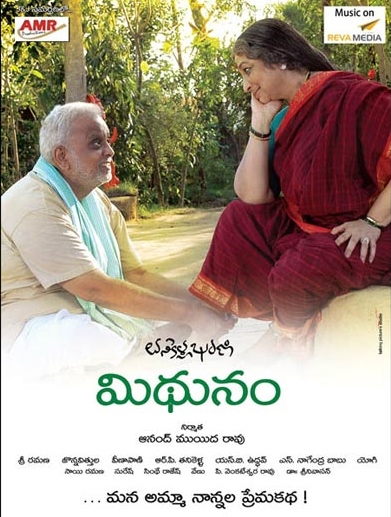
Midhunam (2012)

Midhunam Poster Over the past few years of watching Telugu films I’ve seen Tanikella Bharani on-screen in many roles, but most usually as the sensible father or responsible authority figure providing support to the hero or heroine. He appears as such a natural actor and fits those roles so well that I was surprised to find out that he is also an accomplished writer, dramatist, poet and now film director. In Midhunam, Tanikella Bharani has adapted a short story by Sri Ramana, writing the screenplay and dialogue and also directing the film. It’s a lovely little story about an elderly couple living alone in the country that focuses on relationships and shows that love doesn’t fade with the passing of time. It’s rather unusual in that there are only two actors for the whole two hours, and the film concentrates on their day to day activities and interactions without any momentous dramas or major events. It’s beautifully done, and is well worth a watch for a well-drawn picture of a happy marriage and a glimpse of rural life.

Appadaasu (S.P Balasubrahmanyam) and his wife Buchchi (Lakshmi) live by themselves on a small farm in the country. They have five grown up children who have moved to the USA but who keep in contact with their parents by phone. The couple seem to prefer their solitude and isolation, with Appadaasu shouting at a persistent caller who keeps knocking on his door, and yelling at his son down the phone when he calls unexpectedly. Buchchi on the other hand does seem to miss her children, but doesn’t have any wish to move away from her home despite the hard work it takes to keep everything maintained. She keeps a mobile phone hidden in one of her pots in the kitchen to talk to her children without her husband’s interference, although this seems more to be a way of outfoxing her husband rather than actually something that is completely necessary.

The couple squabble incessantly about literally everything, but their arguments seem to be more as a result of knowing each other too well and being very comfortable with each other rather than from any genuine acrimony. They are like small children, pushing at each other until they get a reaction, but not taking any of it too seriously. It feels comfortable and natural, just like any married couple after a number of years together. There is also a lot of laughter as they play tricks on each other and each tries to get the upper hand. Buchchi seems to be the more sensible one but she strands her husband on a top shelf by removing the ladder so that she can make coconut chutney in peace, and teases him later on by dressing a scarecrow in his clothes. Their love for each other shines through all of the bickering and teasing, and is the central thread around which everything else is woven.

Appadaasu is a man who takes his food seriously and much of the film is either about growing food, the preparation of food or eating.

The couple harvest everything they need from their farm, and they have impressive crops which do look very appetising. In fact the major focus on food might be one of the reasons why I enjoyed this film so much! At one point one of the sons proposes that the family come home for a wedding, and Buchchi immediately starts cooking enough food to feed an army. This is accompanied a song which celebrates pickles amongst many other traditional foods and is just mouthwatering!

There is an old radio on the wall and the programs and old songs are incorporated into the film, adding to the story. Both Appadaasu and Buchchi have conversations with their cow Savithri, who is almost a third member of their family and serves as a sounding board for some of Appadaasi’s ideas.  In between all the cooking and eating, Appadaasu expounds his philosophy that retirement from his teaching job doesn’t mean that he doesn’t work. He makes sandals, cleans cotton, throws pots and does a myriad of other tasks that emphasise his practical nature and willingness to do whatever he feels his wife wants. Actually asking and doing what his wife really wants naturally isn’t an option, and Buchchi makes sure that Appadaasu knows when he’s missed the point completely.

S.P.  Balasubrahmanyam is perfect in the role of Appadaasu. He’s cheeky and mischievous but also appears suitably serious when necessary. His expressions are wonderful and he fits the part of a cantankerous but loving husband perfectly. Lakshmi is also well cast as Buchchi and is the ideal partner for S.P. Balasubrahmanyam. The two have great chemistry together and the rhythm of their dialogue sounds as if they really have been together for years. That’s down to some good writing too, but the body language, delivery and tone from both actors ensures that they do appear to have grown old together and are very familiar with each other as a result. The use of older songs helps set the mood of the story, as does the beautiful location and wonderful farmhouse. I’ve just spent a week staying at a farmhouse near Tanjore, and much of the décor was just the same as my own recent experience. The film feels authentic due to this and many other small touches which is part of why it works so well. The cinematography by Rajendra Prasad Tanikella (a relative?) is also outstanding with beautiful use of light during the night scenes and great shots of the farm and surrounds.

This is a sweet film that simply follows the ups and downs of life for an older couple and shows how a marriage might be after more than 50 years together. It’s charming and yet meaningful with the contrast between Appadaasu and Buchchi’s life and the imagined lives of their children overseas just one of the ideas explored. There is jealousy, anger, forgiveness, tenderness, love and sacrifice, all mixing together to add colour and life to the description of a successful partnership and just what that partnership really means. A beautiful film that deserves a wide audience. 4 stars.

Anegan

Anegan

Somewhat ironically I had to wait until I got back to Australia to see KV Anand’s latest film despite spending the last few weeks in Tamil Nadu.  I was keen to see Dhanush in a triple role, since the trailer looked promising and three times as much Dhanush can only ever be a good thing! I also loved both Ko and Ayan, and was hopeful that Anegan would be a return to KV Anand’s earlier form after the disappointment of Maattrraan. And overall I wasn’t disappointed with Anegan. The first half is a little slow, and Dhanush’s really quite terrible wig in his first incarnation is rather distracting, but the second half is much better with an improvement in the main relationship and some good plot twists. Although the story doesn’t really get going until after the interval, catchy songs, some stunning visuals and an entertaining story make Anegan well worth a trip to the cinema.

Anegan opens in Burma of the early sixties and tells of a romance between a Tamil labourer Murugappa (Dhanush) and the daughter of a high-ranking official Samudhra (Amyra Dastur). It’s all fairly typical stuff, including a damsel in distress and daring rescue scene, secretive meetings in full public view and the stiff parental opposition you would expect. What never fails to amaze me is how young Dhanush can appear to be when required – a shave plus a bad wig and suddenly he looks sixteen. Here he appears younger than his co-star despite her giddy antics and plaited pig-tails, and maybe that’s why the romance never seems to sizzle. It’s not the best start for a love story that is supposed to be strong enough to span time and involve a number of reincarnations, but there is a sweet song and at least the lead pair look reasonably cute together. Naturally fate intervenes when the military coup forces most of the Tamil workers to leave Burma and Samudhra tries to escape her abusive family by tagging along with the general Indian exodus.  However Samudhra’s escape is foiled by Mallika (Aishwarya Devan) who is jealous of Samudhra’s relationship with Murugappa and things don’t end well for the star-crossed lovers.

Fast forward to the present day, where Madhu (Amyra Dastur again) is undergoing regression therapy to help her deal with the stress of her job in a large gaming company in Chennai.  The story of Murugappa and Samudhra is revealed to be her ‘memory’ of a past life and Madhu is convinced that the different incarnations of Murugappa she remembers mean that he is her soul-mate, and that they are destined to finally be together. The previous lives she remembers all have the two separating in quite horrible circumstances, generally involving murder and death, but this possible outcome doesn’t seem to worry her at all. Instead Madhu’s only concern seems to be that she hasn’t managed to meet her ‘soul-mate’ so far in her current lifetime.

Naturally that is remedied almost immediately and Madhu meets Ashwin (Dhansh again), an IT expert, also working for the same company. Yet again he’s from a lower class family but unlike Madhu, Ashwin has no memories of a past life and very little interest in Madhu other than as a work colleague. But soon event start repeating – Ashwin steps in to save Madhu from serious injury, and co-worker Meera (Aishwarya Devan again) is a potential rival for Ashwin’s affections, while Madhu is relentless in her pursuit of Ashwin as her long-lost love.

For most of the first half Madhu is erratic and completely annoying as she veers between bratty rich girl behaviour and total mental instability, although I put most of her crazy psychotic behaviour down to the drugs she is taking from her therapist mixed with the natural remedies from the family’s guru. Her attitude makes her a rather unlikeable character for most of the first half and her attempts to convince Ashwin that they are MFEO should have been enough to see him run for the hills. But instead he seems to suffer from a similar mental disorder and for no particular reason at all (unless it’s her inherited millions – which would at least make sense!) Ashwin decides that he’s in love with Madhu.

Thankfully Madhu becomes somewhat less irritating in the second half. The film moves back in time again while she relives her past life as Kalyani which turns out to be one of the best parts of the film. Perhaps the effect of the wigs wears off after prolonged exposure, but Dhanush’s Kaali is vibrant and likeable while Kalyani is less naïve than Amyra’s other incarnations, leading to some definite sparkage between the couple. The present day scenes also step up a pace in the second half as Ashwin and Madhu work with Commissioner Gopinath (Ashish Vidyarthi) to find out what happened to Kali and Kalyani and Madhu’s boss Ravikiran (Karthik) starts to take an interest in his employee’s mental deterioration. Dhanush is excellent throughout and makes his three separate characters (four if you include one who only appears in a song) quite distinctly different personalities. Murugappa is sweet and innocent, Kaali is a rough and tough rowdy with a heart of gold while Ashwin is the quintessential computer nerd, who still manages to fight like a pro, filmi style. Ashwin provides the thread that binds them all togther, but the most successful is Kaali, and Dhanush looks as if he is having the time of his life dancing and singing through the streets in a mesh singlet!

Anegan is a good blend of romance and action with a reasonable thriller element woven into the story, and generally strong characterisations. There are a few totally unrealistic moments, Madhu speeding through the traffic in Chennai is one (hah! nope – couldn’t happen in Chennai traffic!), and the attempts to make Ravikiran a hip and trendsetting boss fall rather flat, but mostly the screenplay from KV Anad and Subha works well.  Amyra is rather overshadowed by Dhanush and her theatrics in the opening scenes are particularly wearing, but she does improve as the film progresses. Aishwarya Devan is better is her small role  and it’s a shame she didn’t have a longer time on-screen. The rest of the supporting cast including Jagan as Ashwin’s friend and Mukesh Tiwari as Madhu’s uncle are all good, and Om Prakash ensures the film looks stunning with the scenes in Burma particularly well shot. Harris Jayaraj’s songs fit the film well and the background music is also excellent. Overall the film mixes plenty of action, comedy, suspense with the romance, and even if the story is fairly predictable the different incarnations of the lead characters ensure the story feels fresh and engaging. Anegan may not be quite in the same league as Ayan, but it’s definitely a large step in the right direction and well worth a watch –  and not just for the multiple incarnations of Dhanush!