Mankatha

Mankatha

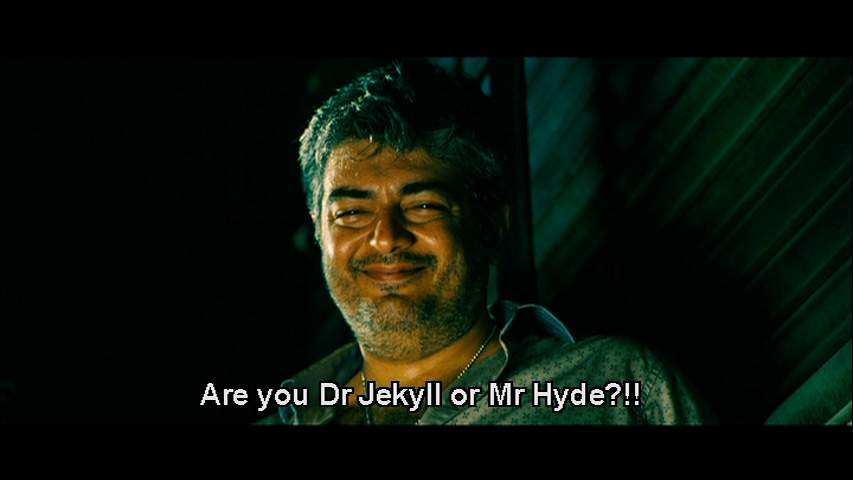
I missed Mankantha when I was in Chennai due to limited time and sold-out shows in my usual cinemas – which I guess was a good indication that the film would be worth seeing.  Venkat Prabhu’s fourth film does feature his usual crowd of young actors, but also stars Ajith Kumar in his fiftieth film – it’s all about the numbers!  Mankatha is an action thriller based around the theft of illegal gambling money and features so many twists and turns that at times it’s hard to keep up with just who’s double-crossing who.  Although there are a few leaps of faith required to fully engage with the plot, overall the pace of the action and an excellent performance from Ajith in a negative role make the film well worth a watch.

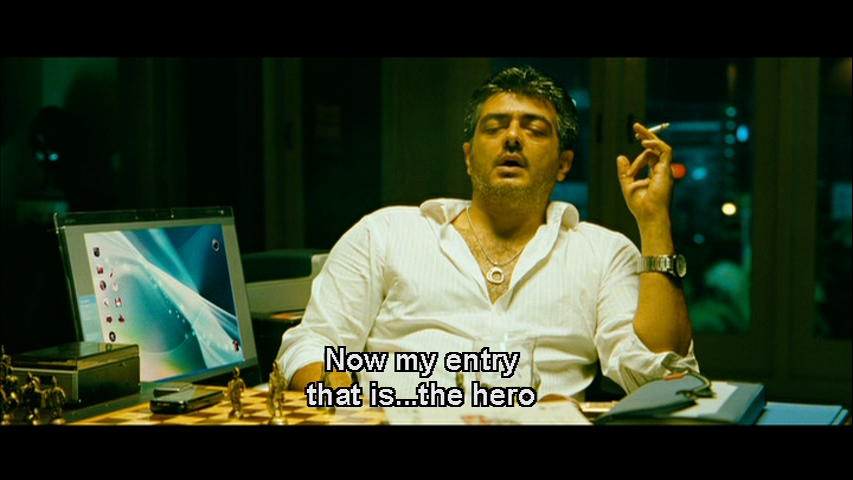
The story starts with Ajith as Police Officer Vinayak Mahadevan, landing onto the screen in a typical Tamil Hero entrance style (i.e. unlikely appearance from out of nowhere) to prevent what appears to be a corrupt police execution of smuggler Faizal (Aravind Akash).  The lines are blurred right from the start – is Vinayak a hero, fighting corruption and gambling despite being suspended from duty for saving Faizal, or does his drunkenness and casual infidelity  point to even bigger character flaws and a tendency to flout the rules for his own benefit?  Each subsequent scene makes the conundrum more difficult to solve, and this ambiguity runs throughout the action in the first half.  It’s not until much later in the film that Vinayak’s true character becomes apparent (or does it?) and his real motives are revealed.

Ajith entranceMankathaMankathaMankatha


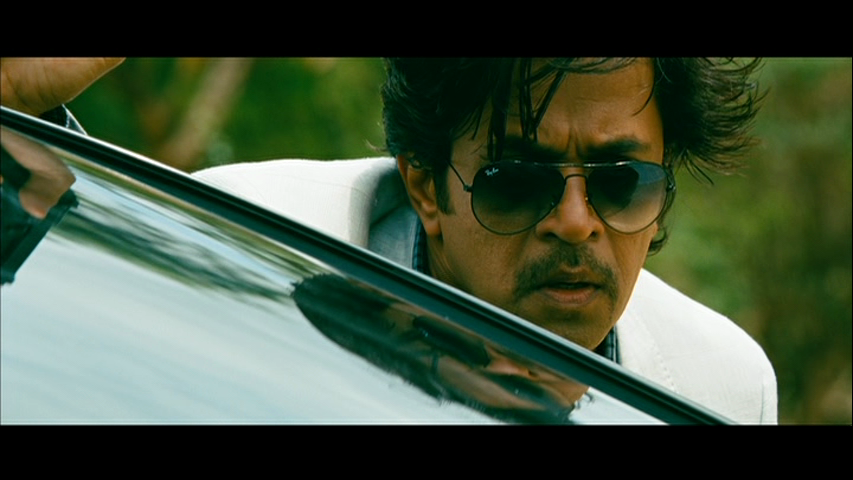
Then there is ‘Action King’ Arjun, who appears as Prithviraj, the head of a special task force entrusted with stamping out illegal gambling on cricket matches after the head of the anti-corruption squad Kamal Ekambaram (Subbu Panchu) commits suicide due to his own gambling debt.  However Kamal isn’t dead, but instead reappears as one of the investigative team, a detail which I kept expecting to have some relevance, but it never actually does.  Arjun is very OTT in his action scenes, made even funnier by his terrible floppy hair, but otherwise delivers  a generally straitlaced and relatively heroic portrayal of a senior police officer intent on stamping out gambling.

ArjunMankathaMankathaMankatha

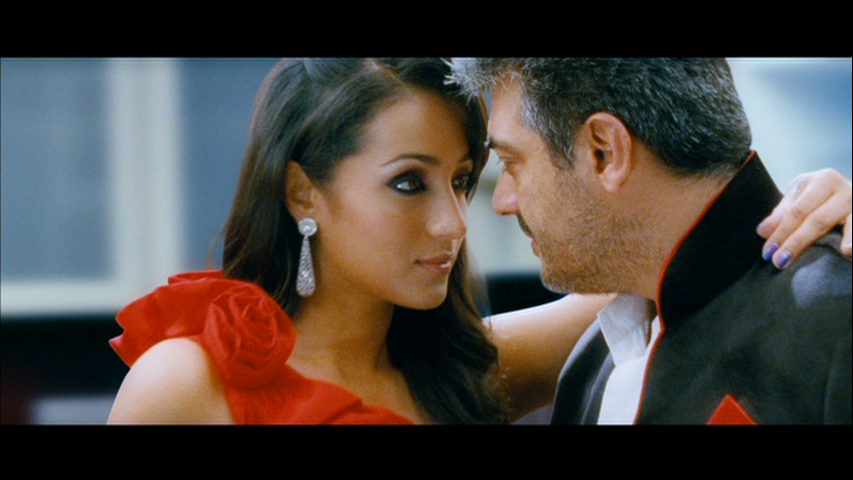
Vinayak, one night stands aside, is in a relationship with Sanjana (Trisha), the daughter of Arumuha Chettiyar (Jayaprakash).  Chettiyar runs the illegal gambling network in Mumbai along with various other illegal activities, and he also just happens to be the man who employs Faizal.  Was this good planning by Vinayak, or just a coincidence?

MankathaMankatha


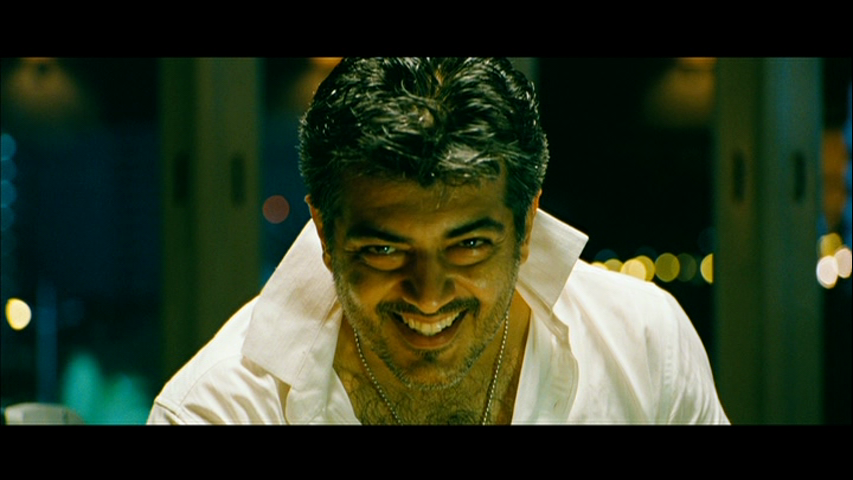
Since Vinayak apparently turns a blind eye to Chettiyar’s illegal activities the question then follows, is this all part of an undercover plan to infiltrate the gang and bring down Chettiyar or does Vinayak really not care about his potential father-in-law breaking the law beyond the opportunity to pocket a few bribes?  It’s hard to tell, as Ajith makes the most of his devastatingly cheeky grin and ever more crazy persona to keep everyone guessing his true motives.
MankathaMankatha

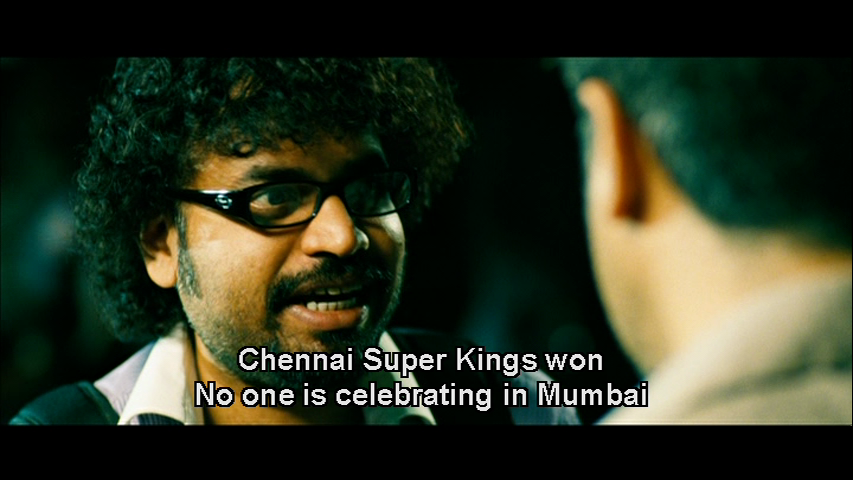
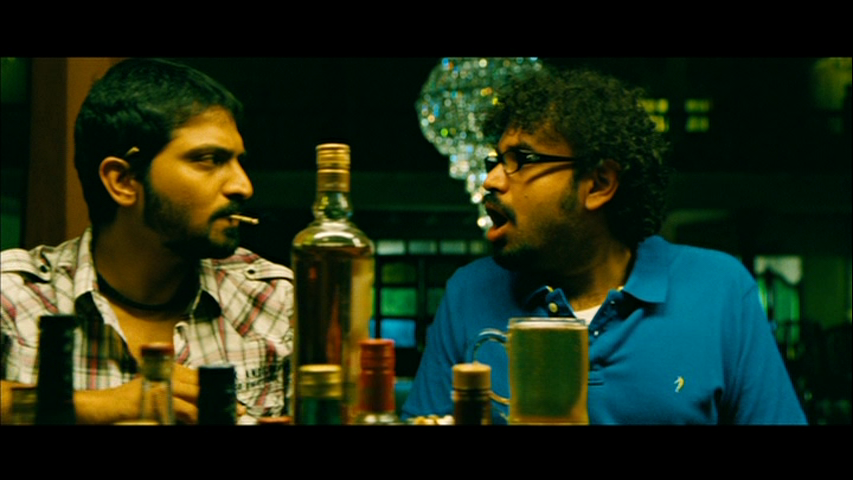
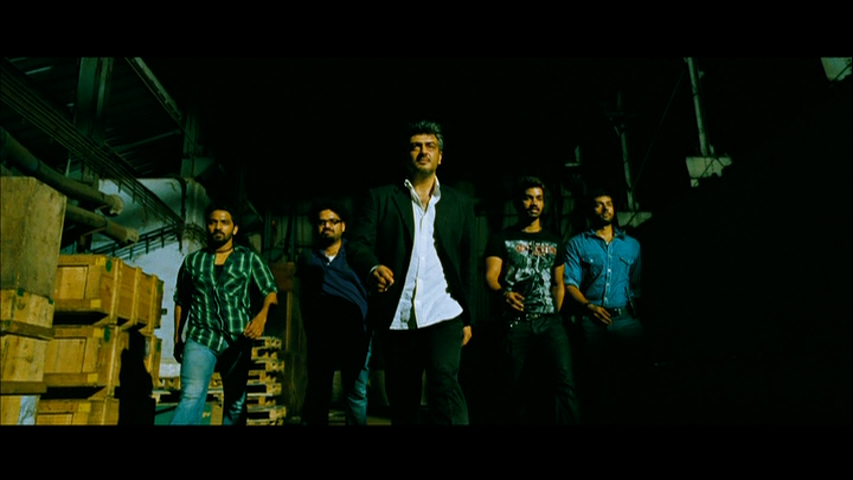
Meanwhile, Chettiyar’s henchman Sumanth (Vaibhav) is in cahoots with local Sub-Inspector Ganesh (Ashwin Kakumanu) and bar-owner Mahat (Mahat Raghavendra) to steal the gambling take from the IPL final.  Mahat ropes in his friend from home Prem (Premji Amaren) who just happens to be an IT expert as well as a terminal idiot.  A little of Premji’s humour here goes a long way and less really would have been better, but cleverly developed group dynamics and good performances from the rest of the gang help keep the story on track.  In due course, Vinayak finds out about the plot which just happens to coincide with his own plans to loot the money, and the conspirators end up joining together to steal $5 billion in US dollars.  While some of the heist details require a major suspension of disbelief, the rest of the story deviously pits everyone against each other with  betrayals, plot twists and unexpected revelations, which mean it’s necessary to concentrate and pay attention to work out just who is allied with who at any given time.
MankathaMankathaMankathaMankatha


While the guys get all of the action and pretty much all of the storyline, there is very little for Trisha and the other female characters to do.  Anjali has perhaps the next most realised role as Sumanth’s wife, but her only value is as a bargaining tool later in the story.  Andrea as Prithviraj’s wife and Lakshmi Rai have even less of a role, and almost all of the female roles could have been eliminated without making any real ripple in the story.  The songs are also mainly superfluous although the soundtrack by Yuvan Shankar Raja does have a few memorable tracks.  This is probably the best choreographed, although the visual effects for Vaada Bin Laada are worth a look too (watch out for the plane on the wall that takes flight).

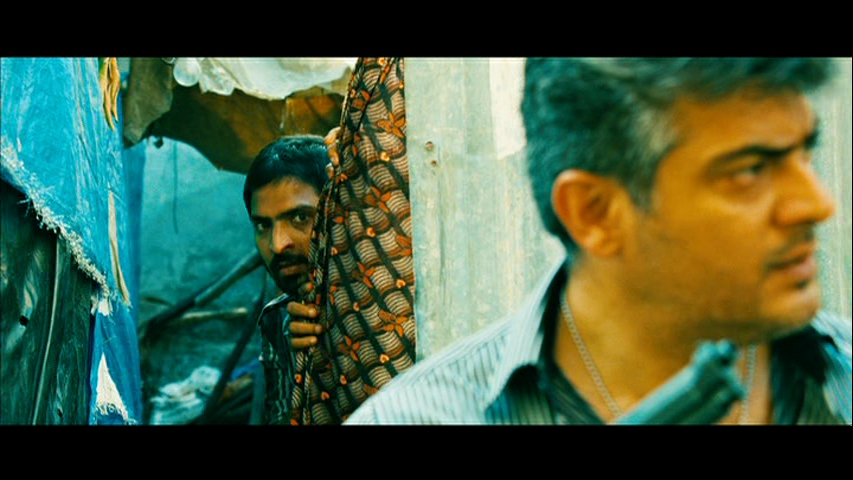
Ajith is definitely the star of the show in a negative role that must have been a hoot to play.  He spits venomous lines with great joie de vivre, throws in plenty of bleeped out profanity and his crazed megalomania is wonderful to behold.  He has great chemistry with Arjun and the two take control of every scene they are in.  However Vaibhav is also notable and the other cast members all provide solid performances.  While the focus is on the action there is also some nifty camera work from Sakthi Saravanan, including a great shot of some boys playing cricket in the slums while Vinayak chases down Sumanth.
MankathaMankatha

Mankatha is not the most convincing heist film, and it would definitely benefit from trimming some of the excess in the form of unnecessary songs and peripheral characters, but it succeeds in entertaining which after all is the main purpose of cinema.  I loved the twists and turns and appreciated Ajith’s excellent demonstration of just how to keep everyone guessing while Arjun tries his best to convince everyone that he is the hero.  It’s amusing and doesn’t take itself too seriously which makes for an enjoyable watch. 3 ½ stars.

Raja Rani (2013)

Raja Rani

I didn’t manage to see this in the cinema in Melbourne, but did manage to get a DVD copy with English subtitles.  Rather strangely it was also the only film they had on the bus in Tamil Nadu this year and I ended up watching the opening scenes over 10 times on the way to various villages in TN.  This added exposure gave me enough time to appreciate just how outlandish Nayanthara’s make-up looks, and just how uncomfortable Arya appears in his suit at the opening wedding which is a good precursor to how their relationship develops. In fact, the lead couple are rather uninspiring throughout this film – at least when paired with each other – but thankfully co-stars Jai, Santhanam and Nazriya Nazim are more appealing and their presence does make Raja Rani worth a one-time watch.

Raja RaniRaja Rani


The story starts with the arranged marriage of Regina (Nayanthara) and John (Arya) who are going through the matrimonial motions for the sake of their respective families.  Or so we are told.  Except as the film progresses this wedding seems to make less and less sense.  The couple obviously dislike each other and I cannot see why Regina’s relatively wealthy and cosmopolitan father would agree to marry her to someone like John.  He seems to have neither the requisite high flying job nor appropriate family background for such a match.  However, as completely random as it seems, and despite the lack of any reasonable explanation the wedding goes ahead even with the bride forgetting her prospective partner’s name and both parties complete lack of enthusiasm throughout the ceremony.

Raja RaniRaja RaniRaja RaniRaja Rani


It’s a match that seems doomed to end in divorce.  John spends his days at work and his nights drinking with his friends before returning home, usually to a locked door.  Regina hogs the bathroom, sobs into her pillow at night and generally ignores her husband as much as she can.  It all feels very unrealistic and overly dramatic – after all there is a large couch in the other room where Regina could sleep if she wanted, and surely John could organise a key to their apartment rather than sleep on the doorstep?  All the OTT drama makes it difficult to care about either John or Regina since they are equally obnoxious to each other, and I really had little interest in their relationship.  That’s not to say that Arya and Nayanthara are particularly terrible, but all Arya has to do in the first half hour is pretend to be drunk while Nayanthara doesn’t stop crying or complaining long enough to do anything remotely interesting either.

Thankfully there is relief in sight, but until we get there Santhanam lightens the atmosphere and is mildly amusing as John’s best friend Sarathy.

Finally there is an incident which prompts John to find out a little more about his wife.  There is some very dodgy medicine on display as Regina has an epileptic fit while her husband seems totally incapable of any sensible reaction, although he does eventually manage to call an ambulance.  Needless to say, despite all the thrashing around and foaming at the mouth (sigh – when will Tamil cinema consult a doctor for some plausible medical problems?) Regina manages to come through the whole episode with her make-up and eyelashes intact. That’s a relief!

Raja RaniRaja Rani


However, after being berated by her doctor for not knowing anything about his wife’s condition, John does discover the reason behind her ‘illness’.  Lost love – of course!

The film gets much better when we head to a flash-back to Regina’s first love, although to be fair this doesn’t have the best of beginnings either.  Jai is excellent as love interest Surya, an incompetent call centre employee, and finally there are some real emotions and reasons to empathise with one of the characters.  Regina is as obnoxious as before, but the role of spoilt rich brat suits her better when she’s a student and she does seem to be more tongue in cheek with her tantrums.  Sathyan makes an appearance as Surya’s friend Iyappan and his comedy shtick complements Jai’s weedy persona well enough to make a reasonably funny duo. Although the romance is typically filmy there is some chemistry between the two actors and while we can see the unhappy ending coming, Regina never does and is devastated by losing her first love.

Raja RaniRaja Rani


It turns out that John has his own sob story, and although it’s another predictable run of the mill tale, again it’s a more believable romance with good chemistry between the actors.  In particular Nazriya Nazim is scintillating as Keerthana and she is the best thing about the whole film.  She has an excellent introduction and her cheeky impishness lights up the screen whenever she appears.  She has much more personality and is much livelier than in Naiyaandi, which just goes to show the difference between a well written character and one that basically isn’t!

Raja RaniRaja Rani


Arya is also transformed into a younger, fitter John who is more personable and likeable, and again there is some reasonable chemistry between him and Keerthana.  It’s not all good though – Santhanam suffers under the burden of some terribly bad hair which seems to make him more pathetic and less amusing than in the first half, but it works out for the best as Nazriya has the comedy covered too.

The main problem I have with Raja Rani is that the relationship between John and Regina never generates any appeal or gives an opportunity to feel sympathetic towards the characters.  There are some interesting issues brought up  here but they are dealt with in a shallow and filmi way which results in a lack of connection between the characters and the audience.  There is no apparent reason for the couple’s actions towards each other, considering that they don’t appear to have met before the wedding, and it seems strange that they would behave so badly to each other right from the start.  The concept of an arranged marriage between two people who have both lost their first love has potential but Atlee wastes it by playing the relationship for laughs and never giving his characters a chance to behave like rational adults.  I found it incredibly frustrating to watch  Arya and Nayanthara appear so wooden and lifeless for most of their on-screen time together, when the difference was so obvious when Arya was partnered with Nazriya and Nayanthara with Jai.  A little more time spent on developing the relationship between Regina and John at the beginning along with a more adult treatment of their problems would have made this a more entertaining watch.  However I did enjoy seeing a better performance from Nazriya and I liked the idea behind the film, even if the execution didn’t quite live up to expectations.  3 ½ stars.Raja Rani

Kanchivaram

Kanchivaram (2008)

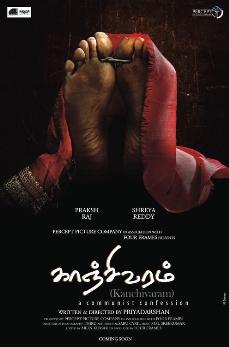
Kanchivaram is a slice of life social drama that largely rests on an excellent performance by Prakash Raj. Priyadarshan eschews the broad almost hyper style more common in his Hindi comedies and delivers a thoughtful and subdued film.

The film opens with a prelude explaining the significance of wearing silk at marriage and on death, and that the weavers were never in a financial position that would allow them to wear the fabric they wove. Vengadam (Prakash Raj) is an exceptional weaver and a natural leader in his community. A visiting writer (Sreekumar) introduces the village men to communism. Vengadam initiates collective bargaining for the weavers, which leads to a lengthy strike. But he had also promised that his daughter would be married in a silk sari, impossible to manage when he is not working. He steals silk, a hank at a time, and secretly weaves the sari he promised her. The conflict between his political and personal ideals and his love for his family is the root of the story.

The story is presented as a series of flashbacks. Vengadam is paroled from jail and travels back to the village by bus, with sounds and incidents on the journey triggering his memories of earlier times. This structure allowed me to concentrate on what was happening now, and to absorb the emotion of the story rather than wondering what would happen. His story unfolds from his marriage, birth of his daughter, the death of his wife and eventually the reason for his incarceration. The breaks in the flow as Vengadam was recalled to himself on the journey just sharpened the contrast between the bluff confident weaver and the broken man on the bus.

Priyadarshan frames the story in the political context of the rise of Communism before party membership was legalised. He efficently sets the scene of the industrial arrangements, the workers dependency on the factory, the clandestine political activism, in just in a few scenes. There are visual cues as to how things stand. The factory owner usually appears sitting or standing on a dais at a higher level than the workers. The communist writer who raises the political awareness of Vengadam and Sarathy skulks around in the dark, fearful of the police.

I’m always interested in industrial relations and the evolution of employee rights and the law so that aspect was appealing. And I particularly liked the villagers reaction to some social theatre – initially passive but on their feet and cheering like any mass movie audience when the ‘blood’ spatter started.

Prakash Raj is wonderful as Vengadam. Whether playing the younger carefree newlywed or the damaged man released on parole he is completely convincing. Vengadam has most of the dialogue in the film but many scenes rely purely on reactions and body language and Prakash Raj nails it. Often political leaders are depicted as single minded zealots, but Vengadam is more human. He understands his why wife is upset by the promise to see his daughter married in silk. He realises his daughter is in love with Ranga and goes to ask for the marriage to be arranged. He knows that when he takes a stand and strikes there will be consequences. And he knows what he is doing when he breaks the strike. Prakash Raj shows these internal struggles and questions and Vengadam’s eyes reflect his turmoil. I’m often intolerant of those who throw their families or friendships under the bus of ambition but this is more complex as Vengadam is not motivated by pure selfishness. He stole silk to weave something beautiful for his daughter, to break the cycle of not having. I could like him even as I rolled my eyes at his obsession with the sari.

Shriya Reddy is excellent  as Annam, Vengadam’s wife. Priyadarshan seems to have a knack for persuading actresses to tone down the glamour (as with Lara Dutta in Billu). Annam is smart, has opinions and politely challenges her husband in private when she thinks he has gone too far. From the initially awkward moments when Annam first comes to her new home, Shriya shows the growing affection and the playfulness in the marriage. Annam doesn’t have much dialogue so much of their closeness and the tensions in the relationship had to be conveyed through glances, the tilt of a head, the set of her shoulders.

She dies after being trampled in a crowd out to see the landlord’s new car, another symbol of the gulf between the workers and owners. Her final anguish is over whether Vengadam will be able to raise their daughter and he does his best to reassure her in his own way.

Family and village ties are revealed in many small interactions so the supporting cast are important and most are very good. I particularly like Jayakumar as Sarathy, Vengadam’s friend and one-time political ally. His rapport with Prakash Raj was excellent, and their friendship felt believably warm. I liked their stilted meeting to discuss getting their children married to each other that ended in affectionate hugs and relieved laughter. The deterioration of their relationship was shown simply but the pain on both sides and the definitive nature of the break was clear. Shammu is engaging and likeable as Vengadam’s daughter Thamarai. I do a certain amount of teeth gritting when I see little daughters made to replace their dead mothers in the home, but Thamarai was a distinct person and not just a household slave. She went to school for a while, then took sewing lessons, and her dad wanted her to be happy. So for a filmi girl in 1948 with no Ma, I thought she had it pretty good. Until things went wrong.

Kanchivaram-Bad actor lovely sariThere is an English character played by a truly bad actor. Well, I am not sure if the brightly over-enunciated yet almost expressionless dialogue delivery is his own style or was required by the director. There are so many good actors working across many Indian film industries yet the ‘English’ are almost uniformly laughable and seem to be reading at a pre-school level.  Who is casting these people?

The colour palette is simple and very effective throughout. The day to day scenes are muted and mostly use neutral and earth tones. The bus trip is drenched in the pale blues and grey of rain and twilight. Scenes at night are touched with the golden flicker of lantern flames. The flash of opulent silks highlights the gulf between the weavers and the eventual owners of those stunning garments, and punctuates the drama with bursts of saturated jewel tones. There are recurring motifs like the sickle, used as an emblem of communism and as a blade. Thiru’s camerawork uses lots of tight close ups of the actors and despite the dark interiors and low lighting in some scenes he catches every expression and gesture.

Despite the period and politics of the setting, Kanchivaram can be watched as a personal and intimate story rather than a didactic message film so I was impressed by his handling of those elements. But I’m not completely sold on the ending. The sensitivity of the characterisation and performances is what stands out for me. The film is available on YouTube with subtitles. 3 ½ stars!