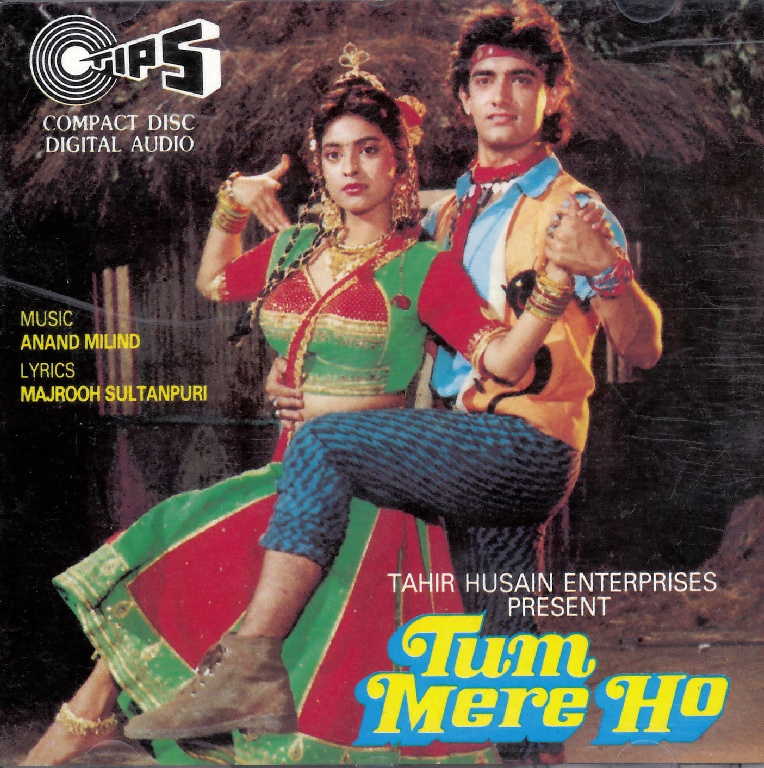
Tum Mere Ho (1990)

Aamir Khan, Juhi Chawla and snakes? Sounds like an excellent Nag Panchami Film Fesssstival subject. The film is pretty terrible, but is almost always So Bad It’s Good, and the songs are quite pleasing in both snakey choreography and energy. It may have lost something in translation due to the dodgy quality youtube version with no subs that I watched, but I doubt it.

It seems of late that Aamir has distanced himself from his pre-Lagaan career. But I say let him be known for his heroic role as Shiva the hairy-chested snake charmer who saves his lady love Paro (oh so young and pretty Juhi) from a crazed Snake Queen (Kalpana Iyer).

The film opens with Thakur Chaudhary attempting to steal a Naag Mani by using a very flawed contraption. In the process, he kills a snake and draws the ire of the Snake Queen on his own household.


She declares that as he killed her child, she will kill his. And off she goes and bites the young lad as he sleeps.
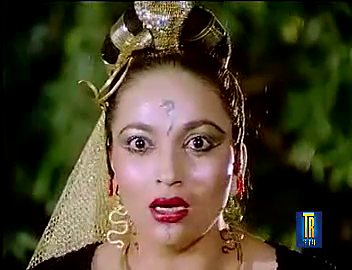
The weeping parents, with the Snake Queen laughing at their grief, put their son’s corpse on a little raft arrangement, and he is sent off on the currents of the river. Of course he washes up at the feet of the one man who can reverse a death by snake bite. The child lives and grows up to become Shiva (Aamir). He learns to use magical powers that involve him waving a bone and a skull around, and doing lots of fist clenching emoting.


He has his uncle, his snakes, a daft sidekick, and is being pursued by the village skank belle. He also has a waistcoat with a snake motif for special occasions.
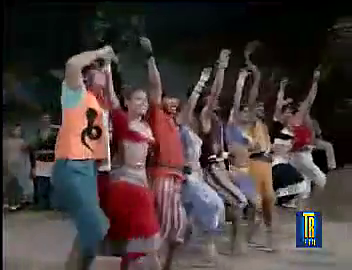
Everything a boy needs!

Shiva goes into the village for some reason, possibly to deliver a snake, and sees Paro at the fair. He impresses her with his snake, and she is immediately full of dreams of love as well as thoughts of garam garam jalebis and thandi thandi kulfi.


My Hindi vocabulary is small and selective so I may not have captured all the nuances of her romantic fantasy. Paro is the daughter of local bigwig Chaudhary Charanjit Singh and is out of Shiva’s league.

No one wants these youngsters to get together and this leads into not entirely boring Romeo and Juliet territory. I was concerned the snake theme may dissipate, but Shiva uses snakes as part of his courtship ritual which was an interesting approach. Paro can’t stop thinking about him, his snake, and possibly those jalebis and so love blooms.

They’re so young! So pretty! He’s in a floral blouse!

Romance blossoms despite Paro’s father arranging attacks on Shiva using black sorcery, beatings and guns.


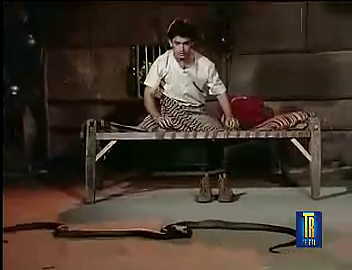
Of course, merely locking Shiva in his room cannot keep them apart, not while clever snake Naga Raj is there to unlock the door.

Shiva’s people want to keep him away from Paro too as they can see she is trouble for their boy.

Shiva and Paro scamper around the forest looking like the poster children for young love and carefree premarital fumbling.

Until the revelation that Paro has been married since she was 3 years old to some unseen Rajput scion. Guess who that boy was? Sigh. Shiva has to perform at her wedding (oh the tragedy!) before Paro is sent to live a widow’s (I’m guessing the widow bit as she wore white, no sindoor, and cried non-stop so it was quite funereal anyway) life at her in-laws and mopes around a lot.

Note: Re the village belle –  Despite her clothing usually erring on the correct side of the fabric to flesh ratio for a snake, she does fail other snake tests and is a Fake Snake.

Anyway Paro’s change of address propels Shiva back to his family home and into Snake Queen territory. He does a lot of pining and trying to lure Paro out with his snake music, which is just asking for trouble.
Naga Raj saves his human from the Snake Queen which made me wonder about the Snake Code and what did a snake have to do for other snakes to turn against it, and did they have to show just cause if they were opposing a more powerful creature?  And also, what were her responsibilities towards lesser snakes? Was she justified in attacking them? It raised so many questions.

I did like this song where the Snake Queen impersonates Juhi, but is caught out by her excessive accessories (compared to the pristine white of the real Paro). She misses a couple of easy bites. I really had to question this whole selective bite placement thing that filmi snakes seem to have.

It emerges that the uncle snake charmer knows Shiva’s real identity. Shiva’s father rejects the idea as some attempt at magic although I wondered if that was really to protect his son given that the vengeful snake was likely to still be around. All unaware of this peril, Shiva and Paro return to the forest and I think they sort of get married. Wedding rituals in the snake charmer village seemed quite straightforward, and there was a robust approach to courtship. Basically, if you can catch your person and subdue them, you’re as good as married.

Having set Naga Raj to wait outside (after a bit of a chat about the privacy required on one’s wedding night), Aamir and Juhi are alone. He does lots of nuzzling and she looks like she has passed out. But the Snake Queen takes the opportunity to attack.


Can Shiva’s magical powers save Paro? Will there be flying snakes? Will it involve a ritual both very silly and slightly icky? Will someone go up in a ball of flames? Will people just learn how to get along? What do you think? (If you really have to know, I can’t help you thanks to Shemaroo – who don’t care enough to release decent quality DVDs but will stop you watching this on youtube. Sigh)

This is not a good film but I was entertained enough and don’t regret the time spent. I can’t say that for every film I see! Tahir Hussain hasn’t created a masterpiece but he has made a pretty solid snake revenge romance. The soundtrack by Anand-Milind is pleasant, and there is some nicely energetic dancing. And you know, Aamir, Juhi and those snakes. 2 ½ stars!

Punnami Naagu (1980)

Punnami Naagu is almost two films in one. It’s as though someone took a deck of cards marked ‘happy animal friends’ and shuffled it with the deck marked ‘a nagin stole my soul’ and voila!  It was an excellent opportunity to apply the principles in Jenni’s Field Guide.  Apologies for the crappy screencaps – the DVD picture is really grainy. And I didn’t have subtitles so I may have made the whole story up.

A local snake charmer uses his snake coercing powers to kill a priest after he had stopped the snake charmer raping a girl. The priest seems to make some dying invocation or curse, and leaves his young son an orphan.

The priest’s son is adopted by the landlord, and I think god sends an elephant to look after him. The elephant is very maternal, making sure Raju eats and washes regularly. It’s all very family friendly and sweet. When Raju moves in with the landlord, naturally his elephant moves in to the luxurious mansion too, and they grow accustomed to the good life. I would have had seizures looking at that decor, but apparently elephants rise above such things.

Meanwhile the snake charmer is in less happy circumstances, and his son Naagulu is growing up unaware of the curse that will take over his life. The father is feeding Naagulu snake venom in his food to help him become immune to snake bites, and he is being trained to take up the family business. It is lucky he is immune as his snake handling is a bit cavalier – I’m pretty sure they could fang you through a hessian sack. Nevertheless.

Naagulu’s heavily pregnant aunt has an animal helper of her own – a very useful monkey that assists with laundry and has exceptional empathy and communication skills along with basic midwifery knowledge. When little Laxmi is born, all the main players are set for the drama which is to unfold.

It’s a standard boy woos girl story, as Raju and Laxmi flirt and fight and make up, all under the watchful and slightly exasperated gaze of their animal friends who also help to patch up fights and carry messages. There is dodgy dancing, Narasimha Raju has an exceedingly voluminous coiff, the elephant and monkey are smarter than the humans, and that storyline is all quite cutesy. Laxmi (Rati Agnihotri) is bright and confident, their courtship is energetic and they get all the upbeat songs. Raju’s costumes are entertaining even without a story to go along with – Could his collars have been any bigger, his pants any higher? It’s kind of fun, especially a song and dance involving the couple wearing each other’s clothes. Laxmi does not fit any of the clothing or eyeliner indicators, so I suspected the snake thing skipped her side of the family.

But. The dark side of the film starts to emerge.

Chiranjeevi as grown up Naagulu is unaware that he is slowly becoming more snake than human. There are some annoying comedy snake charmers on the scene, and they perform with a troupe which includes a spectacularly flexible snake dancer in a bejewelled bodysuit. Naagulu berates the performers for using the gift as entertainment. He may not know why,  but he cannot control his response to the snake music. It was easy to pick the real snake here, bedazzled Fake Snake notwithstanding.

As his hormones kick in, the lust aspect of the snake character takes over when the moon is full. So it’s a bad idea when Naagulu falls for Raju’s sister Menaka after saving her from a rampaging roaring bovine. I applaud the enthusiasm if not the ability of whoever did the voiceover for the animal – I have never heard a cow go “Grrrr-aaaaaargh” nor have I heard one oink like a pig so I was very impressed. Menaka manages to be quite saucy even when barely conscious and Naagulu was smitten.

This can’t end well, what with Naagulu being lethal and all. He lures young ladies to a lonely spot, where it is always night and swirling with mysterious mists, and the venom contained in his bodily fluids is fatal to them. They are mesmerised by his snake gaze (blue contact lenses – tick!) and don’t seem to notice his odd mannerisms that echo some snake behaviours. In his human state he has no recollection of these interludes.

Back in Raju’s storyline, Naagulu’s father repeatedly stomps on a baby snake and the local snake deity eyes him with a vengeful glare. Duelling snakes ensue as Naagulu’s dad tries to kill Raju with his snake, and the deity pursues the snake charmer with eventual success.  Naagulu’s dad delivers a deathbed monologue which seems to include telling his son that he can never marry as he will poison any woman he sleeps with. This revelation came a bit late for poor Menaka.

Naagulu inherits a book that seems to explain his condition, but now he knows what he is there is no one to help him. Naagulu is devastated by what is happening to his body. His eyes change to those blue contacts, his skin is shedding, and he seems to be in agony as he sees these familiar but totally inhuman changes. And that’s what makes this a bit more interesting than I expected. It’s a strong performance in what started out looking like a fairly silly film. There is more to Naagulu than just the killing and being venomous, and Chiranjeevi shows the transition from carefree boy falling in love to tormented soul.

A new school teacher arrives in the village, and takes a photo of Naagulu that later proves his undoing. He offers to guide her to the village but the sun sets and his cobra nature asserts itself. When Raju sees the significant photo he confronts Naagulu. There is no real outcome, just a scuffle and then everything goes back to normal. I was struck by another snake indicator – venom. During the fight, Chiru bit a chunk out of a tree, which then appeared to ooze blue ink. Both he and Narasimha Raju looked a bit taken aback by that, as was I. Another thing the book clearly neglected to mention was hunting technique. Naagulu keeps trying to bite Raju’s neck, when I suspect a nip at the fingers that were pushing at his face might have been just as lethal.

Despite the rising body count, Raju and Laxmi are still flirting madly and Raju doesn’t seem to be too concerned about all the deaths. But then Naagulu is drawn to his cousin Laxmi and it all becomes much more dangerous.

Luckily Laxmi’s monkey Anji has a reliable mongoose supply and the peril is averted.

This scene was so strange – on the one hand very silly with a mongoose being thrown at Chiru’s face repeatedly as he emoted fiercely, but also a strong defining point in the character’s transition from troubled man to snake.

Naagulu makes an unsuccessful attempt at assaulting a blind girl – she couldn’t see his mesmerising gaze so escaped. Raju and a mob of villagers with flaming torches (led by the elephant) are soon on his trail. Naagulu reveals he cannot control the snake and has become a monster even to himself. Raju cannot help but feel sorry for him and tries to help. But what monster ever gets a happy ever after? And seriously, could Raju’s collars be ANY bigger?

Rajasekhar’s film gave  a bit more food for thought than I was expecting. The Raju-Laxmi romance was sunny and a good contrast to the Naagulu story. The animals seemed fairly un-stressed, with the exception of the spring loaded mongoose and the sacrificial snake, and their antics were highly entertaining if predictable.  It’s a strange mix but overall, I really enjoyed the characters, the unusual story, and the general WTFery. The only thing missing was a Chiru snake dance. 3 stars!

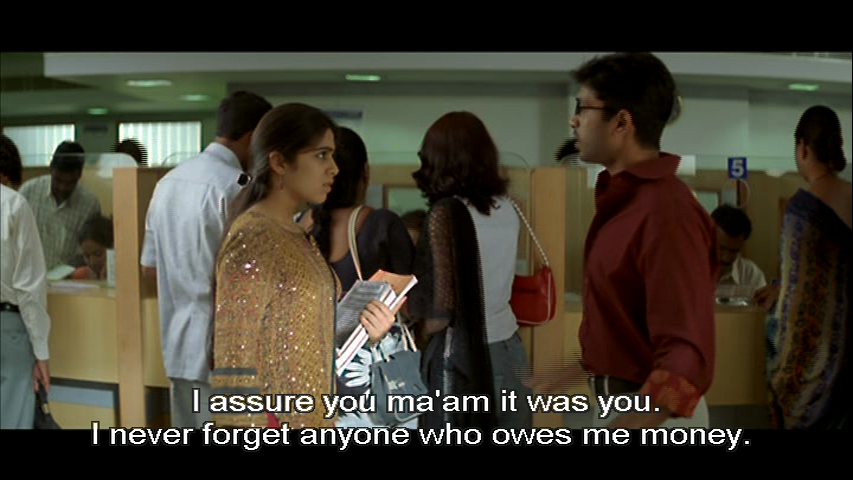
Anukokunda Oka Roju

Sahasra  is a B.Comm student, but her passion is singing. She is a smart, confident girl who is an unwanted addition to her step-mother’s household and she tries to keep her head down.  Her friends are an unexceptional bunch of students and singers, and she is an ordinary girl. So why are people trying to kill her?

Anukokunda Oka Roju translates as Suddenly One Day and the answer lies in a missing day in Sahasra’s life. The action took some time to get going, but I always felt there was some underlying sense I just hadn’t uncovered yet. The direction by Chandrasekhar Yeleti is pacy but allows time for the story to unfold in a way that felt realistic enough and the city setting gives a slightly chaotic edge to the action. It didn’t feel like a join the dots story and there were things that seemed irrelevant initially but took on more significance later. The strength of the characterisations helped keep the suspense set to high despite some overly contrived incidents. Once the motivation behind the attacks on Sahasra was revealed I struggled to completely believe in it, but I was so interested in the characters that I eventually found the ending quite satisfying.

Charmme delivers a great performance as a girl in trouble and out of her depth. Sahasra is a talented singer in a studio chorus with ambitions of singing solos for the great film composers. Charmme shows the spark of confidence and joy that Sahasra feels when she is involved in her music, and how that evaporates when she returns home to a less hospitable environment. Her speech and expressions become younger, almost childlike as she seeks to placate her step-mother, but then regains her robust cheekiness when on the phone to her mother. It makes Sahasra’s fear and also her resilience seem real as we see her strength in everyday situations, not just in the struggle to survive.

This is my favourite of Charmme’s performances, and if you want to see a modern heroine carry a film other than a rom-com, this is a great place to start. And she sings a song sort of dedicated to Chiranjeevi so clearly she has excellent taste in film heroes!

Rajesh (Shashank) is a student who runs an unofficial taxi service on the side. He spots Sahasra and chases her demanding money for a taxi fare she doesn’t remember. She denies everything but they keep crossing paths. He rescues Sahasra from a gang of big burly men and in turn becomes a target of sorts. Shashank does an OK job, but as in Sye he doesn’t do any more than just OK. He is suited to this role, and the fight scenes are realistically scuffly and non-heroic, but despite being in a couple of highly dramatic sequences he made little impression.

SI Suresh Reddy (Jagapathi Babu) is an odd character. A corrupt and eccentric juice-swilling policeman, he is in the vicinity when Sahasra is attacked. His investigation is motivated by both judicial and personal concerns – unbeknownst to Sahasra, her father was in talks to marry the pair. He is socially awkward and falls for her like a ton of bricks.

Jagapathi Babu is brilliant at showing glimpses of the awkward guy with a crush as well as the confident bully. His eccentricities seem to stem more from boredom in his career and his life, and when he means business, he is convincing. He takes on the investigation and at first is totally unwelcome in Sahasra’s life and her friends resist him. But he gets results and as he unravels the events, he realises that other mysterious deaths may be related and Sahasra is in more trouble than she knows. His character builds over the course of the film, and I found myself first dismissing him as a corrupt nutter, but then anxiously looking for his face in the crowd as things looked grim for Sahasra.

Sahasra’s friend Shwetha (Pooja Bharti) took her to a party and Sahasra’s drink was spiked. This is the reason for the lost time, and lost memories. The drugs were let go by Suresh Reddy when he took a bribe from the dealer so his involvement takes on another dimension. The dialogue (by Ganga Raju Gunnam) was excellent, often amusing and very illuminating in terms of character insights. The girls are such different characters and I liked that they were shown as disapproving but not bitchy. There are a couple of dialogue exchanges where the girls discuss sex and it is refreshing to see friends who can tell each other they think the other is an idiot but without rancour.

The safe sex message is loud and clear and despite being linked to an unwanted pregnancy, I didn’t feel that the girl was being demonised, and she certainly wasn’t made to suffer or repent. In fact, the good girl was the one to walk out of the hospital and nearly be killed. It was an interesting detour and suited the low key modern urban setting and the cast of 20-somethings. Sahasra is a typically good girl heroine, but her friends are diverse (although very much in the background) and that makes her more relatable and real.

It was this level of detail in the characterisations that made the film so engaging for me. These people had lives I could identify with to an extent, and their motivations were believable. Sahasra’s home life was complicated by her father’s remarriage, but her step mother wasn’t a crazy evil stereotype, just a bit of a bitch. Shwetha was partially responsible for her friend’s predicament because she didn’t speak up at first, but she was still a good friend when Sahasra needed support. Rajesh had debts and aspirations, but didn’t let his own plans blind him to a person in need. Suresh could have used his authority to pressure Sahasra but he backed off and when she came to him, he helped and did it in as sensitive a manner as he could. There is a scene at the end where Suresh just says what he needs to say to the guy who he thinks might get his girl and it’s touching but realistic.

There is a comedy sideplot, but mercifully it is carried mostly by the very likeable Harsha Vardhan as a hapless school teacher and neighbour, and to an extent by Rajesh in his taxi. The comedic incidents do all in some way feed back into the main story, and involve relevant characters. Harsha Vardhan wins my special gold star for most excellent insults delivered in delightfully plummy English.

And there was a fight in a music shop which I enjoyed a lot as it was funny and still menacing – and Charmme acquitted herself pretty well before her rescuer turned up.

The M.M.Keeravani soundtrack is effective and all the songs have their place either illustrating characters or incidents, so there were no breaks in the dramatic tension just because people burst into song. The cinematography adds to the mood, using changing angles and distances to show the pursuit, but balancing that with character focussed shots that reveal people’s inner thoughts and hopes.

It’s a really enjoyable thriller and I highly recommend it. I have to make a minor deduction for an over the top although rarely seen bad guy, and his motivation. But the conclusion for the three main characters is satisfying and a little less predictable than it might have been. 4 stars!