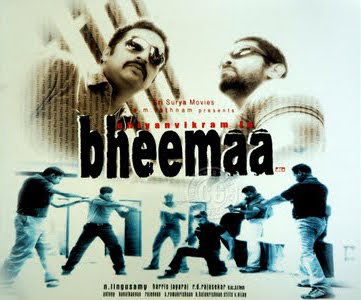
Bheema

Bheema centres on the key players in a gang and their interactions with rivals and police in Chennai. It’s quite a sanitised version of the criminal underworld, and little detail  is revealed about the nature of how these guys make a living. But it has two fantastic actors at the forefront, a delightful bromance, and a focus on characters that makes the who and why of the story more interesting than the what.
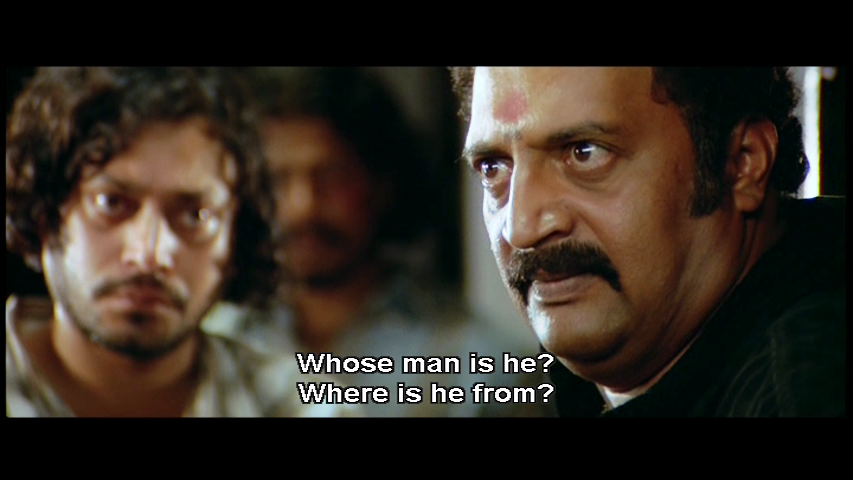
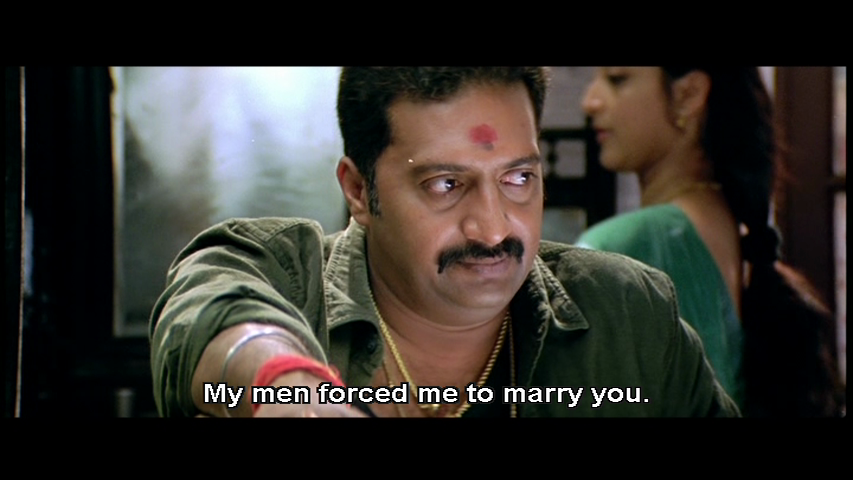
Chinna (Prakash Raj) is the local hard man. He started small in a small town and has risen to become one of the biggest crimelords in Chennai. His business dealings are never overtly discussed but he is presented as a ‘good’ gangster. He looks after the defenceless, his guys don’t attack women and children, and he plays by ‘the code’. Prakash Raj is perfectly cast. He makes Chinna likeable, roguish, aggressive and menacing by turns. Chinna is under threat from an old associate (Raghuvaran) and has an uneasy and crumbling detente with the local police. Things are getting tougher, but he is not one to back down. There is a lot more to the character than just being a figurehead, and I liked the glimpses into Chinna’s past, his conversations with old advisors, his wife, even the police, that showed different facets. He thought through the consequences, he reacted emotionally to some situations and I could understand the loyalty Chinna inspired because he seemed real yet powerful. I always enjoy seeing Prakash Raj in a more substantial role, and this is one of my favourites.

Sekar (Vikram) is an enigmatic figure, shadowing Chinna and despatching his enemies before Chinna can. The reason for his obsession eventually emerges via flashback, and it reinforces the notion that justice is not delivered by the law, and what makes a man is the ability to beat the living daylights out of another man. Sekar believes in instant justice, delivered as he sees fit. Even the police in Bheema argue that they can’t operate with the constraints of bureaucracy and low budgets, and have to break the rules to achieve what they see as justice. Sekar is given the name Bheema by the police in recognition of his strength and his role in Chinna’s life.

Sekar’s sole ambition was to one day join Chinna, his role model for strength and justice and a more satisfying father figure than his ineffectual policeman dad. I’ve often wondered why characters stick with their gangleader and don’t just leg it when things get crazy. Writer Sujatha provides a backstory and motivation that gives more to these guys than just being the good baddies. Vikram switches effortlessly from the full throttle action sequences to gazing mistily at Chinna or quarrelling with Shalu, and his physicality suits the invincible Sekar. Vikram’s rapport with Prakash Raj is one of my favourite things about the film and they play off each other very well.

It’s a man’s world, and sometimes in unexpected ways. Vikram steals the focus from the item girl in this song, and Prakash Raj is the one to be almost upskirted.

What sets Bheema apart from other grim gangster fairytales is characters having a life, or at least ideas, outside of the job. Chinna was in love with Padma but they drifted apart. Sekar, ever the loyal lieutenant, reunites them.

Prakash Raj does some delightfully girly fidgeting and stammering, and can’t hide either his happiness or trepidation at marrying his old flame.

Padma (Lakshmi Gopalaswamy) is gorgeous and her scenes with Chinna have a warmth and maturity that suits the slightly older lovebirds. They talk about the risks of her being part of his life, and she is firm in her assertion that she has no illusions. I found the dialogue rather flowery but the emotions came through and they seemed to have a deep mutual affection. He talks to Padma about Sekar, since Sekar is like family and Padma is in charge of the household. She and Chinna make fun of Sekar when they find out he is turning into a gooey romantic wittering about flowers, and their playful banter is another glimpse into the relationship.

Sekar loses his focus on being a thug when he starts to think of love and  Shalini (Trisha). He knows that his priorities have shifted and he can’t rely on himself to be as focussed, fearless and impulsive as he once was.  Chinna lets Sekar go, in a scene more like a breakup than an exit interview.

Unfortunately, Shalini (Trisha) is stupid and irritating for almost all her time in the story. I’m not sure why Indian film heroines characterise innocence by appearing to be dim-witted but Shalu is dumb as a box of rocks and about as interesting. Sekar falls through the roof into her courtyard one night, landing on her. Because of this, she decides he is the one, manufacturing reasons to be near him and imagining they share likes and dislikes based on absolutely no evidence. I did find her stalking Sekar mildly amusing just because it is a bit of turning the tables, but that was all I could see in her favour until quite late in the piece.

Once Sekar succumbs, Vikram and Trisha generate some chemistry and that made their relationship seem vaguely plausible. I liked that they had playful but still intimate scenes together as things developed, and it helped make up for the brain-dead start.

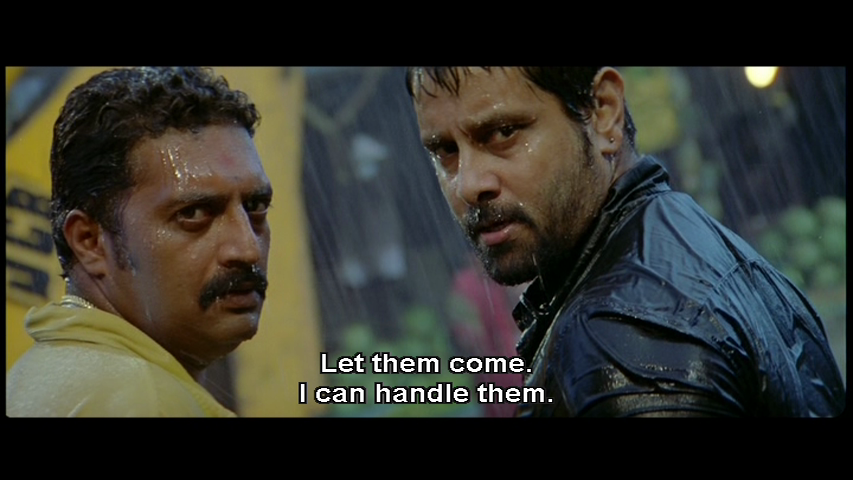
Chinna is a surprisingly sentimental old school don and sometimes that works against him, as he plays by rules others are starting to disregard. Sekar idolises Chinna and can’t abandon his old boss but feels compelled to take Shalini away. Once the other players sense weakness in Chinna, they start closing in. How will it all work out?

There are indicators. Shafi is in the support cast in Chinna’s gang. And Shafi does tend to play characters that bite the hand that feeds them. Also, I have developed a theory. In the imaginary Tamil Film Writing School in my mind, the compulsory class on ‘Ways to End a Film – Traditional (aka Everyone Dies (Rape Optional)’ is well attended. The final elective class ‘Ways to End a Film – Creative Writing (aka ‘No Rape, No Murder – stop being so lazy and think of something else’) falls the day after the big end of year dinner and people are either too hungover or they’ve already got enough credits to graduate, so most students don’t go. Thus there is generally one ending for a Tamil film, regardless.

I quite like the songs by Harris Jayaraj, but the picturisations of the romantic duets seem to exist mostly as a safe channel for the wardrobe department to vent their creativity.

The support cast includes so many reliable character players but the focus isn’t on them and I barely paid any heed to Ashish Vidyarthi, Tanikella Bharani, Shafi, or Raghuvaran among others. Chinna and Sekar dominate the story and Prakash Raj and Vikram likewise dominate the performances.

Linguswamy has directed an action packed film that doesn’t feel hurried or slapdash, and it is very satisfying to a point. The ending was a disappointment and yet almost exactly what I expected. The action scenes are typically excellent as is standard for this genre. There were some nice little extras – when Sekar belted a group of guys with a metal pipe, they chimed like bells as they dropped. The editing is good and the quick cuts and occasional use of effects enhance the sense of urgency or disorientation. It’s a very competent film and a pleasure to watch.

If you’re lukewarm on the South Indian gangster genre, this could be well worth a look. It has better than usual characterisations, some excellent performances and good production values. And one of the best filmi bromances. 3 ½ stars!
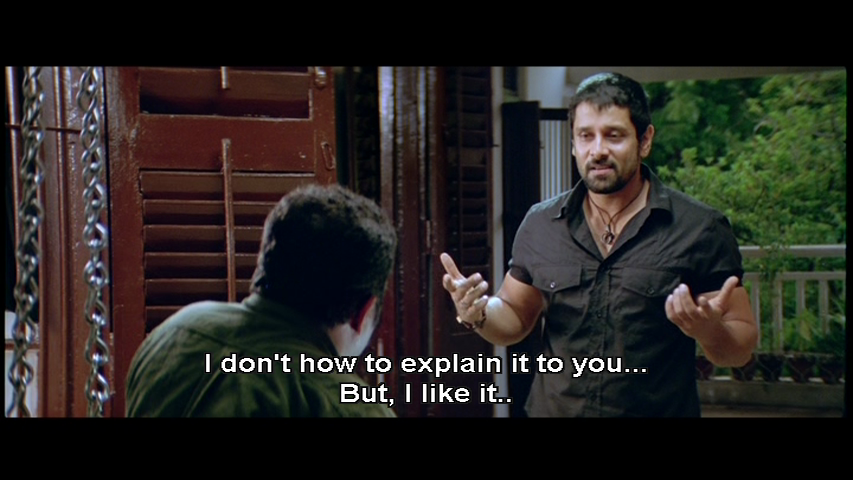
Heather says: I’m a fan of Tamil gangster films and usually enjoy anything by N. Linguswamy, but Bheema was rather disappointing all round. Instead of the usual well-developed storyline and strong characterisation I expect from such an accomplished director, Bheema staggers from fight scene to overdone fight scene without any real justification for the characters acting in the way they do. Rahguvaran is ineffectual as the ‘evil’ don Periyavar and his feud with ‘gangster with a concious’ Chinna seems clichéd and unimaginative. The second part of the film which concentrates on the new Police Commissioner and his vendetta against the gangs is more convincing but still seems formulaic and just not that interesting. The relationship between Chinna’s new lieutenant Sekar and the rest of the gang could have been made into something more exciting but instead it’s thrown in towards the end to try and spice up the climax. Something which only works to a limited extent. However, it’s good to see that Shafi continues his quest to always play the smarmy, self-satisfied sycophant and he does his usual thing here as one of Chinna’s men to good effect.

Despite the issues I have with the story, Bheema is saved to some extent by the excellent performances from Prakash Raj and Vikram who both breathe life into the film. I agree with Temple that their camaraderie feels very genuine and the interactions between the two do much to make up for the dreariness of the plot. Vikram’s character is very much the strong silent type and he does a good job with the rather dour Sekar, but Prakash Raj steals the show as the gangster with a heart. His romance is perfectly played and he brings out a human side to Chinna making him much more than just another world-weary gangster. Despite his good performance, Vikram looks rather over muscled here and I confess that I prefer him in more character driven roles such as in Pithamagan and Kasi where he has more range to work with. The one-man indestructible army of Sekar was just a little bit too much to take, especially with the distracting musical sound effects and overly loud soundtrack during the fight scenes.   The implausible relationship between Shalini and Sekar was another disappointment and the two never felt comfortable together –  odd, considering the considerable chemistry the two actors shared in Saamy. In fact there is much more sparkle between Chinna and Sekar!

Bheema does have a good soundtrack and there are moments where the film starts to grab your attention, but sadly they’re just not sustained. Worth watching once for Vikram and Prakash Raj but that’s all. 2 ½ stars.

Pithamagan

Pithamagan is not a film for the faint hearted. Like other Bala films, it deals with society’s poorest and most disadvantaged – in this case, he delves into the world of cremators, petty con artists and drug pedlars.  And yet it’s very watchable, with excellent performances from Vikram, Suriya and the rest of the cast making Pithamagan much more than just another film about the miseries of being poor and outcast.

The focus of the film is the relationship between Chittan, an orphaned cremator and Sakthi who is a small time criminal. Chittan is born in a graveyard and brought up there by the cremator who seems to do his best for the child. However Chittan grows up to be unable to deal with society; he cannot communicate in words, and is unable to understand the basic tenets of normal behaviour.

After his guardian dies, Chittan ventures into the local town where he creates mayhem before being rescued by Golmathi, a local cannabis dealer. He ends up following Golmathi home, and since she has a kind heart and feels sorry for another orphan like herself, she helps him to find a job. This turns out to be at a cannabis farm and when it is raided by police, Chittan ends up in jail. There he meets Sakthi who also feels sorry for Chittan and tries to help him cope with life inside prison. Sakthi is a petty crook who runs street tricks and confidence games which seems to have given him a performers approach to life. He has a sunny disposition and a positive outlook despite his circumstances and occasional rather interesting dress sense.

After Sakthi is released from jail he works with Golmathi to secure Chittan’s release, and along with Manju, a student who was once victim to Sakthi’s confidence tricks, the friends then spend most of their time together. They work on improving Chittan’s appearance and behaviour, and try to get him away from the drug trade with mixed results.  However, the local drug baron has other ideas and the final conclusion is as bloody and gruesome as you might expect.

While the story itself is rather predictable, overall the film works well and this is down to the chemistry between Vikram and Suriya. Vikram seems to be able to take any disability and make it instantly realistic. I really believed that he was blind in Kasi and here he is totally convincing as the mentally disturbed Chittan. His facial expressions are just perfect and he really does appear to be totally wild and uncontrolled. It’s hard to define exactly what Chittan’s problem is, but as a scientist (and brain researcher!) I’m immediately intrigued and want to analyse the cause of his condition.  Is he simply a wild child – raised without the benefit of society and therefore unable to function within its rules? Or is it more organic and he has a functional neural developmental problem? I tend to favour the latter as the cremator who took him in was able to speak and obviously had some idea of how to interact with the townspeople. So the total inability of Chittan to communicate and relate seems to be something more than just growing up with little social contact. It also doesn’t explain why he was able to fight so well, but obviously that was essential to the plot and we can’t ask for too much realism I guess. I love that he left the policeman upside down in the shot below – the fight scenes really were good in this.

I also find it interesting that in so many of Vikram’s films, his character is somewhat crazed, and he is completely convincing each time! But as good as Vikram’s performance here is, I think that Suriya manages to equal it. This is the first film where I have really ‘got’ Suriya’s appeal. I’ve seen him in a number of films and while I thought he was good as the cop, or the good guy, or even as the bad guy, I’ve never felt that he’s been anything more than that . But Suriya is absolutely fantastic in this film. He is funny and charming, and breathes life into the story. Most of the comedy comes from Sakthi and his various cons, and without this balance Pithamagan would have been very grim indeed. Suriya’s character has plenty of flaws but at heart he is kind and his relationship with Chittan allows this side of his character to flourish.

Sakthi’s friendship with Chittan is cleverly developed throughout the story and makes it credible that the two would end up as constant companions. Chittan seems initially perplexed by Sakthi’s benevolence towards him but soon realises the benefit of a friend. And later, Chittan’s obvious jealousy when Manju is spending time with Sakthi is both childlike and logical since Sakthi has become the centre of his world.

Sangitha is perfect as Golmathi with her paan-stained lips and philosophical approach to life. Her character is another orphan and her initial pity for Chittan seems similar to how she would feel for a stray dog. But as a drug dealer and someone who is shunned by the local community (unless they want her product), she is able to empathise with his alienation and is the first person to start opening up his world. Golmathi’s emotions and reactions are all plain to see on her face which helps make her character much more sympathetic.

On the other hand, the first time I watched this film I really didn’t like Laila’s character and felt that she over played the schoolgirl. But on re-watching, I think she was supposed to be a fun character with a sense of adventure and an awareness of the possibilities of life which was intriguing to Sakthi. However I think Manju is a much less believable character than the others, and her presence is often more irritating than anything else. Initially her father seemed to be quite strict, even taking her to the jail to beg for Sakti’s forgiveness for her actions, which in itself seemed a really strange thing to do. But then later on in the story, her family seem to let her do whatever she wants, despite knowing that the man she is involved with is a convicted criminal. They do turn up to support Manju in the end, by which time it seems to be too late and is perhaps just a way to make a contrast to the other characters  whose only family is each other. Manju’s presence also provides another dynamic to the relationship between the two men since she becomes a barrier between them. But my biggest issue with her character is her inability to articulate what had happened to Sakthi, and this is a major flaw in the story for me. While I’m quite sure that in real life people become too distressed to be able to communicate, here it just didn’t seem to suit her personality, even allowing for her youth. It was also just a bit too over the top and filmi for a story that relies so much on gritty realism – at least for most of the film.

There is one other odd note, which is the protracted interlude with Simran. This completely changes the nature of the film and lasts just a bit too long. In fact it reminded me of the Hindi film Shakti, where Shah Rukh Khan turns up for an item song and ends up taking over a large part of the final scenes. While the song here is fantastic, and I love it, it stops the flow of the story and the subsequent scenes initially feel out of place as the pace abruptly changes again. But here it is anyway, since both Simran and Suriya are brilliant and it’s very funny.

I think Pithamagan is an excellent film despite a few flaws with the pacing. The friendships are successfully portrayed and the action is fast and well choreographed. Vikram’s grunting and animal noises are interesting and effective, and so much better than his singing which is absolutely brilliant in its tonelessness. I wonder just how hard Vikram had to work to make it sound that bad! The music by Ilayaraja is quite beautiful but not particularly memorable, especially since it’s often used as a backdrop for more of the story. Overall though it’s the performances that make this film worth watching and I would recommend it for Vikram and Suriya who are both outstanding. 4 stars.

Kanthaswamy

Kanthaswamy is not a great film, but instead serves as an excellent example of what might have been. A potentially appealing concept – a modern superhero/Robin Hood taking on the system, with all the benefits of the latest film technology and a good cast. And yet it falls short of the mark. A meandering story line, an irritating heroine and uneven pace mean this falls into mediocre territory.  It’s still a moderately enjoyable film, but could have been a lot better.

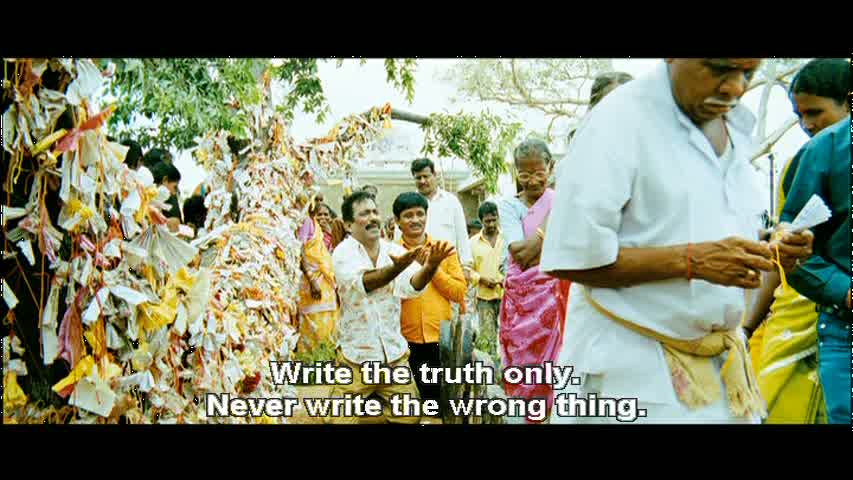
Vikram plays Kanthasamy, an officer in the economic offences department of the CBI who leads a double life as Kanthaswamy, a modern day version of Robin Hood.  Pay attention to that “w”! Using a local temple dedicated to Lord Murugan to assess who is in need , he and his band of merry men use money they have acquired as a result of their CBI raids, and distribute it to the poor.

Kanthasamy’s back up team are skilled in theatrical productions and technology, and after each reckoning with the villains, we get to see how it was set-up. We really enjoyed this – it was a cool twist on the invulnerable loner type of heroes. It also allowed for some back story about the group of friends and the introduction of one of the villains of the story.

Kanthaswamy is literally a ‘chicken’ superhero.  He has a great lair with numerous chickens which presumably come in handy for costume feathers as well as for Kanthaswamy to perfect his chicken impersonations.

Vikram is awesome as a chicken. No one else to our knowledge has managed to capture the mannerisms and emotional range of a chicken as well as he.  He makes the most of these Chicken Superhero moments and these are when the film works best.

There is also some clever comedy as Kanthaswamy metes out punishment to those who try to cheat the poor. One of the best moments occurs when local ne’er-do-wells pray for an Aishwarya Rai lookalike to come visit them and have some “fun” – and their wish is fulfilled in an unexpected but truly deserved manner.

The growing fame of Kanthaswamy brings the attention of police and media, and everyone wants to know who the Masked Chicken Man is. He falls foul (had to do it!) of local big-shot PPP, who promptly fakes illness to avoid further police action.   The rest of the plot revolves around PPP and another local crime lord Raj Mohan; detailing their various machinations to eliminate both avatars of Kanthasamy so they can get back to their illegal financial skulduggery, and the ways in which their plans are foiled.

As a second thread, PPP’s daughter, Subbulakshmi is roped in by her father to seduce Kanthasamy and bring him into her father’s crime organisation.  This very annoying character is played by Shriya. It says a lot that at one stage, Subbu’s life was in danger and we were yelling at the screen for Kanthasamy to let her die!  Portraying the heroine in the monotonously OTT way chosen here gave Shriya nothing positive to work with – as we didn’t buy the emotional element to the story, it became a distraction and deadweight. And her hair looks like a meringue; it’s also very distracting and annoying.  Shriya has been better in other films we have seen, so we suspect the director may have really missed the mark with this. The role itself had potential to elicit more sympathy from viewers but the performance highlights the narcissistic, arrogant and trashy aspects over the more likeable qualities that could have been conveyed.

Vikram plays his role quite deadpan, and the direction relies on a psychic voiceover to convey many of the inner thoughts and feelings “I know she knows that I know she knows”. This is a good gimmick, but is overused and may hamper the performances.

The running comedy track involving a dim-witted petty crook who operates in the vicinity of the temple is integrated with the story and is occasionally funny. But it is too long, recurs too often and disrupts the rhythm of the story.

The songs were huge hits. They are well integrated into the film and are successfully used to show aspects of the character.  However, there is limited dancing, always a negative in our view, and what dancing there is wasn’t well choreographed for the actors’ skills.  The exception to this is the songs featured on Vikram and friends which does work much better.  Allegra in particular is a fine example of how bad choreography can derail a song!   And the subtitles throughout the songs are frequently perplexing!

The first half of the film moves along pretty well. There is intrigue as Subbu and her evil father PPP attempt to destroy Kanthasamy as he takes on big business and corruption in and out of the police force. Then it all goes off the rails as the story shifts to Mexico for no good reason.

The motivation of characters seems to get muddled as well. Subbu wanted Kanthasamy to love her so she could destroy him but she loves him or doesn’t (we really couldn’t work this out!) and there is no rationale embedded in her changes of heart.  A needlessly convoluted sting operation later, the characters return to India, and the film starts racing to its conclusion.

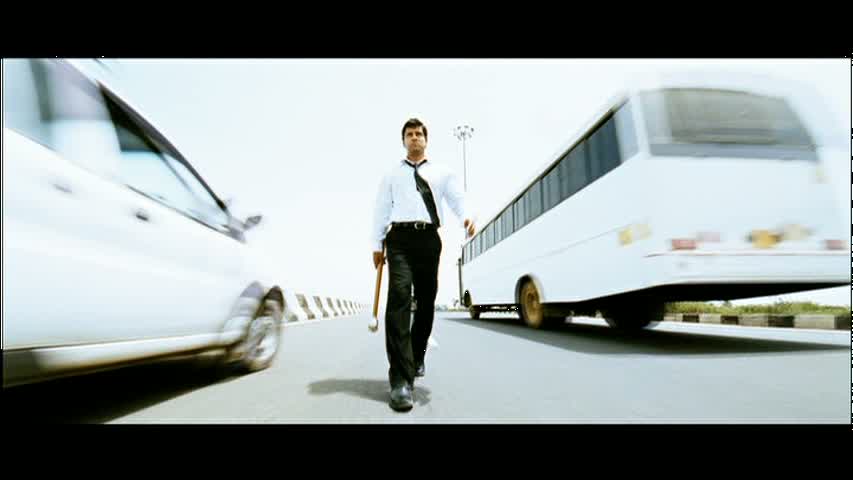
Finally, PPP gets Kanthasamy in his clutches and thinks he has control over the activity of Superhero Kanthaswamy as well – but he is mistaken. Subbu learns that her father isn’t the man she thought he was, and Kanthasamy is more than a match for her. We learn that we are all Kanthaswamy or maybe we’re not, and that in the Rock-Paper-Scissors of life, a sledgehammer will beat a bus any day.  All’s well that ends well, but do we still care?

You may be wondering about item numbers. We were. Luckily Mumaith Khan shows them how it’s done! (Beverage warning applies – get the drinks away from the computer before you watch this. We have warned you.)

Heather says: I heard the songs from Kanthaswamy while I was working in Tamil Nadu as they were being played everywhere.  Even the local school children performed to Allegra at their prize giving.  I’d even seen the song clips as we had DVDs on our bus, so knew that the choreography didn’t quite live up to the potential of Devi Sri Prasad’s music.  (The reactions of the other Australian Health Professionals  to their first views of Mumaith Khan gyrating away to some uninhibited subtitles was however priceless!)  So I was disappointed when I managed to watch the entire film, as it could have been so much better!  There are quite a few notable moments in the film, but they are all centred on Chicken Superhero Kanthaswamy and his team of experts.  I really didn’t like Shriya in this at all, and found her presence to be an annoying distraction which totally derailed the plot for me.   Her storyline could have been removed which I think would have made for a more coherent plot and subsequently better paced film.  I don’t understand why Susi Ganeshan decided to make her such an unsympathetic character, as by the end there seemed to be no reason why Kanthasamy would fall in love with her. Indeed the actors seem to have come to the same conclusion as this romance was very unconvincing.  The frequent cuts from Vikram fighting as Kanthaswamy to him exercising and training may have been an attempt to make the film feel more like a HW blockbuster, but just disrupted the flow for me.  Despite this, overall the film looks good with some great visual effects and excellent choreography in the fight scenes.  Ashish Vidyarthi and Mukesh Tiwari were excellent as the villains and much more entertaining than the good guys.   But despite the amazing chicken impersonations, and great songs this film ultimately just disappoints – especially when you can see how good it might have been!  3 stars from me

Temple says: I didn’t hate this film, but there wasn’t a lot to love either. Ultimately, the frustration of seeing the potential for this to be a more entertaining film but not getting there overwhelmed the positives. The constant shifts from superhero to comedy to unconvincing romance just grated. If this had been a straight out Robin Hood crime caper with a superhero and his team taking on the system, I think it could have been great. Despite the big FX budget and glossy visuals this has a real pot-boiler feel as elements appeared to be added on at whim – the excursion to Mexico, the comedy track, the sting operation etc. Shriya really fails to impress in the role of Subbu, and yet I have quite liked her in other films (Chatrapathi for example, and she was very good in Kutty). For those of you wondering about whether her hairdo really did look like a meringue:

Vikram was good as the Chicken Man but less effective as the real Kanthasamy – perhaps due to the voice-over which spared him the need to emote in many scenes. They had no chemistry at all as a couple, although there is a really dire attempt at seductive song magic in the “Miaow Miaow” track. I tend to feel the director was at fault for this character misfire as the performers are capable but the film overall lacks a centre. I don’t like the soundtrack that much, and really the only reason to re-watch the songs was for the spectacular subtitles.  It’s actually not a bad time pass, but I was hoping for a lot more. I give this 3 and 1/2 stars – it gets a bonus half star for the excellent drag fight choreography.