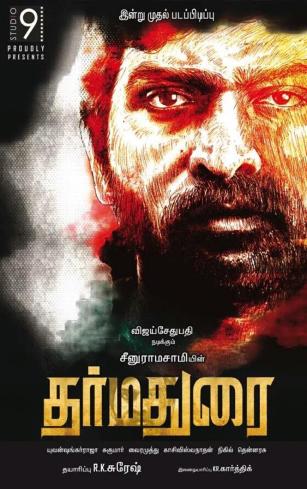
Dharma Durai (2016)

Dharma Durai poster

Seenu Ramasamy’s Dharma Durai tells the story of a doctor from a small village, his highs and lows and his final redemption through the love of a good woman – of course! The film has a slow start and even after the main character is established the pacing is occasionally uneven and erratic, but it has excellent performances from the main leads, a good story and plenty of thought provoking themes around social justice, caste, dowry and responsibility. However, it’s not as nearly as heavy as that sounds and even though the story is about an alcoholic, there are plenty of light hearted moments making the film an overall entertaining as well as a thought-provoking watch.

The film starts in the village where Dharma Durai (Vijay Sethupathi) roams around making a nuisance of himself, mainly to the embarrassment and general detriment of his brothers. Dharma is an alcoholic which explains his rather erratic behaviour, although it did take me a while to realise that alcohol addiction was the problem. It’s not immediately obvious and Vijay Sethupathi is subtle in his portrayal of a drunk, so it’s not until a village event that the full extent of his alcoholism is made clear.

Dharma accuses his brothers of cheating the villagers with the chit fund they run and seems intent on making life difficult for them, to the extent that I started to sympathise with the family, even though their method of dealing with Dharma is fairly extreme. The brothers decide to lock Dharma up in a shed until they can decide what to do with him, and the signs are clear that Dharma is not destined for a long and happy life. Dharma’s only well- wisher is his mother Pandiyamma (Radhika Sarathkumar) and in classic filmi style she arranges a way for him to escape his temporary prison.

Once he escapes the village, Dharma goes back to Madurai and the medical college where he had studied to become a doctor. The film moves into flashback as we relive Dharma’s years as a student and his romance with fellow student Stella (Srushti Dange). I would love to know if medical students in India really do wear white coats and stethoscopes round their necks all the time. It seems odd to me but at least means that they are easy to recognise as medical students rather than trainee engineers or something else entirely!

Dharma is a good student despite a tendency to spout poetry at the least provocation, and ultimately he follows his professor’s advice to return home and work for the village. After all, it’s the common people who have paid for his degree so he is morally obligated to go back and serve these people. The ethical message here is hammered home a little too much, and the students are all somewhat unnaturally altruistic, but overall the flashback is a pleasant interlude that shows Dharma is a much better light and starts to explain his past.

Back in the present day Dharma tries to track down his old friends – Stella and her friend Subhashini (Tamannaah) who also had an unrequited crush on Dharma. These were the last people he felt who really cared about him, and eventually he does manage to meet up with Subhashini and relates the series of events which led to him becoming an alcoholic.

This is the best part of the film and the flashback to the love story between Dharma and villager Anbuselvi (Aishwarya Rajesh) is beautifully done. Aishwarya is easily the best of the female leads and her characterisation of a farmer’s daughter is simply perfect. Anbuselvi is more than she first seems and it’s no surprise that Dharma is immediately smitten. Vijay and Aishwarya have wonderful onscreen chemistry and Sukumar’s excellent cinematography makes this golden time appear even more radiant as the two romance each other through song.

What makes Dharma Durai interesting is the clash between new and old. Dharma is college educated but comes back to his old village to work as he feels that is his duty. But once back at home, his modern ideas don’t sit well with his brothers’ ideas of caste and dowry and that leads to the serious conflict between them. There is also the contrast between Dharma’s old love – the beautiful and traditional Anbuselvi, and his new romance with the more modern and well educated Subhashini. Subhashini has a shiny new medical clinic of her own, but also has an ex-husband to deal with and her own share of past issues that make it difficult for her to reach out to Dharma. The only real downside to the story is the contrived and unlikely method that Seenu Ramasamy uses to get Dharma back to the village at the end. It’s all a little too far-fetched and unlikely, but why should we let any of that get in the way of a good ending!

One other issue is that the story has a few too many stops and starts as it moves from one portion of Dharma’s life to the next and as a result not all the scenes flow smoothly. The moral messages tend to be over-emphasised which also slow down the narrative and move attention away from the characters. However, once the camera is focusing on Dharma and Anbuselvi, or Dharma and Subhashini the film comes alive again and draws us back into the story. Vijay Sethupathi is wonderful throughout, and his Dharma is the absolute essence of a village boy done good for most of the film. Tamannaah is also excellent as Subhashini, although she doesn’t click quite as well with Vijay as Aishwarya, but her depiction of a career woman with a very definite set of values is nicely done. Radhika Sarathkumar is very good as Dharma’s long suffering mother while Rajesh makes a brief but notable appearance as the college professor. The portrayal of village life and a rural clinic is also very well done – I’m sure that I have seen many of those patients in my trips into rural Tamil Nadu on a health camp each year, which probably adds to the whole authentic vibe I got from the film.

Dharma Durai is an interesting story that just needs a little tighter editing to move proceedings along more consistently. The songs are good, the cinematography excellent and both Vijay Sethupathi and Aishwarya Rajesh are on top form, making a perfect match. Worth watching for their performances and for Tamannaah Bhatia and the rest of the cast who all do their part in bringing this fascinating slice of village melodrama to life.
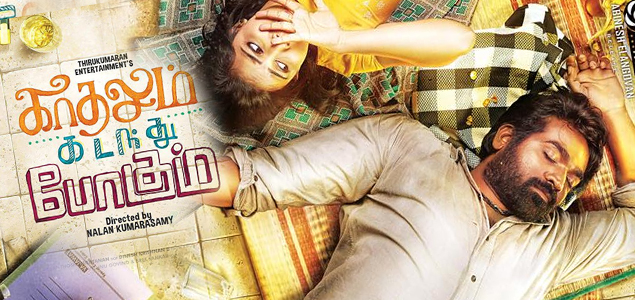
Kadhalum Kadandhu Pogum

Kadhalum Kadandhu Pofum

After the success of his début venture, Nalan Kumarasamy unexpectedly follows Soodhu Kavvum with an official remake of a Korean film; Kim Kwang-sik’s My Dear Desperado. I haven’t seen the original but the story of an unlikely friendship between a gangster and a young IT graduate translates well to Chennai, while Vijay Sethupathi and Madonna Sebastian are both excellent in the lead roles. Despite the title (which translates to “Love too shall pass”), there is little romance in the film, but instead Nalan’s screenplay includes plenty of comedy, a good dash of drama and only a smidgen of violence. Nalan keeps to his trademark witty dialogue and quirky characterisation too with plenty of funny one-liners, making Kadhalum Kadandhu Pogum engaging and definitely well worth a watch.

The focus of the story is Yazhini (Madonna Sebastian), newly graduated from a small regional college and desperate to escape her confining life with her parents in Viluppuram. Somehow she manages to secure a job in Chennai and escapes to a shared flat and the realisation of her dream, but unfortunately her happiness is short-lived. The company folds, her job goes and Yazhini is left looking for somewhere less expensive to live as she struggles to find a new job.

Yazhini’s move downwards into cheaper digs brings her into contact with the seamier side of life in Chennai, and she quickly discovers that her neighbour is a rowdy who works as an enforcer for the local area councillor. Kathir (Vijay Sethupathi) is newly released from jail and wants nothing more than to run his own bar, but his boss decides that his talents lie more in dealing with petty disputes and training up a new recruit. While Yazhini thinks that Chennai offers a world of opportunity, Kathir knows that even a small dream can be impossible to achieve and this difference in outlook is what makes their eventual friendship even more unlikely.

Initially Yazhini is frightened of Kathir and the world he represents, but gradually she warms to her neighbour and discovers that he’s not as violent as first appears. Madonna Sebastian’s Yazhini is confident but not reckless and her determination to succeed makes her a likeable character. She suffers numerous setbacks but rarely loses her optimism and for the most part her dilemma feels genuine and plausible. I really liked Madonna here after her excellent performance in Premam and I hope she gets more of these kind of roles where there is something more to her character than simply eye candy. Yazhini is a strong character who knows exactly what she wants and isn’t afraid of trying almost anything to achieve her dream. Kudos to Nalan for not making Yazhini follow the usual heroine path in a Tamil film, and avoiding a conventional romance and an unhappy end even though she’s an independent, modern career woman.

Kathir on the other hand is laconic and laid back, possibly because he isn’t a very good gangster! It’s rare that the main male lead loses his fights so emphatically, but despite instigating much of the dishoom, Kathir is the one who ends up bruised and bloody by the end. Even Yazhini comments on his frequent injuries and when added in to Kathir’s impulsive and erratic nature it becomes obvious why his boss doesn’t trust him with the management of a bar. Vijay Sethupathi excels at these kinds of roles where he can mix up comedy with fight scenes and a fair amount of melodrama to make a surprisingly convincing character. He has an excellent rapport with his co-star and his bumbling thug with a tender heart has plenty of quirks that make him seem more authentic. My favourite is his ability to rustle up a mean curry despite his deficiencies as a fighter. Jail may not have taught Kathir how to fight but it did teach him how to cook!

The support cast mainly have small roles, but all are good and effective with Samuthirakani the most notable as a corrupt police officer. For the most part the film concentrates on Yazhini and Kathir, their individual failures, small successes and the support each gains from the other as time goes by. To succeed, both Vijay Sethupathi and Madonna Sebastian need to be balanced in their performances and they manage it beautifully – making sure that the film doesn’t lose momentum even when the story switches between the two characters. Together they are even better and their relationship is the reason the film does work so well.

While Kadhalum Kadandhu Pogum may not pack the same punch as Soodhu Kavvum it’s still an enjoyable film with plenty of comedy and a well written storyline. Although there are no major twists it’s still never predictable or dull and I found quite a few surprises along the way. A film about friendship rather than romance between a man and a woman is relatively rare in Tamil cinema and this is an excellent example of just how good a story can be without adding in unnecessary love scenes. Add the always very watchable Vijay Sethupathi and Kadhalum Kadandhu Pogum is definitely well worth a watch.

Pannaiyarum Padminiyum

Pannaiyarum PadminiyumPannaiyarum Padminiyum is another Tamil film I watched initially because I liked the soundtrack and thought the story sounded interesting. It’s based on an original short film with the central idea extended into a full length feature by writer/ director S.U. Arun Kumar. It’s a sweet story about a village landlord and his pride and joy in a vintage Padmini car that he borrows from a friend. While the film is mostly about the various characters in the village and how the car comes to represent their dreams, there are a number of love stories interwoven into the narrative – including one between the driver Murugesan and a village girl Malar. But the best love story is the one between the landlord and his wife Chellamma, and that’s the one that makes this film well worth a watch.

Pannaiyar (Jayaprakash) and his wife Chellamma (Tulasi) have an open house policy, where anyone in the village who needs anything can come and get their help at any time of day or night. They’re somewhat hindered in their efforts by their hapless servant Peddai (Bala Saravanan) who tends to jinx everything he touches, but really the only blot on their horizon is their daughter Suja (Neelima Rani). Suja visits her parents regularly and always manages to remove something of value from the house despite the best efforts of her mother. Chellamma is incensed by her daughter’s avaricious behaviour and Suja very definitely isn’t the usual ‘good daughter’ featured in rural Tamil dramas. I like this different take on the mother/daughter dynamic, particularly since Chellamma is kind and accommodating to everyone else. It’s only with her daughter that she has a mutually antagonistic relationship although it’s clear that the reason for it is the heartache Suja causes her father.

When Shanmugam (Mahadevan) lends his Padmini car to Pannaiyar, at first he is content to just stand and look at it as it sits in his yard. But then there is a village emergency and the car is needed to drive a young boy to hospital. Luckily for Pannaiyar, local farmer Murugesan (Vijay Sethupathi) knows how to drive a tractor, so he is quickly enlisted to drive the car to the hospital. Murugesan is introduced trying to race against a bicycle, so we know that he has a need for speed – even if his tractor can’t even win a race with a pedestrian let alone a cyclist. For Murugesan the Padmini car is a whole new world and he quickly becomes totally besotted with the car, as are Peddai and Pannaiyar and pretty much all the kids in the village. The joy they have in the simple presence of the car is well captured by the delight each shows in cleaning and looking after the vehicle, and the squabbles that occur as each asserts his right to each task.

Chellamma is the only sensible one who keeps her distance, although she is secretly amused by the men’s absorption with an inanimate object. She knows that the car does not belong to Pannaiyar and she refuses to have anything to do with the car and their obsession.

Chellamma is an interesting character who has very definite ideas about her role in life and how to best manage her ‘family’. This includes Murugesan and Peddai as well as her husband and she keeps everyone in line so subtly that they don’t realise just how they are being looked after. When the car unexpectedly is left to them, Chellamma tells her husband that she will only ride in the vehicle once he has mastered the art of driving. Naturally then Pannaiyar accepts the challenge and determines that he will learn to drive in time to take her to the temple for their wedding anniversary. However this means that Murugesan will have to relinquish control of the wheel, so the lessons go very slowly indeed.

Meanwhile Murugesan falls in love with Malar (Iyshwarya Rajesh) when he ends up transporting a body for a funeral. It’s an interesting situation for a love story to start and Murugesan’s struggle not to approach Malar on such a sad day is charmingly depicted.

Eventually Malar and Murugesan do manage to get together although the romance is kept low-key with Malar very definitely in second place behind the car in Murugesan’s affections. Iyshwarya Rajesh is lovely here and has a lovely dynamic with Vijay Sethupathi. She has a small role but makes an impact every time she appears onscreen, while Vijay Sethupathi avoids appearing as a ‘star’ and is perfectly understated, keeping to the background when required but still impressive when the focus is on Murugesan.

The more developed romance is the one between Pannaiyar and Chellamma which shows a well-established and happy marriage, even after all these years. They have their ups and downs, disagree about their daughter, but despite the occasional argument they have a very strong and loving relationship. Each tries to save the other from unhappiness as much as they can and the love the two have for each other comes across clearly in all the thoughtful things they do for each other. Even with all the sentimentality, the romance never feels too sickly sweet but rather is warm and affectionate. Tulasi is just fantastic here, and has some wonderful facial expressions, particularly behind her husband’s back. Jayaprakash is also excellent, and this song perfectly shows their sweet relationship.

While the story is very simple it’s effective, and the car becomes the symbol of the dreams and desires of the various characters. Murugesan wants to keep driving as it gives him enough prestige to attract Malar, and he is worried that he will lose his job when the landlord learns to drive. Pannaiyar wants to drive to impress his wife on their wedding anniversary, while Chellamma wants her husband to be happy. The boys in the village just want to sit in the car and dream big dreams, with one even collecting 5 rupees to pay Peddai to let him sit in the front seat. It’s all very charmingly told and when the inevitable problems occur they are dealt with sensibly, without resorting to excessive melodrama. The soundtrack from Justin Prabhakaran is also excellent, with each song perfectly fitting the situation and well placed in the narrative to move the story along. I love the lyrics in this, including the references to Chitty Chitty Bang Bang and other classic cars – it’s such a happy song too!

Pannaiyarum Padminiyum is a simple story that focuses on the relationships between the central characters and on their naive dreams and aspirations. With such a limited focus the story does end up feeling just a tad too long by the end with some of the diversions adding little to the overall plot. There are one of two moment of mushy sentimentality in the relationship between the landlord and his wife which really weren’t needed as Tulasi and Jayaprakash are at their best when they keep their relationship natural and realistic. Definitely one to watch for the main leads and a sweet story that’s warm and engaging right to the end. 4 stars.