Ammoru

Ammoru_Poster

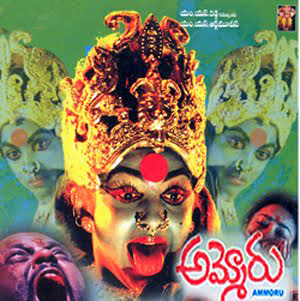
Ammoru is a 1995 film combining mythology and religion with a family drama. Directed by Kodi Ramakrishna, strong performances, a well plotted story and well modulated pace ensure this never gets dull. I like the socio-fantasy and mythological genres and Ammoru has plenty of the elements I find interesting and entertaining.

Ammoru-Ramya Krishna 1Ammoru-Ramya Krishna 2

An entire village is praying to be saved from an illness when a mysterious lady approaches. A kindly woman offers her a meal and shelter after the stranger had been turned away from food dedicated to the deity. In return, the mystery woman makes an infusion of neem leaves and directs the village lady to sprinkle it in front of every house but, whatever she does, not to look back. The stranger will watch over the lady’s house until she returns. Of course she looks, and sees Ammoru in her full glory. Knowing that the goddess would leave the village at the conclusion of the task, the lady kills herself to avoid returning and Ammoru stays and becomes the resident deity. Some years later, the orphan Bhavani is in danger from rapacious Leelamma and her black magic practitioner son Gorakh. Bhavani stopped Gorakh from burying a young girl alive in a ritual to gain his wish so he was not a fan. Leelamma wanted to marry her own daughter off to wealthy Surya, but he married Bhavani to rescue her from Leelamma instigated humiliation. A lifelong devotee of Ammoru, Bhavani is protected time and time again by the goddess. But just when things are at their darkest, Bhavani sends her protector away and compels her not to return unless certain conditions are met.

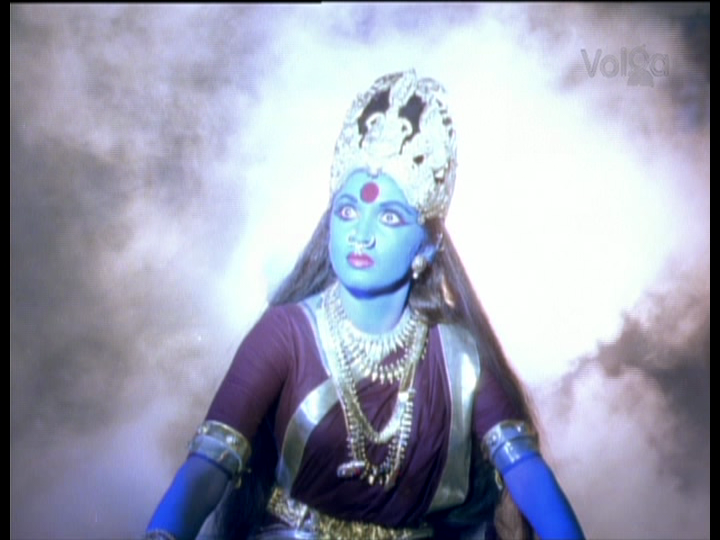
Ramya Krishna dominates as Ammoru although her screen time is limited. Her appearance as the goddess is stunning. The make-up and special effects teams do a great job of making her beautiful yet terrifying, especially when her vengeful nature is stirred.

Also playing an aspect of Ammoru is Baby Sunayana – a preternaturally wise child with a high pitched creepy giggle. I did wonder why no one remarked upon the smoke, coloured lights and echoey vocal effects that often accompanied her, but that is a mere detail. She happily torments Bhavani’s enemies, rarely confronting them directly but making sure their plans go awry. As the little maid, Sunayana is playful but intense with expressive eyes. She conveys maturity and substance despite an unfortunately shrill voice and holds her own in some dramatic scenes with Soundarya.

Ammoru-blessings 1Ammoru-blessings 2

One scene I particularly like is when Ammoru invites her sister deities to attend a ceremonial lunch after Leelamma turned away the intended mortal guests. The goddesses looked matronly and regal and the interplay of everyday and supernatural was striking but not overemphasised. The film often points to a gulf between religious belief and day to day practice. Ammoru is a mother figure, but she is all for tough love. She rewards those who do right and who try to help themselves.

Ammoru-Soundarya as BhavaniAmmoru-wedding night

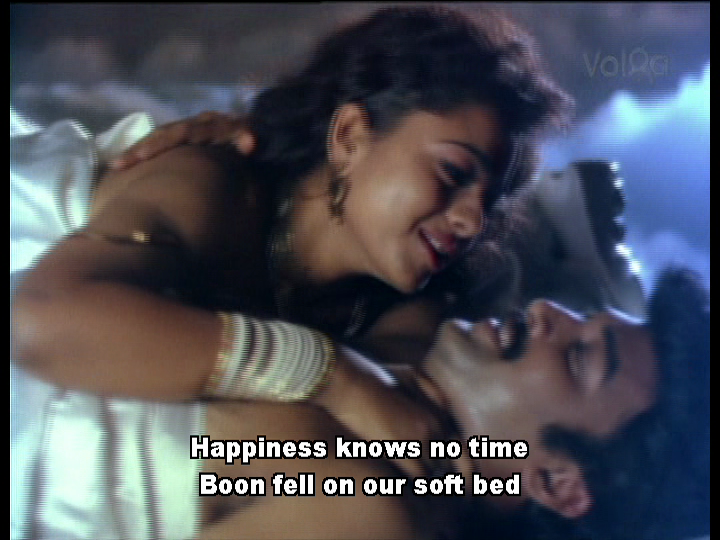
Soundarya delivers an accomplished performance as Bhavani. While the character is a bit dim at times, she has a backbone so there is ample range for the actress to do more than look winsome. She grows from a shy girl to a happy confident new bride who enjoys married life, but when Surya leaves for the USA her in-laws go on the attack. Her baby is targeted and her reputation is in tatters. Undermined and made to doubt her own sanity, Bhavani grows progressively weaker. But when Surya’s life is under direct threat Bhavani throws manners aside and demands Ammoru repay some of the devotion she has been given over the years.

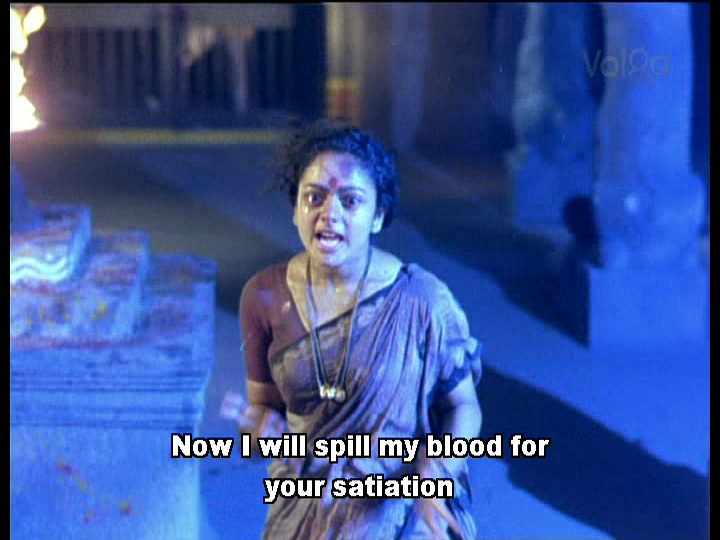
Ammoru-Bhavani is tormentedAmmoru-Soundarya 2

Soundarya transforms from meek to angry and demanding without seeming a caricature. It is a pity that Soundarya died young as she had the ability to play such a range of characters and emotions that her career should have been long and interesting.

But this is by no means a feminist film. Men still rule the roost, with Surya (Suresh) casually disregarding Bhavani’s preferences and generally ordering people about regardless of whether he knew what was going on. He also demands proof before offering obeisance to heaven, which is unwise I think when dealing with a goddess who claims Durga and Yellamma among her names. A girl who is almost raped is told she has to marry the rapist as that is the only way to preserve her honour.

Ammoru-Creepy manAmmoru-what is she doing

The fact that her own mother set the attempt up but intended Bhavani to be the victim did quell a little of my outrage. As did the bizarre sight of the near victim mopping sweat off her attacker with her chunni. And his complaint that he had already raped two women that day so he was a bit tired. As she is a low caste orphan, no one except the old priest takes Bhavani’s situation seriously.

Ammoru-the bad guysAmmoru-evil schemes

Rami Reddy plays the vile Gorakh with uninhibited nastiness. He is driven by overwhelming greed for wealth and power, and uses black magic as a means to that end. He is protected by an evil spirit and believes he is invincible. He was certainly hard to get rid of, surviving many a setback including having his head set alight. His mother Leelamma (Vadivukkarasi), despite having no paranormal tendencies, is even worse. She knows exactly what she is doing and feels no compunction at belittling and torturing Bhavani in an elaborate scheme to separate her from Suresh. While the baddies planning skills are a bit suspect there is no doubt about their commitment. Kallu Chidambaram is a hapless and occasionally demonically possessed servant and Babu Mohan rounds out the family.

https://www.youtube.com/watch?v=dqexqlAI52U

The soundtrack is also very effective (despite that child’s playback singer’s voice). This isn’t a big song and dance film, the music is used mostly to create or enhance the atmosphere.
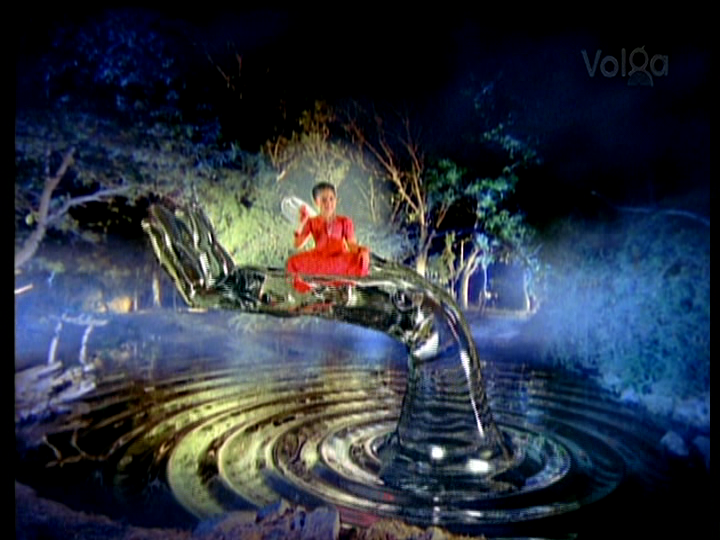
Ammoru-effects

The production design is great and the village scenes are pretty but not too sanitised. The effects used for Ammoru’s interventions and her manifestations are surprisingly good for 1995. Some scenes look a bit cut and paste but the effects budget was used wisely for the big impact moments. I think it helps that the things depicted are not just everyday objects and incidents, so artistic leeway is available for how power is illustrated.

While I don’t like some of the plot points, Ammoru compensates with excellent actresses given room to shine, and strong visuals that help tell the story. The story is gripping at times and while I could guess at the ending, I didn’t see all the twists and turns coming. Highly recommended. 4 ½ stars!

Iddarammayilatho

Iddarammayilatho

I haven’t been too impressed with the last few Puri Jagannadh films I’ve seen, but I was hopeful that this latest offering starring my favourite hero might offer something a little different.  But although the film is visually very pretty and both Bunny and Amala Paul do their best with their respective characters, the story has far too many plot holes and is frequently too unbelievable to make Iddarammayilathi anything other than disappointing.  While there is the expected excellent dancing from the stylish star, some good fight scenes and Bunny and Amala make a sweet couple, it’s just not enough to make up for the screechy, irritating Catherine Tresa and a dire comedy track which almost completely derails the film in the second half.

Bunny 2

The film follows Akanksha (Catherine Tresa), the daughter of a prominent politician in  India (Rao Ramesh) who moves to Barcelona to study psychology.  She has a fantastic room which just happens to contain a box belonging to the last tenant.  Inside is a diary which tells the story of a romance between Sanju (Allu Arjun) and the room’s previous occupant, Komali (Amala Paul).  The romance is played out in flash-back as Akanksha talks endlessly to herself about the diary’s revelations and frankly seems far too interested in the details of a stranger’s love life.

Iddarammayilatho

Bunny looks great as Sanju Reddy, a singer/dancer who performs with his band in the streets of Barcelona and is surprisingly successful considering that the band seems to perform exclusively in Telugu in a Spanish/Catalan speaking city.  He’s also pretty nifty when it comes to the obligatory biffo although his prowess in this area is never really explained – but then neither is anything else so at least there is consistency in the lack of elucidation.  Sanju falls in love with Komali who is in Barcelona to learn classical music from Brahmi – again, completely nonsensical but there is even more absurdity to follow.  Amala does a good job as a demure and rather shy violinist apart from being completely unable to fake playing a violin.  She does look stunning though in some beautiful costumes and has good chemistry with Bunny so at least the romance part of the story is believable.

IddarammayilathoIddarammayilatho


For a change I really liked Bunny’s various outfits too, which aren’t as over the top as his last few films and do appear fashionable with a European touch.  Most of the songs by Devi Sri Prasad are fairly average, but the choreography is good if not exceptional and Bunny as always proves he really can dance. However a dance off between the classically influenced Brahmi and the more rock and roll Sanju would have been much better if the backing dancers had been able to keep up with the choreography.  There is a short tribute to Chiru’s Gangleader which got the biggest cheers from the Melbourne crowd, but this was my favourite:

The love story ends abruptly in the diary so Akanksha tracks down Sanju to find out what happened and learns of a tragedy that occurred when Sanju and Komali crossed paths with a gangster (Shawar Ali). Shawar Ali has to be the dullest and most incompetent villain ever and it’s surely only by chance that Komali is the only person who sees him execute one of his gang on an incredibly public beach in broad daylight.  Unbelievably, it takes all the might of his gang of assorted thugs, sword-wielding ninjas and Subbaraju in a rather dapper beanie to deal with one petite classical violinist and her guitar playing boyfriend!

IddarammayilathoIddarammayilathoIddarammayilatho

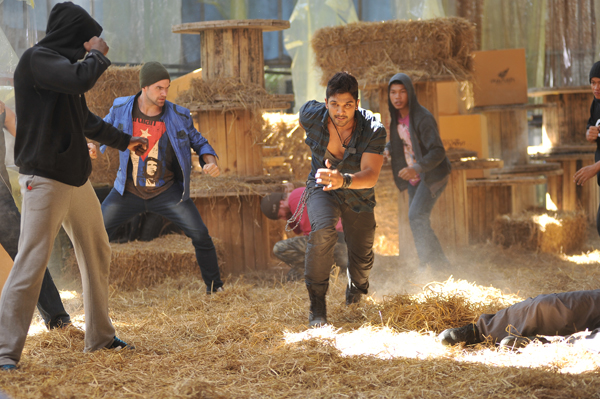
 While Akanksha shrilly indulges in flagrant scenery chewing and desperately tries to persuade Sanju to fall in love with her, Sanju has his own agenda for revenge which ends up with a surprisingly good and effective plot twist with a flashback to some of those awesome sword fighting techniques from Badrinath.  Overall, apart from the woeful comedy scenes with Brahmi and Ali, the second half moves faster and is a little better than the first, although that may just be that I stopped worrying about the lack of logic and settled back to enjoy Bunny’s dancing and the fact that he does look as if he can actually play a guitar.  The fight scenes by Kecha are also beautifully choreographed and appear more like dancing than fighting, an effect which is heightened by Sanju’s total lack of emotion as he calmly and efficiently despatches everything and everyone that is thrown at him.

Iddarammayilatho

Iddarammayilatho looks beautiful and cinematographer Amol Rathod makes the most of the location in Barcelona, showcasing some of the beautiful buildings in the city, but the film is let down by a complete lack of logic in the story and very little in the way of character development .  Although the cast in general put in good performances, most of the supporting mothers, fathers etc have very little to do and both Subbaraju and Srinivas Reddy are chronically underused.  Brahmi is fine in the first half but the comedy with Ali is totally pointless and almost as irritating as Catherine Tresa.  Perhaps understanding the dialogue might have made Akanksha a more appealing character, but somehow I doubt it.  I still enjoyed the film, but more for the location, action scenes and dance numbers which were all good.  Overall, Iddarammayilatho is worth a look for Allu Arjun fans and anyone who likes movies with pretty scenery and great architecture.

Iddarammayilatho

Gouravam

Gouravam-poster

Radha Mohan’s Gouravam is a thoughtful film. Revolving around the mysterious disappearance of the hero’s friend, it is unfortunately undermined by some clumsy plotting and suspension of logic by key characters at pivotal times. But it is visually lovely and a different kind of heroic journey than I expect from mainstream Telugu cinema so I found the time passed pleasantly enough.

Rich city boy Arjun is sent to rural SM Palli by his dad, ostensibly to inspect a factory or something. His college friend Shankar lives in that region, but Arjun finds out that Shankar eloped with the landlord’s daughter some 6 months ago and hasn’t been seen since. Arjun soon realises that the rural idyll isn’t that idyllic once you scratch the surface. He goes back to SM Palli to find Shankar. No one will tell him what happened, but with help of his friend Venky (Sricharan) and lovely young lawyer with a social conscience Yamini (Yami Gautam) Arjun keeps digging. Rather than being a conventional lone vigilante hero, Arjun draws on social media and his friendship networks by the busload as he mobilises The Youth. Prakash Raj is Pasupathy, the landlord whose daughter allegedly eloped with Shankar. His brothers (played by Harish and Brahmaji) are a looming menace, trying to send the young outsider back to Hyderabad. The Establishment vs The Youth plays out as you might expect but there are some twists. How Arjun deals with this is surprising for a Telugu film as he does not dismember anyone. He uses the courts, the media, public attention and even the usually useless police.

There are red herrings and characters who turn up to highlight significant moments. A young boy, possibly autistic, is a constant presence as he draws everything he sees. The plot is partly a mystery and unfortunately there are some miscalculations. It was blindingly obvious that there was a witness and there were other early indicators of who could shed some light. The pace was a bit slow with respect to the dramatic development, but the leisurely tempo did work well with the rural setting. I’ll skip over most of the plot to avoid spoilers but overall the incidents mostly made sense, just the way things unfurled was a bit iffy.

It is a very pretty film to look at. Arjun and The Youth stay in a very colourful and neat tent city in the countryside, the village is picturesque, houses are beautiful and seem lived in. Things are keenly observed by the camera if not the characters, so I found I was often more engaged in just looking at details.

gouravam-yami-and-sirish

As the latest Mega Boy to take to the screen, Sirish has chosen an unconventional story. However his hero intro is pure formula. Arjun runs, swims, prays, pouts, kicks the bejesus out of his trainer and – ladies take note – he cooks. What a paragon. The comparisons with his older brother Bunny are unavoidable but naming the character Arjun and filming in what excitable people on Twitter tell me is his brother’s weekender house probably indicates Sirish couldn’t care less. In terms of his acting, he is much more effective in the dialogue driven scenes than when he is required to emote silently. He also looks a little awkward and posed when he has to do nothing in a scene.

gouravam-Yami Gautam

The story would have been more balanced if Arjun was more integrated into an ensemble. Yamini and Venky were pushed aside to accommodate the herocentric approach.  It would have been nice to see more of them, even the little romantic thread with Venky trying to woo Yamini, to give them more substance. Venky dropped everything to go with Arjun, Yamini devoted time and effort to helping and not just because she fancied Arjun. I was pleased to see Yami Gautam playing a quietly assertive young woman with none of the airheaded silliness so common to the Indian filmi heroine.

Gouravam-Prakash Raj and brothers

The supporting cast outside of the The Youth are more successful in blending their performances and they do create some really intense scenes. Prakash Raj has little screen time but huge impact. Pavitra Lokesh who played his wife and Lakshmi Priyaa Chandramouli as his daughter in law were good but that household was all about the menfolk. Harish and Brahmaji were villainous and menacing, and over powered Sirish in most of their scenes together. LB Sriram was effective as Shankar’s bewildered and frail father and Nasser did his usual thing.

True to the more realistic style, there were only a couple of songs (by SS Thaman). I enjoyed the picturisation for Chetinundhi Mannu Thesi most as it used the countryside beautifully and I liked the pleasantly random looking backing dancers. Especially the three dudes who popped up out of the lake for a chorus. No one really dances much in Gouravam and Sirish looks like he is concentrating but not struggling so that might be a good sign. I hope he has the Mega Dance Gene.

I opted to see the Telugu version of Gouravam for a couple of reasons. Of all the languages I don’t speak, Telugu is a little easier for me to pick out the random words I know so an unsubtitled film is a challenge but not unappealing. Prakash Raj took the very commercial and audience friendly step of making the film available online on a pay per view basis where there was no distribution agreement in place. Hurrah! The Tamil version was on in cinemas here but the hit and miss distribution by the local Telugu film guys means I’m never really sure of seeing any new Telugu films unless they star a top hero. And frankly, since ticket prices for Telugu films are now up over $AUD23 I want to be reasonably assured of getting my money’s worth! So shelling out a fiver and watching Gouravam from the comfort of my living room was a good deal, and I think it’s a great way to expand the audience for less mass oriented films.