Bhookailas


Bhookailas is replete with all the necessary elements for fine entertainment; great actors, beautiful music, lots of excellent dancing, fabulous sets and most important, a good story. It’s not just a fluffy fairytale or fantasy though as there is some philosophy underneath the gilding. But more than anything, it is a great entertainment and a pleasure to watch. (The Volga DVD has good subtitles and the picture quality is fine on screen although poor in screencaps.)
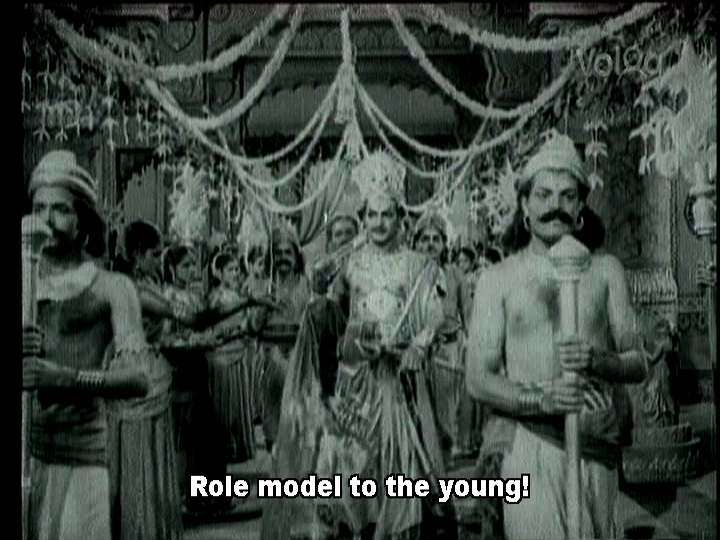

Ravana (NTR) has conquered the human world and is at a loose end. Being a magnanimous ruler, he asks his brother demons what they want as a reward for this victory. His generals suggest a sleeping festival (excellent!), peace and justice for all, and finally that he declare war on heaven as the gods are worthy opponents for demons, not like frail humans. In order to avert this war which Ravana will likely win, the sage Narada (ANR) starts conniving and scheming to keep Ravana from invading.


Ravana is brave, intelligent, principled but very impulsive and has little self control. NTR is in his element as the larger than life Ravana. He creates a sympathetic character but one whose flaws are all too evident. The character spans broad comedy, doe eyed romance and the aggressive assurance of unchallenged leadership. Ravana is easily manipulated by Narada, Vishnu, Parvathi, his own mother and Ganesh among others.
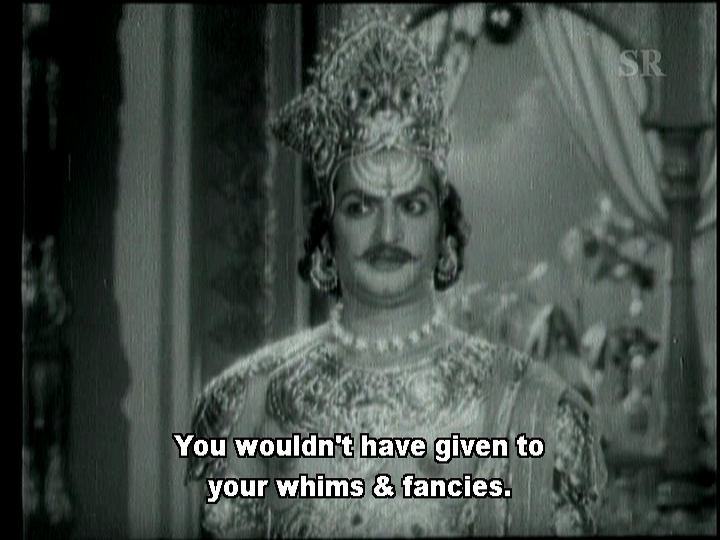
His lack of insight and self awareness brings him undone when he has the potential to rival the gods should he focus his will. So he is like lots of men we all know- asked to bring back one specific item from the shops, and coming back with either nothing or something completely random.
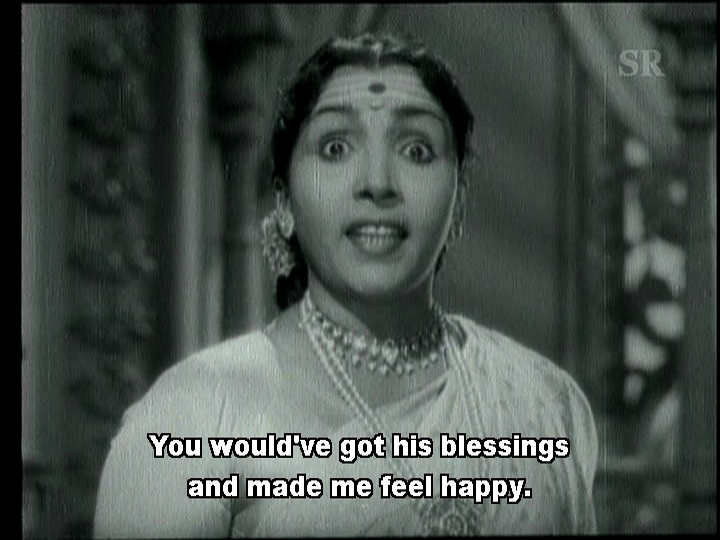
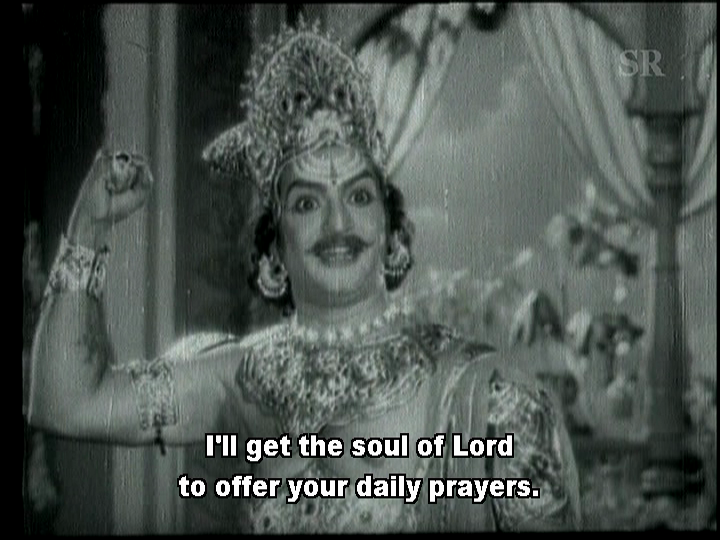
Ravana’s mother Kaikasi (Hemalatha) is a devotee of Shiva. When her prayers are disrupted to stop her gaining Shiva’s benediction, she charges Ravana with making Shiva answer her prayer. He is a total mummy’s boy. He takes it one step further and promises to bring back Shiva’s atmalingam, his soul, for her to pray to. When he decides to beseech Shiva through rigorous penance, not even Helen can distract him.

But he loses this focus and falls under an illusion that sends him off on a tangent. Ravana’s quest to win back that blessing from Shiva takes many detours thanks to Narada.
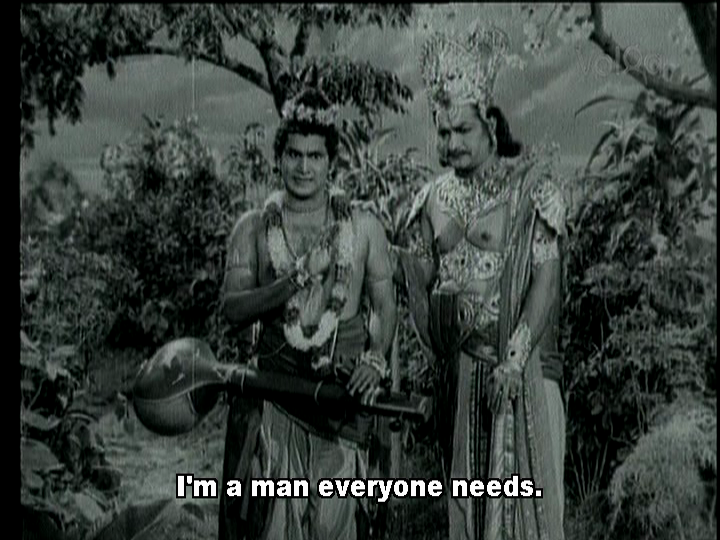

Narada (ANR) is intent on maintaining the status quo. He plays on the susceptible Ravan and the change resistant gods. He puts the wind up heaven with dire predictions about what will happen should Ravana succeed. He stirs up Ravana’s impulsive and suspicious nature to manipulate him. ANR’s performance is lots of fun with a supercilious eyebrow here, a self serving whinge there, and a whole lot of economy with the truth. He sabotages Ravana’s request for a boon from Shiva, using illusion to persuade Ravana to ask for Parvathi as his reward. But the plan doesn’t play out exactly as Narada hoped, and he scrambles from drama to catastrophe and back again with only his wit and sophistry to help him navigate between the gods and demons. The gadfly tactic manoeuvres the protagonists, sets up conflict and also provides some of the more comedic moments.
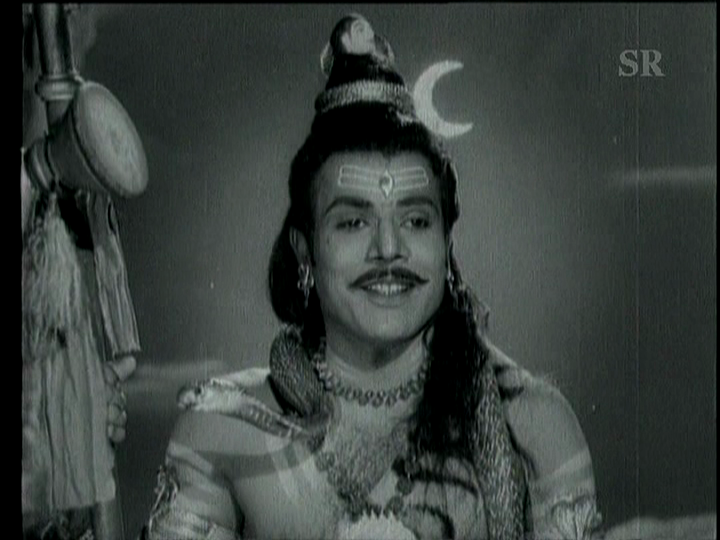

Shiva’s alert and active snake companion was a highlight. The snake is quite interested in the proceedings. I was picturing the person responsible for snake directing and the bag of tricks they must have employed. Occasionally the snake would have a snooze and seemed to be waiting for someone to do something entertaining. Nagabhushanam portrays Shiva in a more paternal style, taking an indulgent approach to his devotees most of the time.
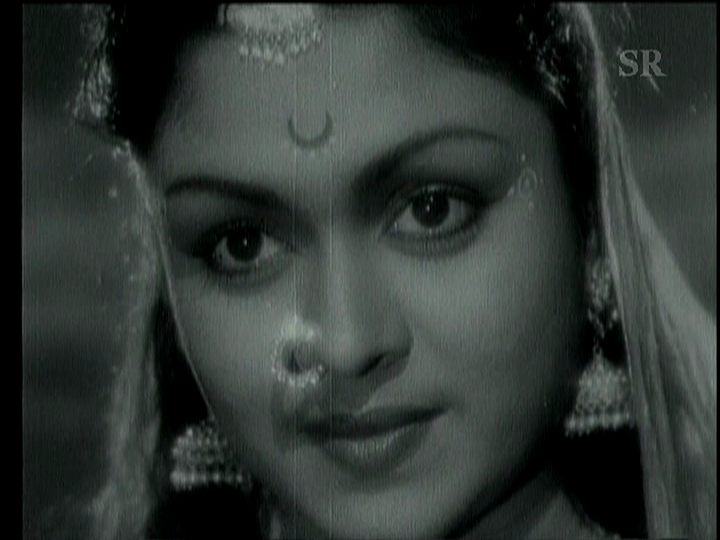
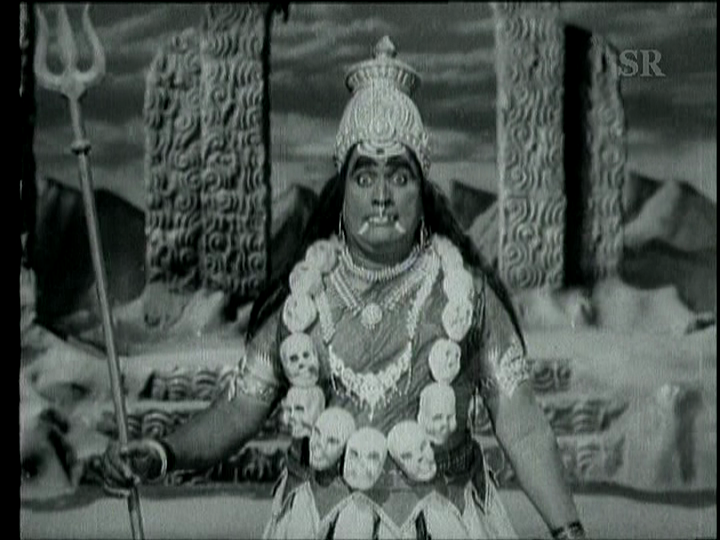
Parvathi (B Saroja Devi) is beautiful and stately and her role requires little more than that. Parvathi is used as a pawn in the game Narada is playing with Ravana, and despite her power she finds herself being carted around from pillar to post. But finally after prompting from the ever helpful sage, she uses her own power of illusion to break free. Apparently Ravana couldn’t see her inner beauty.

Mandodari (Jamuna) is Mayasura’s daughter, and persuades herself to fall for Ravana. Jamuna is lovely but she looks a little too mature and knowing to be totally convincing as the young and inexperienced princess. Her handmaidens joke about how Ravana will be a bucktoothed crosseyed hunchback and then tease her when they see she has feelings. Mandodari is very privileged and enjoys the finest things in her father’s lavishly decorated aquatic themed underwater kingdom.

But she has a hard time of it when she gets the husband she wants and discovers he was under the impression he had married the goddess Parvathi. Mandodari is another unwitting player in Narada’s plan to keep the three kingdoms in their proper place.
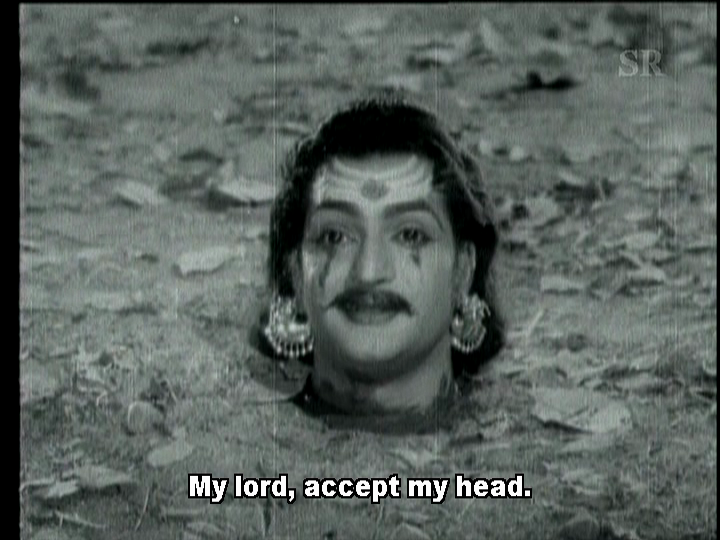
After all the trickery and deceit, Ravana offers penance in very dramatic style, cutting off his own head. It makes the acts of contrition my school priests used to dish out look pathetic. Ravana wins forgiveness but fails to triumph thanks to his inability to stay on task. Again. He neglects an instruction, disregards a warning and jeopardises the very thing he had struggled for.

His flaws were his undoing and they were all things he could control or learn to manage. Luckily his failure created something very special for the human world, so the film ends on a cheery note.
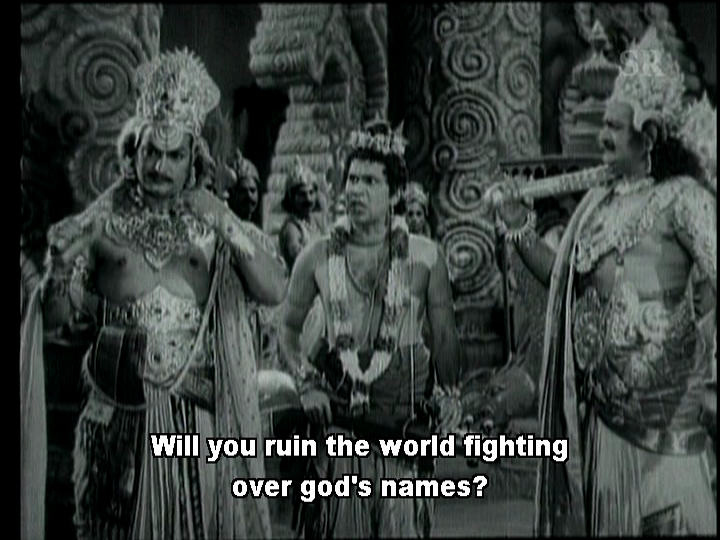
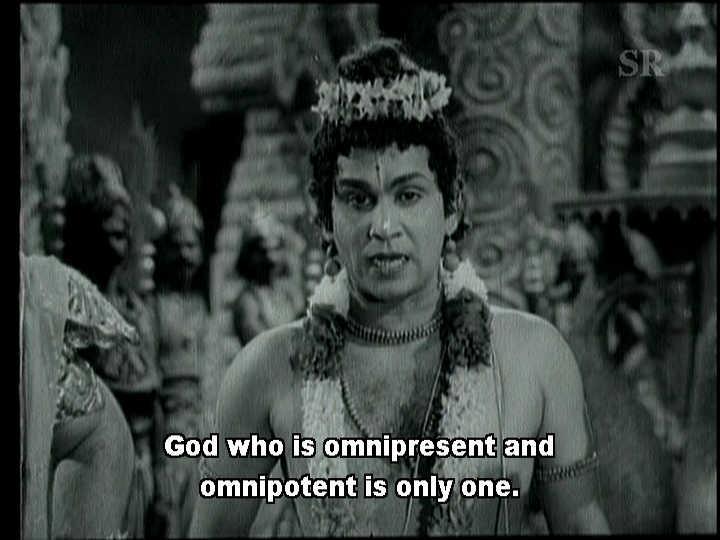
The animosity between would-be in-laws Ravana and Mayasura (an ebullient S.V Ranga Rao) is due to their worship of different gods – Shiva and Vishnu. There are some very pointed references to this, including Narada rebuking them for not realising that god is one and omnipotent. I wondered if this speech was in response to current day issues or purely part of the story. It seemed to be directed straight down the barrel of the camera which made me think it was at least partly commentary aimed at the audience.
The songs are particularly enjoyable, even more so with the bonus of excellent dancers. The songs are directly linked to the story so expand on things or underline issues. In Mayasura’s palace Kamala Laxman performs a very elegant dance depicting Vishnu’s avatars, while Gopi Krishna dances in a more wild and entranced style in devotion to Shiva.

The visual effects are simple, and the use is restrained, so they also enhance the atmosphere of a world outside of human reality.
As with many of the devotional, religious and mythological films from the 50s and 60s that I’ve seen, you don’t need to know anything about the main characters as a preqrequisite to enjoy the story. Bhookailas is beautifully self-contained, and K. Shankar has structured it to make the story accessible and entertaining. Watch this for the rattling good story, the wonderful actors and the visual riches. 5 stars!

Heather says: I found Bhookailas to be an interesting film as it shows Ravana from a totally different point of view. NTR’s demon king is depicted more in his ‘devoted follower of Shiva’ character rather than the more traditional ‘Ravana as the embodiment of all evil’ and for most of the film he is heroic and really quite dashing. It’s quite a change as I think this is the first film I have seen where Ravana hasn’t been just the villain that everyone is supposed to hate and it does make for a fascinating story.

NTR is excellent in his role and his depiction of Ravana’s all-conquering and all-powerful king is very believable. His devotion to Shiva is well shown but even better is his colossal arrogance which NTR hits just right, and when Ravana loses his temper there is a real edge which brings out his demonic nature clearly. However, Although I really liked NTR here, the standout performance for me was ANR. He is brilliant in his depiction of the sage Narada, and I think that this is probably the best characterisation of the trouble making sage I have seen. Narada’s frequent nods, winks and knowing looks are very well done, and he excels in causing trouble for trouble’s sake. ANR hits the character perfectly and his mannerisms and facial expressions make his scenes very enjoyable to watch.  The interactions between Narada and Ravana are also very well written, and both actors work very well together to bring their characters to life.

As Temple has mentioned, there is very little scope for any of the female roles here, and Hemalatha as Kaikasi probably has the role with the most substance. I enjoyed her performance and her exasperation at her impetuous son was excellently done. I wasn’t very impressed with Jamuna’s Mandodari and all her simpering, but I did love the underwater palace where she lived. Seeing Helen pop up in a song was a lovely surprise, and I was suitably impressed that Ravana was able to ignore her wonderful dancing as he meditated. Great music, fantastic performances and a thoroughly entertaining story make Bhookailas very well worth watching and I thoroughly recommend it. 4 stars.

Lakshyam

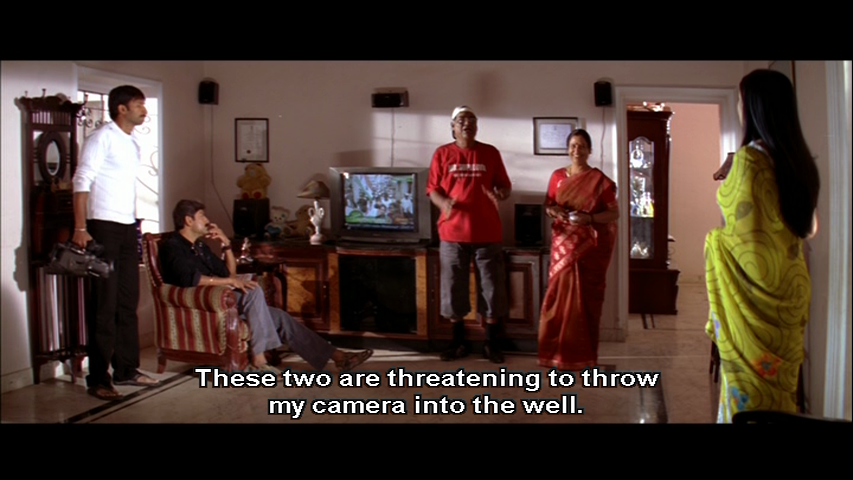
Lakshyam is a highly entertaining mishmash of romance, comedy, action, politics and family drama. It succeeds largely because of the casting – Jagapathi Babu, Gopichand and Anushka in particular do a fine job – and some skilful writing and direction that balance all the elements.

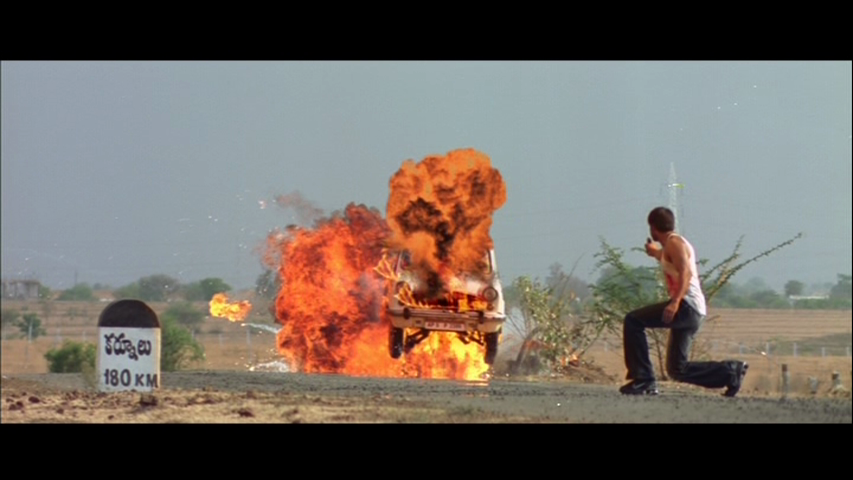
The film opens with a girl running away from her own wedding. She looks so pretty and pristine as she scoots off across town, eventually making a rendezvous with a bloody and battered man. I was intrigued by the look of happy pride on her face when he efficiently blew up a car, shot a policeman and then hopped on the back of her moped. I wondered how they got to this point, and what was going to happen next. With a bit of time travel, we get to the chronological start of the story. The film is very well constructed, and the flashback and current day sequences flow well. There are some pleasingly playful references to filmi clichés and the cast seem to enjoy the improbable shenanigans.

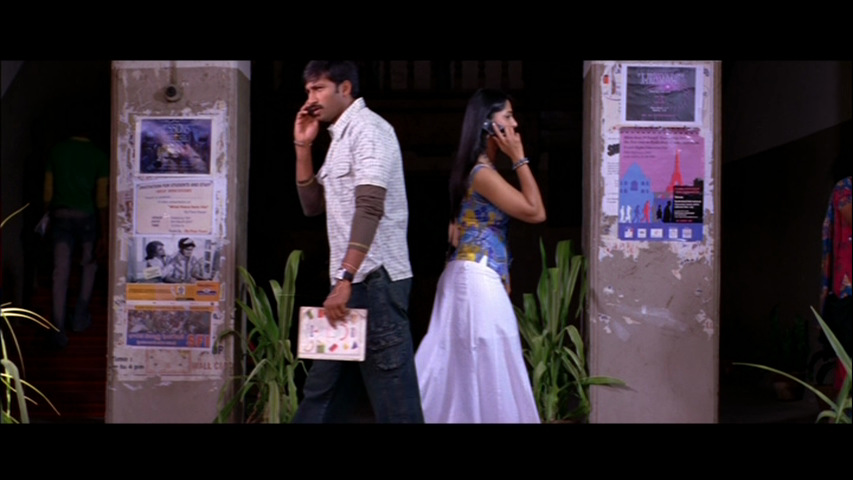
Anushka is Indu, a modern uppity type of college girl. She has a very specific list of demands for a prospective husband and seems to think it is perfectly reasonable to share this with a young child on the train. Pinky immediately decides to set Indu up with her uncle, Chandu. He has his own, very different, list of required qualities and even the kid knows it’s not likely to work.

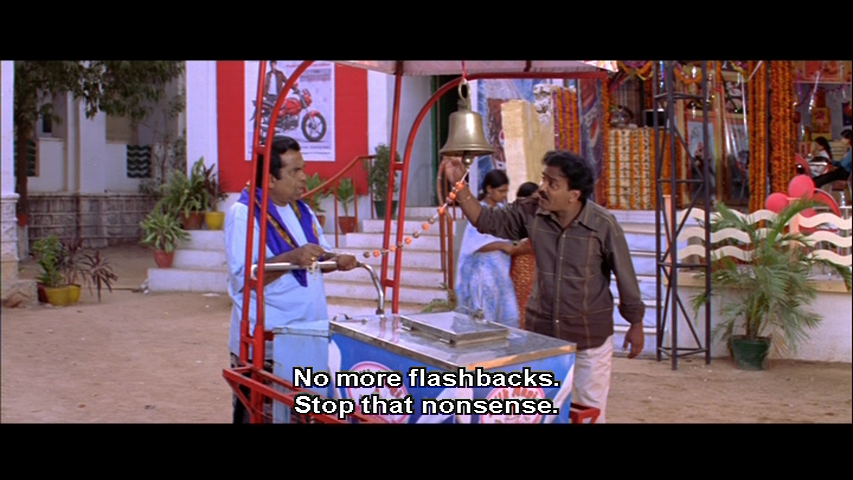
Anushka is one of my favourite current day actresses (yes, actress not ‘heroine’), and she is quite good in this role. Her character has some silly and selfish moments, but underneath it she is a likeable young woman. At the very least she knows when to apologise for her mistakes, so she is not too bratty. Indu is a Telugu heroine so of course if anything goes wrong she is reliant on any and every man within 20 metres of her for help and a solution. But the helpless female act is balanced with Indu cheekily pretending to be a gangleader’s sister and using his name to get her own way. This leads her into conflict with the cool dude on campus, Chandu. So she calls her little train friend’s uncle to sort him out. Yes – Chandu again. So there is a romantic comedy of errors as Chandu takes on Chandu and tries to bluff his way through. The silliness is increased with Brahmi and Venu Madhav battling each other for control of the student canteen.

My reason for picking this film a while ago was that I hadn’t seen Gopichand in a lead role and I was curious. He does well and seems to be a good generalist in terms of Hero Skills. He can act a bit, dance a bit, fight a bit, and has an engaging onscreen presence. His introduction scene is vintage hero stuff – he is chained and dangling upside down in a police lockup. But with a single bound he frees himself and escapes to wreak havoc. The college romance scenes don’t work quite so well as the later more energetic action sequences but he and Anushka do have chemistry and he gets right into hamming it up. And let me applaud a song with a backup dancing Spiderman.There is not enough of it around.

Chandu and Indu eventually fall in love and actually tell each other so they then just have to deal with all the usual obstacles – telling his family, her disapproving dad, and of course a crazed psychopath who happens to be a mad inventor. Chandu also gets caught in the fallout of his brother’s activities. He is a man of action, and takes a direct approach to solving problems. Although I did like that he sometimes cowed his opponent just with a graphic description of what he would do, so had no need of the actual biffo. You can have your cake and eat it too – a non-violent solution that incorporates a violent fantasy sequence. Gopichand is well able to match the changing tone of the film from the fluffy  romance to the revenge driven action and drama.

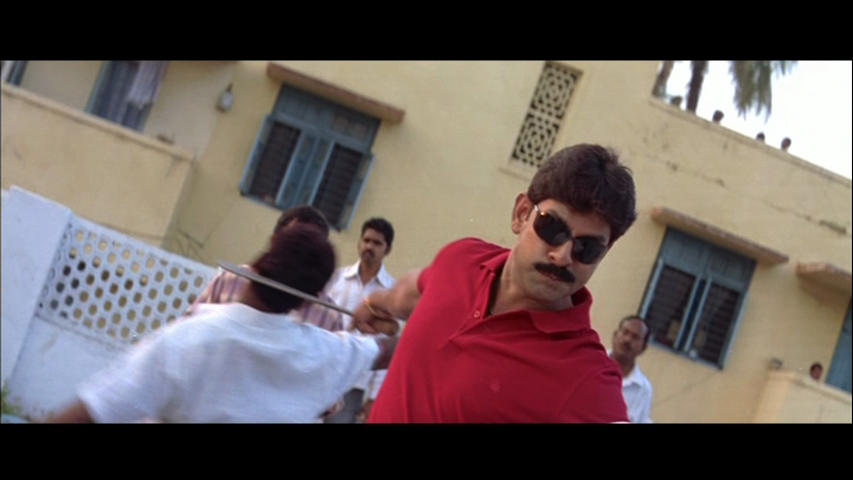
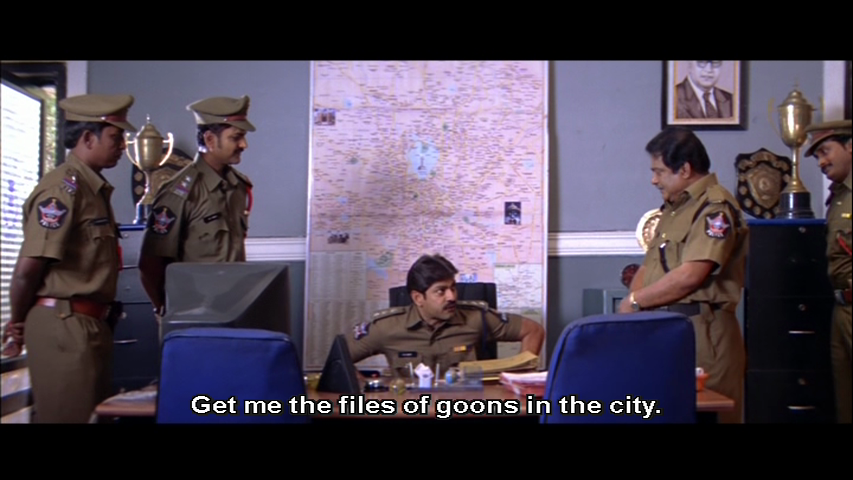
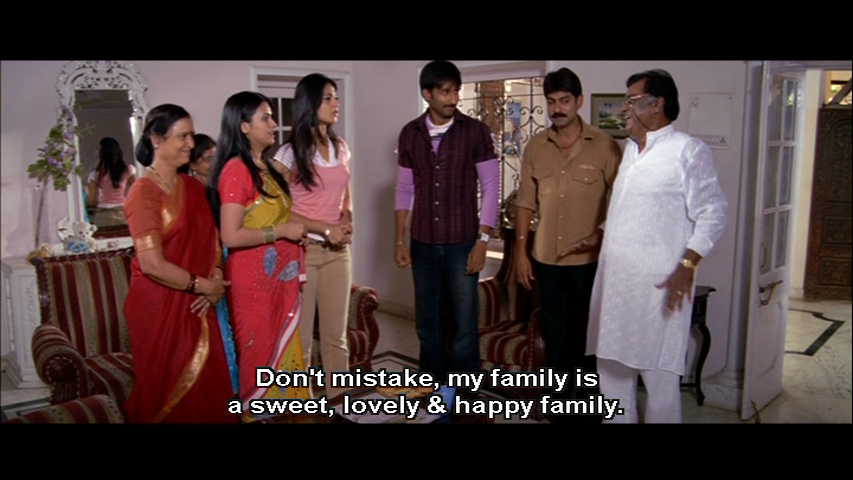
Chandu’s brother is Inspector Bose – Jagapathi Babu. He is an honest, crusading policeman and of course is wildly unpopular with the underworld. Newly transferred to Hyderabad, Bose takes on Section Shankar, Indu’s ‘brother’, a thug protected by senior police. I like Jagapathi Babu and this role is a good fit for him. Bose is a cop but also a family man and has a competitive relationship with his brother and his journalist father (Kota Srinivasa Rao) so there is lots of scope for his offbeat style.

The brothers have different approaches but are not forced into a separation or battle for whose philosophy should win, and I really liked seeing that more natural sibling rivalry. They were great mates as well as brothers, and the family scenes were fun. Bose and his wife (Kalyani) have a very affectionate relationship, and it is a nice domestic environment. But Bose also has a kickarse side and Jagapathi Babu gets his own action sequences, including some excellent use of coconuts as both defense and offense. He is also the victim of one of the most elaborate assassination attempts I can recall seeing. I was muttering “What? He’s not dead – yet? What!” as the drama kept unfurling.

It’s interesting that once again the law is shown as helpless in the face of crime and they rely on people like Chandu to get things done. Dharmavarapu Subramanyam is cast as an honest cop, and his comedic skills are used to help the story as a bumbling but good guy. Even Ashish Vidyarthi as the DIG makes it clear that the police need to rely on subterfuge to even compete let alone succeed, so there is an oddly defeatist note to the brother’s battle with Section Shankar and his corrupt cop associate (Devaraj).

I was moderately alarmed when I read the long list of ‘comedy uncles’ in the cast, but Srivas and writers Gopimohan and M Rathnam do an excellent job of balancing the story elements and allowing a lot of the humour to emerge in a more natural style. Kota Srinivasa Rao is in good form as the newsman father who believes he might possibly be in charge of his household. Venu Madhav and Brahmi have a running battle which keeps them from bogging down the rest of the story, and when they do interact with the rest of the characters it is usually fun. And there are some amusing touches – a fixer for Section Shankar has gunfire as his ringtone, one rowdy knocks himself out in a fight, and there are lots of little reactions and one-liners that liven things up.

The song picturisations are nothing out of the ordinary and neither is Mani Sharma’s music, but they are executed and placed well. Anushka is not much of a dancer although she does give her dance performances some energy and excellent facial expressions. I would say Gopichand’s natural genre might be ‘uncle dance’ and he does it pretty well. He certainly looked like he had fun dancing, and it added another degree of contrast to his vengeful brother aspect. And he seemed quite unperturbed by some of the shirts bestowed upon him.

Lakshyam does strain the credibility muscles more than a few times, but it is such an entertaining and well paced effort that I just go with the flow. The cast are good and are given characters with a little bit more depth than I expected. There are convoluted schemes, a deathtrap, peculiar decision making – all the trappings of a good potboiler. The writing is clever and kept me smiling if not laughing out loud. And the baddies got their various comeuppances in suitable style. It was all quite satisfying.

Give it a go! 3 ½ stars.

Devadasu (1953)

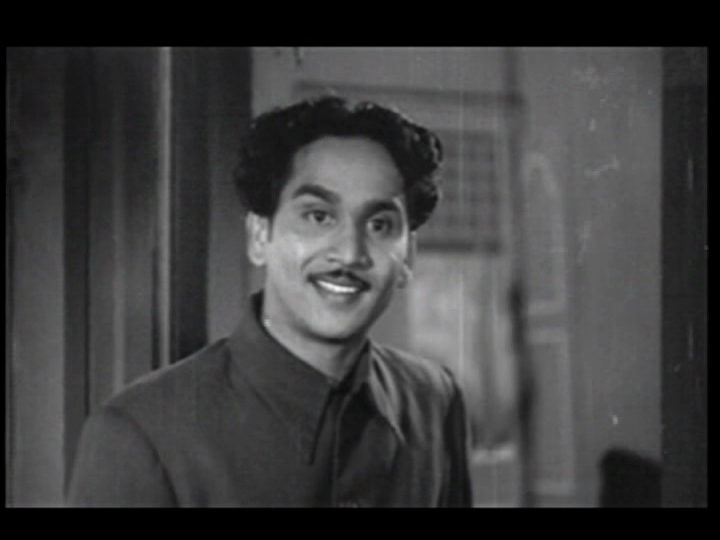
So many people recommended versions of Devdas when I started watching Indian films. Prior to seeing the Telugu Devadasu, I’d watched a few of the various adaptations in Hindi. I have mentioned before that the role of Tight Slap Administrator could be a dream job for me, but honestly I would have been exhausted about an hour into any film version of Devdas. I prefer romances to involve people I can care about to some extent, otherwise why bother? Whether we’re talking whinging Dilip Kumar, tear drenched Shah Rukh or aggressively self centred Abhay Deol, Devdas is one of my least favourite characters. This is a drawback when the story is just a long wait for Dev to work out how to drink himself to death. So it was a bit of a surprise to find myself not exactly liking but empathising with Devadas (Akkineni Nageshwara Rao) and feeling quite kindly towards Parvati (Savitri). Maybe it was the lack of subtitles that let me reshape the story to suit myself. I certainly had no trouble following the story –  there are so many adaptations of the book by Sharat Chandra Chattopadhyay it’s almost a plague – and it’s easy to find a synopsis if you need one.

Director Vedantam Raghavaiah’s version opens with Devadas and Parvati as little children, partners in crime, tormenting their teachers and causing mayhem. Devadas demands her obedient following, Parvati demands to be spoilt and adored and generally that is how things go. If one upsets the other, they retaliate with no thought of the consequences. And that sets the tone for their whole relationship even as they grow up. When he was sent away to school, he seemed to become that rich kid who funded his friends’ adventures and went with the flow. Meanwhile Parvati waited at home, confident he would come back and she would be part of his life.

ANR’s Devadas is a man who knows he has screwed up and has no one else to blame. He conveys the frustration of a young man caught under the thumb of his domineering father (SV Ranga Rao), and the weakness that paralyses him. He and Parvati realise that they can’t continue to be inseparable as they were in childhood without formalising their relationship. There are some really lovely scenes early on when he and Parvati are rediscovering each other, as in this song.

There is also the infamous scene where Devadas strikes Parvati in retaliation for her pride. ANR looked appalled and remorseful after lashing out so viciously and Savitri portrayed a mix of shock, anger and sadness that spoke volumes about the way their relationship still played out. Her parents proposal is rebuffed as they are of a lower social status, and suddenly time is running out.

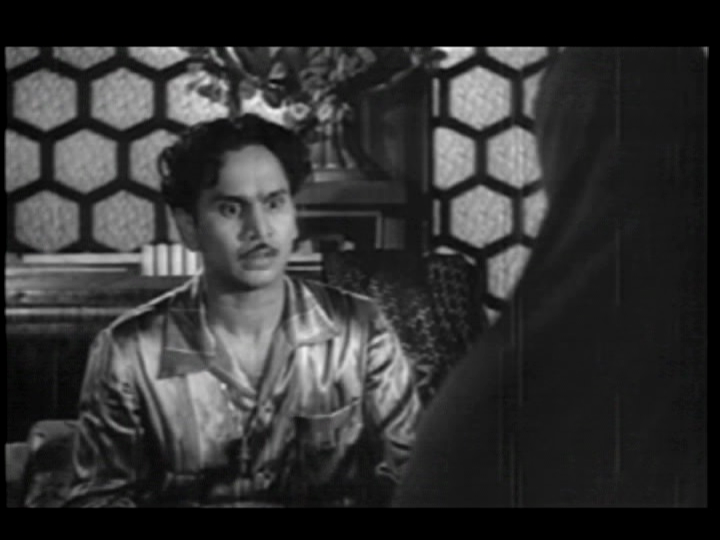
Parvati sneaks into his room to beg him to marry her before she is married off elsewhere but he cannot stand up to his dad (or whoever chose these pyjamas for him).

And so he loses her, cuts ties with his family and is ripe for a decline into self pity and booze.

Later, when Devadas returns home following his father’s death, he sees the married Parvati. They have a beautiful scene together where suddenly the old Devadas is visible just for a moment. They light up in each other’s presence even as they break down. He has no resilience or motivation – he is carried by the currents of luck and money and when the luck is bad, he doesn’t know how to change things.

His refuge in alcohol initially makes him happy as he hallucinates seeing Parvati. Once the addiction has hold of him, the euphoria starts to disappear and he becomes a shambling wreck. ANR portrays the gradual descent into self destruction very well. While I think Devadas is an idiot I had to look away in some scenes because he was so painfully frail and damaged.

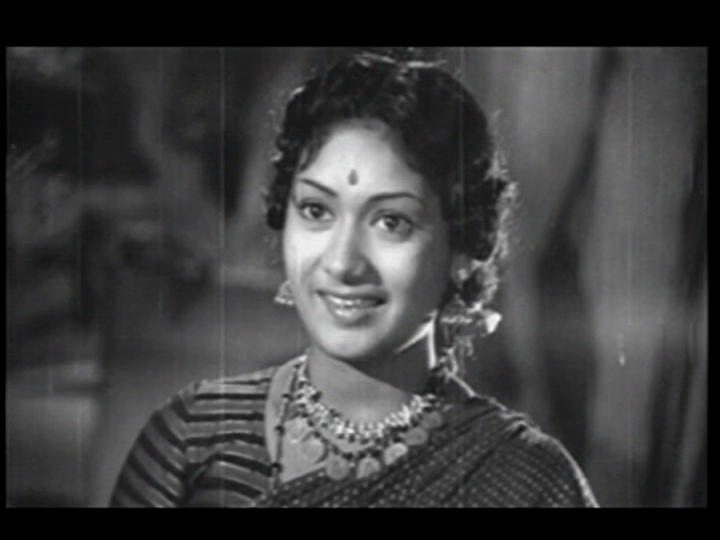
Parvati is a minx and gets her own way but she isn’t completely obnoxious. Savitri does a wonderful job of showing Parvati using her childish impulsive ways but aware of Devadas’ attraction to her, experimenting with her sexual appeal. When she sees Devadas after he has been at school for so many years, her affection is obvious. They talk about his father’s objection to her proposal and there is little game playing when it counts. When she is married off to an elderly widower who really seems to want a nanny more than a wife, her grief is evident but she tries to fit in.

I wasn’t quite sure about the physical side of her marriage – her husband mostly treats her like a niece or daughter, but there was one scene where he said something and Savitri looked quite ill and horrified so I wondered if a conjugal visit was on the cards. She is affectionate towards her stepchildren and wins over her jealous sister-in-law. She really does make the best of it and the kids seem very fond of her so her life isn’t shown as empty without her first love. In the final scene where she realises Devadas is near and tries to see him before he dies, the family seem to stop her because they are worried, not to punish her or protect their honour. Thanks to Savitri’s nuanced acting I really felt for Parvati.

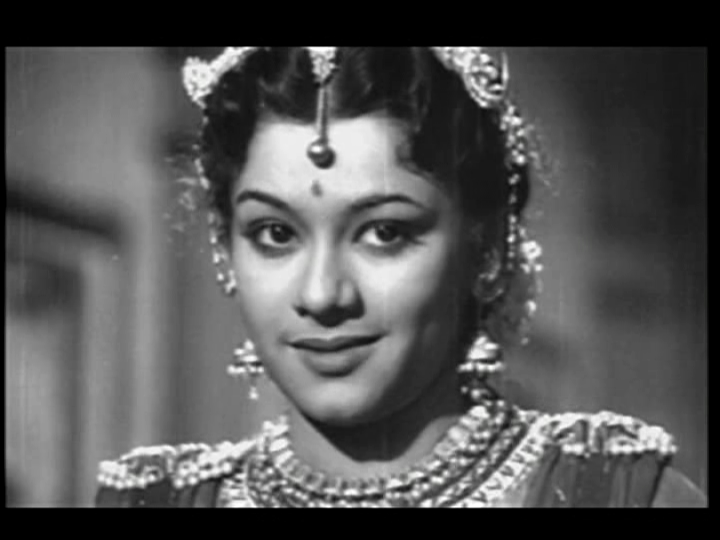
Lalitha, one of the renowned Travancore sisters, is Chandramukhi, the other woman who loves Devadas. Her role is important but doesn’t occupy as much screen time since Devadas usually prefers to pity himself in solitude.  She is flirty and practiced, a woman who knows what men want and knows she has it. Despite her commercial nous, she can’t resist the misery of her newest and most reluctant client. While he initially rejects her, a relationship of sorts does grow over time. She is prepared to lose her livelihood over him and argues with her staff, including a comically inclined orchestra, as she cuts back on working. When Devadas really deteriorates she searches for him and brings him home, offering practical care to keep him comfortable. Lalitha has great physical presence and really suits Chandramukhi’s self aware femininity. Her dancing is assured and she displays her body with confidence, again a perfect fit for this character.

I liked the less grandiose sets in this version as they suit the characters and allow them to be the focus. The music is lovely and as the duets often take the place of conversations, they fit the mood of the scenes. The dances at Chandramukhi’s brothel are quite simple and she performs alone to entertain her clientele – it’s clear what she is selling but the scenes aren’t overly vulgar.

It is really hard to comment on the technical aspects of the film as the DVD picture and sound are so bad, and there are clearly some scenes missing and abrupt edits. Once again I will have a whinge about the terrible print quality of a classic film, and wonder why this is almost the norm. If so many people can recommend a movie as a classic of their industry, why doesn’t anyone take on the task of preservation and restoration? I’m not sure who most of the supporting actors are, but they were all very good and suited their roles.

Anyway – I’ll never wholeheartedly love the story of Devadas and Parvati, but this is my favourite version to date. See it for the excellent acting that made two silly fools seem more relatable than I expected, and for some beautiful melodic songs. 3 ½ stars.

Heather says:  Devdas has never been my favourite story, perhaps because the first version I saw was Sanjay Leela Bhansali’s extravagant epic and I found it difficult to relate to the characters. However I’ve appreciated some of the earlier Hindi film versions a little more, and now agree wholeheartedly with Temple that this Telugu version is the best.

Devdas is certainly not an attractive character at all. He’s arrogant and selfish; almost child-like in his inability to deal with the world and ANR captures this perfectly. In the early scenes his conceit takes centre stage and despite the lack of subtitles his inability to deal with his family’s disapproval of Parvati comes through clearly.  As Devdas falls into self-recrimination and takes up a decadent lifestyle, ANR’s portrayal of the shattered and hopeless alcoholic almost manages to wring some sympathy, despite knowing that he brought it all on himself. So even although I want to dislike Devdas (and usually do), ANR makes his weakness understandable to such an extent that I end up pitying him. It really is an outstanding performance.

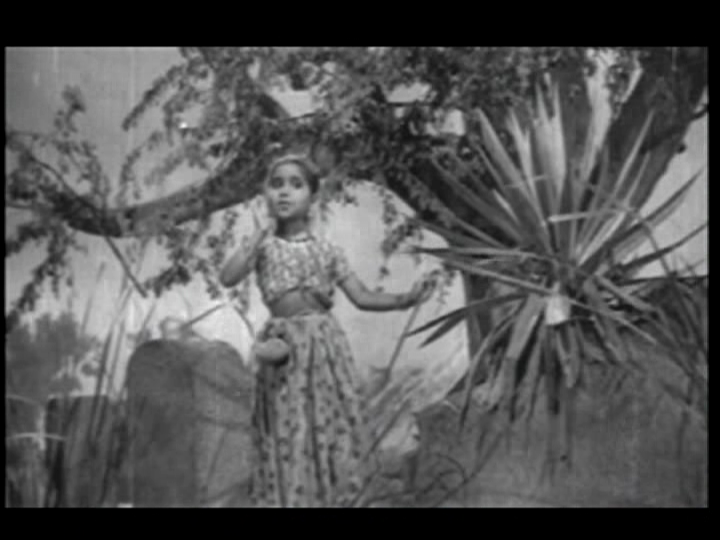
I agree with Temple that Savitri is excellent here as Parvati, giving her innocence and a child-like adoration of Devdas which makes her later actions more reasonable. I also loved Lalitha in her portrayal of Chandramukhi, but my favourite actor is the little girl who played the young Parvati. Her eyes were incredibly full of expression for such a young actor and every emotion was written loud and clear on her face. I ended up watching her scenes over and over again and would love to know who she was. Anyone know?

It is such a shame that this film isn’t available with subtitles as much of the beauty in other versions of the story is in the dialogues. I will add my plea that someone needs to please restore and re-release all these old films before they are too far gone to salvage, preferably with English  subtitles too. This really is a classic and should be required viewing for everyone interested in Telugu cinema! 4 stars.