Gair Kaanooni

Gair-Kanooni-Title Gair Kaanooni is a cracktastic masala film that I overlook far too often. Director Prayag Raj was responsible for the story or screenplay of many of my favourites – Ajooba, Mard, Geraftaar, Coolie, Suhaag, Dharam Veer, Parvarish, Amar Akbar Anthony – so that should tell you what you need to know about plot and logic. Plus it has a killer cast.

This slideshow requires JavaScript.

Just look at the lineup in the opening credits! (Question: Who is Sunny Bee? I love them just for the name but know nothing about them.)

Gair-Kanooni-Don't moveGair-Kanooni-they start revenge young

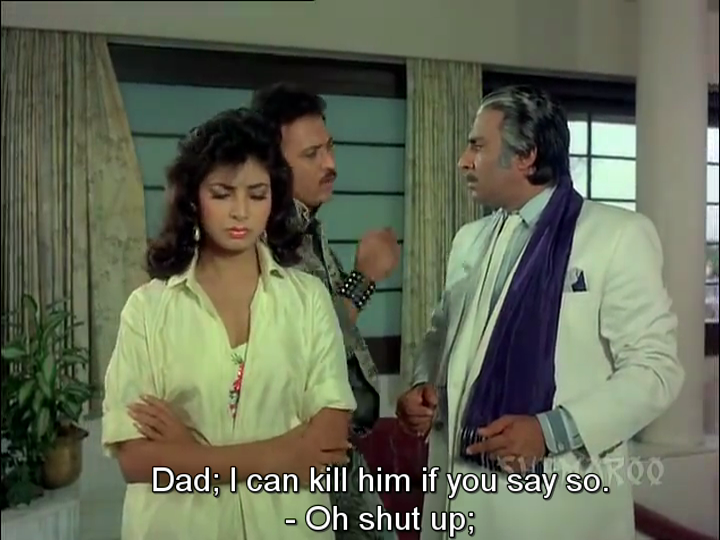
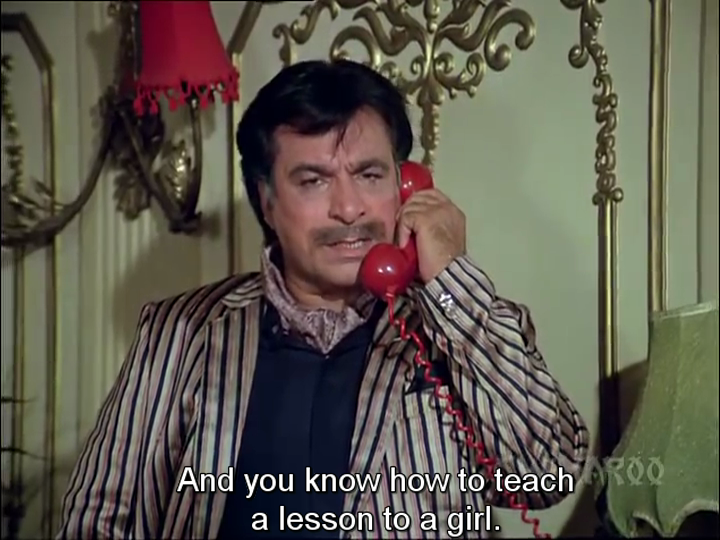
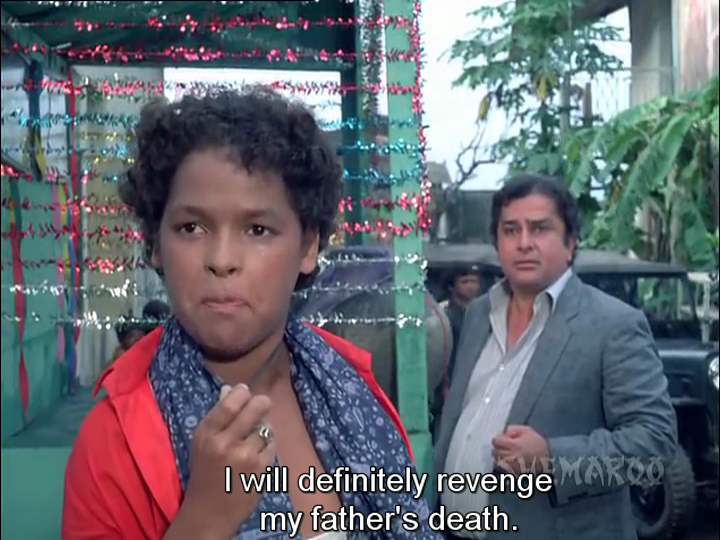
Kapil Khanna (a portly Shashi Kapoor) is a zealous policeman out to bring down underworld don D’Costa (Ranjeet). He leans on an informer, and sadly the goodhearted crook Azam Khan (Rajinikanth) is killed (stabbed AND electrocuted) by D’Costa and Dalal (Kader Khan) leaving an orphaned son. Meanwhile Mrs Khanna and Mrs Dalal are both in the maternity hospital. When Mrs Dalal has a baby girl, D’Costa repays his friend by switching the ‘worthless’ girl for a newborn boy – The Khanna’s son. Oh lord. Three kiddies to keep track of and we haven’t even started…Kapil Khanna rejects the infant girl and demands his son back. He will not accept his ‘daughter’ and sends her off to be raised by strangers, paying what he needs to but not giving her any familial affection or contact. Travel through time and we have Laxmi (Sri Devi), a petty thief introduced in a lovely song as she fleeces worshippers at a temple. Hey, she is Laxmi after all (or so she reasons). Om Narayan is the son of Kapil Khanna who has been raised by Jutawala Dalal, and Rajinikanth is back as Azam’s son Akbar Khan. Of course they cross paths and naturally, vengeful hijinks ensue.
Gair-Kanooni-Kapil KhannaGair-Kanooni-Shashi and Sri Devi

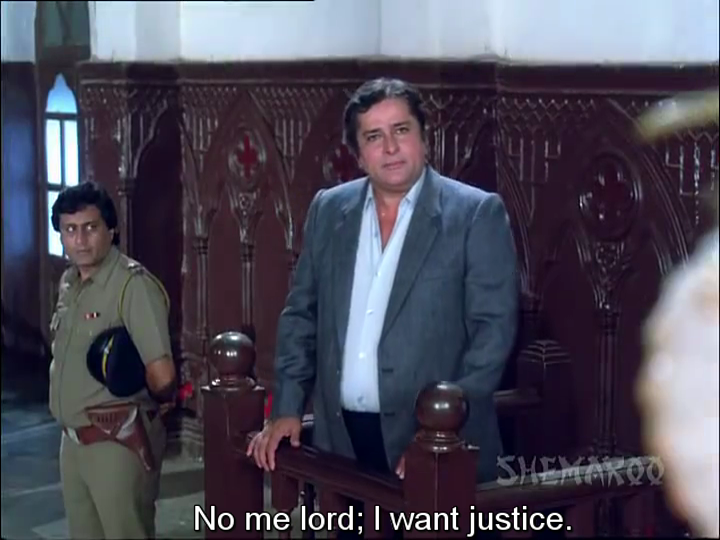
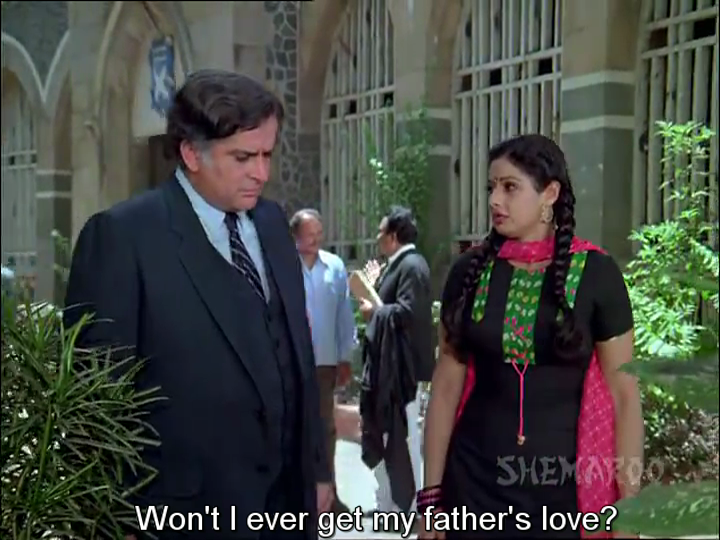
Shashi is, dare I say, a bit past it as Kapil Khanna but he knows his way around and has mastered the art of bromance. There is lots of “Yeh jhoot hai!” and insistence on setting things right. Kapil cannot accept Laxmi as, to him that means giving up on his son and leaving his wife’s last wish unfulfilled. Shashi kind of phones it in but every now and then he shows a gleam of vintage Kapoor masala style. I like his scenes with Rajinikanth, especially when they compete with dialogues to see who can be more pompous.
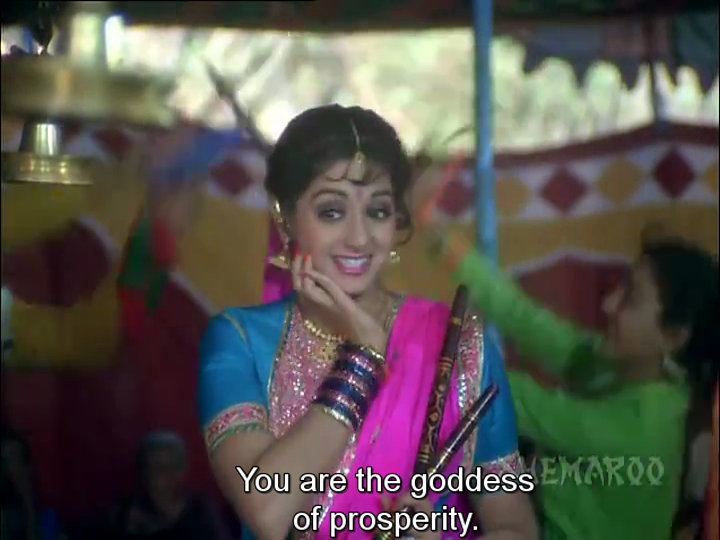
Gair-Kanooni-Sri Devi as LaxmiGair-Kanooni-Laxmi is her namesake

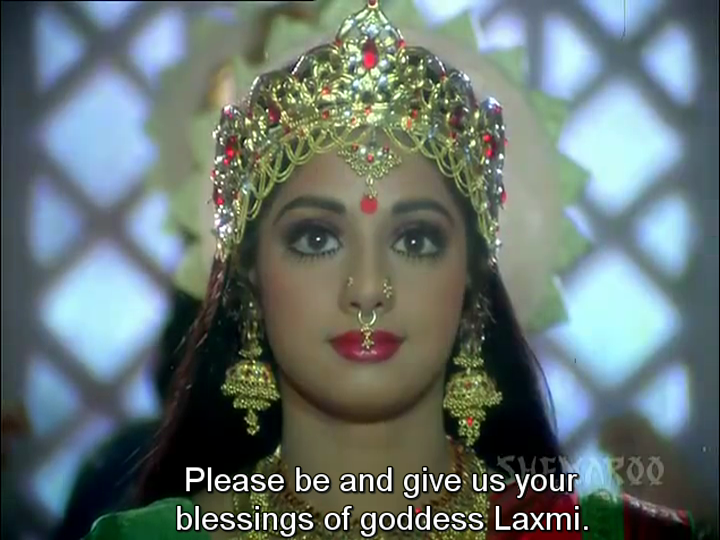
Sri Devi is perfectly cast as Laxmi. Fostered by Bantho (Aruna Irani) and Nathulal (Satyendra Kapoor) Laxmi imbibes her guardians’ world view and skillset. (Nathulal is the man who went to jail for killing Azaam Khan, just in case we needed a Sign that there were going to be Coincidences and Revelations.) Laxmi makes her money via illegal means but she is not a bad person at heart. Similar to other roles Sri Devi essayed – Kumari in S.P Parasuram, Seema in Roop Ki Rani Choron Ka Raja and even Seema in Mr India – Laxmi is brave, funny and generally smart with interludes of ditziness. Her focus is on getting by and doing what she needs to do to survive.

Gair-Kanooni-Sri Devi

Laxmi falls for Om but their romance is a lesser subplot compared to the goings on between the villains. She describes him at one point as her friend and her future husband, which I liked.

That song has to be one of the most eye-popping introductions ever. Govinda is partly overshadowed by Rita’s (Kimi Katkar’s) hideous skirt, but still! Om and his dad have a scam whereby he accepts dowry and then weasels out of the marriage. Like Laxmi, Om isn’t an actively bad person but he doesn’t try too hard to stay on the straight and narrow. Generally he sails through all fine and dandy until he falls in love for real. At least Laxmi had an equally flexible approach to ethics so they were well suited. Govinda is a great choice in this kind of role – lots of colour and movement. It needs an actor who just goes all in for the entertainment factor and he does that, boots and all.
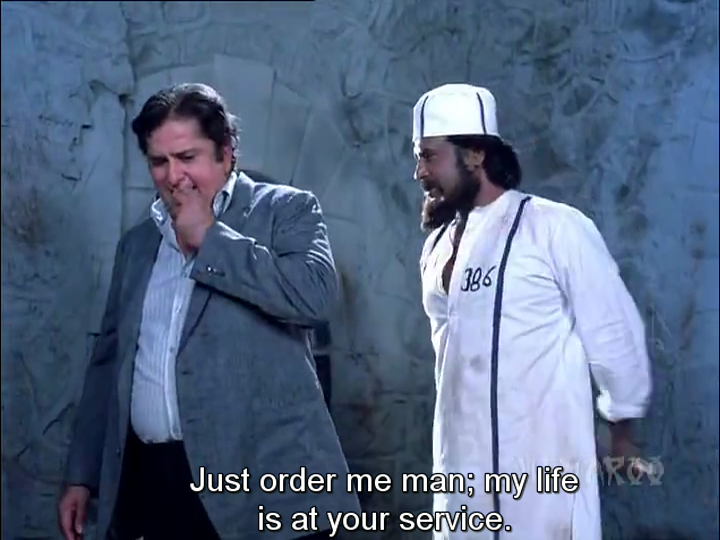
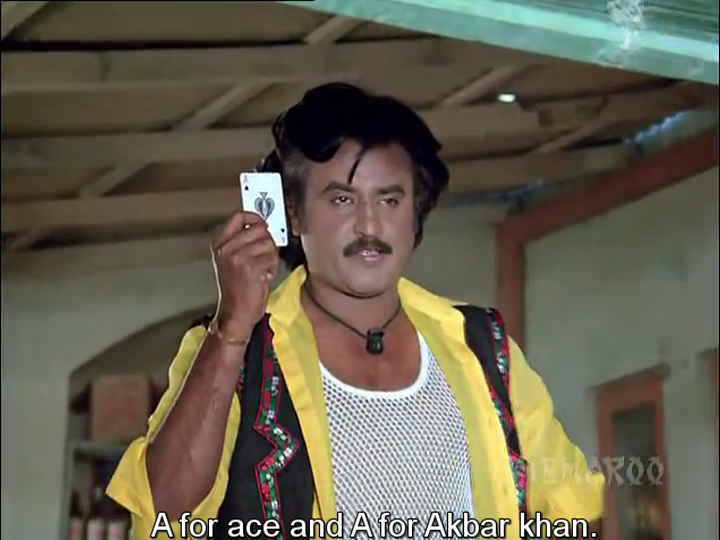
Gair-Kanooni-Shashi and RajnikanthGair-Kanooni-Rajini as Akbar

Often I feel Hindi film-makers missed the point of Rajini – they either cast him as a bit of an idiot (like in Hum) or a grim chain-smoking vengeful type. He is such a great actor and he can handle any kind of filmi ridiculousness with aplomb. Initially I expected his appearance as Aazam to be it, and was lamenting the wasted opportunity. But who better to play vengeful son of Rajnikanth than Rajini himself! Akbar is the grown up son and soon gets tangled up with the plot, quickly finding out who the real bad guys are. Rita (Kimi Katkar) falls for him despite his harsh criticism of her morals as apparently evinced by her skirt length and his generally bleak outlook on life.

Rajini gets to declaim elaborate threats and back them up with flashy fighting (choreographed by Judo Rathnam, who did such amusing work in Geraftaar). I especially love one dramatic escape where he launches himself head first through a breeze-block wall. Amazing. Dancing is not his forte however so it is good that the total entertainment burden does not rest on his shoulders.

Ranjeet and Kader Khan play their usual villainous types and they are truly, irredeemably, despicable. D’Costa and Dalal are locked in a dysfunctional relationship where neither likes or trusts the other but just can’t walk out. There is a large supporting cast but they are a bit lost behind the histrionics of the main protagonists.

Gair-Kanooni-Govinda and KimiGair-Kanooni-soot free Kimi Katkar is feisty and over-accessorised as Doctor Rita, and I like her spirited self defence and addiction to ruffles. Tej Sapru has a very small role as D’Costa’s son Tony, prone to acid wash denim and hissy fits when he isn’t allowed to go kill people. Aruna Irani is memorable as Bantho who takes pride in her adopted daughter’s thieving abilities.

Gair-Kanooni-Shashi and Govinda

There are misunderstandings, confrontations and tearful confessions galore. The song lyrics often express what is happening or how characters see things, which I find refreshing and relevant compared to some modern efforts. Plus it must be helpful to the other characters to have things explained so melodically. Resolution arrives through forced proximity (jail is good like that) and … ‘tribal’ disco.

That song wasn’t such a good idea really, but it is memorable. Plus a kidnap and forced kidney donation brings the rest of the family together. And I have left out so much!

Sure, Shashi Kapoor in blackface is unnerving but Sri Devi and Govinda, a Bappi Lahiri soundtrack and Rajnikanth in dual roles make this pretty special. See it for the cast, the song picturisations and the the plot that hits the point of ridiculousness and accelerates, cheering itself on towards WTFery. 3 ½ stars!

Gair-Kanooni-no words

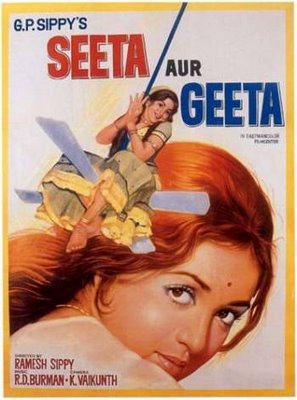
Seeta aur Geeta

Seeta Aur Geeta is a classic dual role movie so common in Bollywood, but for a change it’s the heroine who has the double part to play and Hema Malini excels as both characters in this tale of separated sisters. This is my favourite film with her as she flawlessly provides drama, action and comedy and looks totally stunning throughout. It’s a pleasant change to have a heroine-centric film and although Dharmendra keeps trying to sneak a piece of the action, Hema always gets the last word. You go girl!

The film opens by explaining how the twin sisters get separated at birth and brought up by different families. But there are no mystical songs, lockets or other identifying objects needed because the two just happen to be identical, which means of course that there will be confusion between the two when they grow up.

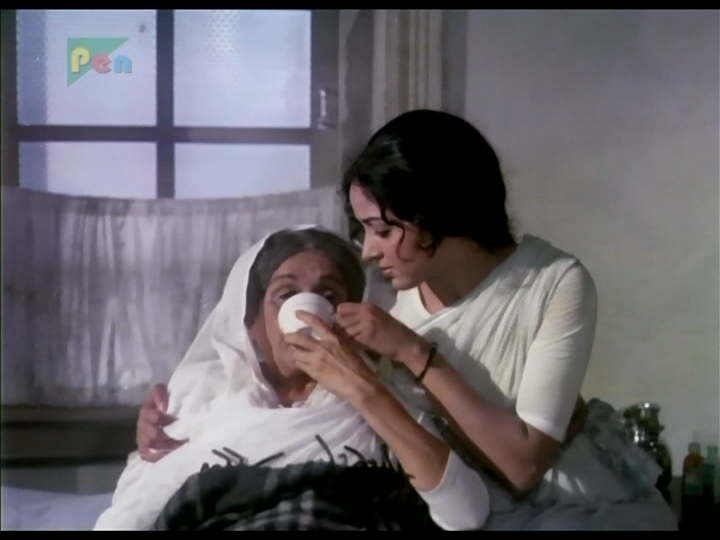
First of all we meet Seeta and her family. Her parents are dead and Seeta is living with her Aunt Kaushalya, Uncle Badrinath and their two children. Also living in the house is Kaushalya’s brother Ranjeet (Roopesh Kumar) and Seeta’s grandmother.

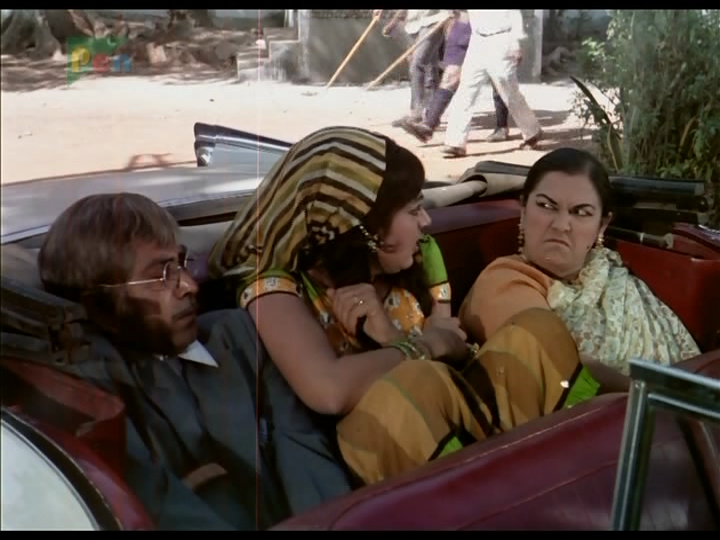
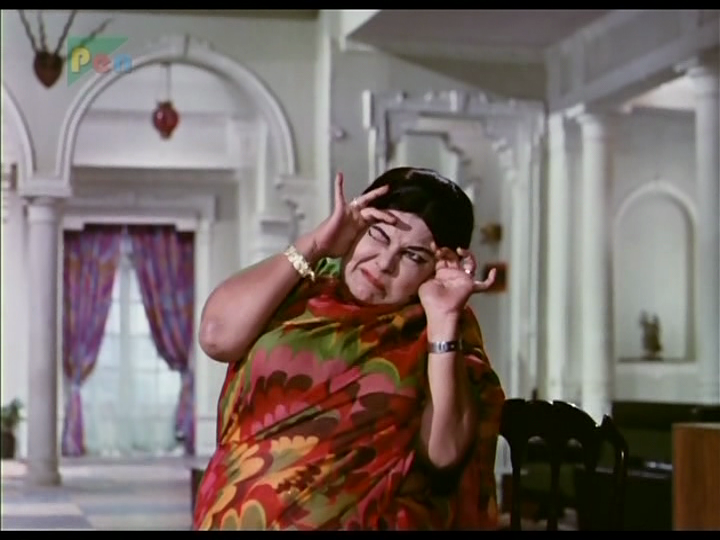
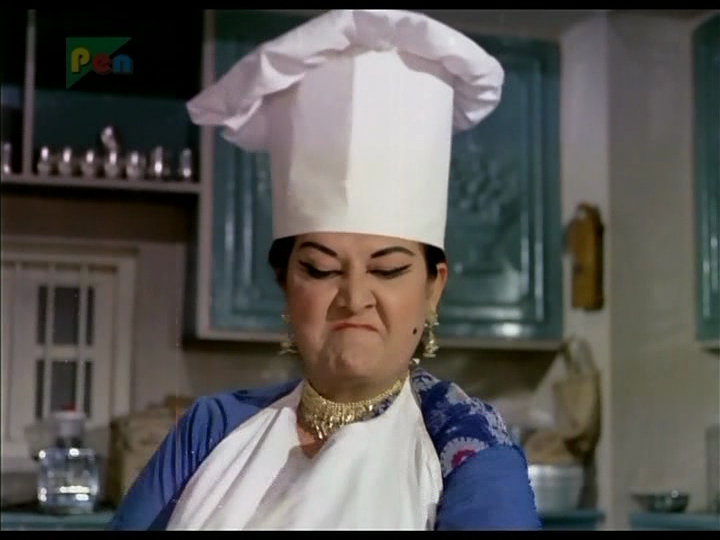
Kaushalya and her daughter Sheila treat Seeta as a slave and she is constantly abused and overworked. Seeta is the weak-as-water type of heroine I usually want to slap and tell to pull herself together, but since her rather pathetic and hopeless character is the whole point of this part of the film, I can live with it. Anyway, the focus at this point is much more on Kaushalya who is the best wicked aunt ever. Manorama is outstanding in her role as Kaushalya and has the best selection of grimaces I have seen outside of a gurning competition. Here is just a selection of some of her expressions which she uses to excellent effect.

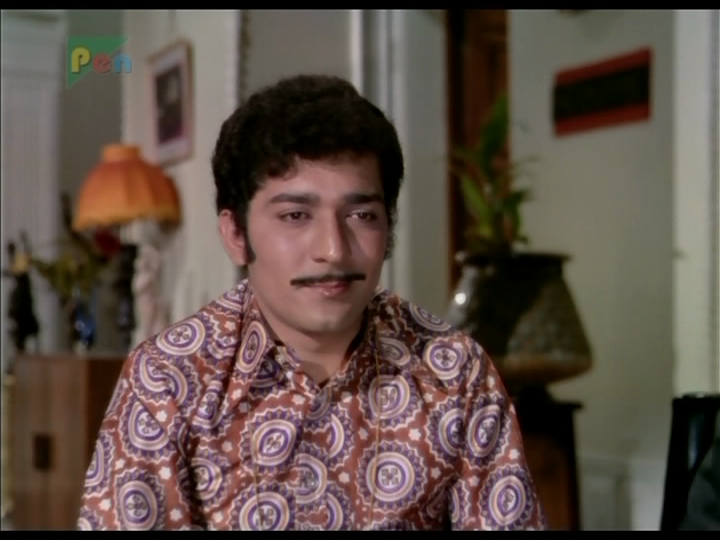
Honey Irani appears in front of the camera in one of her first roles as an actress playing the mean and spoilt mommy’s girl Sheila. I love the way she stands and screams as an iron burns her sari rather than just lifting out a hand to move it away. She really does seem to believe she is the delicate flower her mother calls her and she wonderfully nasty towards her cousin. Ranjeet is appropriately sleazy and obviously the villain once he turns up in a selection of increasingly bad shirts and terrible scarves.

After Seeta’s trials and troubles have been established we are introduced to Geeta. What a difference! Seeta is introduced in a scene where she is scrubbing the floor and her evil aunt is yelling at her. Geeta is introduced by a song – upbeat, full of life and fun, it’s an apt description of Geeta and her outlook despite her humble status.

https://www.youtube.com/watch?v=8Jzyd6EY15A

Geeta lives with her mother and works as a street performer with Raka (Dharmendra) and Jhumroo (Master Ravi). She’s loud, vivacious, a bit of a crook and nothing at all like her twin sister. There is much made of the differences between the two: Geeta’s fiery nature and her loving relationship with her mother for example, compared to Seeta’s meek obedience and her constant craving for her lost parents. It all sets the scene for the inevitable switch between the two sisters.

After further abuse and inappropriate attentions from the slimy Ranjeet, Seeta finally escapes from the house and Kaushalya reports her as missing to the police. However Geeta happens to be at the local police station where she is ‘recognised’ as the missing Seeta and picked up by her ‘aunt’ and ‘uncle’.

On the way home Geeta decides she doesn’t want anything to do with the crazy fat lady and escapes, ending up hiding in a car with Dr Ravi (Sanjeev Kumar) in a coincidence that is only ever possible in Bollywood. Dr Ravi has already met Seeta as a possible marriage candidate and at the time wasn’t impressed at the way Kaushalya presented her niece, but he finds the new ‘Seeta’ intriguing and the two end up falling in love.

Since she feels sorry for the grandmother, Geeta ends up back in the mansion living with Seeta’s family, but she doesn’t appreciate the idea of being their servant and certainly won’t put up with any abuse. It’s a shock for everyone in the family when their previously docile slave lashes out and forces everyone else to work instead. Geeta is hilarious as she pretends to be Seeta and turns the tables on Kaushalya and Ranjeet. There is so much to laugh at, but also plenty of drama and a good balance between the two. It all works so well because of the excellent performance by Hema Malini as the two different sisters. Geeta is a strong and determined character and Hema conveys this resolution with body language and expression just as much as by the dialogue. Seeta is quieter and more submissive, keeping her eyes downcast and her voice softer, but in her own way is just as determined to get what she wants once she breaks free of her restrictive family. It’s hard to believe that no-one seems to question the identity of the two sisters, especially since Hema makes them two very different people but no-one ever seems to consider the possibility and that allows the chaos to continue.

While Geeta is busy reforming Seeta’s family, Seeta is found by Raka who naturally thinks she is Geeta and takes her back to Geeta’s foster mother Leela (Radhika Rani).  Seeta blossoms with the love of her new ‘mother’ while Leela is amazed to have a daughter who can cook, sew and volunteers to visit the temple.

Despite her abysmal attempts at street performing, Raka falls in love with Seeta while for no real apparent reason, Seeta falls in love with him. Although to be fair he is probably the first person she has met who is as self-absorbed about his orphan status as she is, and their shared misery does create a bond. Their wedding is set, as is Geeta’s to Dr Ravi but of course the path of true love never runs that smoothly and there is still the confusion between the two sisters to sort out. Although Raka tries to save the day, in the end it’s Geeta with a little help from her sister who proves that anything a Bollywood hero can do, a heroine can do even better. It’s all totally crazy, over the top and Hema seems to have an excellent time beating up all the bad guys in the fight scenes.

The cast here are all excellent and they are perfectly cast to fit well into their roles. Sanjeev Kumar is effortlessly charming and debonair as Dr Ravi. His assertion that he wants a good Hindustani girl as his ideal wife did make me groan, but despite his initial statement he doesn’t seem to mind when Geeta dresses in more Western style clothes and he positively encourages her to go roller-skating (which may actually be something that good Hindustani girls do considering the number of times it happens in films). I’m often quite ambivalent when it comes to Dharmendra, but since he is rather overshadowed by Hema Malini and his over acting goes almost totally unnoticed beside the caricature of Kaushalya, I really enjoyed his performance. Both Pratima Devi as the long-suffering grandmother and Satyendra Kapoor as Kaushalya’s hen-pecked husband provide excellent support, as do the various other members of the cast. But it’s  Hema and Manorama who are the two essential elements to the film and their scenes together still make me laugh every time.

The music is by R. D. Burman and his songs are lovely and well-integrated into the story.  Asha Bhosle and Lata Mangeshkar provide beautiful vocals for Hema while Kishore Kumar and Manna Dey provide the male voices for Sanjeev Kumar and Dharmendra. The songs are all pictured on Geeta rather than Seeta which is perhaps a shame, although there is one solo song with Dharmendra which works well. I love this famous song with Geeta pretending to be drunk to dissuade Dr Ravi from marrying her. It’s funny but very sad too and while Hema is excellent, Sanjeev Kumar provides excellent backing for her drama.

Javed Akhtar, Satish Bhatnagar and Salim Khan have done a great job adapting the ‘Prince and the Pauper’ storyline to suit a Bollywood audience and the dialogue is well written and very funny. Director Ramesh Sippy keeps everything moving along and despite knowing the switch is going to happen he still builds plenty of suspense into the story.  This is a total Bollywood classic for me – great performances, good songs and excellent comedy, all delivered with such style by Hema Malini. I absolutely love this film and I’ve lost count of the number of times I’ve watched it. A full 5 stars!

Temple says:

I like Seeta aur Geeta, but I don’t love it. I first saw it several years ago and I really liked it at the time. I’ve watched it a couple of times since, and each time I enjoyed it a little less and fast forwarded a little more. I can’t quite warm to Hema Malini, Sanjeev Kumar is not my idea of hero material and I lack the Dharmendra Swoon gene. So it all comes down to the story and the characters.

I really like the way the story plays with the masala tradition of twins separated at birth, and there are lots of fun moments as Geeta impersonates Seeta. But it does drag on a bit once the twin swapping starts, and Seeta is such a wet dishrag that I get restless whenever she is at centre stage. Geeta is more lively but as with so many filmi heroines, she can only get a husband when she pretends to be something else – in this case, a demure young lass like her sister. So that detracts from the ‘you go girl’ mood as it turns into ‘you go girl and put on a nice sari and a long-sleeved high-necked blouse’. I also found the roller skate scene stupid and not in a good way – Geeta was a tightrope walker and acrobat and all of a sudden she can’t work out how to balance or control her body? Yes she was on wheels, but it was just a lazy way of asserting the hero’s superiority when there was no real need. Kickarse girls can only kick so much before decorum demands they are put in their place. And then to have Sanjeev Kumar as the vision of young love…oh dear. The romances didn’t grab me in the slightest as neither couple seemed to be well suited or even mildly interesting. There wasn’t really enough of a threat or menace to keep the dramatic tension either, as most of the ‘bad’ characters were more slapstick than villainous.

Overall, I like this enough to say see it as a good timepass. It’s colourful, the music is pleasant although I don’t think it’s great, the mood is generally upbeat (apart from all the attempted rapes and beatings). But it’s not a film that rewards repeated views and there are many other masala favourites I would rather see again. 3 stars.

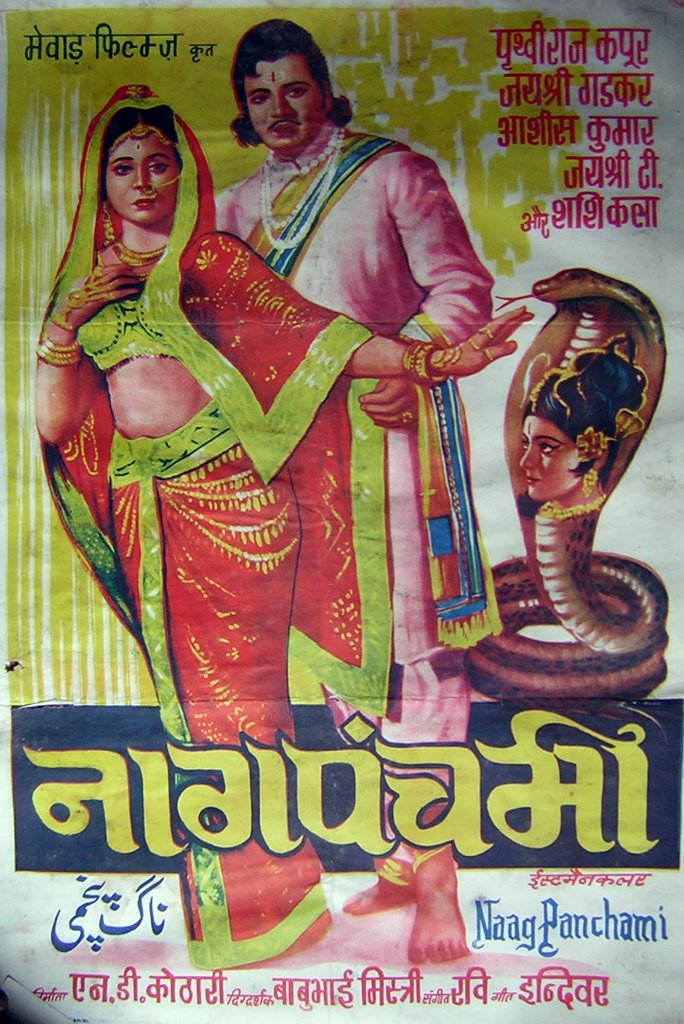
Naag Panchami (1972)

Snakes Galore!

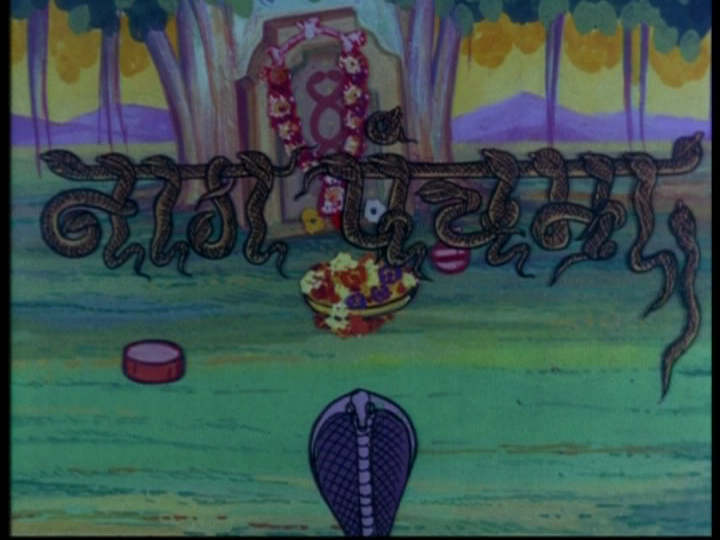
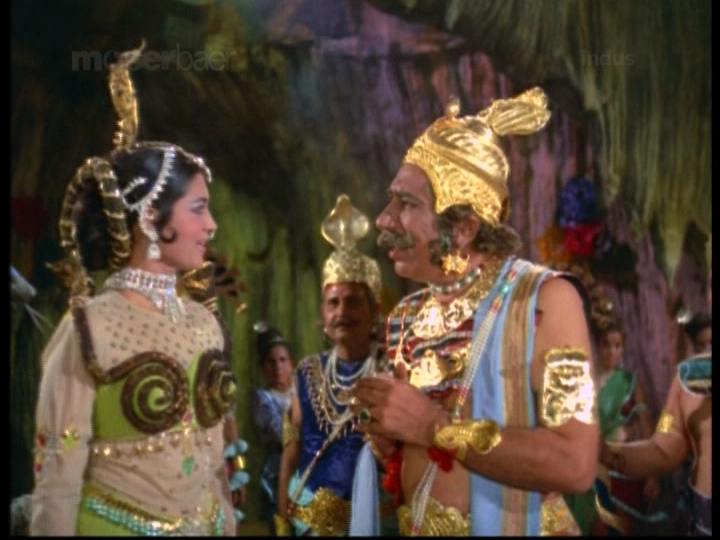
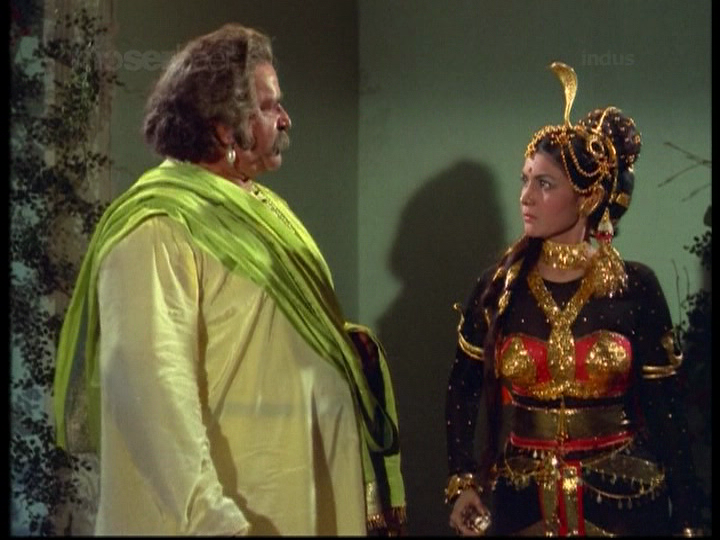
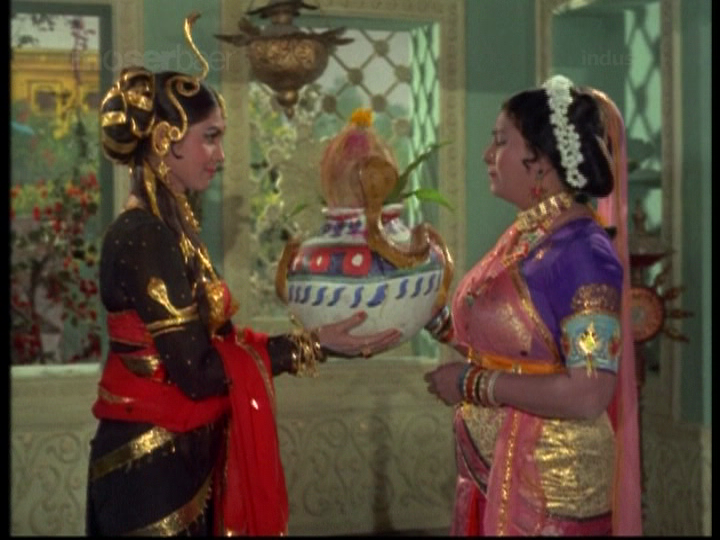
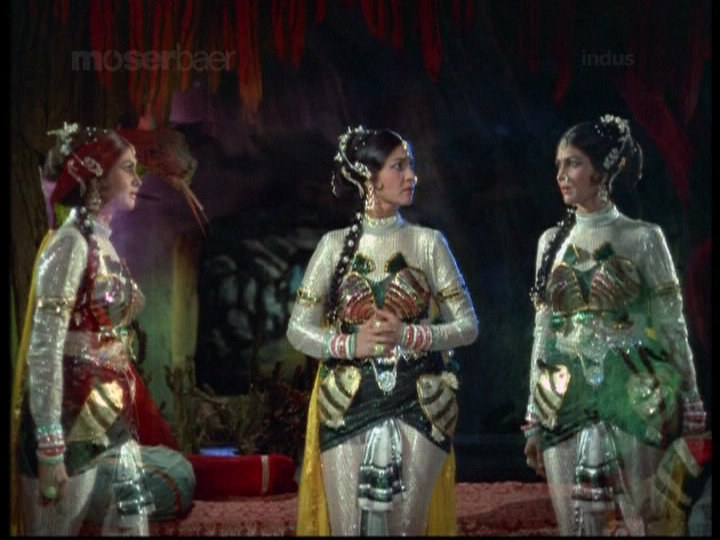
Perhaps as an omen of the awesomeness which is to come, the film opens with some excellent snake animations which include a very snakey title. Love it!This film is a feast for costumes lovers – every outfit seems to have extra glitz, glamour and shine with some really amazing fabrics and accoutrements. Just look at these bodice designs – very apt for the snake goddess and her poisonous serpent sidekick:


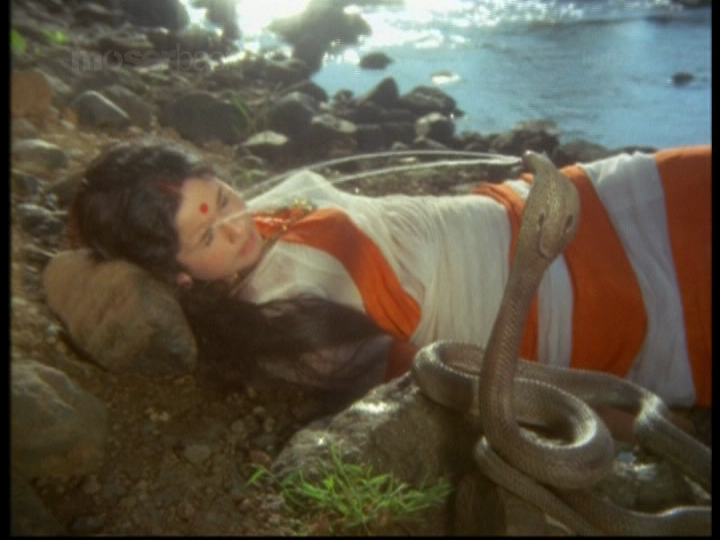
And just for some variation, later on Goddess Mansa decides to try out a fish theme with a wonderful headdress.But there are also plenty of real snakes throughout – not just on the costumes – although the film seems to use a combination of some really quite bad model snakes interspersed with the real thing. These are some of the real ones.

Naag Panchami starts with the rather petulant Snake Goddess Mansa having a bad day. It’s her birthday but she is restless and irritated by her followers in Naglok. Fortuitously Nagraj turns up and she manages to cajole him into revealing the name of her father, who is none other than Lord Shiva. Mansa is thrilled by this news and immediately goes to see her father who takes her to meet her mother and siblings in Khailash. Once there she discovers the existence of ‘the rest of the world’, and decides she wants to be worshiped just like Shiva and the other Gods. To achieve her aim she decides to make Lord Shiva’s chief devotee Chandrakhar her worshiper too, and to that end she appears to him on board his ship and demands his instant worship. But the successful merchant is unimpressed by Mansa and reviles her for her arrogance and presumption.

Various ploys by Mansa to force his worship fail to work and finally she kills all six of Chandrakhar’s sons. Mansa seems to work on the theory that the more insane her actions, the more likely it is that Chandrakhar will devote himself to her, which of course is guaranteed to have the opposite effect entirely. Lord Shiva very wisely declines to get involved so the scene is set to allow Mansa to do her worst.

As part of her long term plan she then approaches Chandrakers wife Alta and gifts her with another son – not really a lot of consolation for the lost of the last six, but then that’s not her ultimate plan. Rivers flow, birds fly and suns set as he grows up incredibly fast to be the handsome and dashing Lakshmindra. Lakshminda crosses paths with the equally daring and beautiful Behula when she is out hunting. Naturally the two fall in love and in next to no time determine to marry.

Meanwhile, Mansa’s chief handmaiden Maithreyi has also married and as husband and wife are cavorting in the forest, Lakshmindra inadvertently runs over her husband in his chariot, killing him instantly.

Unaware of this fresh disaster Lakshmindra is now under threat of death from both Mansa and the vengeful Maithreyi – a situation with plenty of snakey potential. It all becomes very Sleeping Beauty-ish as Mansa turns up to the engagement and threatens Lakshmindra with death on his wedding night. Queue evil laugh Mwah ha ha ha! Even Maithreyi is starting to look a bit worried! To protect his son, Chandraker orders a house to be built of iron to ensure that nothing will be able to enter and kill his son. Now I would have thought that an iron house would be quite impractical , hot in summer and hard to keep warm in winter, and not necessarily the only way to keep snakes at bay. Nevertheless, the newlyweds end up in a supposedly impregnable house on their wedding night. Except of course it isn’t. Maithreyi turns up to seek her revenge, but Behula is resolved to save her husband and manages to convince Maithreyi not to kill Lakshminda.

Sadly though, after Maithreyi leaves, neither Behula nor Lakshmindra think to bung up the hole in the wall and Mansa sends another snake which does manage to complete the job. Not one to be easily defeated, Behula resolves to carry her husband’s corpse on a pilgrimage around various temples in order to revive him. While on her quest, Mansa assails Behula with many really bad special effects including a huge crocodile and lightning induced blindness just to name a few.

We also get to see that not all snakes are bad, or at least not all the time, as Maithreyi turns up to help Behula in her snake form, towing the body to safety and waking Behula up with a nicely placed spray of water. I really do think all of this would have been much easier to accomplish as a human, but probably nowhere near as much fun to watch.

I really enjoyed this film. The costumes are wonderfully sumptious and there is just oh so much evil that Mansa manages to accomplish. The songs are fantastic and with playback singers Asha Bhosle, Kishore Kumar and Lata Mangeshkar and music by Ravi it all sounds beautiful. There is even a great snake dance by Maithreyi as Mansa looks on in her fab fish ensemble – already mentioned by jenni, but I think it deserves to be seen again.

The snakes here do conform pretty much to the standard in the Filmi Snake Spotters Field Guide. There is the less is more approach to clothing, plenty of embellishments and headdresses, great eyes and plenty of snake inspired architecture to pose with. Mansa also has the ability to conjure snakes whenever she is feeling annoyed with someone and flings them around with gay abandon. She becomes more and more maniacal and Shashikala is wonderfully crazy, changing from self-indulgent and immature one minute to totally malevolent and insane in the next.  Her eyes get wider and wider and she is definitely a master of ’the look’. She even talks to herself.

Maithreyi (Jayshree T.) is much less vengeful despite losing her husband, and a much nicer person snake all round. Hers becomes the voice of reason which Mansa of course totally ignores.

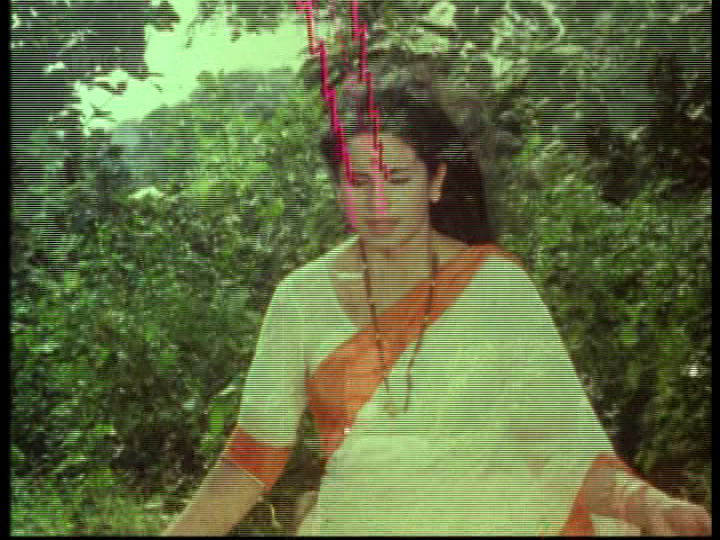
Jayshree Gadkar is lovely as Behula. She invests her with grace and determination and plays the devoted wife perfectly. Out of her lavish costumes as the princess she looks beautiful in her plain sari when she is making the pilgrimages around the various temples. The other actors are all fine but are mainly just there as targets for Mansa. Prithviraj Kapoor is suitably imposing as the rich merchant, and Ashish Kumar does a good job as Lakshmendra. Satyendra Kapoor has a small role as Lakshmendra’s friend Vishwavardhan and makes the most of it.

The end involves various Gods and Shiva dancing to shake the world – yet more excellent costumes and ‘bad enough to be really good’ special effects. This is so much more than just another snake movie and I’m rather surprised that it doesn’t seem to have the recognition I think it deserves – if only from aficionados of shiny fabric and bejewelled headdresses. A great film for Nag Panchami Film Fessstival  I love it! 4 stars.