Agnyaathavaasi

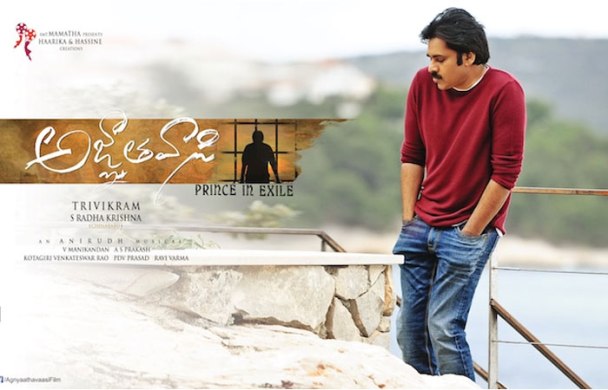
PosterDespite a stellar cast and a rocking soundtrack, Agynyaathavaasi turns out to be a rather disappointing watch. Trivikram takes an interesting plot and fills it chock full of masala, to the extent that the story of a son’s mission to exact vengeance on his father’s killers becomes lost in the morass of comedy, romance and OTT fight scenes. Nothing too much out of the ordinary for a Telugu film then you might think, but there is simply too much of everything here, making Agynyaathavaasi a clutter of confusion instead of the thrilling action film it could have been.

The story (when you can catch a glimpse of it) follows the exploits of Balasubramanyam (aka Abhishikth Bhargav aka Bala aka Abhi!) as he attempts to discover who murdered his father and brother, and then follow through to exact revenge. Abhi (Pawan Kalyan) has been raised in secrecy, allowing his younger half-brother to assume the role of heir to his father Vinda’s pharmaceutical empire. Vinda (Boman Irani) is notorious for always having a Plan B, hence the existence of Abhi who is rather oddly is his step-mother’s favourite, despite his exiled status. Indrani (Khushboo) suspects that her son and husband did not die accidental deaths, and calls Abhi back to discover which of the two aspirants to Vinda’s AB Company were responsible for the deed. Varma (Rao Ramesh) and Sharma (Murali Sharma) have been part of the company since its formation, but neither seem up to the challenge of running a multi-national organisation. Both actors do their best, but with poorly etched characters played mainly for comedic value it’s hard to see why they could ever be in the running as suspects for the murders.

Adding more unnecessary slapstick is Raghu Babu as a particularly sleazy office manager whose antics aren’t even remotely funny and who is completely superfluous to the plot. As too are Abhi’s side-kicks, who start off by offering technical support for his scheme to infiltrate the company but end up as a kind of enthusiastic group of cheer-leaders on the sidelines instead. These include Tanikella Bharani as Abhi’s uncle, Srinivasa Reddy and Abhishek Maharshi who all gasp, cringe and applaud at appropriate moments but otherwise have little to do as Abhi smoothly goes about his investigation without encountering too many problems.

Naturally there has to be a romance – so why not two? Anu Emmanuel and Keerthy Suresh are the two women Abhi uses as part of his schemes to discover the truth, which goes some way to explaining the mainly superficial nature of the relationships. Still it does mean a couple of songs and a quick jaunt to Bulgaria in between Abhi’s many fight scenes. Outside of this though, the two actors only appear as light relief in between beautifully staged but surprisingly dull fight scenes.

Normally the saving grace in these films is the performances of the actors, but almost everyone here, including Pawan Kalyan overact like crazy. The Powerstar doesn’t seem engaged with the screenplay at all for most of the film – not surprisingly perhaps, since I found it difficult to engage with too! There’s a bizarre scene where an insightful police officer (Sampath Raj) starts to postulate on who Abhi could possibly be, and manages to reconstruct the entire sequence of events without any clues, witnesses or evidence to back up his theory! It’s another example of needless frills that hinder the story. A flashback sequence would have worked much better and there was no need to add such speculation, particularly when the police officer involved reported that both Vinda and his son died by accident despite Vinda being shot in the head before he plunged to his death from a high-rise.

On the plus side, the music from Anirudh Ravichandler is excellent and suits both the action and romantic sections of the screenplay. The songs are also catchy, but for the most part don’t sit well within the screenplay and most seem to be added rather randomly. Despite this, the choreography is excellent and the locations beautifully filmed. Indeed, overall the cinematography is excellent with some stunning shots of Varanasi near the start of the film. I also liked the attempt to link Abhi’s story to parts of the Mahabharata and the story of Krishna, which helped to fill in some of the back-story that was glossed over rather quickly.

There are some terrific performances too in the midst of all the general scenery chewing. Boman Irani is good and Khushboo is notable in her return to the big screen as Abhi’s step-mother and Vinda’s widow. She’s compelling in her scenes and her understated performance stands out in the midst of all the other melodrama. Also very good is Aadhi Pinisetty as the main protagonist, Seetharam. He gets the balance between arrogant brat and murdering megalomaniac just right while looking dapper and well-groomed at every occasion. Despite only a short amount of screentime Aadhi is impressive and makes an excellent villain once again.

Agynyaathavaasi is simply too uneven to be anything other than a one-time watch. Although there is a good basic storyline, the added fluff and masala buries it too deep and not even the excellent production values can keep it from sinking under all that weight. Although Khushboo and Aadhi along with Anirudh’s music and V. Manikandan’s cinematography are worth seeing, this is really a film best for fans only.
Duvvada Jagannadham (2017)

duvvada jagannadham poster

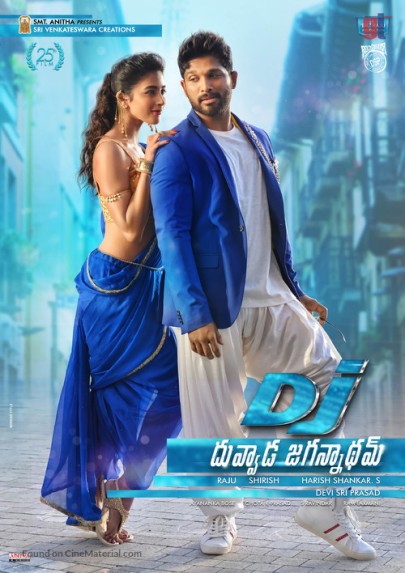
In his latest release Harish Shankar sticks closely to the standard formula for Telugu hero-centric films, which makes Duvvada Jagannadham rather less exciting than it could have been. There is hardly any suspense and few surprises as the hero flexes his muscles, obliterates the bad guys and romances the heroine while recouping lost money for the victims of a property scam. What makes it watchable are the excellent performances from Allu Arjun, Rao Ramesh and Subbaraju who add life and energy to an otherwise pedestrian plot. The story might be plodding along, but the cast give it their all, and with many other veteran performers including Murali Sharma and Posani Krishna Murali, and some good songs, DJ ends up as a reasonable timepass.

The story opens with a young Duvvada Jagannadham Sastry picking up a gun and executing a gang of thugs who attack policeman Purushottham (Murali Sharma) in his local market. Not content with his body count so far, he then turns the gun on a suspected rapist in the police station and shoots him too. Bizarrely the police officer in question rapidly recovers from his previously incapacitating wound and then doesn’t bat an eyelid at the young multiple murderer, instead enlisting him as a vigilante in his never-ending war against crime. Because of course there is nothing abnormal about a young boy killing in cold blood (and also being a fantastic shot) – not in this film at any rate.

Moving quickly among to the present day and Duvvada Jagannadham (Allu Arjun), aka Sastry is a Brahmin priest who runs an all-vegetarian catering business in Vijayawada along with various members of his family. Sastry is devout, speaks in very precise Telugu and is passionate about his cooking, although he doesn’t take life too seriously as demonstrated by a recurring joke about using asafoetida in tamarind rice. Bunny is good here, particularly with the comedy scenes and dialogue, while the trio of Sastry, his father (Tanikella Bharani) and uncle (Chandramohan) make a good team as they feed the hungry hordes of wedding guests around Vijayawada.

However, when Sastry answers his phone he becomes a totally different person – his posture is different, his voice deeper and the language less classical. Going by the name of DJ, Sastry’s alter ego is still a vigilante killer working for Purushottham eliminating criminals permanently from the streets of Hyderabad. DJ is super stylish and ultra cool, which ensures that Bunny remains ‘the stylish star’ despite spending much of the film in more traditional attire. Naturally DJ is also an accomplished killer, although quite where he learnt his skills is as much of a mystery as his motivation to cleanse Hyderabad of all criminals. The action scenes here are all beautifully choreographed by Ram Lakshman and Bunny carries out the various impalings, defenestrations and executions as smoothly and effortlessly as he performs his dance routines, and with just as much style. Sadly, there isn’t much else to the character of DJ beyond the dapper surface and efficient bloodshed. There is no rationale behind why his character is driven to such violence, particularly since he has been raised as a priest and generally seems to be a kind-hearted and benevolent priest at that. There is a brief comment by his father at the start, questioning why his son has so much rage, but this is not explored at all, and of course Sastry never shows any sign of the explosive ferocity that is characteristic of DJ.

Naturally there is also a heroine, and as might be expected from the formulaic plot, Pooja Hegde’s presence is completely superfluous to the story with her only purpose seemingly to be to appear in as many skimpy costumes as possible and dance in a few songs. The brazen character of Pooja seems unlikely to appeal to the traditionally minded Sastry, and although her designer credentials might interest DJ, her nasty, childish behaviour when they first meet is unlikely to impress. The camera spends more time focused on Pooja’s navel than on her face and it’s a shame that the only real emotion she gets a chance to display is when she’s shopping in Abu Dhabi – her excitement here is the only genuine moment her character has throughout the entire film. Still, she does look stunning, and has good chemistry with Bunny in the songs, but it’s a shame that she has no opportunity to do anything more.

DJ becomes personally involved in the case of a property scam where the real criminal Royyala Naidu (Rao Ramesh) hides behind a proxy (played by Prabhakar). Royyala’s son Chintu (Subbaraju) also becomes involved when Royyala conspires with Pooja’s father Minister Kusuman (Posani Krishna Murali) to marry their respective children. Subbaraju is excellent as a crook with an unusual idiosyncrasy, particularly in the final showdown with DJ and Royyala.

Throughout the film Bunny excels with his comedic dialogue as Sastry and does a good job of keeping the two sides of his character quite separate and different. As always his dancing is superb on every level and I did appreciate his collection of sparkly sneakers in various colours too. Devi Sri Prasad’s songs are good, although the song sequences aren’t connected to the plot of the film and seem to be simply added in as part of the standard formula – “fight scene/ family scene/ romantic moment/ song”, and repeat. However, the dance sequences add in energy and give Pooja and Sastry/DJ a chance to develop their romance that otherwise appears rather lacklustre.

Duvvada Jagannadham is disappointing, but the action sequences are impressive, the songs are excellent and Bunny is always watchable. There are some good dialogues that were well appreciated by the audience here in Melbourne, and the comedy with Bunny, Vennela Kishore as his cousin Vighneswara Sastry and the rest of the family is generally pretty funny. The major issue here is the formulaic plot and uninspiring screenplay that feels dull despite the good performances from the cast. However it’s not all bad and there are some scenes that work very well, it’s just that it doesn’t all gel together as it should. Worth watching for Bunny, the songs and the action, just don’t expect too much from the plot.

Brahmotsavam (2016)

Brahmotsavam

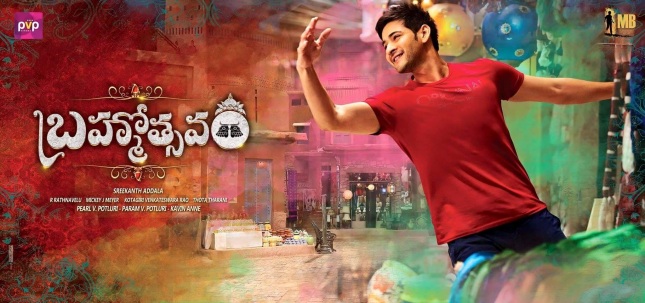
Srikanth Addala’s Brahmotsavam is a real mishmash of a film, where random family scene follows random family scene with the emphasis on feel-good values and upbeat emotions rather than anything inconvenient like a storyline. This is one film where the subtitles didn’t seem to help at all and much of the dialogue made absolutely no sense, but a few other audience members explained that not only were the subtitles inaccurate, but that the script was fairly random too and they were just as confused. It doesn’t help that most of the characters don’t have actual names but are called brother, brother-in-law or sister-in-law (and there are a lot of them), making Brahmotsavam less of a celebration and more of a memory test. Mahesh is always watchable and the strong cast are all charismatic, but with nothing much actually happening over more than two and a half hours, Brahmotsavam is sadly uninspiring.

The film starts with a family celebration, which I think was a wedding but could have been almost anything – maybe just breakfast – given the families propensity for breaking into song and dance at any moment.  Whatever the occasion, Sathyaraj likes to ensure that the whole family celebrate it together – that’s all his brothers, their wives, children and his brother-in-law Rao Ramesh. Everyone is sickeningly happy all the time except for Rao Ramesh who suffers from intense (but understandable) familiyitis and resents Sathyaraj’s success with the paint factory he runs. Naturally everyone in the family works at the paint factory when they’re not singing and dancing around the family home, and they’re all deliriously happy to be working there too. It’s actually a little odd to see Mahesh in such ultra-happy family mode for most of the film, but when he sheds the happy and has to show a range of emotions he really is excellent. More of this would have made for a better and more enjoyable film.

Just to add to his individuality a small animated figure appears to speak to Rao Ramesh any time he is particularly exasperated with his brother-in-law. Since most of the time this imaginary figure berates him for his lack of appreciation for Sathyaraj and the family gatherings this has the effect of making Rao Ramesh even more miserable and less willing to participate. After the first 15minutes I was totally on Rao Ramesh’s side and could completely understand how the continual en masse family gatherings could very easily make anyone want to run screaming for the hills as fast as possible. Rao Ramesh is much more tolerant however and manages to last almost until the second half before he snaps and leaves the family group.

As part of the celebrations, Kajal arrives from Australia for a few months and her father decides it would an excellent idea if she stayed with Sathyaraj and his family rather than spend the time with her own relatives. She’s gorgeous and confident, and Mahesh is smitten the moment he sets eyes on her. However, since she lives in Australia where the accepted practice if you like someone is to tell them you’re interested, Kajal is rather taken aback by someone staring relentlessly at her at every available opportunity without speaking. Living in the same house makes it ridiculously easy for Mahesh to stalk Kajal without appearing to do so but after a few uncomfortable moments Kajal seems intrigued by her silent admirer. The romance progresses as expected but despite Mahesh and Kajal seeming to get on well together, Kajal decides that she wants more from life than to be the wife of a paint manufacturer and decides to move on. She has ambition and is prepared to sacrifice what’s basically a holiday romance for her in order to ensure her dreams come true. I like this assertiveness in her character and Kajal is appropriately confident in the role, while still remaining respectful to the family and her father. It’s a good performance and I like this more mature and sensible Kajal.

Luckily for Mahesh, Samantha turns up in slightly manic friendly overdrive mode and the pair set off pair set off around India in the search for Mahesh’s roots. One of the first family members he meets is the hapless Vennela Kishore and the couple decide to drag him along with them on their road trip. It seems strangely unnecessary but at least Vennela Kishore and Samantha speak to each other which does help to make sense of the second half. Samantha is just a little too zany to be convincing but her energy does help lift the second half. The problem here is a lack of definition for her role and a fluffy backstory that does little to establish her character.

The biggest issue with Brahmotsavam is the addition of too many random scenes which are only peripherally connected to the main ‘plot’ (such as it is) and don’t serve any purpose. For example, at one point Mahesh and his parents are talking by video connection to his sister in the UK. His mum is showing off various sarees while Mahesh teases his sister and the talk finally comes round to how much they miss her and wish she was there. Big family moment – lots of tears, virtual hugs and emotion. And then that’s it – she’s never mentioned again. So much of the film starts with an apparent purpose and then fizzles out without ever going anywhere, making it difficult to work out what (if anything) is relevant.

The first half is also very song heavy with most of the songs coming one after another with little reprieve, including one where Mahesh and his backing dancers frantically try to get insects out of their clothes. That is definitely one of the high points and got the most cheers from the fans in the audience, but possibly not for the choreography. The second half settles down to a standard road trip and there are fewer songs which makes this part of the film flow more smoothly. It’s still a series of random encounters, but at least that does fit in more with the idea of a journey to find yourself while Samantha keeps everything moving along nicely.

There are a few positives to the film. The songs by Mickey J Meyer are good if oddly placed, and Gopi Sundar’s background music is generally effective and not too intrusive. The film looks beautiful and R Rathnavelu’s cinematography captures the warmth of the family home and the stunning landscapes as Mahesh and Samantha travel around India. All the main leads are fine, if somewhat incomprehensible for much of the film, and Mahesh certainly delivers in terms of emotion but the star of the show is undoubtedly Rao Ramesh with his grumpy and often bewildered demeanour. However, the lack of a comprehensible storyline and the random pointlessness of many scenes means that Brahmotsavam is probably best enjoyed on DVD where it’s possible to skip the vague dialogue, watch the songs and admire the beautiful scenery without worrying about the deficiencies in the story.