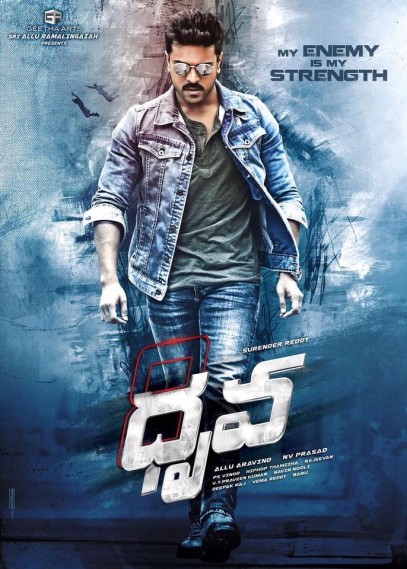
Dhruva (2016)

dhruva

Dhruva is a reasonably faithful remake of 2015 Tamil film Thani Oruvan that benefits from Arvind Swamy reprising his role as the villain of the story. Dhruva is definitely slicker and glossier than the original, but the story is essentially the same although the emphasis is even more on the two main characters than in Thani Oruvan. Thankfully both Ram Charan and Arvind Swamy are excellent and the cat and mouse game between the two makes Dhruva an entertaining and worthwhile watch.

The film is a thriller that follows the attempts of a young and righteous police officer, to track down and catch one of three über criminals. Dhruva (Ram Charan) believes that if he locks up the kingpin of any criminal organisation this will immediately impact on 100 petty criminals and be more effective than tackling each street thug individually. It doesn’t take long before he discovers that his three possible targets each themselves are controlled by an even bigger villain – Siddharth Abhimanyu (Arvind Swamy). Siddharth is a respected scientist, recipient of a Padma Shri award and all round respected businessman so Dhruva has to somehow find convincing enough evidence to send Siddharth to jail for his crimes.

In the original film Dhruva was helped by his close friends who all formed a posse to fight crime together while they were in training college. However their role in the story here has been reduced and although the friends are still there, they have less to do in the hunt for Siddharth.  Goutham (Navdeep) is the only one who has been kept fairly true to the original, but without the detail of their friendship as background, his character is less effective. This also has an impact on the characterisation of Dhruva who appears more isolated and less of a leader as a result, making his assumption of control of a crime task force immediately after his graduation rather less credible.

Another casualty of the re-write is Ishika (Rakul Preet Singh) whose character has even less to do than Nayantara in the Tamil version. Ishika is a victim of love at first sight when she sees Dhruva, and she pursues him relentlessly, knowing that in a Telugu film eventually her persistence will be paid off by Dhruva finally accepting her love – rather than arrest for stalking, which would be the most probable outcome in real life. Although she is a forensic specialist, this is barely mentioned in the film, and Ishika has little involvement in the search for evidence against Siddharth. Where Nayantara’s Mahima had useful ideas and forced her way into the investigation, Ishika is limited to appearing only as the romantic interest. However Rakul Preet Singh does a good enough job in this role and has reasonable chemistry with Ram Charan, which at least makes the scene where Dhruva finally does admit his feelings one of the better moments in the film.

The film is all about Dhruva and his developing relationship with Siddharth and Ram Charan is excellent as the obsessed police officer, determined to track down Siddharth no matter what it takes. He certainly looks the part, easily demonstrated since Surender Reddy is an equal opportunity director who ensures that for every shot where Rakul Preet Singh appears in a bikini there is a shot of Charan without his shirt. No complaints here!  While Ram Charan expertly channels his inner Salman Khan, he also does a good job of portraying the more cerebral side to his character and his monologues where he describes his theories about the local criminals are well delivered. He’s even better when Siddharth’s tactics begin to hit home and Dhruva begins to doubt himself as he loses Goutham and his every move is known by Siddharth even before he makes it. This gradual erosion of his self-confidence is well depicted and Charan gets the emotions across effectively while still maintaining his tough cop persona.

However, as in Thani Oruvan the real star of the film is Aravind Swamy, who is perfectly evil as the amoral and unscrupulous Siddharth. His callously dismissive way of ordering the execution of anyone from mere bystanders to major players in his plots is wonderfully chilling and his appreciation of a worthwhile enemy in Dhruva just adds more menace to his character. I think he is even better here than in Thani Oruvan, or perhaps it’s because there is less focus on the other criminals and his added screen time lets him play nasty more effectively. Posani Krishna Murali does well as Siddharth’s bumbling politician father and the contrast between the clever but absolutely evil son and his unaware and totally inept father is simply brilliant and works just as well here as in the original.

The story stands up well to the remake in Telugu, even if shifting the focus even more onto the two lead characters does make for a less believable plot. Ram Charan is suitably heroic and the only disappointment is that there is little opportunity for him to show off his dancing skills. The music from Hiphop Tamizha is fine but not as memorable as his Tamil soundtrack, and the songs occasionally seem rather oddly placed, particularly in the second half. Still, the picturisations are good, and the scenery for Choosa Choosa stunning. Neethoney has the best dance moves though.

Dhruva is a good remake of an excellent film and definitely well worth a watch. Ram Charan takes on the role of a dedicated police officer, but one with more flaws than a usual Telugu hero and performs his part admirably. Arvind Swamy is perfect as his nemesis while the psychological cat and mouse game between the two is beautifully played out. Mohan Raja is credited with the original storyline and Surender Reddy has aptly modified the plot to give a slick and entertaining thriller. One to catch in the cinema if you can.

Sarrainodu

Sarrainodu

If all you want in a movie is plenty of gory fight scenes and a couple of good tunes then Sarrainodu is probably the film for you. But on the other hand, if you prefer a cohesive story with an actual plotline, semi-plausible romance and an attempt at more than one-dimensional stock characters, then best to steer clear. The one saving grace in Sarrainodu is Allu Arjun, who manages to entertain even while playing a violent, psychopathic stalker who nonetheless is actually the hero.

Bunny is Gana, ex-military, although ‘ex-‘ exactly what is never specified in a general vagueness that afflicts every character.  Gana spends his days bashing up offenders his lawyer uncle Sripathi (Srikanth) has failed to bring to justice in court, much to the frustration of his father (Jayaprakash) who feels he should be doing something more worthwhile with his life. The rest of the family dramatics follow Telugu Mass Movie Formula No 1, with the addition of a comedy track featuring Gana’s sister-in-law (Vidyullekha Raman), a Tamilian obsessed to the point of mania with sambar and Brahmi as a philandering brother-in-law. Neither of the two comedy tracks is funny and Brahmi’s sleazy character is particularly off with little relevance to the rest of the film but then that’s nothing unusual for this type of film.

With some nice symmetry, while Gana is belting the living daylights out of gangsters to reclaim land they appropriated, uber-villain Vairam Dhanush (Aadhi) is cheerfully slaughtering villagers to grab their land for his pipeline project. Vairam likes the sound of his own voice and witters on about ‘background’ as if the concept may have some significance to the plot later on. Perhaps it was meant to, but since the background of neither Gana nor Vairam (or anyone else for that matter) is given anything more than a brief mention, Vairam’s insistence on the concept makes little sense.

As a villain, Aadhi has a good sneer and appears appropriately nasty, but his character is so one-dimensional that Vairam himself has very little impact. He’s evil purely for the sake of being evil and naturally (adhering to TMMFNo1) he’s rich and privileged with the Chief Minister as his father and a large criminal network at his beck and call. Aadhi tries hard to give Vairam some personality but he has little to work with and his villain pales beside the spectacle of Gana’s righteous fury.

Gana falls in love with Hansitha Reddy (Catherine Tresa), oddly cast as a very unlikely MLA, and decides to follow the usual path to true love (TMMFNo1 again) by stalking the girl until she falls for his charms. This is even less viable than usual given that as an MLA Hansitha has the wherewithal to send Gana about his business, but bizarrely she declares her love for him instead. The path to true love is not smooth however and there is a complication in the form of Maha Lakshmi (Rakul Preet Singh), who falls heavily for Gana when he rescues her from Vairam’s thugs. Sadly neither of the romances works well at any point in the film and there is zero chemistry between Bunny and his two leading ladies, probably due to a lack of screen time together and therefore little opportunity for any relationships to develop.

Bunny is on top form here and single-handedly manages to hold the film together despite the many flaws and gaping holes in the barely-there plot. Whether he’s fighting or dancing he looks amazingly fit, and effortlessly switches between his devotion to Hansitha and his uncontrollable fury when he sees injustice against the helpless. As always he looks awesome in the song sequences where every dance routine features excellent footwork, amazing energy and that trademark Bunny grin. S.S. Thaman’s songs are catchy and memorable too, and the choreography is well suited to showcase the stylish star. He gets to wear some incredibly bright and colourful costumes and fares rather better in the wardrobe department than Catherine Tresca and Rakul Preet Singh, who both suffer from the curse of inappropriately skimpy Western style costumes in the songs, although both look stunning for the rest of the film. Anjali has a better time of it with her guest appearance in the item song blockbuster – which I love for many reasons, not the least of which being that one of the backing dancers is totally rocking a cool pair of specs – you go girl!

The other aspect of Sarrainodu that works well is the action, with fight sequences that are well imagined and expertly staged despite being incredibly violent and completely over the top. Where else would you have a fight scene on roller blades for example, or a wonderful stand-off by the hero beating numerous thugs while the participants in Puli Kali leap energetically around the fight? Most of the action contains a lot of slow-motion, but this highlights the choreography and showcases the small vignettes in the background – the bystanders, a horse bucking as it runs past and the portentously displaced gravel with every one of Gana’s footsteps. And it’s just as well that the action sequences are good as there are a lot of them – Gana spends most of the film fighting in increasingly violent and bloody encounters, throwing thugs around like confetti at a wedding and inflicting maximum damage on Vairam’s crime empire.

Boyapati Srinu adds almost every possible masala ingredient in this mish-mash of a film, but fails to provide a coherent plot or any rationale to his characters. I love a good mass entertainer – I don’t expect great character development or logic and realism in the plot, but there does need to be an actual plot and some sort of reason for the antagonism between the hero and the villain.Sarrainodu does not succeed by any of those criteria and yet I still enjoyed the film. The fight scenes are excellent, the dance sequences well worth watching and Allu Arjun puts in a magnificent performance that just about manages to overcome all the flaws in the film. One for the fans sure, but if you’re a fan this is Bunny at his best and that’s all that’s needed.

Pandaga Chesko (2015)

Pandaga Chesko

This is the first film from ‘Energetic Star’ Ram that I’ve seen in the cinema, a fact that seemed surprising until I realised that Ram’s last film release was in 2013. I’m always wary with films billed as comedy, and Pandaga Chesko isn’t an exception to the rule that they should be approached with caution. However, surprisingly it isn’t Brahmi’s stale sleazy comedy that’s the biggest issue here, or the usual surfeit of comedy uncles with no real role in the story. Rather, the plot itself is tired, repetitive and well past it’s use by date. The story follows a young NRI’s return to India to attempt to reunite two families – sound familiar? Attarintiki Daredi, Govindudu Andarivadele and a whole host of other films have told this story before, and told it better. However Ram is personable and definitely energetic, although his performance and the best efforts of the support cast aren’t quite enough to save the film from being anything more than a one time watch for me.

Ram is Karthik, an NRI living in Portugal and a successful businessman running his own business. His success is enough to make him a candidate for marriage with Anushka (Sonal Chauhan) who is also a successful businesswoman although from her behaviour it seems barely conceivable that she could organise a two-ticket raffle let alone a business empire. But as her ability to play rugby to win a sports club presumably shows, she is a woman of hidden talents and a rather surprisingly slutty wardrobe for a business tycoon.

After Karthik and Anushka meet and decide that a merger would give them both the best chance to succeed in their respective businesses, Karthik learns of a complaint against his factory in India and heads off to fix the problem a month before his wedding. He’s also found out about a feud in his mother’s family, and despite not having shown any family feelings up until now, decides that while he is back in India he might as well sort out that little problem too.

However it’s not going to be as easy as Karthik thinks. For a start, no sooner does Karthik see Green Army founder and activist Divya (Rakul Preet Singh) than he falls in love with her. And the family feud proves to be tricky too, particularly when Karthik confuses the issue by including various other people pretending to be someone else. And muddying the waters further is Weekend Venkat Rao (Brahmi) sent to bring Karthik home for his wedding with Anushka but who spends his time indulging in cheap and nasty comedy instead.

Most of the comedy is in the dialogue so I didn’t find the film as funny as the rest of the audience, and since the physical humour mainly comes courtesy of Brahmi it’s generally crass and not particularly amusing. M S Narayana does have a small role but is generally not well used, while Abhimanyu Singh is reasonably funny in his role as a bumbling goonda in love with Divya. Divya and Karthik get some of the better comedy scenes too, although I don’t think all of it was actually supposed to be funny! They do make a likeable couple though and their scenes together are the most enjoyable part of the film.

The best performances come from the veterans in the cast including Jayaprakash, Sai Kumar, Raghu Babu and Pavitra Lokesh to name just a few of the large support crew. The feud between Karthik’s uncle and his erstwhile best friend is fairly standard fare but the actors give it their all and this part of the film works well. Rakul Preet Singh is good and has plenty of chemistry with Ram that serves their romance well, but Sonal Chauhan is a disaster in a role that doesn’t suit her and is badly written to boot. Ram doesn’t get much chance to show off his acting skills here either but he does well with what he is given – and if nothing else he does have good wardrobe choices and an energetic dance style. However even the choreography isn’t novel and although the songs from S Thaman are fine and generally well placed they don’t stand out as anything special.

Overall Pandaga Chesko does raise a few laughs but is let down by the disappointingly derivative and formulaic story. It’s frustrating since the film is well made with a great cast and generally good performances which do at least go some way towards making up for the tired plot. It’s not a terrible film, and it mainly works as a comedy, but it just needs a newer angle on a familiar tale and perhaps a few less comedy uncles. Worth watching for Ram and his energetic dance sequences, the romance scenes between Karthik and Divya and Arthur Wilson’s excellent cinematography.