Yaaradi Nee Mohini

This was my very first Dhanush film and the one that made me a fan, despite the fact that for most of the film his character is not very appealing at all. Added to that, the first half contains annoying plot points that seem to recur in Southern Indian films with disturbing regularity and it’s amazing that I enjoyed this film as much as I did! But it’s the performances, particularly by Dhanush and Raghuvaran, along with an excellent soundtrack and a better second half that made this film worth watching. It’s a remake of Selvaraghavan’s Telugu film Aadavari Matalaku Ardhalu Verule which I haven’t seen, but it does seem a lighter romance than Selva’s usual fare.

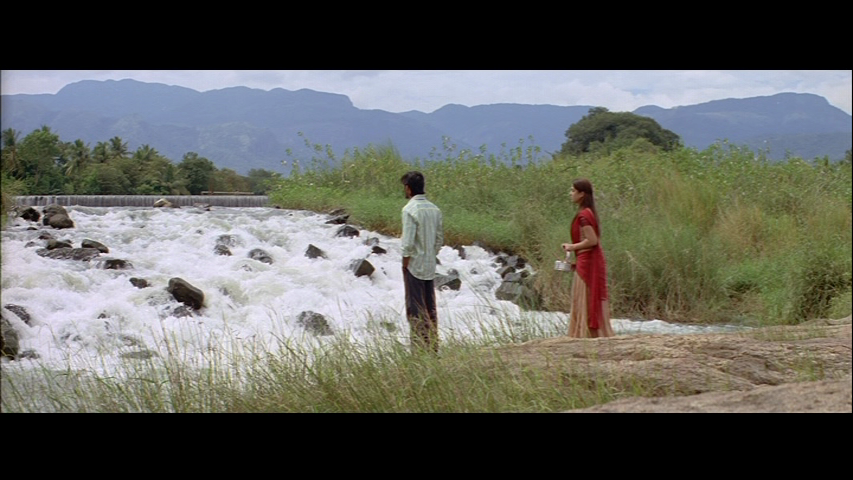
Back in 2008 when this film was released, I’d never heard of Dhanush and the Tamil films I’d watched were all either Rajinikanth or Kamal Hassan starrers with the odd Vijay or Madhavan film that somehow made their way into my DVD collection. But then I saw this song on the bus heading out to work in the villages around Trichy and I was instantly intrigued. I wanted to know why the guy was wandering around in a total daze following a girl who seemed totally oblivious to his presence and since I loved the song too, I knew I had to find a copy of the film!

Dhanush plays Vasu, a rather miserable layabout who half-heartedly applies for jobs where he doesn’t really ever seem to have a hope of being employed. He has a couple of good friends, Cheenu (Karthik Kumar) and Ganesh (Karunas), who seem willing to put up with his morose disposition, and a long-suffering father (Raghuvaran) with whom he has a difficult relationship. But just when Vasu seems to be going nowhere, he sees Keerthi (Nayanthara) and falls instantly in love – although this does seem to be based solely on her appearance and enjoyment of the rain. Which is where that song comes in. We’re back to the disturbing premise that stalking = love for this part of the film, but as Vasu follows Keerthi he finally becomes motivated and manages to secure a job at the same software company. Keerthi is his boss, and although she isn’t impressed with Vasu, her irritation with him doesn’t deter Vasu’s enthusiasm or belief that she will fall in love with him too.

Despite never having shown any previous signs of genius or diligence, Vasu turns out to be a computer whizz-kid and manages to single-handedly save a project by working all night. The power of love I presume since he also has to teach himself basic programming along the way!  As a result he is sent to Australia with Keerthi and a few others from their team for a short-term contract. I have no idea why Selvaraghavan’s screenplay demanded that the job should be in Australia since these scenes are quite clearly shot in Thailand with Thai extras, even though director Mithran Jawahar has tried to add an Australian flavour with the addition of surfboards and a song on the beach. It’s still not very Aussie though.

The best part about the first half is the developing relationship between Vasu and his father. Raghuvaran is excellent as Vasu’s father although his illness at the time is apparent in his frail appearance, and sadly Yaaradi Nee Mohini was his last film released before his death. He complements Dhanush in their scenes together and their relationship feels very genuine as a result. As Vasu gains maturity through his job he becomes better able to relate to his father and there are some great moments between the two as they explore their new rapport. Dhanush is very believable as the young man gradually discovering his self-worth and makes Vasu’s developing confidence seem very natural.

But after such promising character development, the next few scenes are just awful as Vasu declares his love for Keerthi and is rejected. There is some completely inexcusable dialogue as Vasu threatens Keerthi for insulting his father, and his immature and aggressive behaviour here is disappointing after an hour of watching his character supposedly grow up. Keerthi also seems to act out of character but thankfully the screenplay quickly moves on and things do improve for the rest of the film.
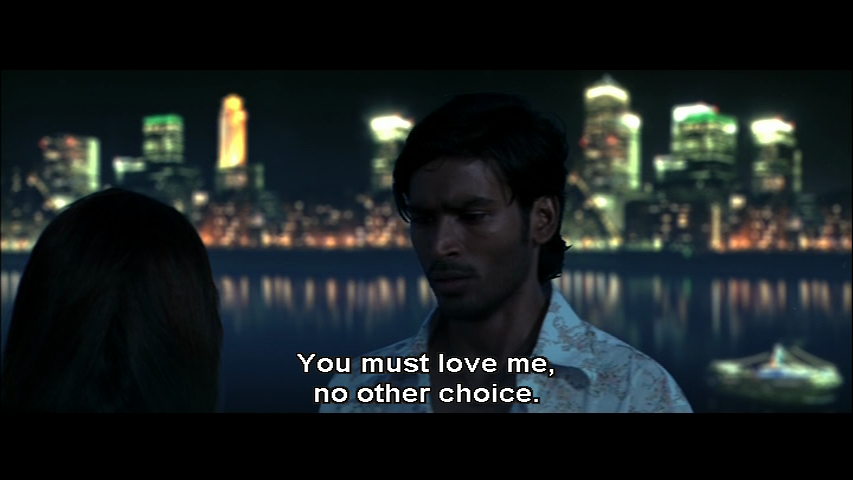
The action moves to a rural village in the second half as Vasu is persuaded to visit his friend Cheenu after Vasu’s father dies suddenly. Cheenu is getting married to his cousin who of course turns out to be Keerthi, and Vasu is forced to confront his unresolved feelings for her as well as deal with Cheenu’s large and very traditional family. The strangeness of village life for a city-bred boy provides some comedy, and Vasu lurches from disaster to disaster as he tries to cope with the lack of sanitation and contend with Cheenu’s tyrannical grandfather (K. Vishwanath) and Keerthi’s eccentric grandmother (Sukumari). Keerthi’s younger sister Pooja also presents a complication as she falls in love with Vasu and stalks him relentlessly. I was waiting for some realisation from Vasu that Pooja’s obsession for him was similar to his own for Keerthi but sadly this never happens. Still, Pooja’s character is very entertaining and Saranya Mohan is excellent in the role. Her attempts to get Vasu to notice her are amusing and I love her fantasy as she imagines them together in this remix of Palakkattu Pakkathile from the Sivaji Ganesan and Padmini starrer Vietnam Veedu

https://www.youtube.com/watch?v=gY0rZYHufto

Although Vasu still mopes around miserably for most of the second half, his interactions with the children and Keerthi’s grandmother are charming and the development of his relationship with Keerthi seems natural and sweet. There are some funny moments as Vasu struggles to adapt and since the comedy is integrated into the story it flows well without disrupting the romance. The one fight scene is rather less successful since the only reason for a gang of rowdies threatening Cheenu’s grandfather seems to be just so that Vasu can defeat them single-handedly, and as such it doesn’t add anything to the plot.

While the story is fairly routine, there are a number of reasons why this film appeals to me as much as it does. Firstly the performances are excellent and there is good chemistry between Dhanush and Nayantara as their relationship develops. Dhanush really is impressive and fits well into the role of a rather ordinary young man while still capable of displaying a wide range of emotions without veering into melodrama. His attempts to do the right thing and keep Keerthi at arm’s length are very well portrayed and he gets the facial expressions just right to portray his inner turmoil. Plus he is funny and can dance – that’s pretty much everything I need.

Nayantara has a role with a reasonable amount of depth and she does a good job in making Keerthi more than just an average Tamil heroine, while Karthik Kumar makes Cheenu an interesting and likeable alternative to the hero. All the other cast members are excellent in their roles and I love Sukumari’s grumpy and fractious grandmother and Saranya Mohan’s determined younger sister.

Another plus for the film is the soundtrack by Yuvan Shankar Raja which has some great songs and in general they are well pictured. This is my favourite,  and it’s still one I watch regularly. I love the way the backing dancers are added in to the choreography and I think it’s  just a beautiful song that fits into the development of the romance perfectly.

https://www.youtube.com/watch?v=3JRIECsOu6E

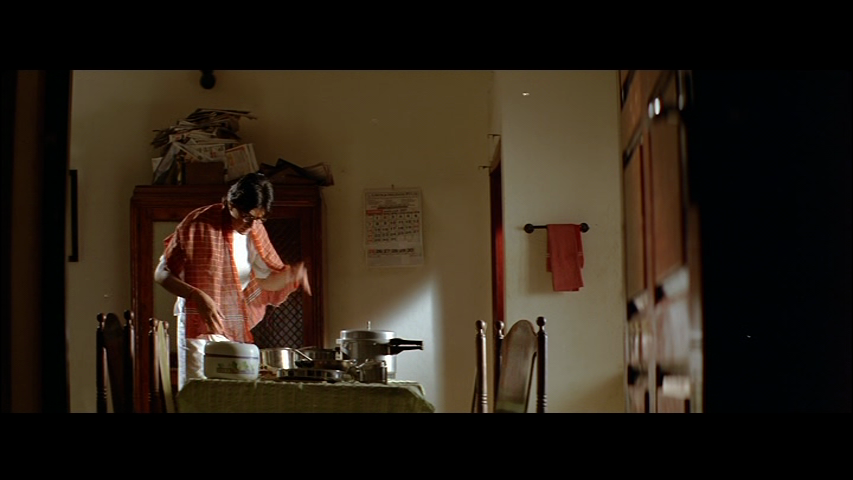
There are also lots of little touches that keep the film feeling realistic such as the general clutter and disarray in Vasu’s house and the organised chaos of the family house in the village, while a shopping trip to buy sari’s is scarily familiar! These very normal scenes contrast nicely with the really quite wonderful dream landscape where Vasu dances with Keerthi which seems to be the only place where their romance can possibly happen.


Despite the issues I have with the first half of the film, I love the second half and Yaaradi Nee Mohini will always be special as the film that introduced me to Dhanush. It’s not just for Dhanush fans though as all the cast are good and it’s nice to see Nayantara in a role with a bit more substance. I give the first half 2 stars, but the second half 5 which comes to a probably just about right average of 3 ½ stars.

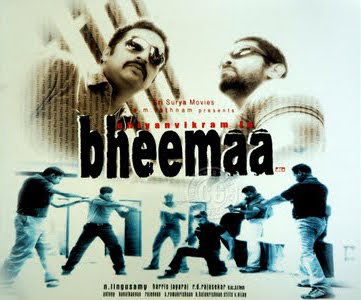
Bheema

Bheema centres on the key players in a gang and their interactions with rivals and police in Chennai. It’s quite a sanitised version of the criminal underworld, and little detail  is revealed about the nature of how these guys make a living. But it has two fantastic actors at the forefront, a delightful bromance, and a focus on characters that makes the who and why of the story more interesting than the what.

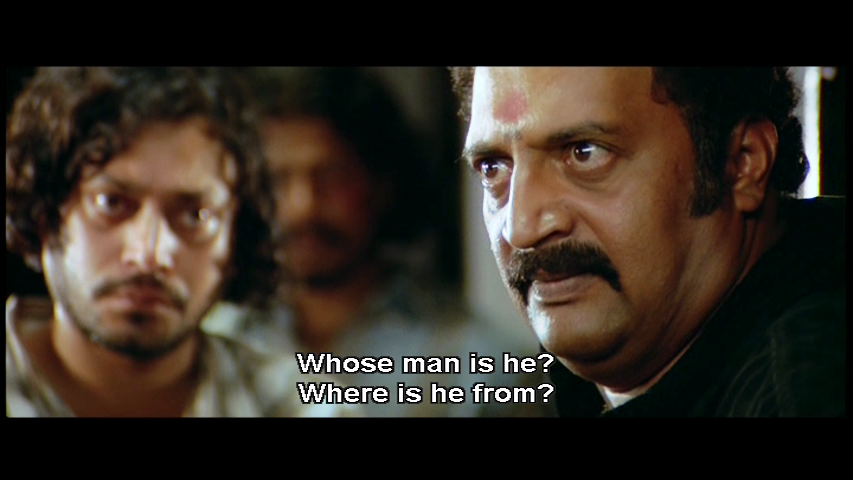
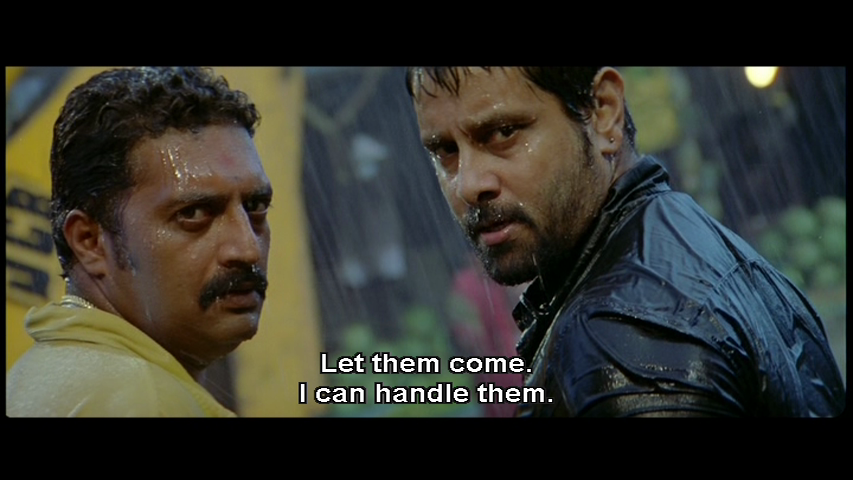
Chinna (Prakash Raj) is the local hard man. He started small in a small town and has risen to become one of the biggest crimelords in Chennai. His business dealings are never overtly discussed but he is presented as a ‘good’ gangster. He looks after the defenceless, his guys don’t attack women and children, and he plays by ‘the code’. Prakash Raj is perfectly cast. He makes Chinna likeable, roguish, aggressive and menacing by turns. Chinna is under threat from an old associate (Raghuvaran) and has an uneasy and crumbling detente with the local police. Things are getting tougher, but he is not one to back down. There is a lot more to the character than just being a figurehead, and I liked the glimpses into Chinna’s past, his conversations with old advisors, his wife, even the police, that showed different facets. He thought through the consequences, he reacted emotionally to some situations and I could understand the loyalty Chinna inspired because he seemed real yet powerful. I always enjoy seeing Prakash Raj in a more substantial role, and this is one of my favourites.

Sekar (Vikram) is an enigmatic figure, shadowing Chinna and despatching his enemies before Chinna can. The reason for his obsession eventually emerges via flashback, and it reinforces the notion that justice is not delivered by the law, and what makes a man is the ability to beat the living daylights out of another man. Sekar believes in instant justice, delivered as he sees fit. Even the police in Bheema argue that they can’t operate with the constraints of bureaucracy and low budgets, and have to break the rules to achieve what they see as justice. Sekar is given the name Bheema by the police in recognition of his strength and his role in Chinna’s life.

Sekar’s sole ambition was to one day join Chinna, his role model for strength and justice and a more satisfying father figure than his ineffectual policeman dad. I’ve often wondered why characters stick with their gangleader and don’t just leg it when things get crazy. Writer Sujatha provides a backstory and motivation that gives more to these guys than just being the good baddies. Vikram switches effortlessly from the full throttle action sequences to gazing mistily at Chinna or quarrelling with Shalu, and his physicality suits the invincible Sekar. Vikram’s rapport with Prakash Raj is one of my favourite things about the film and they play off each other very well.

It’s a man’s world, and sometimes in unexpected ways. Vikram steals the focus from the item girl in this song, and Prakash Raj is the one to be almost upskirted.

What sets Bheema apart from other grim gangster fairytales is characters having a life, or at least ideas, outside of the job. Chinna was in love with Padma but they drifted apart. Sekar, ever the loyal lieutenant, reunites them.

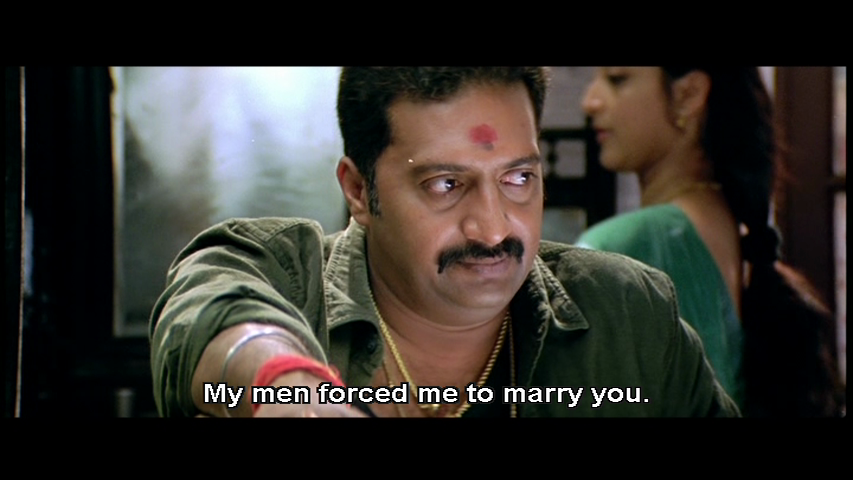
Prakash Raj does some delightfully girly fidgeting and stammering, and can’t hide either his happiness or trepidation at marrying his old flame.

Padma (Lakshmi Gopalaswamy) is gorgeous and her scenes with Chinna have a warmth and maturity that suits the slightly older lovebirds. They talk about the risks of her being part of his life, and she is firm in her assertion that she has no illusions. I found the dialogue rather flowery but the emotions came through and they seemed to have a deep mutual affection. He talks to Padma about Sekar, since Sekar is like family and Padma is in charge of the household. She and Chinna make fun of Sekar when they find out he is turning into a gooey romantic wittering about flowers, and their playful banter is another glimpse into the relationship.

Sekar loses his focus on being a thug when he starts to think of love and  Shalini (Trisha). He knows that his priorities have shifted and he can’t rely on himself to be as focussed, fearless and impulsive as he once was.  Chinna lets Sekar go, in a scene more like a breakup than an exit interview.

Unfortunately, Shalini (Trisha) is stupid and irritating for almost all her time in the story. I’m not sure why Indian film heroines characterise innocence by appearing to be dim-witted but Shalu is dumb as a box of rocks and about as interesting. Sekar falls through the roof into her courtyard one night, landing on her. Because of this, she decides he is the one, manufacturing reasons to be near him and imagining they share likes and dislikes based on absolutely no evidence. I did find her stalking Sekar mildly amusing just because it is a bit of turning the tables, but that was all I could see in her favour until quite late in the piece.

Once Sekar succumbs, Vikram and Trisha generate some chemistry and that made their relationship seem vaguely plausible. I liked that they had playful but still intimate scenes together as things developed, and it helped make up for the brain-dead start.

Chinna is a surprisingly sentimental old school don and sometimes that works against him, as he plays by rules others are starting to disregard. Sekar idolises Chinna and can’t abandon his old boss but feels compelled to take Shalini away. Once the other players sense weakness in Chinna, they start closing in. How will it all work out?

There are indicators. Shafi is in the support cast in Chinna’s gang. And Shafi does tend to play characters that bite the hand that feeds them. Also, I have developed a theory. In the imaginary Tamil Film Writing School in my mind, the compulsory class on ‘Ways to End a Film – Traditional (aka Everyone Dies (Rape Optional)’ is well attended. The final elective class ‘Ways to End a Film – Creative Writing (aka ‘No Rape, No Murder – stop being so lazy and think of something else’) falls the day after the big end of year dinner and people are either too hungover or they’ve already got enough credits to graduate, so most students don’t go. Thus there is generally one ending for a Tamil film, regardless.

I quite like the songs by Harris Jayaraj, but the picturisations of the romantic duets seem to exist mostly as a safe channel for the wardrobe department to vent their creativity.

The support cast includes so many reliable character players but the focus isn’t on them and I barely paid any heed to Ashish Vidyarthi, Tanikella Bharani, Shafi, or Raghuvaran among others. Chinna and Sekar dominate the story and Prakash Raj and Vikram likewise dominate the performances.

Linguswamy has directed an action packed film that doesn’t feel hurried or slapdash, and it is very satisfying to a point. The ending was a disappointment and yet almost exactly what I expected. The action scenes are typically excellent as is standard for this genre. There were some nice little extras – when Sekar belted a group of guys with a metal pipe, they chimed like bells as they dropped. The editing is good and the quick cuts and occasional use of effects enhance the sense of urgency or disorientation. It’s a very competent film and a pleasure to watch.

If you’re lukewarm on the South Indian gangster genre, this could be well worth a look. It has better than usual characterisations, some excellent performances and good production values. And one of the best filmi bromances. 3 ½ stars!

Heather says: I’m a fan of Tamil gangster films and usually enjoy anything by N. Linguswamy, but Bheema was rather disappointing all round. Instead of the usual well-developed storyline and strong characterisation I expect from such an accomplished director, Bheema staggers from fight scene to overdone fight scene without any real justification for the characters acting in the way they do. Rahguvaran is ineffectual as the ‘evil’ don Periyavar and his feud with ‘gangster with a concious’ Chinna seems clichéd and unimaginative. The second part of the film which concentrates on the new Police Commissioner and his vendetta against the gangs is more convincing but still seems formulaic and just not that interesting. The relationship between Chinna’s new lieutenant Sekar and the rest of the gang could have been made into something more exciting but instead it’s thrown in towards the end to try and spice up the climax. Something which only works to a limited extent. However, it’s good to see that Shafi continues his quest to always play the smarmy, self-satisfied sycophant and he does his usual thing here as one of Chinna’s men to good effect.

Despite the issues I have with the story, Bheema is saved to some extent by the excellent performances from Prakash Raj and Vikram who both breathe life into the film. I agree with Temple that their camaraderie feels very genuine and the interactions between the two do much to make up for the dreariness of the plot. Vikram’s character is very much the strong silent type and he does a good job with the rather dour Sekar, but Prakash Raj steals the show as the gangster with a heart. His romance is perfectly played and he brings out a human side to Chinna making him much more than just another world-weary gangster. Despite his good performance, Vikram looks rather over muscled here and I confess that I prefer him in more character driven roles such as in Pithamagan and Kasi where he has more range to work with. The one-man indestructible army of Sekar was just a little bit too much to take, especially with the distracting musical sound effects and overly loud soundtrack during the fight scenes.   The implausible relationship between Shalini and Sekar was another disappointment and the two never felt comfortable together –  odd, considering the considerable chemistry the two actors shared in Saamy. In fact there is much more sparkle between Chinna and Sekar!

Bheema does have a good soundtrack and there are moments where the film starts to grab your attention, but sadly they’re just not sustained. Worth watching once for Vikram and Prakash Raj but that’s all. 2 ½ stars.

Sivaji (2007)

Sivaji is a wonderfully over-the-top film celebrating all things Rajinikanth. There are references to the superstar’s previous films and to his own life, plenty of classic Rajni style and he’s present in almost every frame. Sivaji also features stunning sets for the songs and a myriad of different looks for Rajinikanth throughout the film. While the story has an interesting plot involving corruption, the screenplay gets somewhat tangled in the numerous set-ups to introduce the next song or fight scene.  But in the face of so much else that is fantastic, the disjointed nature of the story doesn’t seem to matter. When the first song is as much fun as this, then the film is already a winner for me. This features Nayantara in a cameo role along with an incredible number of  men with round, jiggling painted bellies – I love it!

The film opens with Sivaji returning from the USA with truck-loads of money and deciding to set up a University and Hospital where everything will be available to the poor for free. His grand plans are opposed by local businessman Adisheshan (Suman) who blocks him at every turn. To make Sivaji’s life more difficult there is the practice of bribes and kick-backs that seems to be built in to the system at every stage. Despite his unwillingness to play along, Sivaji has no choice but to fall in line and pay everyone off if he wants to get his hospital and university built. I’m quite sure that all these people in yellow hats were the inspiration for minions in Despicable Me – or at least they should have been.

Ultimately this works to Adisheshan’s advantage when he contrives to have Sivaji arrested and charged in court. There Sivaji admits that he paid bribes to get permission to build and ends up losing everything. This might have been the end of the Sivaji foundation, but Adisheshan is the one person in Tamil Nadu who has no idea who he’s really dealing with and he rashly mocks his defeated enemy.  This sparks Sivaji’s quest for revenge, and the 1 rupee coin Adisheshan tosses at him to start his begging career becomes a talisman and also funds the start of the fight back. Sivaji devises a cunning plan to restore his finances and bring about Adisheshan’s downfall at the same time.

Rajinikanth is truly in his element here as the crusading Sivaji. He still has his trademark tricks, but this new  health conscious Sivaji spruiks the ‘cigarettes are bad for you’ message, catching mints and tossing his sunglasses instead of cigarettes. It’s all a little contrived, but the tricks are so much a part of any Rajni film that Sivaji would seem incomplete without them. There areplenty of fight scenes, and these are well choreographed by Peter Hein. The final showdown features some Matrix style action and Rajinikanth pulls it off with great style. If he has slowed down a little in some of the fight scenes and songs, well, that’s understandable but it’s barely noticeable. As well as the romantic songs, there is a fabulous sequence where Rajinikanth impersonates Sivaji Ganesan, MGR and Kamal Hassan and he gets really gets the mannerisms of the different stars very well.

During the course of his crusade against corruption, Sivaji meets and falls in love with Tamizhselvi (Shriya) and despite her family’s initial reluctance and dire predictions of disaster from the priest, the two go ahead and get married. Thankfully Shriya is much less annoying than usual, perhaps because she is totally overshadowed by Rajinikanth, but I stand by my previous observations that the more clothes she wears the less irritating she is. Her main raison d’être here is to look pretty in the songs which she does very well.

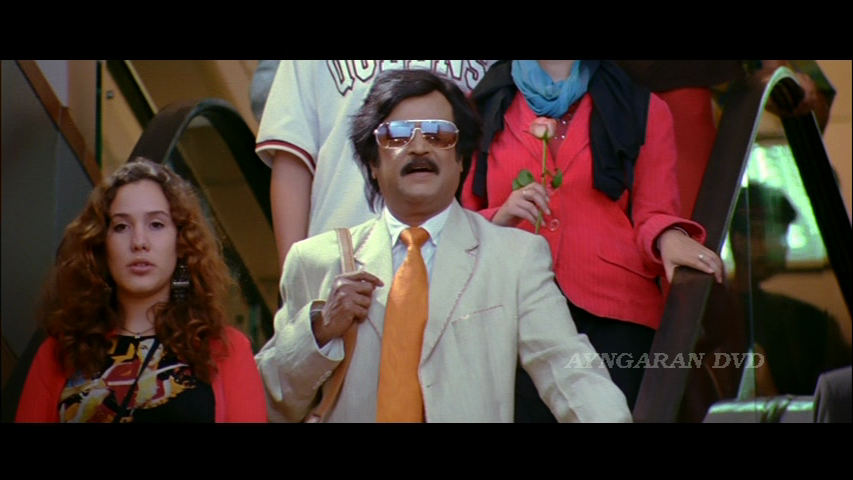
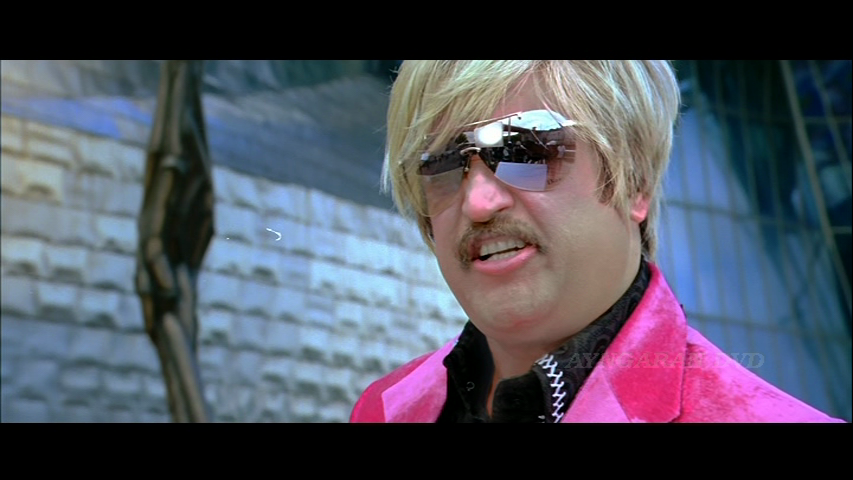
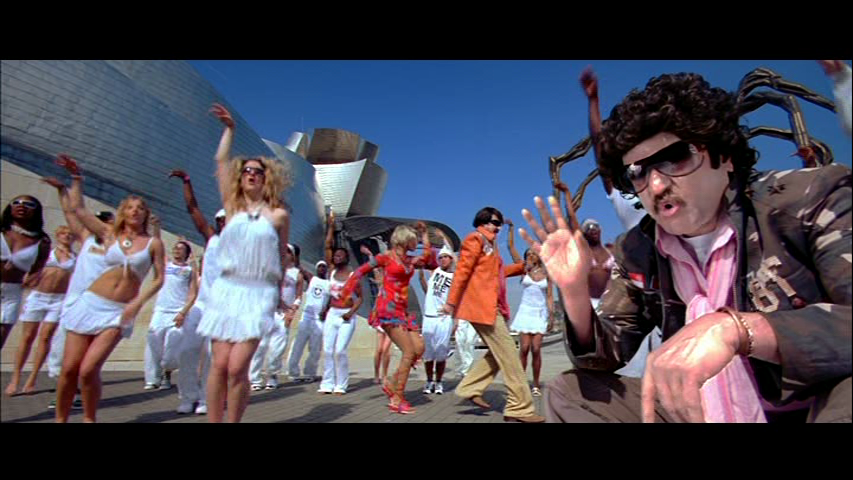
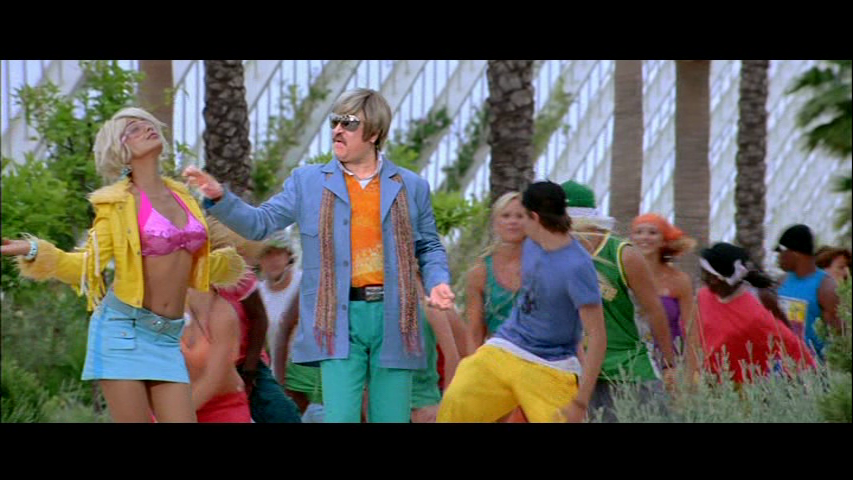
Other than her presence in the songs, Tamizhselvi is the ‘perfect Tamil girl’ of Sivaji’s dreams and that ensures plenty of traditional outfits and a fairly restrained performance, making her more tolerable than usual. Someone in wardrobe really does have a grudge against her though because she does appear in some of the worst outfits I’ve seen in the song ‘Style’.  I’m not quite sure what to make of this song for many reasons. As a song extoling style it has some truly dreadful costumes and the whole white-skinned Rajni just seems very wrong. I’m always perplexed by the quest for paler skin in India, but then I’m equally as baffled by the drive for tanned skin among Europeans. I don’t like the melody or the lyrics of this song at all, but it does feature an incredible selection of amazing wigs for Rajni and is worth watching for that alone. Pick your favourite style!

And the contrasting faces of Shriya.

While the film deals with the theme of corruption, there is still plenty of comedy along the way. Although much of the humour comes from Rajinikanth and his various mannerisms, Vivek is excellent in his role as Sivaji’s uncle Arivu and provides many funny moments. Even though I’d normally cringe at Arivu’s match-making technique of parading girls in front of Sivaji, Arivu’s character is self-aware enough to make this funny rather than crass.  There is more slapstick comedy in the scenes with Tamizhselvi’s family who disapprove of Sivaji and his exuberant family. The actor playing Tamizhselvi’s father (Pattimandram Raja) has some excellent expressions and I love the way he looks as if he smells something bad every time he sees Sivaji.

On the other hand, Suman’s Adisheshan is a very mild mannered villain without any real evil tendencies. Although I’m sure this is meant to make sure that all eyes are firmly on Sivaji, he still seems rather unimpressive in comparison. His demeanour however is quite realistic as a businessman with political leanings and his reasons for opposing Sivaji are understandable considering how much the free hospital and university will cut into his profits. His methods of opposition are also consistent with his character and perhaps S. Shankar is trying to point out that corruption can be present in even the most reasonable appearing businessman.

The second half of the film relies more heavily on the effects and gimmicks, and it’s disappointing that Vivek’s character gets more sidelined. But it’s still a lot of fun to watch mainly due to Rajinikanth’s performance. The music by A. R Rahman is excellent apart from the Style song mentioned previously, and the high budget of the film is easily explained by the song picturisations. The sets and costumes are totally fabulous and both Thotta Tharani as art director and K. V. Anand as cinematographer deserve the awards they received for their work. There are guest appearances by a number of established Tamil stars including Raghuvaran and Manivannan and  the support cast are all very competent, although generally overshadowed by the superstar.

Although Endhiran (S. Shankar’s latest film with Rajinikanth), had a bigger budget and even more special effects, I prefer Sivaji. The story is engaging despite the way it jumps around and Shankar shows corruption within government systems in a way that seems quite plausible. Even though the one man crusade requires a leap of faith, it is after all Rajni and so anything is possible. It’s one to watch for the lavishness of the sets and the larger than life presence of Rajinikanth. And for all those wigs! 4 stars.

Temple says: Sivaji is what I have come to think of as a typical Shankar blockbuster in that it is all spectacle and very little plot. I think Heather is being overly kind in saying there is a theme to the story as I see it more as a collection of ideas that never really develops. Shankar introduces statements about corruption, the brain drain overseas as bright graduates pursue careers outside of India, the returning NRI and how they navigate between worlds, the obsession with all things American being seen as ‘better’ than local, the clash between tradition and modern living and the nostalgic ideals that may no longer exist. All interesting, and yet there is no real exploration of these notions as there is too much else happening. We move from fight to song to comedy to spectacular song and rarely pause for breath. It’s hugely entertaining, but it doesn’t really bear analysis.

Rajnikanth is in excellent form and this is his film from go to whoa. Sure he is way older than his character, but it somehow works as he deadpans his youthful dialogues, daring you to not believe,  and throws himself into the action with gusto. The fights have been tailored to suit him, and the music shop sequence is one of my all time favourites from any film industry. Shriya can range from terrible (e.g. Kanthaswamy) to pretty good,  and this is one of her better performances. She handles the comedy really well  (I love her expressions in the “Chandramuhki” sequence), isn’t completely overshadowed by Rajni, and does justice to the massive song sets and costumes. And she manages to look like she isn’t staring intently at Rajni’s wigs in the romantic moments so I decided Shriya may be a better actress than I had previously thought.

See this for the spectacular sets and design, for a Superstar who can dominate the hyperactive pace and attention grabbing visuals, for the music (except Style) and for the filmi equivalent of a crazy amusement park ride. You’ll be dizzy and none the wiser at the end, but it was so much fun while it lasted. 4 stars!