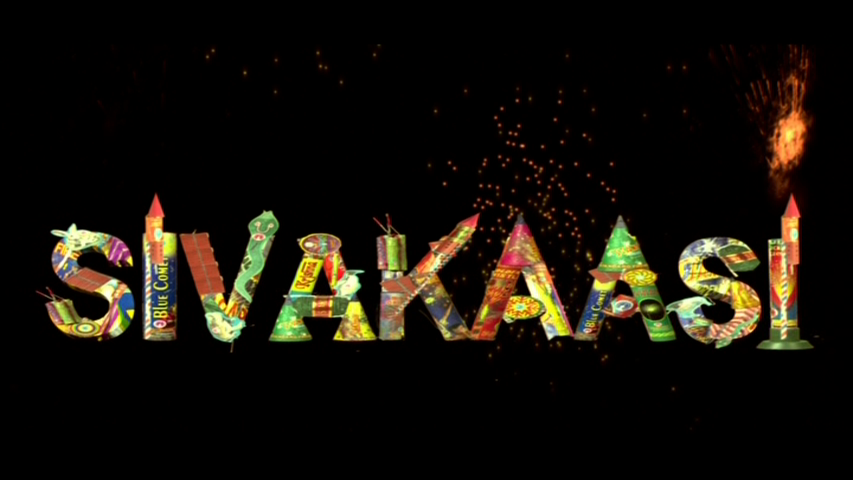
Sivakasi

Let’s cut to the chase. Watch Sivakasi for the highly enjoyable songs, and you might find a few other little gems along the way. Perarasu (writer/director) has made a movie of two halves that doesn’t quite succeed in being a cohesive entertainment and is a bit too long. But likeable stars, some excellent action scenes, vigorous dances and a commitment to always choosing the silliest solution help the time pass pleasantly enough.

Vijay is the hero, Sivakasi. The police are largely useless against local thugs and he looks after the shop owners and residents of his area. His every gesture is underlined by a sound effect, he wears hideously embellished trousers and his eyes turn red whenever he is enraged.
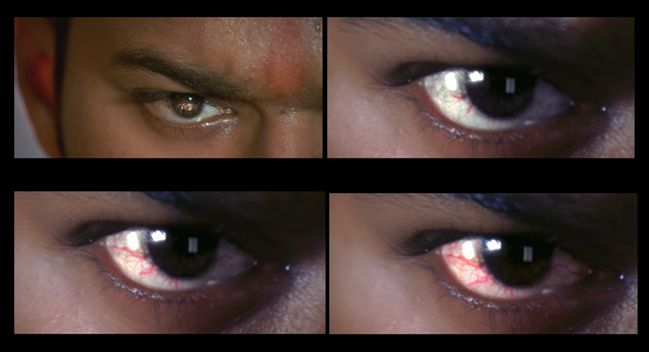
In case that isn’t enough, a colour effect often emphasises the many (bad) moods of Sivakasi.


Perarasu also introduces himself by way of introducing Sivakasi, which amused me greatly (as did the spelling).

Sivakasi spends a lot of time blow-torching the same piece of perforated metal sheet so I am not sure how successful his business was. I suspect he was on commission at a local glazier as the number of window panes broken in fight scenes was HUGE. The character of Sivakasi is self-righteous and inflexible, and I could understand why he was single and stuck with a comedy gang as his only close friends. Vijay is good as a boyish prankster but once he has to deliver more serious dialogues, he is a bit lightweight and tends to overact in compensation. I can’t help comparing him with the other baby-faced killer in South Indian films and he just doesn’t stack up. But he is brilliant in the physical scenes, whether fights or dancing, and that is where I can more readily understand his star appeal.
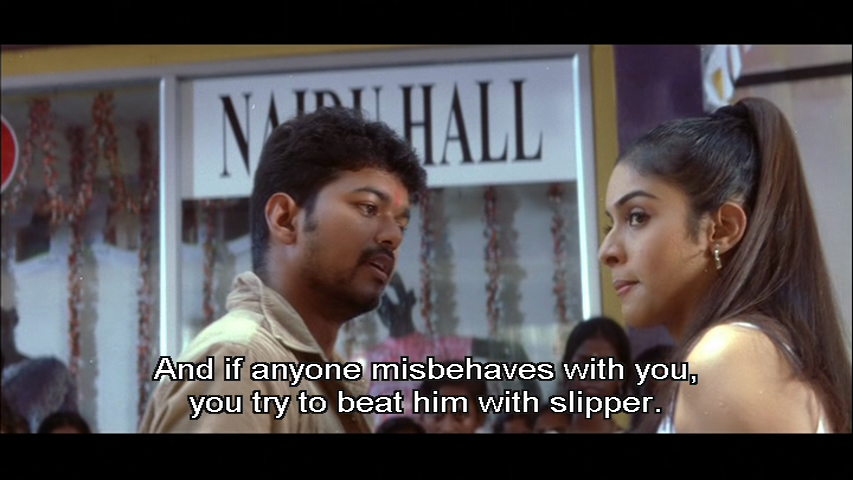
Asin is Hema, the rich girl who sees no need to feel bad about being rich. She takes on Sivakasi at his own game. It’s a Tamil film with a big name hero so there was no danger of the story being skewed by her perspective but I enjoyed watching her challenge the hero.

Sivakasi told Hema off for dressing skanky and western and said if she wore a sari men would treat her like the goddess Laxmi rather than trying to cop a feel. So when she arrives in a sari with a gang of sari-clad aunties and hijras, Hema calls his bluff.
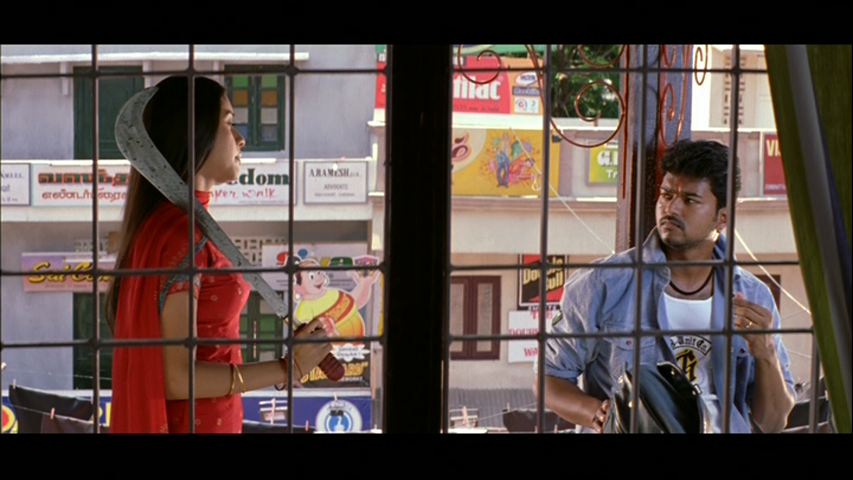
Hema is a smart girl with a good heart and a healthy dose of mischief so she is not overwhelmed by the domineering Sivakasi. Asin more or less holds her own in the dancing too, going for maximum energy and not overly concerned with technique. She is a good counter to Vijay in all regards.

Her romantic song fantasy puts Vijay in a vintage pink suit so perhaps she has a more vengeful streak than was immediately apparent. I don’t like the female vocals at all in that song (Deepavali), but the dancing is fun.

The relationship between Hema and Sivakasi starts as a cartoonish battle of the sexes, with each trying to put the other in their rightful place. It is fun but goes on longer than it needed to. Eventually the two declare their feelings but Sivakasi’s pride and temper keep getting in the way. Finding out he is an orphan, Hema accuses him of not knowing how to be a decent person as orphans can never understand love or affection. He then tells her his tragic backstory. Sivakasi chose his alias based on a horrible incident in his past, but he is really Muthappa, estranged from his well-off family. Hema says she can’t possibly marry someone who would desert his responsibilities over such an issue as it is likely he would do the same to her. She will only accept him if his family come to make an offer, showing that he has mended those fences.

And this is where the story takes a turn into flashback and revenge. Rather than just turning up at home, establishing his identity and setting things to rights, Muthappa embarks on a long and complex series of  manipulations.
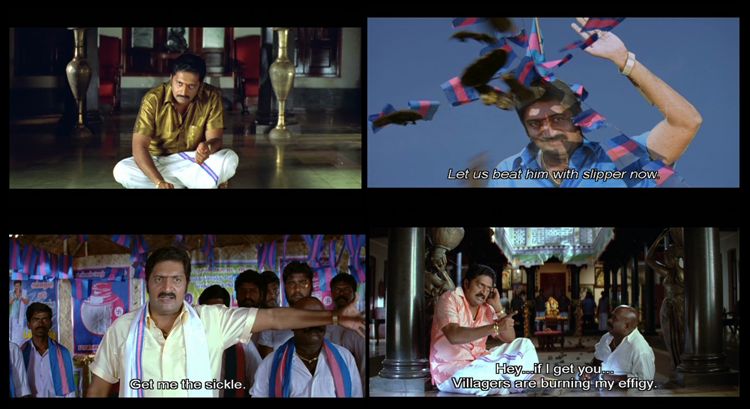
It becomes a bit tedious but there are some highlights. Prakash Raj is in good form as evil older brother Udayappa and sports a pleasing array of colourful shiny shirts. He is a local politician/industrialist/landlord/standover merchant. Some of Muthappa’s shenanigans work quite well. Having found a bunch of vintage film star impersonators to support his sister, Muthappa discovers Udayappa has one-upped him and hired Nayantara (as herself)  for his rally. She ends up lured into a dance-off with Vijay, which is actually one of his more practical schemes.

Muthappa isn’t really that much better a person than Udayappa when you get down to it. He manipulates his sister to ensure her election win – reprehensible behaviour, but it does produce one of my favourite campaign images.

There is a large support cast but they made little impression as the action is all about Sivakasi/Muthappa. No one really goes beyond the stereotype of crying Ma, suffering wife, comedy sidekick, bad guy, poor but honest villager etc, so they could have been played by anyone. Lakshana as Muthappa’s sister had the outline of an interesting character as the wronged woman turned politician, but true to the mass hero style everything was handled by her brother.

Hema and the Chennai gang turn up to see Muthappa, drawing all the storylines into one place. The stakes escalate as there are abundant hostages for the taking and the unscrupulous methods of both sides come to light. But there is nothing that can’t be fixed with an all in brawl or a group hug. There is little substance to any of the characters or the situations, despite all the dramatics. I found the ending neat but unsatisfying and I think that sums up the movie.

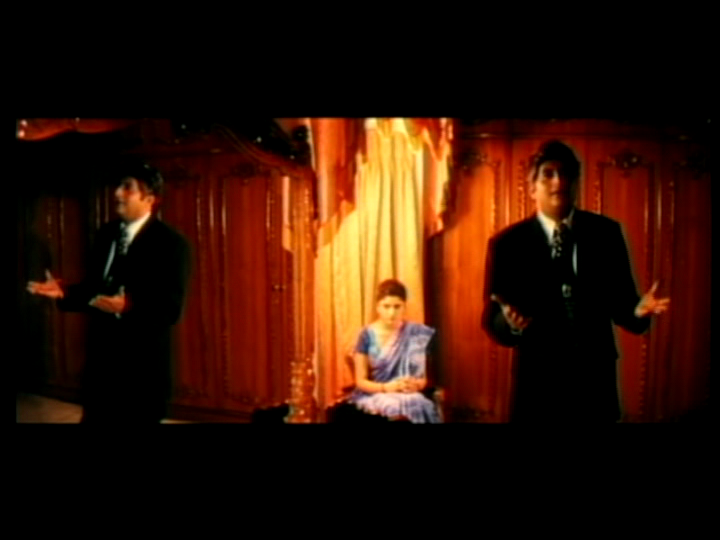
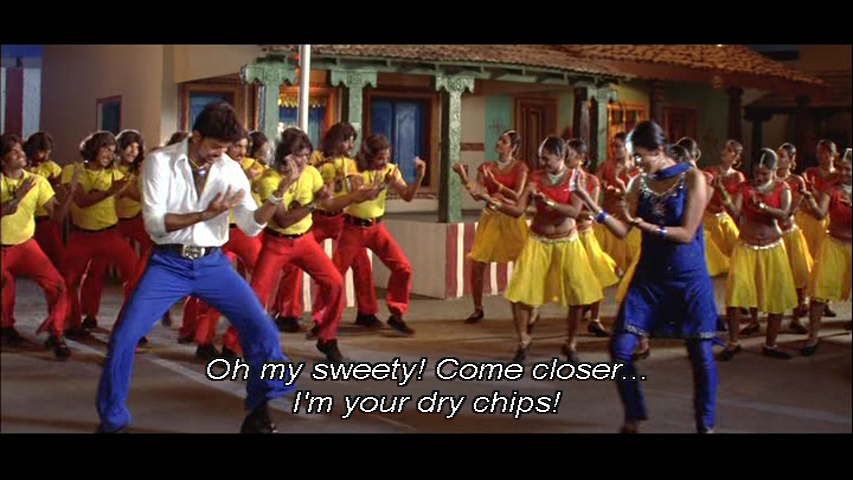
The songs (by Srikanth Deva) are what I expected – upbeat, loud, with colourful picturisations and flat-out dancing in exuberant mass filmi style. I must compliment the backing dancers, especially the guys. They are great fun and really enhance the dances with their facial expressions and uninhibited prancing. I particularly like this song, which is Muthappa’s romantic fantasy about Hema and again demonstrates his terrible taste in clothes.

Speaking of clothes, when I saw this film something niggled away at my mind. And then it hit me. I know plots and songs get recycled – but costumes?

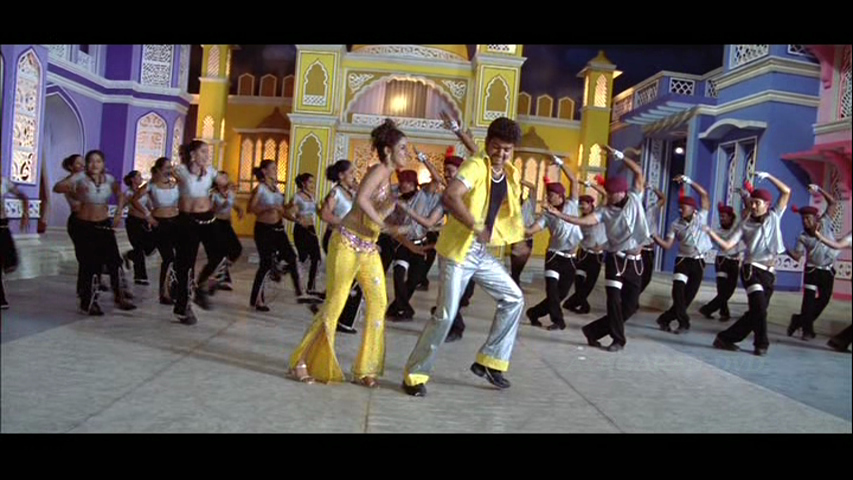
Vijay has at least 2 costumes very similar to those worn by Bunny in and as Bunny in the song Bunny – the red & white ensemble and the silver and yellow number. Surely there are enough costume designers to ensure a rich and varied wardrobe for all?

Perarasu also made the dreadful Thirupaachi – I made Heather buy me lunch as compensation for forcing me to watch it – so I had low expectations when I watched Sivakasi and I was pleasantly surprised. Vijay and Asin are likeable and Sivakasi is more light and cartoonish than the usual gloom and nastiness common in Tamil romance films. 3 stars!
Heather says: I first saw the opening song for Sivakasi on a bus in Tamil Nadu with the local health workers singing and dancing along which at least partly contributes to why I like this film.  Then I bought a song DVD featuring Vijay in that awesome pink suit which was enough of a reason for me to sit down and watch the entire film, even if none of his other outfits in the movie come close to matching it.   Sivakasi is a typical mass entertainer to Vijay’s well-tested and regular formula, but since that formula does work well for him it’s worth a watch.  The first half really is all about the comedy and is a bit more hit and miss, although I do like the way Hema takes on Sivakasi’s prejudices and at least attempts to stand up for herself before the inevitable declaration of love.  When the action takes over in the second half the film gets much better and no-one can beat Prakash Raj when he fully embraces the evil villain character.  I also liked Lakshana as Sivakasi’s sister, both for her performance and the rather better than usual way her character is used, and I’m surprised I haven’t seen her in any other films.  I do get a little annoyed by the alternate mild violence towards women followed by the worshipping of mothers in this film, but it’s all so cartoonish that a mild irritation is the most I can feel.  The dancing is excellent even if sometimes the choreography is less so and the Vijay-Asin combination works well considering they don’t actually spend a lot of time together.  Even though every character is painted with very broad strokes it’s still an entertaining film, and definitely better than Thirupaachi (I don’t think I’ll ever be forgiven for that one!). One of Vijay’s better efforts.  3 ½ stars.
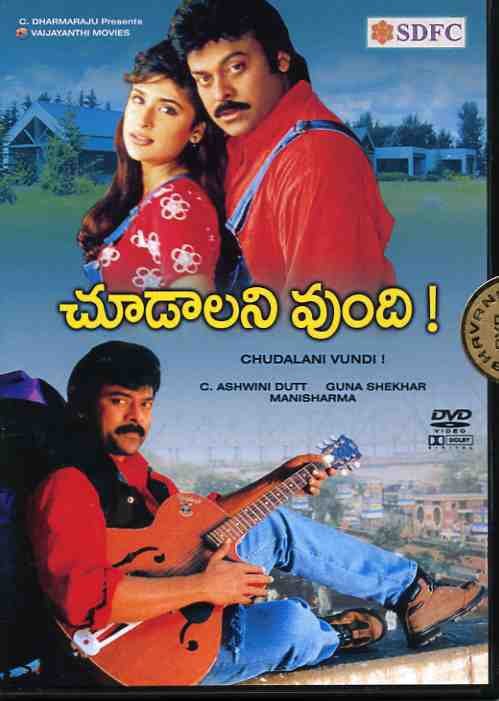
Choodalani Vundi

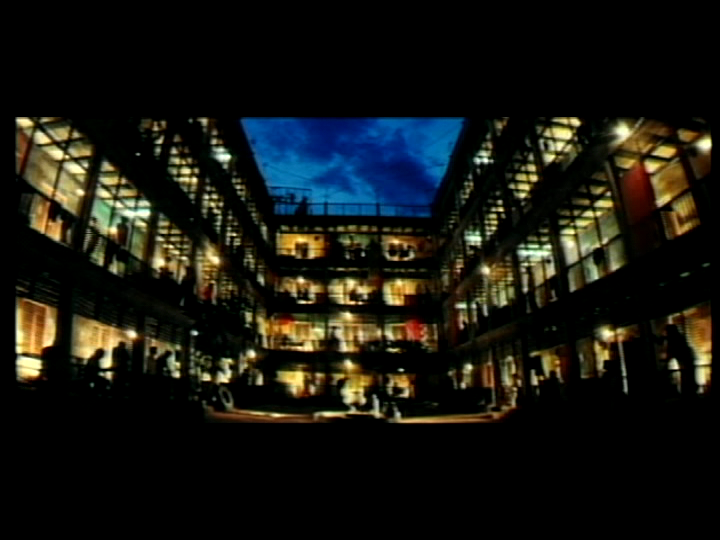
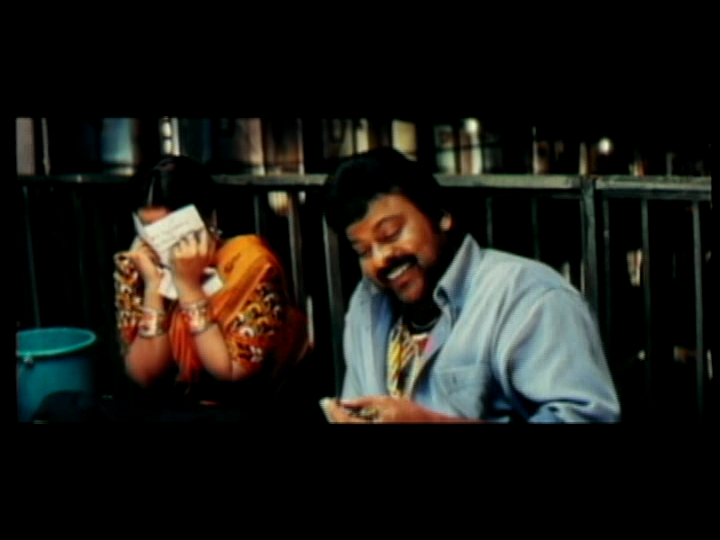
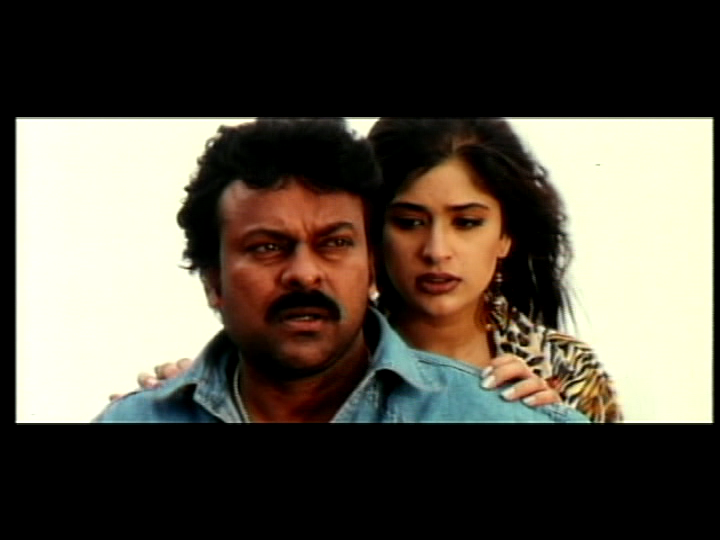
Time for some Chiru masala! Choodalani Vundi has a little bit of everything but mainly has a lot of Chiranjeevi. It’s very much his film the whole way through as he fights and dances his way through the streets of Hyderabad, Kolkata and even spends some time in the jungle. Since it’s an unsubtitled DVD I missed a lot of the humour, but could pick the comedy from the gleam in Chiru’s eyes and Soundarya’s excellent reactions. The usual suspects form the support cast as Brahmi and M.S. Narayana pop up to add some slapstick and Prakash Raj plays the villain of the story in a truly terrible wig. But be warned there is also a small child who is continually terrorised every time he appears on screen (which thankfully isn’t too often) and I just hope the child actor wasn’t scarred for life as a result. The film opens with Ramakrishna (Chiranjeevi) arriving in Kolkata. We know we are in Kolkata because there are trams, wonderful old Colonial style buildings and of course Howrah Bridge – we even get a song about it.

With the help of some friendly locals, Ramakrishna finds a chawl which has a few Telugu speaking inhabitants. The Ravindra apartments seem to be rather ineptly managed by Brahmi and M.S. Narayana and after some friendly banter, they rent out a room to Ramakrishna. However the room has the unfortunate problem of already being occupied by Padmavathi (Soundarya) and she’s not inclined to share. But with a little application of Ramakrishna’s charm, the two seem to reach an agreement and Ramakrishna is free to deal with the reason he came to Calcutta in the first place.


Ramakrishna seems to be looking for someone although he doesn’t seem to be having much success until the day a group of thugs come to shake down the chawl residents. In what seems a lucky break Ramakrishna recognitions one of the gang (Brahmaji) but despite some nifty moves doesn’t manage to catch him in a chase through the streets of Kolkata. That turns out to be rather unfortunate as Brahmaji comes back with a few more mates and in the resulting brawl Ramakrishna is seriously injured. Perfect time for a flashback then. Back in time, and presumably back in Andhra Pradesh, Ramakrishna spots Priya (Anjala Zaveri) on a train and naturally it’s love at first sight. She doesn’t seem to mind his attentions and when he stalks follows her to the next station even seems glad to see him.


I’m not totally clear on why Priya suddenly ends up running down the platform with a gang of thugs chasing her at this point, but it probably doesn’t really matter. Naturally Ramakrishna is on hand to provide a rescue on the back of his trusty motorbike and Priya seems to have no worries about trusting a stalker she has only just met rather than the gang of what turn out to be her father’s men. Mahendra (Prakash Raj), the local don, has plans for his daughter and they quite definitely don’t involve Ramakrishna, so he packs a few SUV’s with machete waving thugs and sends them off in pursuit of Ramakrishna and Priya. This eventually leads to a wonderfully dramatic Thelma and Louise inspired leap from a cliff into the ocean which seems to dispose of our couple in a rather final fashion.


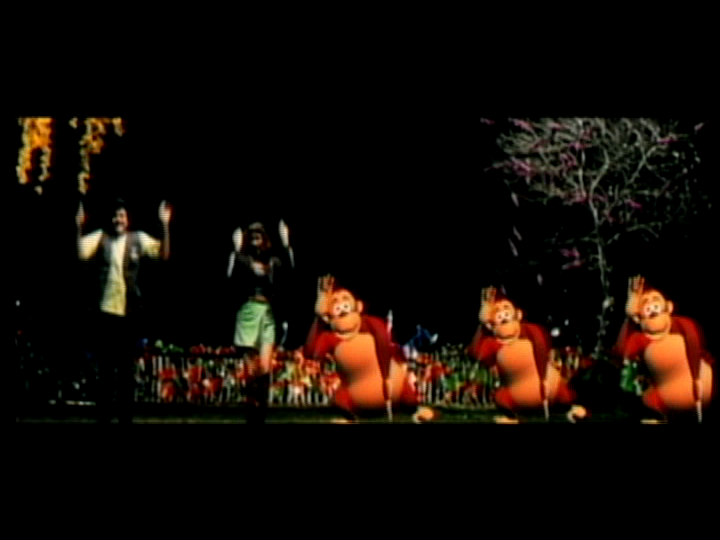
Somewhat surprisingly then, the next scene shows Ramakrishna and Priya living happily in the jungle with their young son, where they spend their days rescuing animals, swimming in their back-yard rock pool and socialising with the natives. There is some Lion King inspired cartoon animation as they sing and dance around the forest but that’s a clue that something bad is about to happen.

And I don’t just mean the animated dancing lions.


Mahendra somehow manages to track the couple down (although how he even knew they were alive a mystery), and he turns up in a helicopter to take his daughter back. The action ramps up several notches as Ramakrishna tries to rescue first his wife, and then his son from the clutches of Mahendra. Ramakrishna is of course an unstoppable one-man army but Priya has some unexpected talents as well. Which do you think is faster – the speeding bullet or Priya?

I’ll give you a clue -it’s not the bullet!

Gunasekhar seems to have thrown almost everything into this film to make sure there is something for everyone. The cartoon characters almost fooled me into thinking it was even child friendly but the subsequent events quite definitely aren’t. But there are lots of chase sequences – on foot, motorbikes, cars, buses, jeeps and even a jeep vs truck chase although stealing a truck that is emblazoned with the words ‘danger – explosives’ does seem to be just asking for trouble and is perhaps just a little bit of overkill. The first half is beautifully shot around Kolkata and focuses on the lives of the people in the apartments. It feels warm and homely and Chiranjeevi and Soundarya have good chemistry in their scenes together. Although we later learn that Ramakrishna is a desperate man searching for his son, this part of the film seems very upbeat and generally happy.

The second half is less successful as Anjali Zaveri seems to spend a lot of time under waterfalls, seductively draping herself around pools, but otherwise doesn’t have much to do. The problem is that there just isn’t much substance to the romance between Ramakrishna and Priya. Their relationship moves very quickly from promising first glances at the train station to very domestic scenes of Ramakrishna chopping wood and Priya looking after a toddler. The romancing in between is confined to one song and those waterfall moments, none of which have much sparkage happening so it’s almost a relief when Mahendra turns up to steal Priya back.


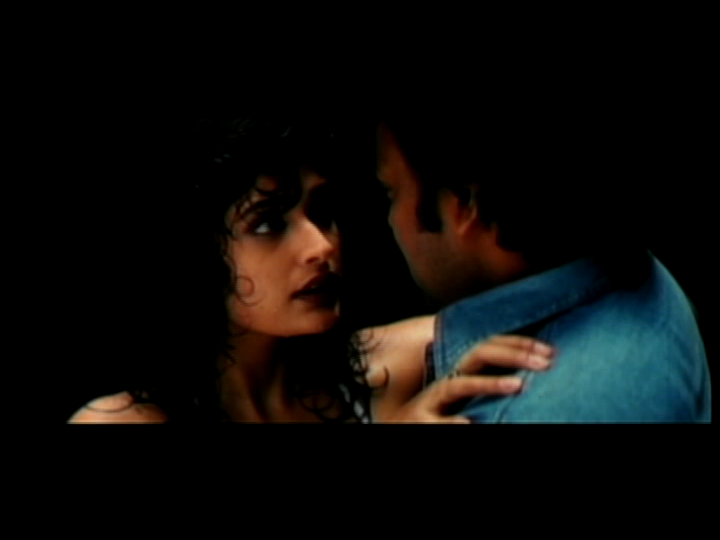
Gunasekhar is much better with action and the various chase sequences and the fight scenes work well. The music by Mani Sharma is generally good and Chiru looks amazing in the songs. The best are those with Soundarya although the choice of backing dancers in this one does seem a little odd. Rather stocky men wearing Lycra cut-off tops with bare mid-riffs wouldn’t have been my choice, but luckily it’s hard to take my eyes off Chiru dancing so I can manage to ignore those wobbling hairy stomachs! (You have been warned!)

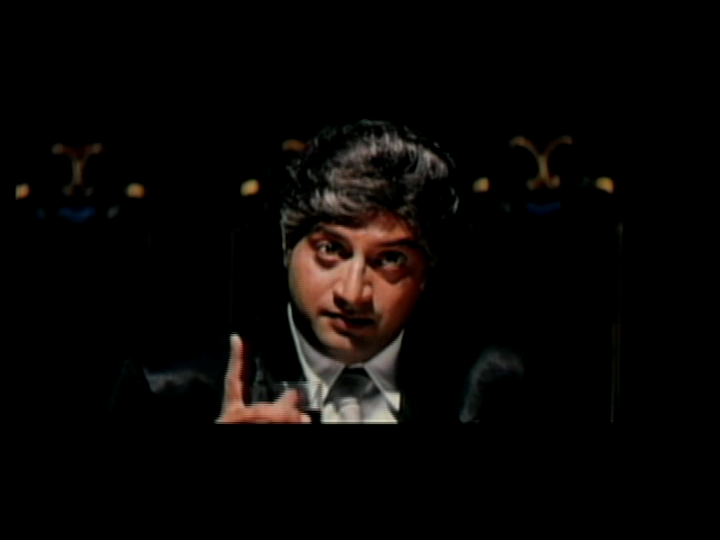
Prakash Raj seemed to be trying a little too hard to be evil at times but once past all the posturing his treatment of his daughter and grandson is suitably chilling and the climax scene with Chiru is excellent. Prakash Bad is always a treat to watch even with all the gun waving and declarations, and I did appreciate that when stressed he chose to sit right underneath a large chandelier rather than anywhere more plebeian. Such style!


Choodalani Vundi is a by-the-numbers masala film. It has the requisite number of songs and fight scenes, and in between there is a mixture of comedy and romance as required by Telugu Filmi Masala Law. And that’s not such a bad thing. The various elements are woven together well and it’s an entertaining watch even if it doesn’t really break any new ground. Chiru is the drawcard, but the rest of the cast provide able support and the change of scenery to Kolkata is refreshing. Plus lots and lots of Chiru screentime! 3 ½ stars.
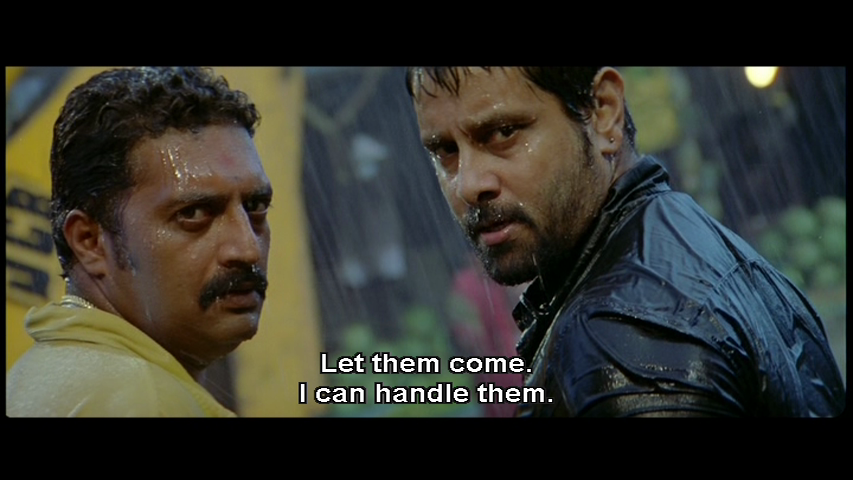


Bheema

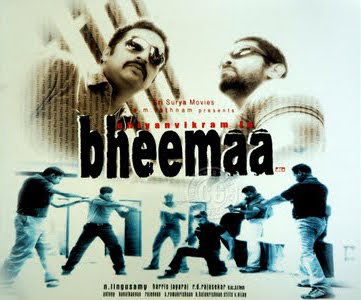
Bheema centres on the key players in a gang and their interactions with rivals and police in Chennai. It’s quite a sanitised version of the criminal underworld, and little detail  is revealed about the nature of how these guys make a living. But it has two fantastic actors at the forefront, a delightful bromance, and a focus on characters that makes the who and why of the story more interesting than the what.

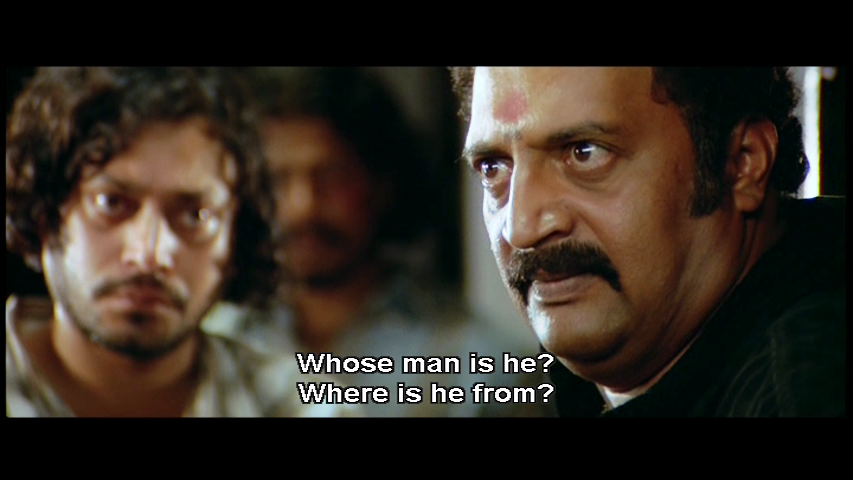
Chinna (Prakash Raj) is the local hard man. He started small in a small town and has risen to become one of the biggest crimelords in Chennai. His business dealings are never overtly discussed but he is presented as a ‘good’ gangster. He looks after the defenceless, his guys don’t attack women and children, and he plays by ‘the code’. Prakash Raj is perfectly cast. He makes Chinna likeable, roguish, aggressive and menacing by turns. Chinna is under threat from an old associate (Raghuvaran) and has an uneasy and crumbling detente with the local police. Things are getting tougher, but he is not one to back down. There is a lot more to the character than just being a figurehead, and I liked the glimpses into Chinna’s past, his conversations with old advisors, his wife, even the police, that showed different facets. He thought through the consequences, he reacted emotionally to some situations and I could understand the loyalty Chinna inspired because he seemed real yet powerful. I always enjoy seeing Prakash Raj in a more substantial role, and this is one of my favourites.

Sekar (Vikram) is an enigmatic figure, shadowing Chinna and despatching his enemies before Chinna can. The reason for his obsession eventually emerges via flashback, and it reinforces the notion that justice is not delivered by the law, and what makes a man is the ability to beat the living daylights out of another man. Sekar believes in instant justice, delivered as he sees fit. Even the police in Bheema argue that they can’t operate with the constraints of bureaucracy and low budgets, and have to break the rules to achieve what they see as justice. Sekar is given the name Bheema by the police in recognition of his strength and his role in Chinna’s life.

Sekar’s sole ambition was to one day join Chinna, his role model for strength and justice and a more satisfying father figure than his ineffectual policeman dad. I’ve often wondered why characters stick with their gangleader and don’t just leg it when things get crazy. Writer Sujatha provides a backstory and motivation that gives more to these guys than just being the good baddies. Vikram switches effortlessly from the full throttle action sequences to gazing mistily at Chinna or quarrelling with Shalu, and his physicality suits the invincible Sekar. Vikram’s rapport with Prakash Raj is one of my favourite things about the film and they play off each other very well.

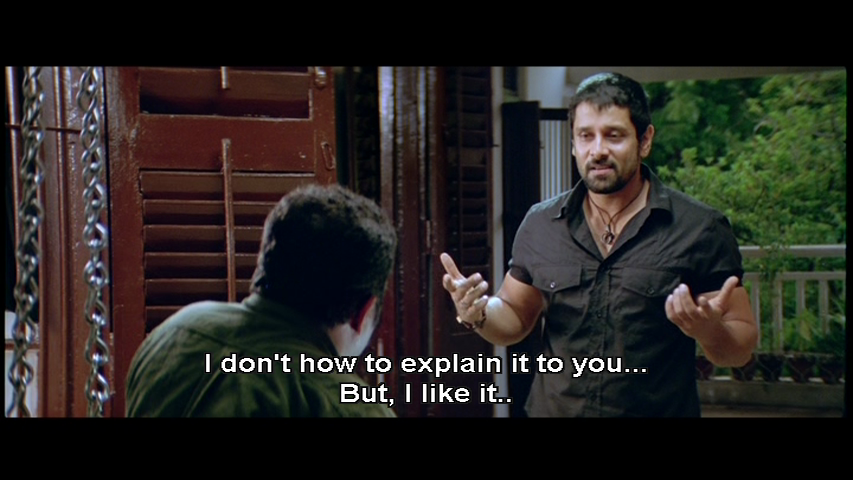
It’s a man’s world, and sometimes in unexpected ways. Vikram steals the focus from the item girl in this song, and Prakash Raj is the one to be almost upskirted.

What sets Bheema apart from other grim gangster fairytales is characters having a life, or at least ideas, outside of the job. Chinna was in love with Padma but they drifted apart. Sekar, ever the loyal lieutenant, reunites them.

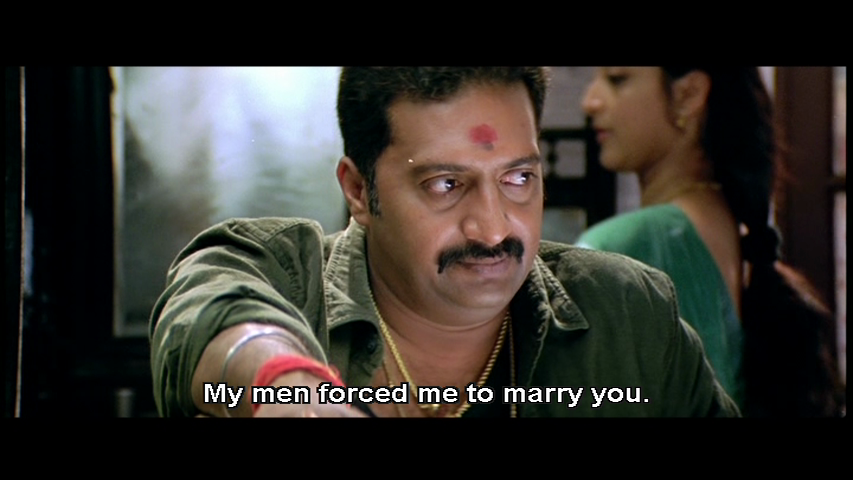
Prakash Raj does some delightfully girly fidgeting and stammering, and can’t hide either his happiness or trepidation at marrying his old flame.

Padma (Lakshmi Gopalaswamy) is gorgeous and her scenes with Chinna have a warmth and maturity that suits the slightly older lovebirds. They talk about the risks of her being part of his life, and she is firm in her assertion that she has no illusions. I found the dialogue rather flowery but the emotions came through and they seemed to have a deep mutual affection. He talks to Padma about Sekar, since Sekar is like family and Padma is in charge of the household. She and Chinna make fun of Sekar when they find out he is turning into a gooey romantic wittering about flowers, and their playful banter is another glimpse into the relationship.

Sekar loses his focus on being a thug when he starts to think of love and  Shalini (Trisha). He knows that his priorities have shifted and he can’t rely on himself to be as focussed, fearless and impulsive as he once was.  Chinna lets Sekar go, in a scene more like a breakup than an exit interview.

Unfortunately, Shalini (Trisha) is stupid and irritating for almost all her time in the story. I’m not sure why Indian film heroines characterise innocence by appearing to be dim-witted but Shalu is dumb as a box of rocks and about as interesting. Sekar falls through the roof into her courtyard one night, landing on her. Because of this, she decides he is the one, manufacturing reasons to be near him and imagining they share likes and dislikes based on absolutely no evidence. I did find her stalking Sekar mildly amusing just because it is a bit of turning the tables, but that was all I could see in her favour until quite late in the piece.

Once Sekar succumbs, Vikram and Trisha generate some chemistry and that made their relationship seem vaguely plausible. I liked that they had playful but still intimate scenes together as things developed, and it helped make up for the brain-dead start.

Chinna is a surprisingly sentimental old school don and sometimes that works against him, as he plays by rules others are starting to disregard. Sekar idolises Chinna and can’t abandon his old boss but feels compelled to take Shalini away. Once the other players sense weakness in Chinna, they start closing in. How will it all work out?

There are indicators. Shafi is in the support cast in Chinna’s gang. And Shafi does tend to play characters that bite the hand that feeds them. Also, I have developed a theory. In the imaginary Tamil Film Writing School in my mind, the compulsory class on ‘Ways to End a Film – Traditional (aka Everyone Dies (Rape Optional)’ is well attended. The final elective class ‘Ways to End a Film – Creative Writing (aka ‘No Rape, No Murder – stop being so lazy and think of something else’) falls the day after the big end of year dinner and people are either too hungover or they’ve already got enough credits to graduate, so most students don’t go. Thus there is generally one ending for a Tamil film, regardless.

I quite like the songs by Harris Jayaraj, but the picturisations of the romantic duets seem to exist mostly as a safe channel for the wardrobe department to vent their creativity.

The support cast includes so many reliable character players but the focus isn’t on them and I barely paid any heed to Ashish Vidyarthi, Tanikella Bharani, Shafi, or Raghuvaran among others. Chinna and Sekar dominate the story and Prakash Raj and Vikram likewise dominate the performances.

Linguswamy has directed an action packed film that doesn’t feel hurried or slapdash, and it is very satisfying to a point. The ending was a disappointment and yet almost exactly what I expected. The action scenes are typically excellent as is standard for this genre. There were some nice little extras – when Sekar belted a group of guys with a metal pipe, they chimed like bells as they dropped. The editing is good and the quick cuts and occasional use of effects enhance the sense of urgency or disorientation. It’s a very competent film and a pleasure to watch.

If you’re lukewarm on the South Indian gangster genre, this could be well worth a look. It has better than usual characterisations, some excellent performances and good production values. And one of the best filmi bromances. 3 ½ stars!

Heather says: I’m a fan of Tamil gangster films and usually enjoy anything by N. Linguswamy, but Bheema was rather disappointing all round. Instead of the usual well-developed storyline and strong characterisation I expect from such an accomplished director, Bheema staggers from fight scene to overdone fight scene without any real justification for the characters acting in the way they do. Rahguvaran is ineffectual as the ‘evil’ don Periyavar and his feud with ‘gangster with a concious’ Chinna seems clichéd and unimaginative. The second part of the film which concentrates on the new Police Commissioner and his vendetta against the gangs is more convincing but still seems formulaic and just not that interesting. The relationship between Chinna’s new lieutenant Sekar and the rest of the gang could have been made into something more exciting but instead it’s thrown in towards the end to try and spice up the climax. Something which only works to a limited extent. However, it’s good to see that Shafi continues his quest to always play the smarmy, self-satisfied sycophant and he does his usual thing here as one of Chinna’s men to good effect.

Despite the issues I have with the story, Bheema is saved to some extent by the excellent performances from Prakash Raj and Vikram who both breathe life into the film. I agree with Temple that their camaraderie feels very genuine and the interactions between the two do much to make up for the dreariness of the plot. Vikram’s character is very much the strong silent type and he does a good job with the rather dour Sekar, but Prakash Raj steals the show as the gangster with a heart. His romance is perfectly played and he brings out a human side to Chinna making him much more than just another world-weary gangster. Despite his good performance, Vikram looks rather over muscled here and I confess that I prefer him in more character driven roles such as in Pithamagan and Kasi where he has more range to work with. The one-man indestructible army of Sekar was just a little bit too much to take, especially with the distracting musical sound effects and overly loud soundtrack during the fight scenes.   The implausible relationship between Shalini and Sekar was another disappointment and the two never felt comfortable together –  odd, considering the considerable chemistry the two actors shared in Saamy. In fact there is much more sparkle between Chinna and Sekar!

Bheema does have a good soundtrack and there are moments where the film starts to grab your attention, but sadly they’re just not sustained. Worth watching once for Vikram and Prakash Raj but that’s all. 2 ½ stars.