7 Aum Arivu

After reading all about the buzz with 7 Aum Arivu, this was the film I was most looking forward to watch this Diwali. Especially since we had the promise of English subtitles for the first time for a Tamil film in a mainstream cinema release here in Melbourne. However there was so much hype in the build-up to its release that it was almost inevitable that it would fail to meet my high expectations. Despite an interesting concept and a generally good cast, the film pacing is slow with too many gaping plot holes to be anything more than just an OK watch. But there are some good points along the way and finally seeing a Tamil film in the cinema (with subtitles) is a definite plus. This is the first time I’ve seen Surya on the big screen and he certainly makes a good impression. The action scenes are well shot and I’m always happy to see a heroine who is capable of more than hand wringing, sobbing and looking helpless. I just wish they had spent more time on the actual plot and less on the set-up which takes up most of the film.

The film starts with an almost documentary style depiction of the life of Bodhidharma – the 5th century Tamilian monk who reputedly was the founder of the Shaolin temple in China. The documentary feel comes mainly from the interview style used and the lecturing voice-over as 150 years is neatly compressed into 20 minutes. The entire story is treated as factual although a quick internet search shows there appear to be a number of different versions around and no clear agreement on Bodhidharma’s lineage. But that really doesn’t matter here as the point is to illustrate Dharma’s expertise in war craft, medicine and hypnotic techniques, which these opening scenes do very well. Surya is perfect as the Pallava prince who journeys to China to become the ‘blue-eyed barbarian’. Yes, I did notice the blue contact lenses. Much is also made of the fact that people in China know exactly who Bodhidharma was while the Indians interviewed had never heard of him. This lack of knowledge of Tamilian heritage and history by people in India is pointed out a few times throughout the film and does become a tad wearing after a while.

Once the story of Bodhidharma has been established, we are transported back to the present day where an assassin has, rather improbably, been sent from the Chinese government to deal with a troublesome scientist and to initiate something called Project Red. The assassin Dong Lee (Johnny Tri Nguyen) is the top student of Kung Fu from the Shaolin temple and apparently an expert in all forms but seems to prefer the use of hypnosis where possible.

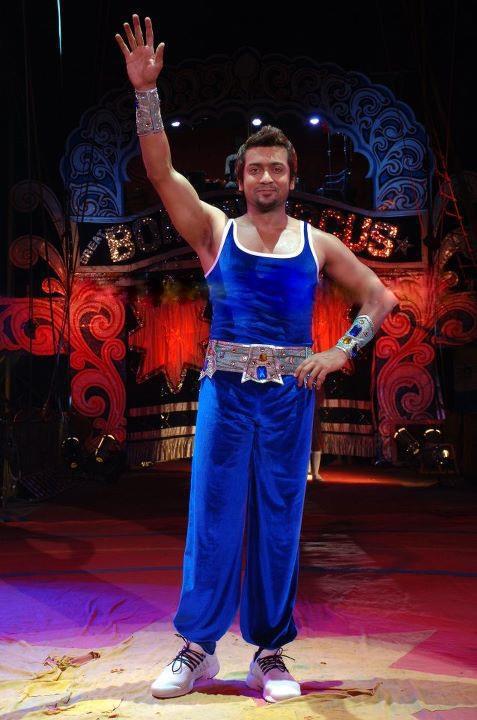
The scientist in question is Subha Srinivasan (Shruti Hassan), a researcher in the field of genetics whose work involves manipulating genes to resurrect DNA encoded attributes such as the fighting techniques and medical prowess displayed by Damo. Subha has tracked down the descendent of Damo who is most likely to be suitable for a little gene manipulation and he just happens to be the circus performer and general layabout Aravind (Surya). While Aravind thinks he has managed to trick Subha into meeting him to further their relationship, in fact she has been stalking him for over a year and has a scary collection of his discards including a tooth brush to show for it. It makes a change for the hero to be the victim of some determined stalking and I liked this deviation from the norm. Strangely Aravind is not as upset by the stalking as he is by the realisation that Subha doesn’t love him but just wants to get at his genes. Although from my SI filmi education so far I thought that stalking was supposed to prove true love but maybe I’ve just got it all wrong?
Not only has Subha been collecting Aravind’s DNA, but has compounded her dishonesty by stealing  a book from the local museum to further her research. It’s no surprise then to discover that her project doesn’t get past the local ethics committee although their reasons for rejecting her are more based on her youth and lack of kow-towing to their authority rather than her actual unethical approach to research. I found a lot of the science very funny since I do actually work as a medical researcher, often alongside geneticists, so have more than a passing knowledge about the subject. So while a lot of the science is very dodgy and eventually becomes implausible, it does have some basis in fact and it’s a relief not to have too much dumbing down of the subject matter. However the most unrealistic part of the film for me is Shuba’s apparently unlimited source of funds for her research – now that really was unbelievable!

Having learnt that Subha was only interested in him as a human lab rat, Aravind is devastated and mopes around theatrically (well he is a circus performer) until he finds out about the threat from Project Red. Dong Lee is also trying to assassinate Subha and decides Aravind needs to be removed too in order to guarantee the success of his mission. In between saving Subha and trying to save the world, Aravind barely has time for Subha to genetically transform him into Bodhidharma.

The first section of the film detailing Bodhidharma’s exploits in China is definitely the best part of the film. There is very little dialogue and Surya makes the most of his very expressive eyes to convey the various trials Bodhidharma has to undergo. While copious amounts of research appear to have gone into the making of the film, in this section it has paid off and it makes for a strong opening. Sadly though this isn’t maintained. The story has a lot of potential as it mixes science fiction with a disaster movie theme and a dash of Indian masala romance but it doesn’t quite gel. The plot rambles over the first half and it takes far too long to find out exactly what Project Red is and why Subha is a threat to the Chinese. The romance doesn’t work very well as a plot point and there is very little chemistry between the two leads. However I think this is intentional as Subha tries to keep her distance from someone she essentially sees as a walking experiment but there was a lot of time spent developing this non-relationship which slowed the story. There also doesn’t seem to have been any need to make Aravind a circus performer other than to make Surya learn a few new tricks since the whole circus background is totally abandoned in the second half.

Shruti Hassan is fine as the researcher and committed geneticist. She has plenty of passion and is able to convey the obsession necessary for Subha’s research although this does make her lack of enthusiasm in her romance with Aravind more obvious. She is particularly good in the confrontation scenes – those with the research committee and also with Dong Lee. Her character is strong, decisive and capable all of which she handles with ease.

Johnny Tri Ngyugen has excellent presence as the villain and exudes chilly menace. However there is a little too much reliance on his super hypnosis and not enough good old fashioned kick-ass kung fu for my liking , and this  slows down the action sequences. In one scene, where he hypnotises a large number of innocent bystanders and sends them after Aravind and Subha like destructo-robots, he keeps attacking for much longer than any respectable villain should allow before realising that the technique isn’t working and a change of tactics is in order. Perhaps it’s my over exposure to Southern Indian cinema but Peter Hein is an excellent action choreographer and I wanted to see more actual fighting between Dong Lee and Aravind. The few fights they had were worth waiting for though and I did enjoy the final sequence despite the overtones of Crouching Tiger, Hidden Dragon.

The soundtrack by Harris Jayaraj is great and I do love the songs, but while they are generally well pictured they don’t fit easily into the narrative and only serve to further disrupt the story. The exception to this is the first song ‘ Oh Ringa Ring’ which is fun and a good introduction to the character of Aravind. The songs are however the only time Aravind and Subha have any chemistry together so perhaps that’s one reason for leaving them in.

The screenplay by director A. R. Murugadoss is the main problem with 7 Aum Arivu as the film takes so long to get going once it moves to the modern era, and then is full of plot holes and unlikely scenarios. The last few minutes are dedicated to moralising about history and having pride and belief in your ancestry referring back to the lack of knowledge in India about the life of Bodhidharma. It seems very ‘Hollywood’, which seems to feel the need to deliver a sermon along with a happy ending, and didn’t seem to fit into a film which ends up being more masala than perhaps is intended. It’s still worth watching for the opening scenes and good performances from the leads, but just don’t expect too much from the actual story.


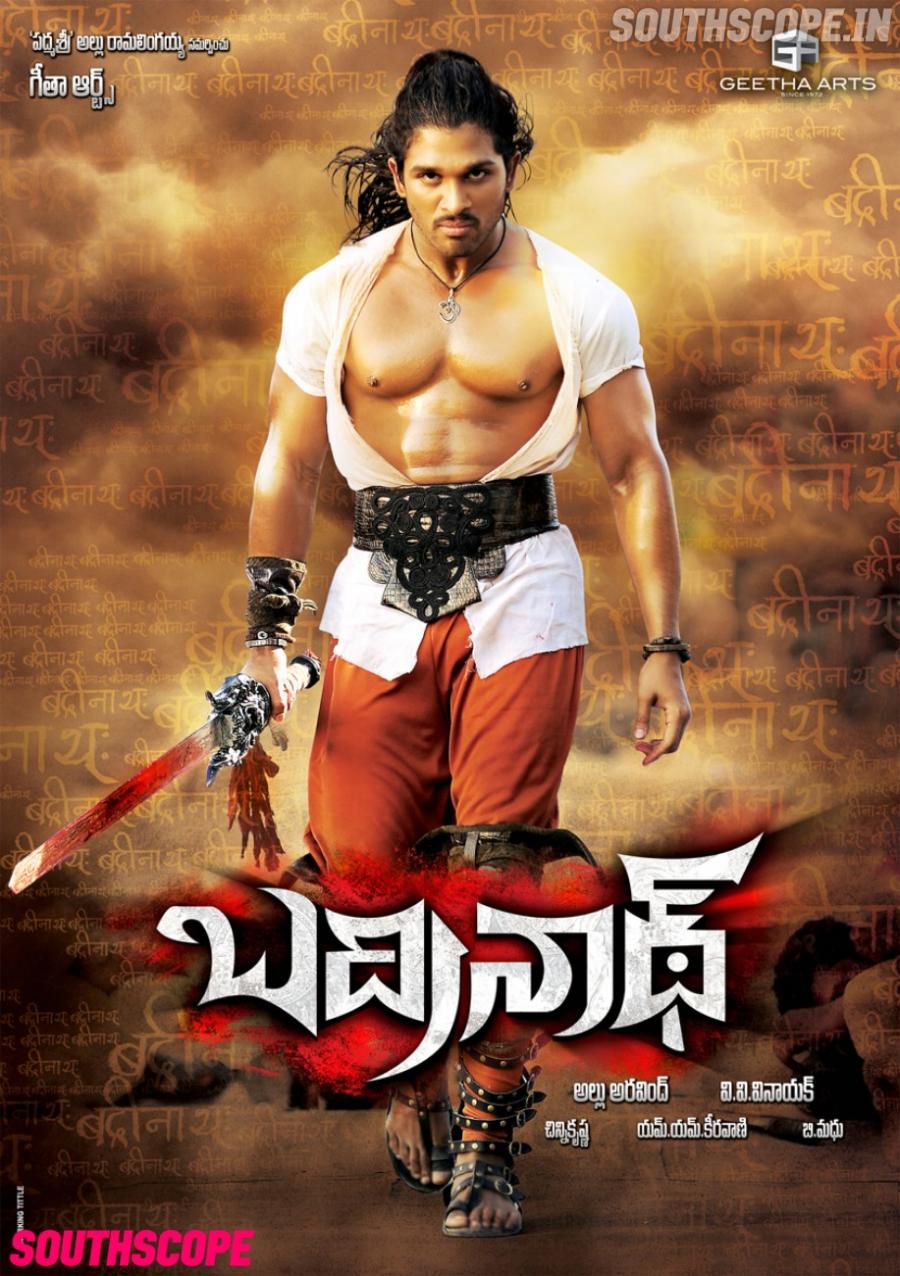
Badrinath

The great thing about an Adventure without Subtitles when Allu Arjun stars is knowing that no matter what, the dancing will be awesome.  But there is so much more to enjoy in Badrinath, and we had a great time.

The plot, for what it’s worth, can be summed up as follows. Prakash Raj is a guru who trains young boys to defend temples in the major holy cities of India. His school is located high in the mountains, and the scenery and the sets are nothing short of spectacular. Allu Arjun is Badri, who is assigned to protect Badrinath. Badri has a special relationship with the place, amazing sword and fighting skills, a strong faith in god and his guru, and is earmarked to take over the training camp. Tamanna is Alaknanda, a very pretty atheist who lost her faith after seeing her parents accidentally catch fire and die at a pooja. Badri and Alaknanda eventually fall in love, then the bad guys turn up to kidnap her. Will Badri desert his post, anger his guru and rescue his love? So much drama!

This is a vehicle for Bunny and, as expected, he excels in the dancing and fighting scenes. We had questioned the efficacy of an Indian Samurai when pitted against men with guns, but that question was put to rest. You need arms attached to your body to pull a trigger. Swords win! The fight scenes were cool, and it looked like someone may have been inspired by games where each set of bad guys has a particular set of weapons. So once the guys with sickles are defeated, the next batch has axes and so on. It isn’t all gore and anger though; there is room for what our friend calls Funny Bunny and he is joyful in the dances. He does an excellent wet shirt, and even wears a Chiranjeevi inspired silver cape in one song! This pleased us greatly.

Tamanna is a beautiful girl, and she can act and dance. She more or less keeps up with Bunny, and her facial expressions when she dances are great. Alaknanda is rarely more than a sketch, a pretty face on the sidelines, and sadly it seems that she discovers faith and love only after Badri slaps her. She also discovers more appropriate clothing. (And she had been spectacularly rude and stupid in the lead up to the slap). There is a fun moment when she keeps pretending to slip so she can fling herself on Badri’s manly chest and cop a feel. That seemed perfectly sensible so we decided we liked her a lot. Her subplot involving abduction by evil relatives and an attempt at forcing her to marry could have been cut back without diminishing the idea of the damsel in distress. Tamanna was very good in 100% Love, and lovely in Badrinath, so we hope more substantial roles come her way.

Alaknanda had the best imagination. Most of the songs were her dreams and she spared no effort in dressing Bunny up and giving every single backing dancer the most amazing outfits as well.

On the subject of wardrobe, this is what Badri wore as his going into town outfit so there are arguments for and against him choosing his own clothes.

Prakash Raj is excellent as the guru. He gets to do pretend martial artsy stuff, levitate, growl at people and also use his misty eyes of love. His character is the cause of Badri’s conflict as he demands the young man be sworn in as his replacement, and thus swear off marriage and women. He probably should have thought that through a bit more.  But we could rely on him to do the right thing when it counted and all was well between the master and disciple.

The Comedy Sideplot was over represented by MS Narayana, Venu Madhav , Master Bharath and Brahmi among others. Too many! And took up at least 30 minutes that could have been condensed or cut. Brahmi was fun, and the crowd went wild for him, but it was basically the same fleecing the pilgrims shtick he did in Indra. We guess that was a deliberate reference. The supporting cast was full of familiar faces, all of whom do the thing they do so well. We think the Allu family pug made an appearance too so if Ice’s agent is reading this, please confirm? But in an unsubtitled film we tend not to give the support artists their full dues as we have to concentrate on the main action. And yes, there were compelling visuals adding to the distractions. We totally appreciated the backing dancers for their enthusiasm, their dancing and the way they rocked the purple and gold glittery outfits.

We did have to notice the evil family as they showed dedication to the bulk purchase of coloured contact lenses, and the matriarch wore some excellent saris.

The evil henchmen deserve a shout out. From the Pick n Mix Assorted Terrorist Stereotype Brigade to the Ninjas in Hoodies, they gave it their best, and Peter Hein and team really made them work for their money. He knows how to make chaos look elegant.

There are massive plot holes, but they aren’t an impediment to enjoying the story. There is no pretence at realism so questions of why there are never any police around or how Badri could survive the latest incident just didn’t matter. We were far more interested in why people wore some of the crazy outfits. The soundtrack is effective and enjoyable, and the songs are well placed. How well they stand up without the supporting visuals is another question.

This is an out and out entertainer that succeeds, and the audience last night certainly enjoyed it. The balance of action and ridiculous stunts with beautiful visuals and fantastic dancing is just about right. See it on a big screen if you can!

Mr Perfect

There really is only word to describe Mr Perfect, and that is boring. That’s not just because we couldn’t understand much of the dialogue either, there was just nothing at all to keep our interest in this very predictable and slow-moving romance.

Mr Perfect starts in Sydney with Prabhas as Vicky, a computer game developer who has dreams of running his own company with his friends. Straight away there is a rather inexplicable fight in a pool with some Europeans – French? Or possibly Belgian? They certainly sounded more like Inspector Clouseau than any Australians we know. After some rather impressive ‘Man from Atlantis’ impressions by Prabhas and his jet-propelled feet the action moves on to various parts of Sydney. He and his friends spend a lot of time hanging around various landmarks but never really doing any of the work that is supposedly their dream. He goes back to India for his sister’s wedding, and meets Priya  (Kajal Aggarwal), a childhood companion. A flashback introduces the idea that Vicky needs to learn the art of compromise and explains to some extent the animosity between the two.

Over time Priya’s likeable personality wins Vicky over but he decides that he can’t possibly remove Priya from her family or her obviously happy life in India, and he won’t leave his life of aimless wandering around Sydney. Vicky keeps insisting that he will not compromise, but we don’t know what sparks these speeches as really people are only asking him to have some manners and be considerate which is hardly the end of the world. He’s such a grumpy, argumentative man who falls into fights for no reason whatsoever.  There is some attempt at comedy involving Brahmi as an uncle who is trying to get rid of Vicky, and also some funnier moments involving Master Bharath but none of it works very well. There are some good points though.  This part of the film in India was beautifully shot and there were some lovely moments with Priya and her family. The teasing and banter between Priya and Vicky is also amusing, even without understanding the dialogue, and Prabhas and Kajal have excellent chemistry.

Vicky heads back to Sydney and through the wonders of product placement meets Maggie who is his ideal partner – or so he thinks. Her family disapprove of Vicky, mainly due to his brattish and immature habit of arguing with everyone senior to him. It really made us wonder how he would ever manage to run a business successfully! There were more Europeans in Sydney – this time Dutch we think – and a stylist who really didn’t like Taapsee. This is one of the better outfits as sadly we can’t find any of the really terrible ones.

After more confrontations and more inexplicable, although very nicely choreographed fights (thanks to Peter Hein) Maggie’s father challenges Vicky in order to win his support for their marriage. At a wedding somewhere that wasn’t Sydney or India, but may possibly have been Malaysia both Maggie and Priya are present and Vicky has to decide between the two. And really that was it – most of which could have been condensed into an hour and saved us from the never-ending drama of the second half.

A word on Prabhas’ styling in the film – which was really quite terrible. But not terrible enough to be interesting. Dressed in far too many designer T’s, which looked to have come straight from the street markets of Bangkok, worn over the top of plaid shirts, this really was not the best look for him at all. He looked awkward and overdressed in the various layers especially when seen next to Kajal who looked beautiful in some lovely saris.

Overall, the whole story was predictable with far too many contrived ‘chance’ meetings and co-incidences. Prabhas character was essentially unlikable and had no convincing relationship with his family. In fact the scenes with his father (Nassar) and mother in Australia were much more reminiscent of a live-in boarder rather than an only son. At least in ‘Orange’ the hero’s decision never to compromise and to live life on his own terms blah blah blah was given a context so while you might not empathise with him, there was at least a reason. Here there was nothing – just a lot of attitude. The interactions with his friends were a little more convincing but only just. There was never any sense that he was ever going to achieve his dream of owning a company and none of them seemed to actually do anything like work.  It’s such a pity as we both like Prabhas and were so disappointed in this lacklustre venture.

Kajal was lovely as Priya but seemed to fall for Vicky just a little too quickly. Initially she seemed to be a strong character with plenty of determination and confidence but lost her backbone when she fell in love. However her character was reasonably well developed and she delivered a good performance in her role. Taapsee’s character was less interesting and suffered from some very unfortunate choices in the wardrobe department. Prakash Raj and K. Vishwanath play their usual type of role as do many of the other uncles, aunts and family members and it’s nothing we haven’t seen many times before. And that really is the problem here – there is nothing new and the story isn’t interesting enough by itself. The comedy didn’t fit and in general just wasn’t funny. The fights were technically impressive but added nothing to the drama and didn’t serve to progress the story. It felt as though they were just added because they are more or less obligatory and people would want to see Prabhas in action.The songs were much better and mainly were well picturised although the placement was rather clumsy. We tried to look for good points but even the pictures on the walls and the furniture failed to inspire!  Less a Mr Perfect and more a Mr Ordinary.