Maattrraan

I’m a big fan and I expect a lot from K.V. Anand and his writing team of Subha but sadly Maattrraan fails to deliver despite the presence of two Suriya’s, the hint of a good story and the best efforts of all the cast.  I was expecting the worst when I read about that the plot involved conjoined twins since anything even vaguely medical in Indian cinema is always replete with the totally impossible and that’s exactly the case here.  As if the ridiculous medical themes weren’t enough to deal with, the second half also has plot holes and inconsistencies big enough to swallow a small asteroid while it treads a well-worn path without any real excitement or tension. Just to cap it all off, Maattrraan also has one of the most ridiculous and unsatisfactory endings I’ve ever seen in a Tamil film!

It’s not all bad though.  The first half is generally entertaining and the interaction between the twins is engaging, but when the best chemistry in the whole film is between Suriya and himself then you know things aren’t looking good.

Suriya plays conjoined twins Akilan and Vimalan, who are almost separate, but can’t actually be separated because they only have one heart between them – which is only the start of the questionable medical statements.  Vimalan is intelligent, quiet and studious and completely different from his drinking, smoking and music-loving brother. They tend to overlook the fact that only having one heart means they share the same blood supply so if one twin was blind drunk, the other one would be intoxicated too, but logic never really intrudes on their relationship.  The differences between the two would have worked well for two fifteen years olds but seemed a little out of place in two grown men, especially since Akilan seems to be channeling late seventies Rod Stewart most of the time.

But the relationship between the brothers is the best part of the film and Suriya convincingly plays the part of the conjoined twins making them seem real rather than the product of a special effects team.  The twins are the offspring of Ramachandran (Sachin Khedekar), a genetic scientist who was forced out of Russia by the end of the cold war.  After some financial difficulties he set up the increasingly successful business of Energion, an energy drink for kids which consistently outsells and out performs all its competitors.  Add in a suspected Russian spy who is actually a journalist reporting on the connection between Energion and a health supplement which had serious side effects in a group of young Russian athletes and the scene is set for some dodgy chemistry and dubious genetic manipulation.


The film tries to ramp up into an action thriller, but since we know the villain is the rather mild-mannered Ramachandran along with his faithful side-kick Dinesh (Ravi Prakash) there aren’t many thrills to be had.  The fight scenes, especially one at the end of the first half between the twins and an assortment of thugs in an amusement park, seem to drag on forever. Perhaps it’s the challenge of the conjoined twins but even in the later fights, Peter Hein’s choreography isn’t as effective as usual.

There doesn’t seem to be any real reason for Akilan and Vimalan to be conjoined twins other than a gimmick to grab our attention.  It’s difficult to tell without understanding the dialogue, but there wasn’t enough in their relationship to fully explain why most of the budget had to be spent on creating the duplicate Suriya effect.  Especially since the rest of the film seems to have suffered as a result.  K. V. Anand films usually have great explosions, thrilling chase scenes and innovative fight sequences, but here the best of them are muted and the helicopter crash in particular is a rather damp squib.  Two brothers would have worked just as well, and although I get the nod to the fact that their father was a genetic scientist and the sequences with Akilan missing Vimalan in the second half were good, it wasn’t enough for me to justify the conjoined aspect.

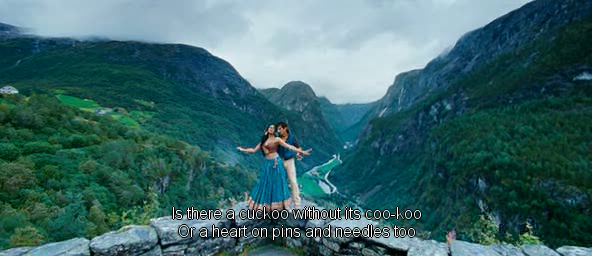
Kajol Agarwal plays the role of Anjali, who starts off interested in Vimalan but then seems to change her allegiance to Akilan without too much distress in the second half.  Rather more believably, Anjali is a Russian interpreter which at least allows her to feature occasionally in the action and Kajol is fine in her role. Since the other female protagonist is the rather stilted and uncomfortable-looking Russian journalist, Kajol is also the better dancer which gives you a clue that the dance sequences aren’t anything too great either.  Even Suriya appears awkward for most of the choreography and the best thing about the songs are Kajol’s beautiful saris and skirts.  One song appears to have been shot in the Fjords in Norway and the scenery is absolutely stunning but also totally overshadows any hint of romance between Suriya and Kajol.

The basic story could have worked well, but it’s buried underneath all the CGI and far too many irrelevant trimmings that work against building excitement or tension as the plot unfolds.  Suriya is excellent and worth watching but that’s not enough to hold Maattrraan together. If you can watch with a willingness to completely suspend disbelief and don’t mind the constant clichés then this is probably a film that you will enjoy.  Otherwise wait for the DVD where judicious use of the FF button will likely make Maattrraan more watchable.

Sivaji (2007)

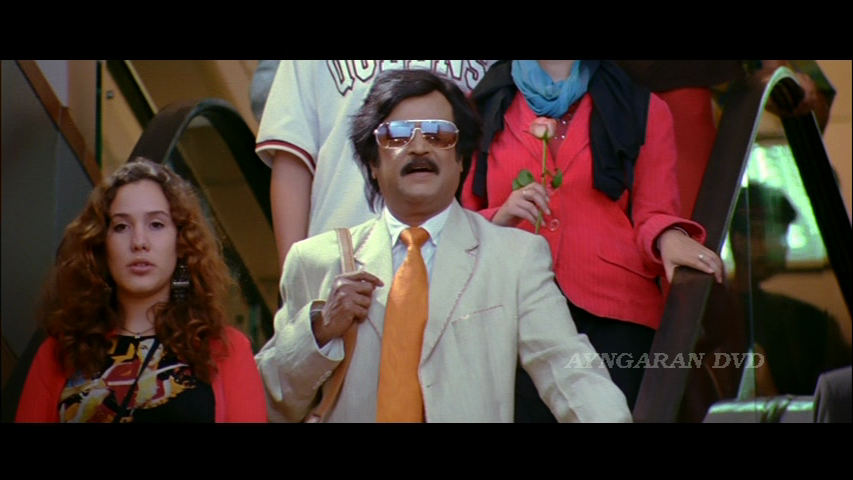
Sivaji is a wonderfully over-the-top film celebrating all things Rajinikanth. There are references to the superstar’s previous films and to his own life, plenty of classic Rajni style and he’s present in almost every frame. Sivaji also features stunning sets for the songs and a myriad of different looks for Rajinikanth throughout the film. While the story has an interesting plot involving corruption, the screenplay gets somewhat tangled in the numerous set-ups to introduce the next song or fight scene.  But in the face of so much else that is fantastic, the disjointed nature of the story doesn’t seem to matter. When the first song is as much fun as this, then the film is already a winner for me. This features Nayantara in a cameo role along with an incredible number of  men with round, jiggling painted bellies – I love it!

The film opens with Sivaji returning from the USA with truck-loads of money and deciding to set up a University and Hospital where everything will be available to the poor for free. His grand plans are opposed by local businessman Adisheshan (Suman) who blocks him at every turn. To make Sivaji’s life more difficult there is the practice of bribes and kick-backs that seems to be built in to the system at every stage. Despite his unwillingness to play along, Sivaji has no choice but to fall in line and pay everyone off if he wants to get his hospital and university built. I’m quite sure that all these people in yellow hats were the inspiration for minions in Despicable Me – or at least they should have been.

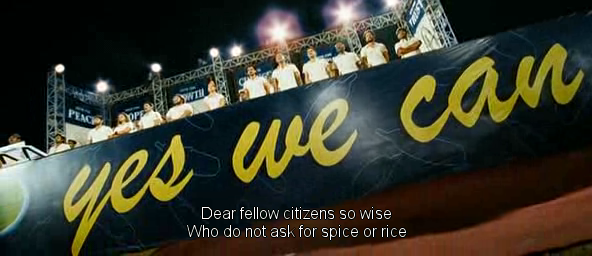
Ultimately this works to Adisheshan’s advantage when he contrives to have Sivaji arrested and charged in court. There Sivaji admits that he paid bribes to get permission to build and ends up losing everything. This might have been the end of the Sivaji foundation, but Adisheshan is the one person in Tamil Nadu who has no idea who he’s really dealing with and he rashly mocks his defeated enemy.  This sparks Sivaji’s quest for revenge, and the 1 rupee coin Adisheshan tosses at him to start his begging career becomes a talisman and also funds the start of the fight back. Sivaji devises a cunning plan to restore his finances and bring about Adisheshan’s downfall at the same time.

Rajinikanth is truly in his element here as the crusading Sivaji. He still has his trademark tricks, but this new  health conscious Sivaji spruiks the ‘cigarettes are bad for you’ message, catching mints and tossing his sunglasses instead of cigarettes. It’s all a little contrived, but the tricks are so much a part of any Rajni film that Sivaji would seem incomplete without them. There areplenty of fight scenes, and these are well choreographed by Peter Hein. The final showdown features some Matrix style action and Rajinikanth pulls it off with great style. If he has slowed down a little in some of the fight scenes and songs, well, that’s understandable but it’s barely noticeable. As well as the romantic songs, there is a fabulous sequence where Rajinikanth impersonates Sivaji Ganesan, MGR and Kamal Hassan and he gets really gets the mannerisms of the different stars very well.
During the course of his crusade against corruption, Sivaji meets and falls in love with Tamizhselvi (Shriya) and despite her family’s initial reluctance and dire predictions of disaster from the priest, the two go ahead and get married. Thankfully Shriya is much less annoying than usual, perhaps because she is totally overshadowed by Rajinikanth, but I stand by my previous observations that the more clothes she wears the less irritating she is. Her main raison d’être here is to look pretty in the songs which she does very well.

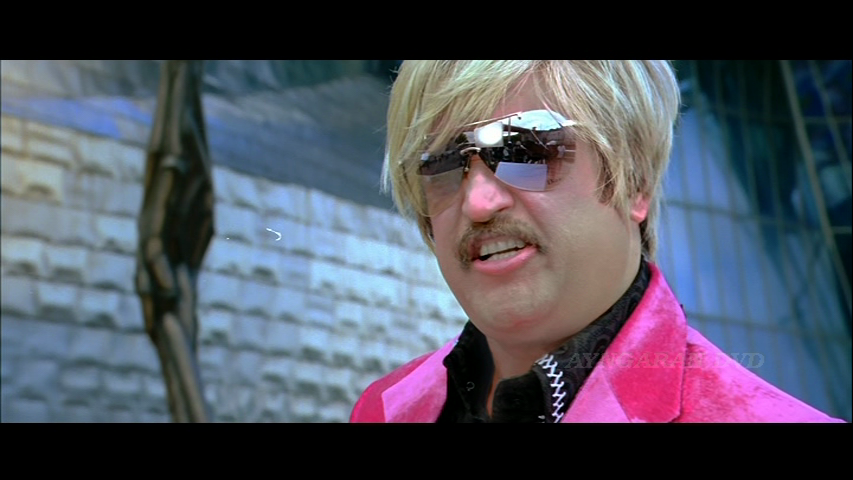
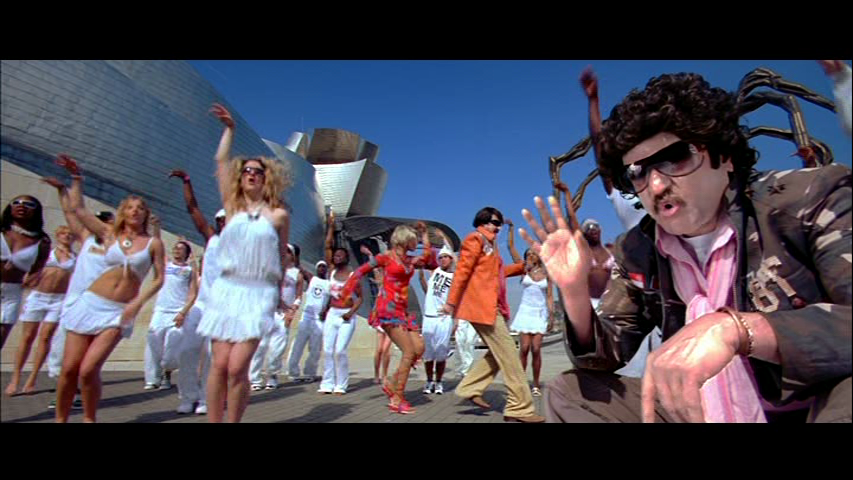
Other than her presence in the songs, Tamizhselvi is the ‘perfect Tamil girl’ of Sivaji’s dreams and that ensures plenty of traditional outfits and a fairly restrained performance, making her more tolerable than usual. Someone in wardrobe really does have a grudge against her though because she does appear in some of the worst outfits I’ve seen in the song ‘Style’.  I’m not quite sure what to make of this song for many reasons. As a song extoling style it has some truly dreadful costumes and the whole white-skinned Rajni just seems very wrong. I’m always perplexed by the quest for paler skin in India, but then I’m equally as baffled by the drive for tanned skin among Europeans. I don’t like the melody or the lyrics of this song at all, but it does feature an incredible selection of amazing wigs for Rajni and is worth watching for that alone. Pick your favourite style!

And the contrasting faces of Shriya.

While the film deals with the theme of corruption, there is still plenty of comedy along the way. Although much of the humour comes from Rajinikanth and his various mannerisms, Vivek is excellent in his role as Sivaji’s uncle Arivu and provides many funny moments. Even though I’d normally cringe at Arivu’s match-making technique of parading girls in front of Sivaji, Arivu’s character is self-aware enough to make this funny rather than crass.  There is more slapstick comedy in the scenes with Tamizhselvi’s family who disapprove of Sivaji and his exuberant family. The actor playing Tamizhselvi’s father (Pattimandram Raja) has some excellent expressions and I love the way he looks as if he smells something bad every time he sees Sivaji.

On the other hand, Suman’s Adisheshan is a very mild mannered villain without any real evil tendencies. Although I’m sure this is meant to make sure that all eyes are firmly on Sivaji, he still seems rather unimpressive in comparison. His demeanour however is quite realistic as a businessman with political leanings and his reasons for opposing Sivaji are understandable considering how much the free hospital and university will cut into his profits. His methods of opposition are also consistent with his character and perhaps S. Shankar is trying to point out that corruption can be present in even the most reasonable appearing businessman.

The second half of the film relies more heavily on the effects and gimmicks, and it’s disappointing that Vivek’s character gets more sidelined. But it’s still a lot of fun to watch mainly due to Rajinikanth’s performance. The music by A. R Rahman is excellent apart from the Style song mentioned previously, and the high budget of the film is easily explained by the song picturisations. The sets and costumes are totally fabulous and both Thotta Tharani as art director and K. V. Anand as cinematographer deserve the awards they received for their work. There are guest appearances by a number of established Tamil stars including Raghuvaran and Manivannan and  the support cast are all very competent, although generally overshadowed by the superstar.

Although Endhiran (S. Shankar’s latest film with Rajinikanth), had a bigger budget and even more special effects, I prefer Sivaji. The story is engaging despite the way it jumps around and Shankar shows corruption within government systems in a way that seems quite plausible. Even though the one man crusade requires a leap of faith, it is after all Rajni and so anything is possible. It’s one to watch for the lavishness of the sets and the larger than life presence of Rajinikanth. And for all those wigs! 4 stars.
Temple says: Sivaji is what I have come to think of as a typical Shankar blockbuster in that it is all spectacle and very little plot. I think Heather is being overly kind in saying there is a theme to the story as I see it more as a collection of ideas that never really develops. Shankar introduces statements about corruption, the brain drain overseas as bright graduates pursue careers outside of India, the returning NRI and how they navigate between worlds, the obsession with all things American being seen as ‘better’ than local, the clash between tradition and modern living and the nostalgic ideals that may no longer exist. All interesting, and yet there is no real exploration of these notions as there is too much else happening. We move from fight to song to comedy to spectacular song and rarely pause for breath. It’s hugely entertaining, but it doesn’t really bear analysis.

Rajnikanth is in excellent form and this is his film from go to whoa. Sure he is way older than his character, but it somehow works as he deadpans his youthful dialogues, daring you to not believe,  and throws himself into the action with gusto. The fights have been tailored to suit him, and the music shop sequence is one of my all time favourites from any film industry. Shriya can range from terrible (e.g. Kanthaswamy) to pretty good,  and this is one of her better performances. She handles the comedy really well  (I love her expressions in the “Chandramuhki” sequence), isn’t completely overshadowed by Rajni, and does justice to the massive song sets and costumes. And she manages to look like she isn’t staring intently at Rajni’s wigs in the romantic moments so I decided Shriya may be a better actress than I had previously thought.

See this for the spectacular sets and design, for a Superstar who can dominate the hyperactive pace and attention grabbing visuals, for the music (except Style) and for the filmi equivalent of a crazy amusement park ride. You’ll be dizzy and none the wiser at the end, but it was so much fun while it lasted. 4 stars!
Ko

Ko opens with an eye catching photo montage and theme music that incorporates thrashy guitars and angelic choirs. I immediately expected something a bit stylish, modern, urban with a splash of heroics and that’s what I got.

Unravelling the plot was integral to my enjoyment of Ko so I won’t discuss what happens in detail. The story focuses on two groups – journalists and politicians – and an upcoming election. The journalists are young and shiny, full of ideals. The politicians are…politicians.

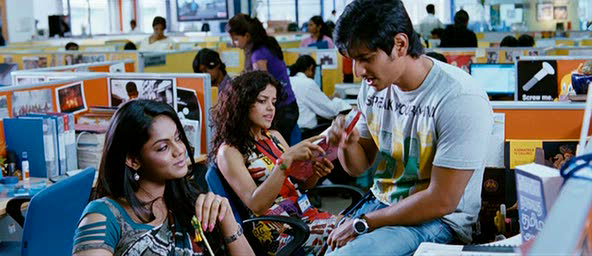
Jiiva is Ashwin, a newspaper photographer. His camera is never far from hand and he is an acute observer. Spotting a bank robbery getaway in progress, he does what any ambitious journalist would do – gets their pictures. That he does it from his motorbike just makes it clear that he is the hero. I think Jiiva conveys the right blend of boyish appeal and serious drama, and he is just so likeable. He can do cutesy flirting and silly dance moves, and be blokey enough to walk into a dodgy bar and track down a witness. He delivers the action scenes with loads of energy and while Peter Hein has set the fights at the outer bounds of ordinary guy capability they are still true to the character.  Ashwin has a knack for seeing what is going on in the background or on the periphery of the action. This makes him valuable as a photo-journalist and really annoying to those he targets. His first reaction to any event is to get a photo and record what is happening.

Ashwin’s observations and photos often have a touch of sarcasm or dark humour about them. But although he jokes, he is passionate about justice and dragging the truth out into the light of day.

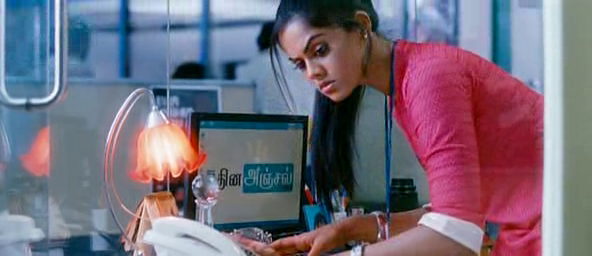
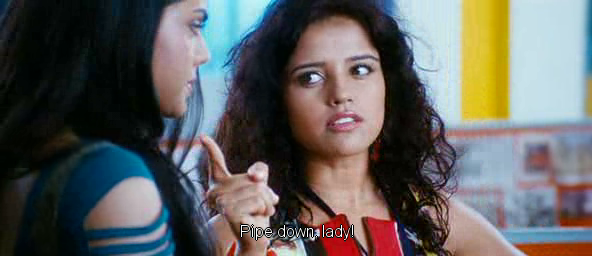
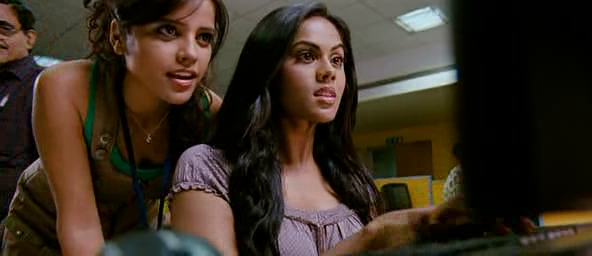
Karthika Nair is Renuka, recently transferred to Chennai. She is an established journalist but finding herself in a new city and a new team, she is a little lost at times. Her relationship with Ashwin starts off on rocky ground due to a case of mistaken identity but soon looks like love is in the air. She and livewire movie reviewer Saro (Piaa Bajpai) become good friends despite Saro having feelings for Ashwin. While this is primarily Ashwin’s story, the girls were strong and relatable characters. I liked seeing young ladies who could be friends, rivals and colleagues without being overly silly or unpleasant.

Work was the main thing all three had in common, and the work remained in focus throughout. Despite some of the less believable incidents, that work/life balance gave them a bit of credibility. Piaa Bajpai is OTT at times, but she needs to be to act as the counterpoint to the more reserved Renuka in the mild love triangle that develops.

I liked both performances although I think a real life Saro as a friend would have me investing in ear plugs. Karthika had more complexity to work with and I think she did well in imbuing Renuka with a maturity that I rarely see in film heroines.

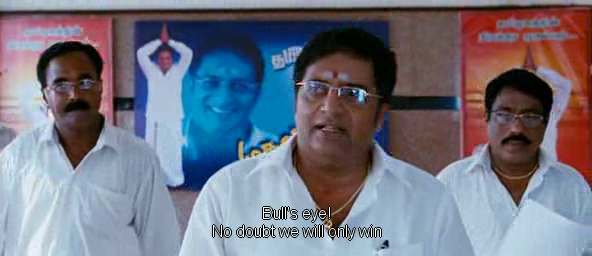
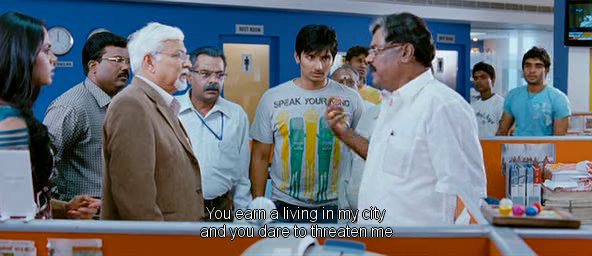
The politicians are represented by Prakash Raj as the statesman Yogi, and Kota Srinivasa Rao as the uncouth Alavandhan – very different men on the surface but not fundamentally different when it comes to the goal of winning office. They both do what they do so well but neither delivers a standout performance.

Tying the two groups together is Vasanthan (Ajmal Ameer) – a young idealistic politician. He and his colleagues are trying to contest elections but are struggling to create a media profile and can’t compete with the bribery and standover tactics of major parties. He is educated, ambitious and a natural leader. Ajmal Ameer played Vasanthan with sincerity and conviction.

Events bring him into the media spotlight and eventually the young Siragugal team are on the brink of success. Then a catastrophe – a bomb blast at their rally – changes the game. The story gets murkier the more Ashwin and Renu dig.

The story starts off running in several different directions before things start to link back together. The plot branches are tied in by characters identifying patterns or spotting inconsistencies in someone’s story so there are a few ‘A-Ha!’ moments. Ashwin, ever keen eyed, spots a familiar face in photos from different crime scenes and that ties a Naxalite band to a local identity. Renu follows up on another clue and Ashwin is under scrutiny. It’s really well done, and kept me thinking about what could happen next.  The resolution is a bit predictable, but I was interested enough in what was happening that I didn’t really care.

This is pretty indicative of the visual style and editing. Ignore the crappy rapping and do a bit of star spotting as almost everyone in Tamil film makes an appearance:

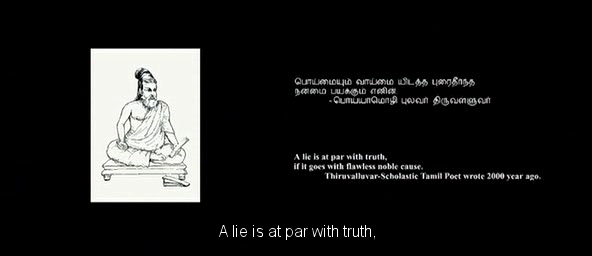
The songs by Harris Jayraj are not unpleasant but I never really remember them without seeing the film. There’s the usual selection; the club song, the falling in love duets, the colourful ethnic costumes in the snow song, the college friendship song. The lyrics are often quite pertinent to the story so I was happy to have them subtitled on my DVD. Well, they’re not always that helpful…

Songs are used well in the first half but are a little out of place later in the film as events got more serious. I found the transition to Venpaniye a bit jarring as it is a lovey dovey duet in an ice palace just after a traumatic event. Jiiva is equal to the limited choreography and his facial expressions are often priceless. I got the impression he was having a blast doing some of the more comedic scenes and the dances. Karthika does more posing than dancing but her wardrobe often makes up for any lack of energy on her side. And the locations are sometimes breathtaking.

It’s not an issue film as such, but it does touch on many social and political ideas and problems as the plot develops. Considering some of the themes, there is a lot of product placement in Ko. There is at least a semblance of building it into the plot so while I politely jeered each new brand’s arrival, it didn’t bother me unduly. KV Anand (director and co-writer) glances at the interdependency of some media and politicians, the role of the police, celebrities in politics, freedom of the press, availability of adequate medical care and education among other things. The perspectives are offered from the various characters points of view so there is more discussion than lecturing. The commentary is often laced with humour and an acknowledgement that truth is not an absolute.

If you like the idea of a modern, urban thriller with some classic masala elements and young and likeable stars, this is well worth a look. 4 stars!

Heather says: I really enjoyed this film.  Yes, the plot does have a few too many twists and turns towards the end and some of the action is rather improbable, but the story moves along at a cracking pace and the lead actors all put in excellent performances. I got this DVD based on K. V. Anand’s previous films which I also enjoyed, and thought the reference to Ayan here as a film only worth 1/2 star was very funny. I would love to know if this was an actual comment that he received about the film!

One of the best parts of the film for me is the number of strong female roles. Not only the characters of Renuka and Saro, but also the fact that there are females characters standing for election, involved in the Naxalite terrorist group and generally well represented among the various minor roles throughout. I like the characters of Renuka and Saro and both actresses brought great individuality to their roles while still keeping them believable as friends. Jiiva is excellent and his journalist, while often taking suicidal chances in his quest for a picture, brings together the right blend of charm, action and determination to make Ashwin a compelling character. Like any good journalist, I think he has all the right characteristics to be able to schmooze his way into any situation. It’s the first time I’ve seen Ajmal Ameer and I must look out for his previous Malayalam films as I think he is just as good as Jiiva in his role here. While there are one or two moments in the film that don’t work for me as they seem too unlikely in such an otherwise plausible film, there are many others which work so perfectly that I don’t mind suspending disbelief from time to time. Ko has a well written screenplay and very likeable actors which make it a film worth watching. 4 stars from me.