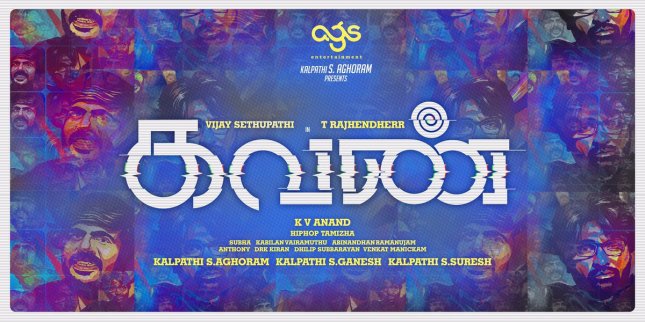
Kavan (2017)

Kavan

K.V.Anand doesn’t tread any new ground with his latest film Kavan, revisiting a theme of land and water contamination by big business that’s been seen many times before. But rather than making another ‘message’ or pure action film, here we are firmly in masala territory, and that’s what helps make Kavan such a watchable film. It’s set in the world of television and journalism where breaking news is the key to big ratings and in this new post-truth world of alternative facts, the machinations of one TV station to keep ahead of the competition don’t appear quite as far-fetched as they may have done a few months ago. Writers K.V. Anand, Subha and Kabilan Vairamuthu have come up with an entertaining screenplay and some excellent dialogue that drive the story along despite numerous diversions. With great performances from Vijay Sethupathi and Madonna Sebastian, Kavan is more engaging and enjoyable than expected, even with the 160 minute run-time.

Vijay Sethupathi is Thilak, the only student in his class who wants to make documentaries rather than work in films or TV which immediately identifies him as someone more interested in facts and the truth than entertainment. However, he ends up working at Zen TV, alongside his former girlfriend Malar (Madonna Sebastian) who doesn’t want a bar of him after their acrimonious break-up. Initially Thilak does well, impressing channel owner Kalyan (Akashdeep Saighal) with his novel approach, but it doesn’t take long until Thilak’s moral stance gets him into trouble. Kalyan is prepared to put anything on-screen as long as it will lift ratings and he isn’t above manufacturing news either. Alongside corrupt politician Dheeran Maniarasu (Bose Venkat) he spins facts out of all semblance of the truth to promote Dheeran Maniarasu’s political career and his own TV channel. The inevitable clash comes about due to Dheeran Maniarasu’s involvement with a chemical company which is polluting the local area.

Activists Mira and Abdul (Vikranth Santhosh) are friends of Malar who fall foul of the politician and his rowdies and their subsequent search for justice sees Thilak and his friends leaving Zen TV for good. They team up with Mayilvaganan (T. Rajendar) who has a small struggling TV channel and start their campaign to broadcast the truth.

Now, initially I found Rajendar’s comedy jarring and out of sync with the slick styling of the rest of the film, but as the story moves on, and Malar and Thilak start to work with Mayilvaganan, his eccentricities become more relevant and I found his scenes to be really funny. His routine may not change, but Rajendar is good at what he does and that can be very effective, especially as here when administered in small measured doses.

The move to Mayilvaganan TV has the added bonus of demonstrating how to renovate on a budget, if you should ever feel the need to know, and of course the new revamped channel starts to become popular as it spreads the true story of Dheeran Maniarasu’s various corrupt practices.

The story plans out exactly as expected but there is a good mix of drama, comedy, action, and just the smallest amount of romance as Malar and Thilak put aside their differences. Despite the total lack of surprises, the film keeps us interested by keeping the story topical – there are mentions of recent events such as demonetisation and the Chennai floods – and adding plenty of good snappy dialogue. Vijay Sethupathi is always very watchable and he excels yet again, ensuring that his character’s belief in truth and honesty in reporting never come across as preachy or too sanitised. No matter how ridiculous the plot (running through woodland carrying a camera chasing a car and still managing to arrive in time to catch the action for instance), it somehow always seems possible in the face of Vijay’s absolute confidence and sincere belief in the role he is playing. He looks the part of a journalist, and I loved the brief glimpse of laser eye-correction surgery to ditch his glasses before he went on-air as a talk show host. Shame though as he looks good in specs!

Madonna Sebastian too is charming and plays the role of a modern career woman well. Her early scenes with Vijay are brilliant and I liked Malar’s gradual realisation that actually Thilak wasn’t such a bad guy after all. For a commercial entertainer this is a better than usual female role where Malar isn’t just the love interest, but has a reasonably substantial part to play in the story too. The romance too is very low-key and more an acknowledgement that the two are in a relationship rather than the more usual excuse for a flurry of songs. This is pretty much all of the romance in the film – nicely condensed into one song from Hiphop Tamizha.

The friends, including a rather subdued Jagan, are all good too, although they don’t have much to do for most of the film. Vikranth Santhosh stands out as the activist and his impassioned appeals for justice come across as more heartfelt and sincere than expected for a masala film.

As in Ayan, Akashdeep Saighal as the villain is the weak link for me, although this is likely due to the sketchiness of his character. All the hair tossing and posing suit the character of a TV mogul better at any rate and his acting has improved slightly, but I didn’t buy into the character of Kalyan at all. Bose Venkat is much better as the corrupt politician and does appear appropriately duplicitous throughout the film. It’s often the villain that lets these films down, but since it’s the policies of Kalyan rather than the character that Thilak and Malar are fighting, it’s not as important that Kalyan fails to make much of an impression.

Basically Kavan is a masala entertainer that doesn’t pretend to be anything ese. There is never any sense that the film is trying to be a serious exposé of the TV industry, or that the various feminist, Hindu-Muslim brotherhood or land right speeches are meant to generate a response; it’s simply a story to enjoy in the theatre with a box of popcorn. It is overlong and there are a number of diversions that aren’t at all necessary but the dialogue is good, the performances generally excellent and the masala mix is just about right. Worth watching for Vijay Sethupathi, Madonna Sebastian and a vision of alternative facts that’s perhaps a tad more realistic than may have been planned.

Kadhalum Kadandhu Pogum

Kadhalum Kadandhu Pofum

After the success of his début venture, Nalan Kumarasamy unexpectedly follows Soodhu Kavvum with an official remake of a Korean film; Kim Kwang-sik’s My Dear Desperado. I haven’t seen the original but the story of an unlikely friendship between a gangster and a young IT graduate translates well to Chennai, while Vijay Sethupathi and Madonna Sebastian are both excellent in the lead roles. Despite the title (which translates to “Love too shall pass”), there is little romance in the film, but instead Nalan’s screenplay includes plenty of comedy, a good dash of drama and only a smidgen of violence. Nalan keeps to his trademark witty dialogue and quirky characterisation too with plenty of funny one-liners, making Kadhalum Kadandhu Pogum engaging and definitely well worth a watch.

The focus of the story is Yazhini (Madonna Sebastian), newly graduated from a small regional college and desperate to escape her confining life with her parents in Viluppuram. Somehow she manages to secure a job in Chennai and escapes to a shared flat and the realisation of her dream, but unfortunately her happiness is short-lived. The company folds, her job goes and Yazhini is left looking for somewhere less expensive to live as she struggles to find a new job.

Yazhini’s move downwards into cheaper digs brings her into contact with the seamier side of life in Chennai, and she quickly discovers that her neighbour is a rowdy who works as an enforcer for the local area councillor. Kathir (Vijay Sethupathi) is newly released from jail and wants nothing more than to run his own bar, but his boss decides that his talents lie more in dealing with petty disputes and training up a new recruit. While Yazhini thinks that Chennai offers a world of opportunity, Kathir knows that even a small dream can be impossible to achieve and this difference in outlook is what makes their eventual friendship even more unlikely.

Initially Yazhini is frightened of Kathir and the world he represents, but gradually she warms to her neighbour and discovers that he’s not as violent as first appears. Madonna Sebastian’s Yazhini is confident but not reckless and her determination to succeed makes her a likeable character. She suffers numerous setbacks but rarely loses her optimism and for the most part her dilemma feels genuine and plausible. I really liked Madonna here after her excellent performance in Premam and I hope she gets more of these kind of roles where there is something more to her character than simply eye candy. Yazhini is a strong character who knows exactly what she wants and isn’t afraid of trying almost anything to achieve her dream. Kudos to Nalan for not making Yazhini follow the usual heroine path in a Tamil film, and avoiding a conventional romance and an unhappy end even though she’s an independent, modern career woman.

Kathir on the other hand is laconic and laid back, possibly because he isn’t a very good gangster! It’s rare that the main male lead loses his fights so emphatically, but despite instigating much of the dishoom, Kathir is the one who ends up bruised and bloody by the end. Even Yazhini comments on his frequent injuries and when added in to Kathir’s impulsive and erratic nature it becomes obvious why his boss doesn’t trust him with the management of a bar. Vijay Sethupathi excels at these kinds of roles where he can mix up comedy with fight scenes and a fair amount of melodrama to make a surprisingly convincing character. He has an excellent rapport with his co-star and his bumbling thug with a tender heart has plenty of quirks that make him seem more authentic. My favourite is his ability to rustle up a mean curry despite his deficiencies as a fighter. Jail may not have taught Kathir how to fight but it did teach him how to cook!

The support cast mainly have small roles, but all are good and effective with Samuthirakani the most notable as a corrupt police officer. For the most part the film concentrates on Yazhini and Kathir, their individual failures, small successes and the support each gains from the other as time goes by. To succeed, both Vijay Sethupathi and Madonna Sebastian need to be balanced in their performances and they manage it beautifully – making sure that the film doesn’t lose momentum even when the story switches between the two characters. Together they are even better and their relationship is the reason the film does work so well.

While Kadhalum Kadandhu Pogum may not pack the same punch as Soodhu Kavvum it’s still an enjoyable film with plenty of comedy and a well written storyline. Although there are no major twists it’s still never predictable or dull and I found quite a few surprises along the way. A film about friendship rather than romance between a man and a woman is relatively rare in Tamil cinema and this is an excellent example of just how good a story can be without adding in unnecessary love scenes. Add the always very watchable Vijay Sethupathi and Kadhalum Kadandhu Pogum is definitely well worth a watch.

Premam (2015)

Poster

I was lucky enough to catch Premam in the cinema when it released earlier this year, but disappointed that the film wasn’t subtitled. Thanks to the great cast, I loved it nonetheless but knew that I’d missed much of the story through not understanding the dialogue. But happily the DVD released quickly and I was finally able to understand why the cinema audience had been laughing so much! Premam is funny, thought-provoking, nostalgic, romantic and occasionally sad, but most of all it’s entertaining, and that, combined with the excellent cast, makes it one of the best Malayalam films released this year.

Premam is a fly on the wall look at George David (Nivin Pauly) and his search to find love during three different stages of his life. The film details George’s day-to-day exploits as he transitions through high school, college and then finally into owning his own business, all supported by his friends Koya (Kichu – Krishna Shankar), Shambu (Shabareesh Varma) and Jojo (Siju Wilson). Throughout, as George grows and matures he keeps the same basic personality traits; he’s quick to respond with his fists, is easily distracted and likes to smoke and drink, but for the most part George is a likeable romantic and it’s easy to want him to succeed in his various romantic endeavours.

The first romance occurs when George is 16 years old and has a major crush on Mary, a girl from his church. Along with almost every other male teenager in the area, George spends his time following Mary home and concocting schemes to make her notice his existence. Not all his friends are quite as enamoured of Mary however, and there is the problem of her father who has a ruthless but effective method of discouraging his daughter’s many admirers.  Anupama Parameswaran looks the part of a young village girl and is remarkably tolerant of the seemingly never-ending stream of boys on bikes outside her family’s gates. Her hair really does resemble a beehive at times though!

Nivin Pauly is excellent here, looking very youthful and totally nailing the obsessive nature of a sixteen year old in the middle of his first love affair. His friends too all manage to appear as typical teenagers, fixated on minutiae and preoccupied with their own lives to the exclusion of all else.  Alphonse Puthren keeps this part of the story light and fairly superficial, as suits the love affair of a sixteen year old, although George David is already wrestling with the big question of exactly what is love?

The second romance is more serious and involves an older, but not much wiser George. Now at college, George is a typical college hoodlum. Along with his friends he rags the new students, creates trouble in and out of class and even drinks on campus before his lectures. However he’s still a romantic at heart, and once he sees new lecturer Malar (Sai Pallavi) he’s immediately smitten. Rather surprisingly Malar seems equally charmed by George although she keeps her distance during classes and initially seems more of a friend than a lover.

Along with George, another lecturer Vimal (Vinay Forrt) is in love with Malar and he desperately follows the advice of fellow teacher Shivan (Soubin Shahir) in his attempts to gain her attention. Vinay Forrt is as excellent as always in a well written comedic role that gives him some brilliant lines including a very funny lecture he gives on the computing language Java that really makes no sense at all!  My favourite scene though is a sequence where Malar teaches the guys a dance routine they perform at their end of year college celebrations. The end result is perfectly executed to look exactly like a bunch of students having a blast performing on stage.

https://www.youtube.com/watch?v=ln5-3lgIXY0

Despite the unlikely nature of the relationship, the romance is well developed and the story meanders through George’s routine days at college with his friends including clashes with other students and their daily visit to the canteen. It’s a stronger and deeper relationship than the first but again Alphonse Puthren has a light hand with the story and paints an engaging picture of young love. Sai Pallavi often appears more like a college student rather than a guest lecturer, but she is charming and very natural in her role.

Sadly events conspire against the relationship and the third part of the film finds George as the owner/manager of Café Agape (the theme of love continues), specialising in cakes and cake decoration. It seems a dramatic change from studying computing in college but George seems to have found his niche in life even if he hasn’t as yet found his soul-mate. But then Celine (Madonna Sebastian) walks into the café one evening and seems to be rather taken with George. It turns out that Celine is the younger sister of Mary and has memories of George being kind to her while he was in pursuit of her sister. Unfortunately there are a few obstacles to be cleared along the way, but in this final part of the story there is hope that George will find true love at last. This part of the film is more conventional in terms of the love story, although again the focus is on George’s life – there is a phone call from an old college friend to invite George to his wedding and interactions with the various customers of the café – rather than just the romance. It works well and again feels very natural as each character adds their own small part to complete the story.

Although there is nothing particularly outstanding about the plot, the method of showing the different love affairs as part of George’s day-to-day life is very effective and ensures that each character has their own well-developed personality. Effectively what we see on-screen are snapshots of George’s life, which also happen to include moments of romance, and his relationship with every other character is portrayed very naturally.  Nivin Pauly is simply fantastic and his performance ensures that his character is seen to grow, not just in age but also in maturity with each part of the story. He isn’t afraid to cry either and he does a credible job of playing both a teenager and a young student with all the emotional ups and downs required. It’s interesting too that although the main focus of the film is George, all the female roles are equally well written and all are strong characters who appear more capable and deal better with adversity than George and his friends. They have lives outside of their relationships with George and are not defined solely by their relationship with him. All the friends too are excellent in their portrayals of young men at three different stages of their lives and the camaraderie between them all feels very genuine. Overall, the casting seems ideal and no-one appears out of place in their role, even Alphonse Puthren himself who has a cameo appearance towards the end.

Anand C. Chandran ensures the film looks amazing and he has an excellent eye for details such as a frog in the pool when the friends are all drinking, or a small sparrow perched up above the menu board at the café. The music from Rajesh Murugesan is also lovely with beautifully poetic lyrics to the songs, although at times the subtitles are rather baffling! The songs also work well within the narrative, although apart from Rockaankuthu they are montages used to further develop each love story.
Premam

Alphonse Puthren has crafted a captivating film where every character has a role to play and the story unfolds very naturally. Dialogue, screenplay, performances, cinematography and music all come together perfectly to deliver a polished and entertaining film that seems to just get better each time I watch it. I loved Premam and heartily recommend watching for Nivin Pauly at his best, Sai Pallavi and an all-round excellent cast. 4 ½ stars.