Sarrainodu

Sarrainodu

If all you want in a movie is plenty of gory fight scenes and a couple of good tunes then Sarrainodu is probably the film for you. But on the other hand, if you prefer a cohesive story with an actual plotline, semi-plausible romance and an attempt at more than one-dimensional stock characters, then best to steer clear. The one saving grace in Sarrainodu is Allu Arjun, who manages to entertain even while playing a violent, psychopathic stalker who nonetheless is actually the hero.

Bunny is Gana, ex-military, although ‘ex-‘ exactly what is never specified in a general vagueness that afflicts every character.  Gana spends his days bashing up offenders his lawyer uncle Sripathi (Srikanth) has failed to bring to justice in court, much to the frustration of his father (Jayaprakash) who feels he should be doing something more worthwhile with his life. The rest of the family dramatics follow Telugu Mass Movie Formula No 1, with the addition of a comedy track featuring Gana’s sister-in-law (Vidyullekha Raman), a Tamilian obsessed to the point of mania with sambar and Brahmi as a philandering brother-in-law. Neither of the two comedy tracks is funny and Brahmi’s sleazy character is particularly off with little relevance to the rest of the film but then that’s nothing unusual for this type of film.

With some nice symmetry, while Gana is belting the living daylights out of gangsters to reclaim land they appropriated, uber-villain Vairam Dhanush (Aadhi) is cheerfully slaughtering villagers to grab their land for his pipeline project. Vairam likes the sound of his own voice and witters on about ‘background’ as if the concept may have some significance to the plot later on. Perhaps it was meant to, but since the background of neither Gana nor Vairam (or anyone else for that matter) is given anything more than a brief mention, Vairam’s insistence on the concept makes little sense.

As a villain, Aadhi has a good sneer and appears appropriately nasty, but his character is so one-dimensional that Vairam himself has very little impact. He’s evil purely for the sake of being evil and naturally (adhering to TMMFNo1) he’s rich and privileged with the Chief Minister as his father and a large criminal network at his beck and call. Aadhi tries hard to give Vairam some personality but he has little to work with and his villain pales beside the spectacle of Gana’s righteous fury.

Gana falls in love with Hansitha Reddy (Catherine Tresa), oddly cast as a very unlikely MLA, and decides to follow the usual path to true love (TMMFNo1 again) by stalking the girl until she falls for his charms. This is even less viable than usual given that as an MLA Hansitha has the wherewithal to send Gana about his business, but bizarrely she declares her love for him instead. The path to true love is not smooth however and there is a complication in the form of Maha Lakshmi (Rakul Preet Singh), who falls heavily for Gana when he rescues her from Vairam’s thugs. Sadly neither of the romances works well at any point in the film and there is zero chemistry between Bunny and his two leading ladies, probably due to a lack of screen time together and therefore little opportunity for any relationships to develop.

Bunny is on top form here and single-handedly manages to hold the film together despite the many flaws and gaping holes in the barely-there plot. Whether he’s fighting or dancing he looks amazingly fit, and effortlessly switches between his devotion to Hansitha and his uncontrollable fury when he sees injustice against the helpless. As always he looks awesome in the song sequences where every dance routine features excellent footwork, amazing energy and that trademark Bunny grin. S.S. Thaman’s songs are catchy and memorable too, and the choreography is well suited to showcase the stylish star. He gets to wear some incredibly bright and colourful costumes and fares rather better in the wardrobe department than Catherine Tresca and Rakul Preet Singh, who both suffer from the curse of inappropriately skimpy Western style costumes in the songs, although both look stunning for the rest of the film. Anjali has a better time of it with her guest appearance in the item song blockbuster – which I love for many reasons, not the least of which being that one of the backing dancers is totally rocking a cool pair of specs – you go girl!

The other aspect of Sarrainodu that works well is the action, with fight sequences that are well imagined and expertly staged despite being incredibly violent and completely over the top. Where else would you have a fight scene on roller blades for example, or a wonderful stand-off by the hero beating numerous thugs while the participants in Puli Kali leap energetically around the fight? Most of the action contains a lot of slow-motion, but this highlights the choreography and showcases the small vignettes in the background – the bystanders, a horse bucking as it runs past and the portentously displaced gravel with every one of Gana’s footsteps. And it’s just as well that the action sequences are good as there are a lot of them – Gana spends most of the film fighting in increasingly violent and bloody encounters, throwing thugs around like confetti at a wedding and inflicting maximum damage on Vairam’s crime empire.

Boyapati Srinu adds almost every possible masala ingredient in this mish-mash of a film, but fails to provide a coherent plot or any rationale to his characters. I love a good mass entertainer – I don’t expect great character development or logic and realism in the plot, but there does need to be an actual plot and some sort of reason for the antagonism between the hero and the villain.Sarrainodu does not succeed by any of those criteria and yet I still enjoyed the film. The fight scenes are excellent, the dance sequences well worth watching and Allu Arjun puts in a magnificent performance that just about manages to overcome all the flaws in the film. One for the fans sure, but if you’re a fan this is Bunny at his best and that’s all that’s needed.

Pannaiyarum Padminiyum

Pannaiyarum PadminiyumPannaiyarum Padminiyum is another Tamil film I watched initially because I liked the soundtrack and thought the story sounded interesting. It’s based on an original short film with the central idea extended into a full length feature by writer/ director S.U. Arun Kumar. It’s a sweet story about a village landlord and his pride and joy in a vintage Padmini car that he borrows from a friend. While the film is mostly about the various characters in the village and how the car comes to represent their dreams, there are a number of love stories interwoven into the narrative – including one between the driver Murugesan and a village girl Malar. But the best love story is the one between the landlord and his wife Chellamma, and that’s the one that makes this film well worth a watch.

Pannaiyar (Jayaprakash) and his wife Chellamma (Tulasi) have an open house policy, where anyone in the village who needs anything can come and get their help at any time of day or night. They’re somewhat hindered in their efforts by their hapless servant Peddai (Bala Saravanan) who tends to jinx everything he touches, but really the only blot on their horizon is their daughter Suja (Neelima Rani). Suja visits her parents regularly and always manages to remove something of value from the house despite the best efforts of her mother. Chellamma is incensed by her daughter’s avaricious behaviour and Suja very definitely isn’t the usual ‘good daughter’ featured in rural Tamil dramas. I like this different take on the mother/daughter dynamic, particularly since Chellamma is kind and accommodating to everyone else. It’s only with her daughter that she has a mutually antagonistic relationship although it’s clear that the reason for it is the heartache Suja causes her father.

When Shanmugam (Mahadevan) lends his Padmini car to Pannaiyar, at first he is content to just stand and look at it as it sits in his yard. But then there is a village emergency and the car is needed to drive a young boy to hospital. Luckily for Pannaiyar, local farmer Murugesan (Vijay Sethupathi) knows how to drive a tractor, so he is quickly enlisted to drive the car to the hospital. Murugesan is introduced trying to race against a bicycle, so we know that he has a need for speed – even if his tractor can’t even win a race with a pedestrian let alone a cyclist. For Murugesan the Padmini car is a whole new world and he quickly becomes totally besotted with the car, as are Peddai and Pannaiyar and pretty much all the kids in the village. The joy they have in the simple presence of the car is well captured by the delight each shows in cleaning and looking after the vehicle, and the squabbles that occur as each asserts his right to each task.

Chellamma is the only sensible one who keeps her distance, although she is secretly amused by the men’s absorption with an inanimate object. She knows that the car does not belong to Pannaiyar and she refuses to have anything to do with the car and their obsession.

Chellamma is an interesting character who has very definite ideas about her role in life and how to best manage her ‘family’. This includes Murugesan and Peddai as well as her husband and she keeps everyone in line so subtly that they don’t realise just how they are being looked after. When the car unexpectedly is left to them, Chellamma tells her husband that she will only ride in the vehicle once he has mastered the art of driving. Naturally then Pannaiyar accepts the challenge and determines that he will learn to drive in time to take her to the temple for their wedding anniversary. However this means that Murugesan will have to relinquish control of the wheel, so the lessons go very slowly indeed.

Meanwhile Murugesan falls in love with Malar (Iyshwarya Rajesh) when he ends up transporting a body for a funeral. It’s an interesting situation for a love story to start and Murugesan’s struggle not to approach Malar on such a sad day is charmingly depicted.

Eventually Malar and Murugesan do manage to get together although the romance is kept low-key with Malar very definitely in second place behind the car in Murugesan’s affections. Iyshwarya Rajesh is lovely here and has a lovely dynamic with Vijay Sethupathi. She has a small role but makes an impact every time she appears onscreen, while Vijay Sethupathi avoids appearing as a ‘star’ and is perfectly understated, keeping to the background when required but still impressive when the focus is on Murugesan.

The more developed romance is the one between Pannaiyar and Chellamma which shows a well-established and happy marriage, even after all these years. They have their ups and downs, disagree about their daughter, but despite the occasional argument they have a very strong and loving relationship. Each tries to save the other from unhappiness as much as they can and the love the two have for each other comes across clearly in all the thoughtful things they do for each other. Even with all the sentimentality, the romance never feels too sickly sweet but rather is warm and affectionate. Tulasi is just fantastic here, and has some wonderful facial expressions, particularly behind her husband’s back. Jayaprakash is also excellent, and this song perfectly shows their sweet relationship.

While the story is very simple it’s effective, and the car becomes the symbol of the dreams and desires of the various characters. Murugesan wants to keep driving as it gives him enough prestige to attract Malar, and he is worried that he will lose his job when the landlord learns to drive. Pannaiyar wants to drive to impress his wife on their wedding anniversary, while Chellamma wants her husband to be happy. The boys in the village just want to sit in the car and dream big dreams, with one even collecting 5 rupees to pay Peddai to let him sit in the front seat. It’s all very charmingly told and when the inevitable problems occur they are dealt with sensibly, without resorting to excessive melodrama. The soundtrack from Justin Prabhakaran is also excellent, with each song perfectly fitting the situation and well placed in the narrative to move the story along. I love the lyrics in this, including the references to Chitty Chitty Bang Bang and other classic cars – it’s such a happy song too!

Pannaiyarum Padminiyum is a simple story that focuses on the relationships between the central characters and on their naive dreams and aspirations. With such a limited focus the story does end up feeling just a tad too long by the end with some of the diversions adding little to the overall plot. There are one of two moment of mushy sentimentality in the relationship between the landlord and his wife which really weren’t needed as Tulasi and Jayaprakash are at their best when they keep their relationship natural and realistic. Definitely one to watch for the main leads and a sweet story that’s warm and engaging right to the end. 4 stars.

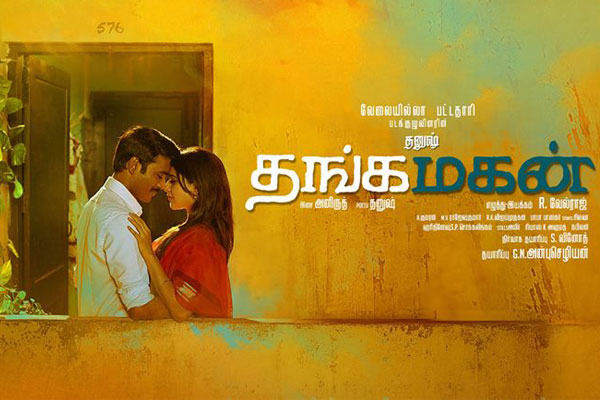
Thanga Magan (2015)

Thanga magan

I was rather apprehensive about watching Velraj’s new film, given that VIP was such a huge hit, and follow-up films from new directors can be rather hit and miss. However with Dhanush on board again surely things couldn’t go too badly wrong? Well, no, at least not completely. Thankfully Velraj doesn’t simply try for a VIP 2, but instead starts with a rather different atmosphere and a more mature and responsible hero, although he does venture back into more familiar territory as the story reaches resolution. He’s also enlisted a generally excellent cast who keep the film entertaining even if the story does falter somewhat in the second half. Still, for a follow up film it’s not a bad attempt and Dhanush is as good as always ensuring Thanga Magan is worth a watch.

The opening scene is possibly one of the best in the film, and works well to raise questions and draw the audience into the story. As the rain pelts down, Thamizh (Dhanush) shepherds his pregnant wife Yamuna (Samantha) and his mother (Raadhika Sarathkumar) into a small and rather grimy house, ably assisted by his friend Kumaran (Sathish). By everyone’s depressed and miserable faces, it’s clear that something terrible has happened and that this is a major step downwards for the family, reinforced by Thamizh immediately setting out to look for a job.  That’s the cue for an extended flash back sequence that explains why Thamizh is unemployed and his family have had to relocate and downsize into such an undesirable location.

The flash back starts with a young Thamizh roaming around Chennai with his two friends Kumaran and Aravindh (Adith Arun). The three students spend all their time together until the day Thamizh sees a girl at the temple and instantly falls in love. Hema D’Souza (Amy Jackson) is an apparently intelligent, modern Tamil woman who has some very definite ideas about what she wants from life. She’s a student too, studying architecture, and isn’t afraid to berate Thamizh when she thinks he is following her. But after such a strong beginning, Hema becomes more of a caricature, drinking beer and allowing a mildly physical intimacy that ensures she isn’t going to be the one leaving with the guy – Hema is much too liberated to get a happy ending in a Tamil film!

https://www.youtube.com/watch?v=2AQwp3WCSKs

Dhanush does his usual thing of managing to appear much younger than he really is, and as the relationship between Thamizh and Hema is fairly typical of young and infatuated lovers he doesn’t have to stretch for the role. In comparison Amy Jackson seems rather out of place and despite all the physical intimacy she has little chemistry with Dhanush leading to a relationship that never appears realistic on her side. Amy looks older than Dhanush too, which doesn’t help, but at least when they do finally split it’s reasonably plausible with his immaturity at odds with her ambition finally leading to the separation.

After the break-up Thamizh falls in line with his mothers’ wishes, getting a job working in the tax office with his father and agreeing to an arranged marriage with Yamuna. Yamuna is the ideal traditional wife; quiet, shy and happy staying at home all day to help her mother-in-law. She’s a complete contrast from Hema, but in her own way Yamuna is just as much of a caricature, following the description of classic filmi wife to the letter. Samantha is a much better actress than the character of Yamuna requires, but she still manages to shine despite her rather one-dimensional role. At least she has plenty of chemistry with Dhanush and even if the relationship is an old-fashioned and clichéd version of marriage they do seem to have a mutual respect and a partnership that was lacking between Thamizh and Hema.

The first half works well and Dhanush is on top form as dutiful son, young lover, then husband and father-to-be. He transitions from one to the other very naturally and it’s good to see him have a happier relationship with his family than he usually portrays in his films. Samantha is also excellent here and both K.S. Ravikumar and Raadhika Sarathkumar provide solid support as Thamizh’s parents. The love stories are both sweet in their different ways and there is some good and funny dialogue too which ensures that all the drama doesn’t get too overpowering.

The second half is where things start to go a bit pear-shaped when the story moves on to the problems with Thamizh’s father (K.S. Ravikumar) and his boss Prakash Kumar (Jayaprakash). There is a missing file, possibly some missing money and the flimsy storyline has very little substance but plenty of artifice. It’s a credit to the actors involved that the film still entertains even though large parts of the story don’t make much sense and there are too many large plot holes. The villain of the story is Aravindh who was neglected and left out of everything while Thamizh and Satish were off romancing Hema and her friend – apparently that’s enough of a reason to make you a total jerk and a criminal to boot.  However Aravindh is an ineffectual adversary and suffers from his absence in the first half of the film, leaving him without any real depth to his character. Adith does as well as he can with a very sketchy role, but it’s not enough to make Aravindh a plausible opponent. On a plus note though, Amy Jackson reappears and is much better in this part of the film, while Dhanush is excellent at depicting Thamizh’s growth as a dependable husband and supportive son as he investigates what really happened with his father. Even though the story needs a large suspension of disbelief, there is still some good dialogue and the relationship between Thamizh and Yamuna is well developed and beautifully pictured.

The main problem I have with Thanga Magan is the end. Unfortunately after spending two hours establishing Thamizh as a kind and thoughtful son and husband, the climax suddenly sees him turn into the swaggering, mass-dialogue spouting fighting machine last seen at the end of VIP. Perhaps Velraj couldn’t think of how else Thamizh could win the day, but the abrupt transition is at odds with the rest of the film and seems unnecessary. Thamizh could have achieved the same result without all the posturing and fighting, particularly since the fight scenes aren’t particularly well choreographed and the dialogue is clunky and more suited to a battlefield than a discussion in an office. Dhanush still manages to carry the mass-hero dialogue and posturing well of course, but the film deserves a more satisfying climax that meshes better with the rest of the film.

https://www.youtube.com/watch?v=y3UmNm1V9vk

Although Thanga Magan doesn’t deliver as well as VIP, particularly in regards to the storyline in the second half, the performances are very watchable and Dhanush is simply excellent. He has the ability to show his character’s growth and maturation throughout the film, while still telling the story and ably supporting the rest of the cast. He always appears very natural, whether he’s playing a young student or a more matured married man, and never seems to be obviously ‘acting’. Sathish too does a good job, fitting the role of Thamizh’s ‘side-kick’ while he shares a natural rapport with Dhanush which ensures the comedy between the two works well. Samantha is the other standout performer and even if her role of a submissive wife is rather clichéd, she still plays it with grace and dignity and a good sense of humour. Anirudh supplies the music and it works well for the songs although none are as instantly catchy as I’ve come to expect from his previous soundtracks. I was also a little disappointed by the lack of dancing in the picturisations, as most of the songs are montages to show the two romances. They are all appealingly shot and look good, but I do miss watching Dhanush dance! Worth watching at least once for Dhanush, Samantha and Sathish and an amusing and entertaining first half.