Doodh Ka Karz

I wanted to write something about the late Bob Christo as he was my first ‘That guy again!’ in Hindi films. He seemed to be in everything, often trying to kill Mithun which was considerate of him, and generally being menacing. I think I first noticed him as he was one of the small number of white guys that turned up over and over in a huge array of films. But later I started noticing the gleam in his eye as he flung himself around the set, pretending to be beaten half to death by the hero, and I enjoyed his apparent glee at being the baddest baddie. He played his villainous henchman roles with great enthusiasm and I always look out for his shiny bald head when the main villain appears.

Good friend and snake film aficionado jenni enthusiastically recommended this film. Several times. Her summary on BollyWhat was so persuasive. And now I ask myself – why did I wait so long? I can’t explain the story any better than jenni did, so with her kind permission I quote:

“OK.  The story goes something like this.  A snake charmer, who treats his snake as a son, witnesses the plunder of the local snake temple jewels.  He is then framed by the thieves (local thakurs one of whom is played by Amrish Puri of course) and is beaten to death.  The beating is witnessed by his wife (Aruna Irani), infant son and loyal snake.  It is left to the widow to build a pyre and perform the funerary rites as she contemplates her future as a destitute widow.  Loyal snake has accompanied them to the cremation and when the widow realises she is unable to care for him, along with herself and infant, she feeds him some breast milk, sings a song about him repaying the debt of her milk, then sends him away.  This part is really sad and the snake actually looks sad and lost and grief stricken as he leaves (and I cried).  Not a woman of forgiveness, the snake charmer’s wife then sets about avenging the death of her husband.   And she is still on task 25 years later.

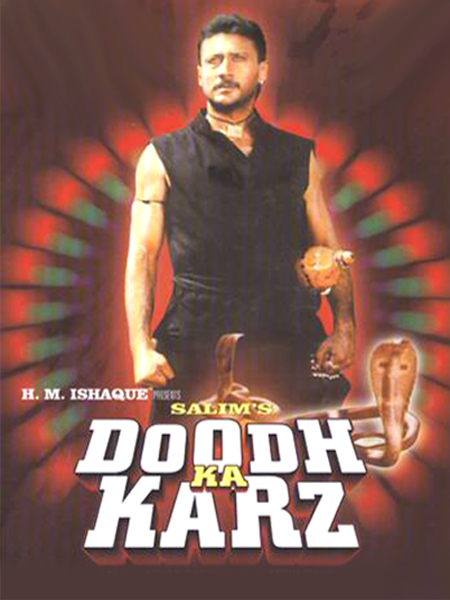
By then, the boy has grown up to be Jackie Shroff (Suraj) and he falls in love with (you guessed it), the evil Thakur’s daughter (Neelam).  Loyal snake has returned to both protect (his family) avenge (his enemy), and pay the debt of the milk, just like his (human) mother would have hoped.  There is parental opposition (both sides) and romantic complication (both sides).  Also a corrupt priest who is handy with snake lore himself.  And Bob Christo in a smooth talking, double dealing,  diamond smuggling minor role.  And let’s not forget, the THRILLING SNAKE FILLED CLIMAX”

The Snake represents all that is good and moral and he is the hero of this film, regardless of what Jackie Shroff might think. Sadly, he was never named which seems remiss considering his important role. The Snake is loyal and protective, has sound family values and judging by the number of friends and relatives who turn up for the final showdown, he must have been a nice snake.


There was genuine emotion in some of The Snake’s scenes and I have to say the editing was outstanding in making it seem that The Snake was reacting to the drama around him. I also have a mental picture of some poor sod standing just out of shot, dangling a mouse or other tasty treat to get The Snake’s attention. And who knew that snakes could emote?

There are always concerns about animals in films but I think the instructions to the snake wranglers went along the lines of ‘Chuck ‘em in and stand back’.  I am hoping that some fake snakery went on in a couple of scenes.  And the mongooses seemed quite chipper in their special appearance. Certainly more enthused than the mongoose wranglers were! I know I wouldn’t have lasted long as an extra on this film.

The human actors go about their supporting roles quite successfully, and I did find the story very engaging.  Aruna Irani nails the vengeful widow role and raises her human son to be as strong as iron, although takes her time in telling him why. The scene when snake and widow separated was quite moving, although I didn’t cry. Perhaps I was too startled seeing breast milk expressed on screen and in close-up. I did find myself singing along with the recurring title track though. Goga Kapoor and Raza Murad make an impression in their smallish roles.  Amrish Puri as the Thakur didn’t put up much of a fight before he was persuaded to turn to crime, and was a villain of the weak and greedy type rather than a creatively dressed megalomaniac. But the allure of the jewels was just too much for him as was the notion of taking the easy way out of his self created problems. And he is backed up by Prem Chopra so you just know how that’s going to work out.


My mind did wander a bit during the songs though as the only thing that seemed to happen was Jackie pawing at Neelam. And it’s a snake film so it’s mostly snake music and that can get a tad monotonous. Meanwhile The Snake was slithering the countryside in search of his father’s killer who he would recognise by a distinctive necklace. That’s something to think about before borrowing jewellery.


When Neelam is bitten by the vengeful loner, she faints gracefully and is spared the sight of Jackie sucking her toes to extract the venom. Dear reader, you will not be so lucky.


Bob Christo has a small yet pivotal role as a venal Englishman who represents all that is bad and stupid. He is a diamond smuggler called Angrezi Master so maybe the script writers had just given up on character names and it wasn’t an anti-snake thing. Bob wants the stolen temple jewels but is afraid of the snake that is reputed to protect the temple, and demands to be shown its corpse. Oh Bob. So many films and still messing with the gods…Finally, Bob has to decide what is more important to him.


The snake gave him a choice, and Bob chose wrong. I also learned that when white people are bitten by snakes, we turn green. This should be a very helpful diagnostic tool in future.


The snake filled climax is really filled with snakes. Bucketloads of snakes. The Snake may not have been wandering the woods alone for all those years. Here’s a little taste of the mayhem, with Bob doing some very fine acting:

I have to say, I really enjoyed Doodh ka Karz. I like a good snake revenge film, and this is very snake-centric and vengeful. Ashok Gaikwad kept the story and editing pacey and there is stuff happening all over the place so there is never a dull moment. There is pathos in the snake charmer family scenes, and Aruna Irana is excellent. The only thing missing was a proper snake dance. This is a great ripping yarn, and a fun way to remember Bob Christo. 3 and ½ stars!

Edited to add: Here is a link to Beth’s round-up of ‘Bob’s Your Uncle’ posts. Go have a look!

http://bethlovesbollywood.blogspot.com/2011/04/bobs-your-uncle-late-great-bob-christo.html

I Am

While Bollywood has just started to show kissing scenes and Hollywood is slowly integrating gay storylines into films, director Onir has moved much further ahead with his latest film. I Am is a confronting and thought-provoking collection of 4 stories which deal with subjects commonly not spoken about in public and rarely seen in mainstream film. In addition to its subject matter, the film is novel in that funding was partly achieved through social networking and has over 400 producers. Onir and Sanjay Suri initiated a page on Facebook where people were invited to sign up to help finance the film or volunteer their time. Manish Malhotra for example designed the costumes for free and many of the actors did not receive any remuneration. Also, somewhat unusually, there are three directors who appear as actors in the film; Anurag Kashyap, Anurag Basu and Nandita Das. I Am has won acclaim in a number of film festivals, a number of awards already, and luckily for us premiered in Australia as the closing film for the Indian Film Festival. As an added bonus, Onir and Juhi Chawla were present at the screening I attended in Melbourne to introduce the film and to take part in a Q and A session afterwards. My favourite actress, a director whose previous work I’ve enjoyed and his brand new film all adds up to a perfect way to spend an evening.

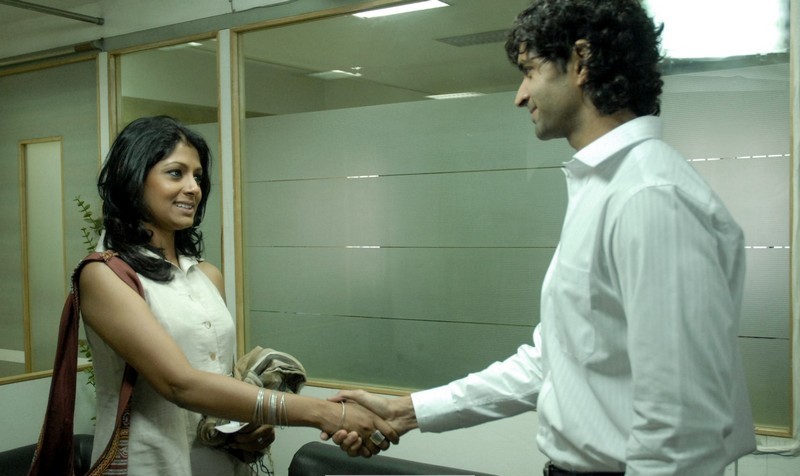
The four stories are loosely linked together by friendships, connections and chance meetings between the characters, and this works well as a connecting thread without feeling too contrived. The first story is Afia’s (Nandita Das)and deals with her determination to have a child by herself after her divorce.  Her friend Megha (Juhi Chawla) speaks as the’ voice of society’ condemning Afia for what she perceives as selfishness and the story raises a number of questions around the issues of single parenthood and artificial insemination versus adoption. The debates between Afia and Megha are honest and natural and the conversations Afia has with a number of her male acquaintances as she looks for a sperm donor ring embarrassingly true. Onir described Afia’s story as the most ‘Bollywood’ and it does follow a more traditional story telling path compared to the rest of the film.  I don’t relate to this story personally as Afia’s decisions would not be mine, although I mainly agree with her right to choose.

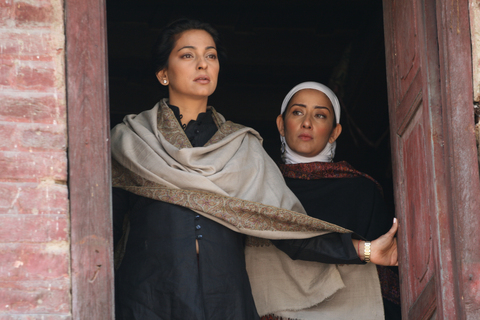
The second story is Megha’s own and describes a trip she makes back to Srinigar for business, having left the area some twenty years before with her family as part of the Kashmiri Pandit evacuation. She stays with her childhood friend Rubina (Manisha Koirala) and the contrast between the two women; one who was forced to leave and one who had to stay, forms the focus of this section. The suffering on both sides is evident and Rubina envies Megha’s freedom of living in Delhi away from the continual threat of fighting. Megha in turn resents having had to flee the violent attacks on her family.  Srinigar looks very similar to my home town of Belfast in the seventies, with bombed out buildings, soldiers everywhere and the ubiquitous presence of barbed wire.  But behind the rubble there is still beauty in the landscape and Onir manages to capture this equally as well as the devastation. This was a very touching story and I was surprised to read in the statistics at the end of the film just how many people were displaced as this is something I know very little about.

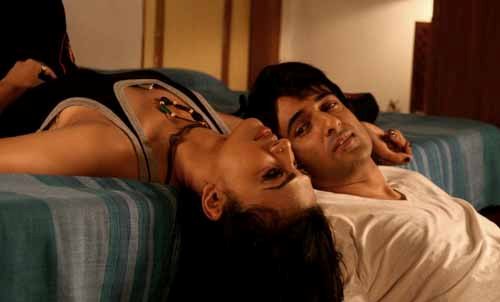
The third story is that of film maker Abhimanyu (Sanjay Suri) and deals with the taboo subject of child abuse. We see that Abhi was abused by his step father as a child and this is his story about finally being able to speak up about his childhood. Abhi has recurrent dreams of his mother and many of the scenes also have a dream like quality as if Abhi can only bear to relive them a step removed. There is a well-defined contrast between Abhi’s party life style and large group of casual friends and the scenes where he confronts his past with his close friend Apama.  Throughout the story Abhi is conflicted about his sexuality and his childhood experiences have had an obvious effect on his ability to form relationships. This is a very difficult subject to film but Onir and Sanjay manage to deal with it sensitively and the story is well told.

 The final story is the most shocking for me in many ways, not because it features men kissing, but because of the events that follow. This is Omar’s story and explains how Section 377 of the Indian Penal Code is used to extort money – and more – from homosexual men. Omar is a hustler picked up in a bar by Jai before they are spotted by a corrupt cop. The confrontation is graphic and detailed, and it’s very disturbing to know that it is based on true accounts.  Onir expressed his amazement during the Q and A session that the film got through the censors without getting any visual cuts (mainly referring to this story) and I am amazed along with him. Some of the dialogue was muted, however the subtitles were abundantly clear as to the viciousness of the scene depicted despite the many ****’s. Rahul Bose as Jai was incredible in this and was able to effectively portray subtle changes in Jai’s mannerisms as a consequence of his experience. I am very impressed with his performance as he really made me believe this story, much as I didn’t want to.

The film starts with an easy to digest story and ends with a truly sickening one. The progression is deliberate and the style of shooting changes along with the dialogue delivery. Afia’s story is shot with open angles and plenty of space, but by the time we reach Omar’s story the style is much more closed in and claustrophobic. The dialogue becomes more graphic in each story as does the action on-screen. I find it hard to describe my feelings about this film – I can’t say that I enjoyed it, because I felt too uncomfortable while watching.  And it’s not a film to be enjoyed as such anyway. It is brilliantly filmed – the actors are outstanding and the stories themselves are very well written and I can appreciate it as a work of art. It would be more accurate to say that I enjoyed the experience and think that the film is excellent, just not one for everyone’s tastes. Thought-provoking and challenging, I Am gets 4½ stars.

Do Dooni Chaar (2010)

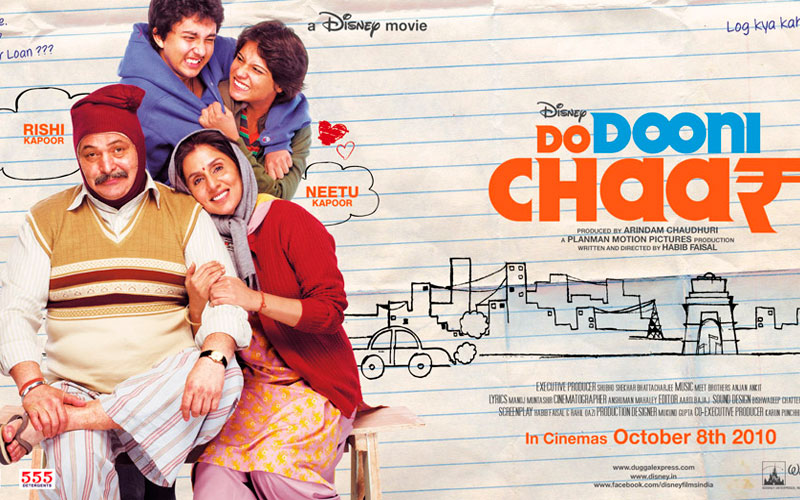
I was pleased to see this as part of the Indian Film Festival as Do Dooni Chaar didn’t get a cinema release here, despite starring legendary couple Rishi and Neetu Kapoor. It only attracted a very small audience at this showing—maybe 20 people —which really surprised me. Half of that number ran for the door when the subtitles failed to materialise, in search of someone in charge. But all was OK. The film was restarted (the Indian audience members complained loudly and jokingly about having to watch the titles again), the subs kicked in and we all settled down. Well, I hadn’t moved. I was going to watch it regardless so it was more fun to listen to all the huffing and grumbling!

The film was picked up for distribution by Disney and that tells you almost everything you need to know. It’s a nice film with message about decency and family, all wrapped up in a sweet sentimental shell. There’s nothing to object to, but I didn’t feel there was much to get excited about either. It was just… nice. And sometimes a nice film is just what you want.

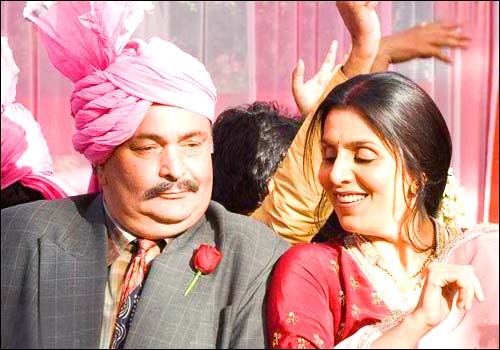
Rishi Kapoor plays Santosh Duggal, a maths teacher and father of two. His wife Kusum (Neetu Kapoor) runs the household on his very limited income and maintains the cramped apartment to the best of her ability.


The kids, Payal (Aditi Vasudev) and Deepu (Archit Krishna), are typical teenagers and want all the latest things and best brands. They don’t have a lot of respect for their father, and see his poverty and lowly job rather than his values and intelligence.

The film opens to an argument about how Santosh’s INR7700 tax refund would be spent. The Duggals are a noisy, argumentative family, and the scene is punctuated by doors slamming and lots of shouting as people careen around the tiny flat. Kusum wants a fridge while the kids want everything from an iPod to dish TV. Payal, depressed by her lack of cash and stylish clothes, is a moody teen who bosses her weedy boyfriend around.  Deepu, or as he prefers to be called, Sandy is cruising by on charm. Until he comes unstuck, Sandy is a slick character with an eye for the girls and an unusual fried chicken based romantic style.


The central issue of the film is the pressure on Santosh to buy a car to replace his antique scooter. The car represents so many things to the Duggal family; success, status, independence, pride. But they can’t afford it. They have to budget carefully to have chicken for dinner so a car is a huge deal. The stress of this situation almost drives Santosh to make some extremely dubious decisions and accept money for giving a bad student a passing grade. He seems to embody the nice guy who finishes last, held back by his honesty and simplicity. He refuses to allow Payal to take a call centre job, ostensibly because it will delay her education, but as Kusum points out he also forced her to leave work on their marriage. She is at her wit’s end trying to keep up with the needs of her family when outgoings always exceed their income. The clash of old school and new world thinking is played really well and the arguments have the authentic ring of conversations that have been had over and over.

Rishi is so effective in the quieter, more soulful, moments when he drops some of his actorly mannerisms and he really looks and sounds like a tired dad.  He has a lovely conversation with Deepu/Sandy where they talk about why Santosh didn’t fly into a rage over a discovery and ends with him quietly asking the boy to make the right choices. Santosh’s relationship with Payal is more challenging and those scenes are more vocal and aggressive. But Payal discovers a new admiration when she sees how much he meant to his old students, and how highly they thought of him for his work ethic and standards. I have to say, Rishi didn’t look at all at home in the tiny apartment and I wonder if he went to boot camp to learn to handle an iron. Neetu plays Kusum as the driving force inside the family home, channelling her energy into alternately cajoling and threatening her husband and kids.  She is charming and energetic, refusing to let the exhaustion of her routine slow her down. Santosh and Kusum have a very delicately played scene where they try not to discuss the potential bribe, and Kusum is all for taking it although she doesn’t want to do anything seriously wrong. In a scene at a family wedding, Neetu drags Rishi out to dance and they prove the old sparkle is still there, even if his moves are suspect. There would be something a bit amiss if they didn’t have great chemistry!

I wish I hadn’t read some interviews with the Kapoors about the making of the film. They both went on a bit too much about how their costumes were just average off the rack shop bought clothes and how they didn’t mind wearing something so common to make the film work (I’m paraphrasing). So every time Rishi pulled on another of his knitted vests, I felt an eyeroll coming on. But Rishi IS synonymous with knitwear so it was also quite pleasing.

The supporting cast were all good. I especially liked Aditi Vasudev’s performance. She was bratty and whiny but also had Kusum’s strength of will. She wasn’t at all glamorous, and looked like a typical student. Akhilendra Mishra was also fun as the neighbour Farooqui. He and Rishi had some lovely scenes as the men tried to avoid their warring wives.

I really enjoyed the family scenes, and thought the dialogue was excellent in those episodes. I was less taken in by the scenes with the neighbours, and the final ‘I just make sweets but a good teacher makes great human beings’ speech was just too much for my taste. The message had been coming through loud and clear so being hit over the head with it for the final fifteen minutes or so was overkill.

I also loved the neighbourhood locations and the glimpses of shops, houses, schools and other settings. I always like a film that gives me a strong sense of place and Habib Faisal did an excellent job in making the locations seem so real. The soundtrack is punchy and matched the inner city feel perfectly.

It was a pleasant enough way to spend a couple of hours, and always nice to see old favourites show they still have form. It’s an almost old-fashioned film, and it promotes values of decency and honesty. It is very sentimental, but not too syrupy. I give Do Dooni Chaar 3 stars.