Love and Shukla

So many films end with the wedding and a vague hand wave in the direction of “ever after”. Siddhartha Jatla starts with the wedding and then challenges really begin, with the household and marriage.
Note: I was given the opportunity to see Love and Shukla by the director. Nobody associated with the film has made any requests for editorial approval or even to know what I might write, or if I chose to. You have to love this very connected world where people can find an audience on so many different platforms.
Shukla (Saharsh Kumar Shukla) lives in a cramped one room home with his drama queen soapie addict Ma (Aparna Upadhyay) and near silent father (Loknath Tiwari). His parents arranged his marriage and his friends do that drunken bloke thing of scaring him with stories of disaster if he can’t sexually satisfy his wife. Laxmi (Taneea Rajawat) moves in to the house, and to Shukla’s dismay he never gets a moment alone with her. His Ma immediately starts with every mother-in-law cliche and bosses Laxmi around. Laxmi is obedient and almost silent. And when sister Rupa (Hima Singh) leaves her husband and moves back in, there is even less space, physically and otherwise. Will they ever get together on any level? How can anyone conduct their private life in full public view? If you marry a stranger, how do you find the space to get to know them and build a life together?
Saharsh Kumar Shukla delivers a nicely calibrated performance. He’s a reserved guy, unless drunk, and has observed many passengers in his auto and their various relationship issues. Shukla is keen and anxious about sex but he’s also interested in who Laxmi is and what she’s really like. He’s aware despite his bravado in front of his mates that watching porn is not actually good research. He wants intimacy, so much more complex than just scoring a quickie behind the wall of suitcases his dad placed for their privacy. He’s delightfully awkward as he goes shopping to buy her presents, giving serious consideration to different shades of nail polish. Taking Laxmi to a hotel for some privacy turns to disaster as the local cops raid his room, thinking that she must be a prostitute because no man would ever pay money to spend time with his wife. There’s a sense that he wants to be understood and be loved, so he gets that she probably feels the same.
Taneea Rajawat looks lovely but I spent quite a lot of the film wondering if there would ever be a resolution for her character or would she just go from being a mute slave of Ma to a mute slave of Manu. But despite not having a single line of dialogue for almost 30 minutes into the film she conveys an awareness of Shukla and a reciprocal interest in getting to know him. She’s passive but not averse to his fumbling attempts, and she lights up when he shows her particular consideration. I admit to being a little disappointed when Laxmi started speaking because she is quite dull. And finding out her favourite actor was another question mark! But her relief and delight in finally being allowed to voice her opinions was quite sweet, as was Shukla’s happiness at having a simple conversation.
Aparna Upadhyay and Hima Singh are a little over the top and rely on being loud and louder, but their characters were emotionally tone-deaf so if they were out of synch with the rest of the ensemble it wasn’t necessarily a problem. Ma and Rupa are so self absorbed they don’t seem to have any awareness of how hypocritical they are. Both bemoan Rupa’s treatment by her mother-in-law and in the next breath, order Laxmi around as a servant. Shukla eventually calls his mother out on her behaviour and while it is satisfying that he does so, the scene goes on for far too long. But I enjoyed seeing family dynamics changed by Laxmi’s presence although Laxmi herself never challenged anything. Loknath Tiwari may as well have been a painting, both his character and his performance merged into the background. The gaggle of friends played by Amol Deshmukh, Shanawaz Alam and Ganesh Kumar are types rather than fully fleshed out characters, but they help Shukla by giving him an outlet to articulate his irritation.
I like films with a strong sense of place, a feeling of a fully realised world. Jatla creates a neighbourhood, full of the detail of how people live cheek by jowl and how they afford each other the small courtesies that stand in for privacy. The domestic scenes show much without resorting to telling. There are some darker moments and the dog eat dog life in a big city is only a wrong step away.
While this is largely Shukla’s story, the female characters are given their dues and are not overly sentimental or idealised. It’s an engaging and thoughtful look at relationships and the concept of a private life with no privacy. Hopefully this will get a wider release following the festival circuit. Do keep an eye out.
Padmaavat

Padmaavat

Note – this review contains spoilers

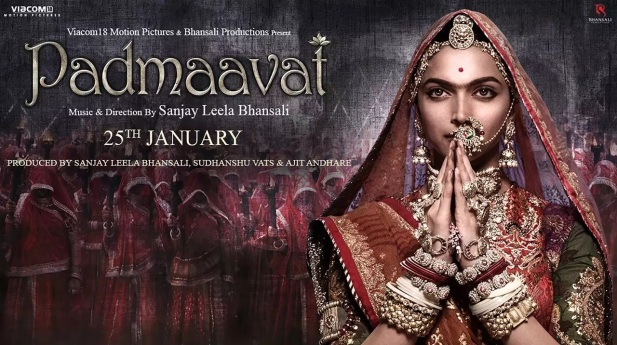
After all the hype, the protests and controversy, Padmaavat finally released in the cinema last week. And now that’s it’s actually here, it’s hard to see what all the fuss is about. With sumptuous costumes, lashings of sparkly jewellery, fantastical sets and very one-dimensional characters, the only possible way to describe Padmaavat is as a very expensive fairy tale. The main characters are all either very, very good, or very, very bad and there is no grey, no hint of any depth or any room to move outside the very strict boundaries of each persona. The film is based on a poem by Malik Muhammad Jayasi, so it’s obvious that Sanjay Leela Bhansali hasn’t set out to make a factual historical drama, and there are plenty of disclaimers at the start to drive home that point. And while there are some problems with the story, most particularly around the problematical ending of the film, it is exquisitely made, stunning to look at and a beautiful work of art. But it’s a work of art that has no soul and even with all the pomp and circumstance, ultimately Padmaavat ends up being surprisingly dull.

The story follows the exploits of two kings, Ratan Singh (Shahid Kapoor), the Rajput king of Mewar, and Alauddin Khilji (Ranveer Singh), ruler of Delhi. Ratan Singh is very, very good. He often wears white clothes, talks a lot about honour and Rajput bravery and is committed to following his rather strict principles. Alauddin Khilji is very, very bad. He murders his uncle to take the throne, sleeps with prostitutes on his wedding day and is generally portrayed as a rapacious monster, instantly ready for any kind of depravity. Ratan Singh is always very clean, Alauddin Khilji wears black and has dirt or blood smeared all over his face. There is no middle ground; these two are the quintessential opposites – the white king and the black king, pure good and pure evil – what else can Padmaavat be other than a fairy tale?

Ratan Singh meets Padmavati (Deepika Padukone) when he takes a trip to Sinhala to buy pearls for his first wife Nagmati (Anupriya Goenka). Padmavati is beautiful and clever, the white queen to Ratan Singh’s white king and although they meet when Padmavati mistakes Ratan Singh for a deer she is hunting and shoots him, they are instantly attracted to each other. The romance is stylised and extravagant. When Ratan Singh is recovering and getting ready to leave, Padmavati takes her dagger and slices open the wound, declaring that now he has to stay longer. But even with all this posturing, there is little chemistry between the two – smouldering looks aside there is very little substance to their relationship even after they are married and back in Mewar. Possibly it’s all the formality and ceremony that comes between them, the application of colours at Holi for example feels cold and ritualised rather than the usual spontaneous flurry of powder, but Ratan Singh’s Rajput pride seems a major barrier to any genuine relationship.

This is partly why Ranveer Singh’s Khilji makes more of an impression. Being totally evil, Khilji gets to do whatever he wants, whenever he wants with whoever he wants, and as a result is exuberantly happy, even when he is pining for Padmavati. A woman whom he has never seen, but still desires because he has to have everything that is unique in the world. Some of his excesses are so ridiculous that they are simply hilarious, such as spraying perfume on a female servant and then rubbing himself against her to transfer the scent.

Ranveer throws himself into the role with such passion and energy that of course by comparison Shahid’s Ratan Singh appears rigid and cold. He is, but the contrast between the two men makes the white seem insipid, while the black resonates with evil intensity.

While both men turn in excellent performances, Ranveer stands out for the sheer lunacy of his portrayal. Khilji is a monster, and Ranveer conveys his evil nature and total obsession while still managing to make the audience laugh. He brings everyone with him on his madcap ride into depravity and ensures that he is the central focus of any scene, no matter what else is actually happening around him.

Deepika Padukone has more to do since Padmavati has a fraction more depth than her husband. Think ivory rather than pure white. She’s also got more common sense than everyone else in the film put together, illustrated by her detailed plans and well thought out rescue of Ratan Singh after he is captured by Khilji. Of course, most of that could have been orchestrated by her two faithful generals, but Padmavati gets the chance to prove that she can fight and develop a plan of attack. Better than her husband to be honest, who bizarrely keeps believing Khilji will act with honour despite never seeing any indication that this will be the case. All of which makes it seem odd that Padmavati would commit all the women to jauhar rather than grab her trusty bow and arrow and die fighting. Regardless, Deepika Padukone looks stunning, even managing to rock a unibrow, and looks perfectly graceful and regal whether she is dancing for Ratan Singh, running through the forest or explaining her strategy to the generals.

A few of the peripheral characters also fare rather better. Jim Sarbh is excellent as Malik Kafur, Khilji’s assistant, general and sometime lover. Aditi Rao Hydari is also very good as Khilji’s first wife Mehrunisa and Raza Murad is excellent as Khilji’s uncle Jalaluddin.

However, Ranveer’s histrionics, the wonderful fabrics and stunning sets aren’t enough to disguise what is a rather lacklustre story. Every scene seems to be drawn out unbearably long to add yet more speeches about Rajput honour and bravery, or showcase beautifully designed costumes and breath-taking scenery that simply distract from the plot.  It’s also predictable and that makes it somewhat dull, no matter how stunningly beautiful the film looks, or how ridiculous Khilji’s excesses become.

However, much of that is as expected for a Sanjay Leela Bhansali film – his attention to detail is amazing and every single scene is constructed as if it is a still-life painting with wonderful balance of light and shade, colour and depth. We expect extravagance, and that is what he delivers. What is more problematic though is the final scene where all the women commit jauhar rather than submit to Khilji’s victorious army. Despite the disclaimers at the start of the film, Bhansali seems to glorify the women’s march to the flames and adds many unnecessary details. It also goes on for a very long time so that the inappropriateness of the camera angles and discordant notes of the triumphant theme are emphasised. While the final act of jauhar may be true to the poem, and a historical reality of the time even if Padmavati herself is perhaps not, it doesn’t seem right that such actions should be seen as a ‘victory’ for the women and not a tragic loss of life. This is disturbing on many levels and while I don’t disagree with Bhansali’s addition of the final chapter to the story, I do feel that such celebration and exaltation is completely the wrong way to approach the subject. It’s a disturbing and jarring end to the film and simply doesn’t fit into the fairy-tale of the preceding two and a half hours.

Padmaavat is a stunningly beautiful film with much to enjoy in the sets and costumes. I could spend hours pausing this film on DVD and marvelling at the fabrics, the details in the palace floor tiles and even the plates and cutlery. Ranveer too is amazing despite his Khilji being such a one-dimensional construct and Padmavati is generally a strong female character. But the finale seems a direct contradiction to the disclaimer at the start while the story, for all its fantasy elements, never really comes alive. All of which makes Padmaavat a visual treat for anyone who enjoys the artistry of Bhansali films, but unfortunately not essential viewing for anyone else.

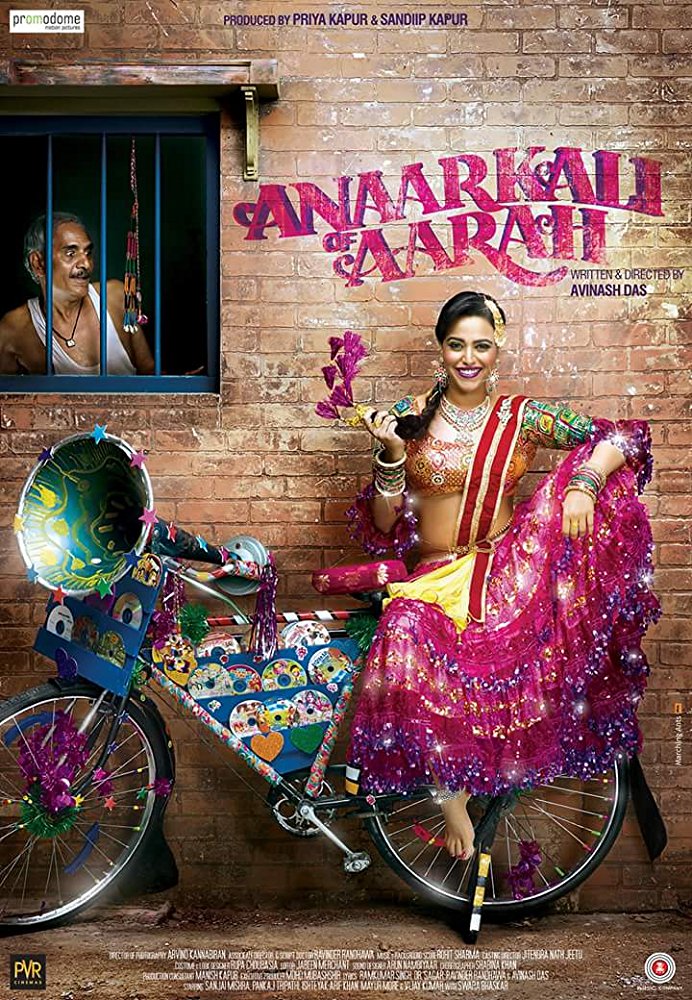
Anaarkali of Aarah

Avinash Das’ Anaarkali of Aarah is a powerful and highly entertaining film with a strong thread of feminism in action, not just in speeches. And Anaarkali is a kickarse woman who compelled my full attention.

Anaarkali (Swara Bhaskar) is a folk performer, singing and dancing her way through innuendo laden songs for appreciative male audiences. She is loud and proud in both appearance and action, and genuinely loves what she does. She lives in a small world in a small town, and is happy and confident strolling the streets and turning men’s heads as she sashays by. But one of her troupe’s patrons, Dharmender Chauhan the VC of the local university (Sanjay Mishra), is obsessed with Anar. At a high profile police event he gets dangerously drunk and invades the stage. Anaarkali and her ‘friend’ and business associate Rangeela (Pankaj Tripathi) try to put Dharmender off but he persists in trying to rape her on stage. She is frightened and angry, and slaps him hard, adding a mouthful of curses for good measure. Can a woman really get away with defending her honour when the men around her don’t see that she has any? Can a woman assert autonomy over her body when men don’t think she has the right to say no?

Mild spoiler – in this film world, she might. But even if you know the ending this journey is really worth taking.

Anar is a wonderful character and Swara Bhaskar is brilliant in the role. Anaarkali is not a fallen woman, she doesn’t need or want redemption. She’s a star in her particular field, and she thrives on the glitz and attention. When Anaarkali struts down the lanes near her home she tosses her hair and sways for her public. When she’s at home she’s foul mouthed and a bit goofy.

Anaarkali is an astute judge of character and mood, usually knowing when to be abrasive and when to simply listen and let the situation deflate. And then she realises that there is such a thin line between acclaim and notoriety and the line is drawn by men in power. Bhaskar delivered a layered performance, showing Anar’s stagecraft, her public persona, and her domestic side and the fluidity with which she switches between them. When Anaarkali lost her home and her troupe I felt her profound and debilitating grief. But Anaarkali is a strong and pragmatic woman. There is no attempt to paint her as a virgin prostitute who only dances. She is frank about her industry but retains the right to choose who, when, and where she has sex with a client. There are men in her life but far from waiting for a white knight, Anaarkali was pretty set on rescuing herself. I might want to be friends with Swara but I’d probably be slightly scared of Anar’s acerbic wit.

It was telling that when the police went into damage control, it was to protect the VC not uphold the legal rights of an assault victim. And also telling that the men near rioting when the show was cut short were not protesting in support of Anaarkali, they were furious because they were denied a spectacle. She is accused of bringing about her own downfall due to arrogance. Nobody seems interested in telling the VC not to be so rapey or allowing her to file charges against him. Sadly I didn’t find much of this to be a stretch of the imagination. Sanjay Mishra is vile as Dharmender, but in a very restrained and slimily real way. The VC’s entitlement is sometimes breathtaking. He only sees Anaarkali as a mirror of his own desires, and nothing is more important to him than his own gratification. He is so convinced she must submit to him, ostensibly because he is crazed with love but really because he is so rich and influential she has no right to refuse. Mishra’s scenes with Anaarkali seethe with anger (mutual), fear (hers), and thwarted desire (his).

Rangeela is an interesting character. He defends Anaarkali but will sell her out in a heartbeat. I tried to believe that was to protect the rest of his motley troupe but even so. When she needed him, he was a weasel. Pankaj Tripathi is solid in the role although I felt maybe some of his character’s story might have been cut and that I wanted to know more about his relationship with Anar. Mayur More is sweet and funny as Anwar. He adores Anaarkali and music. Their dynamic is more cute and flirty, with Anaarkali taking a while to see him as a young man rather than a kid. He tries to step up to look after her but he respects her wishes when she wants to resume singing. Hiraman is a devoted fan of Anar’s and he helps her get her mojo back through a recording gig. I really loved Ishteyak Khan’s performance. He was subtle but radiated love and pride when he was near Anar. His silent and dogged anti-bromance with Anwar was also fun to watch. It’s a really good ensemble cast with everyone fully inhabiting their roles.

Avinash Das has written a strong screenplay and delivered it with an assured visual interpretation. The lighting and composition underscores the drama but isn’t so stylised that it distracts from the performers. This is a small and vivid world and beautifully realised. The story rockets along but there is room for some directorial flair with a nice loop from an early flashback to the finale. Whoever cast the playback singers did an awesome job as the tones and style matched so well I never once thought it was anyone but Swara Bhaskar singing. The songs are full of double entendres that are sexual and also relate to the social position of a woman in Anaarkali’s job. When she sings her final song it is an awesome middle finger to the patriarchy.

I’d had this film on my list to write about for a while but then conversations with a Twitter friend and reading Anu’s review seemed to be a sign to get a wriggle on.

See this for a genuinely female centric film that has a fairly sound feminist position, and a rousing good yarn into the bargain. Swara Bhaskar is fearless and imbues Anar with an unapologetic sensuality and strength of purpose. 5 stars!