Singapore (1960)

Singapore

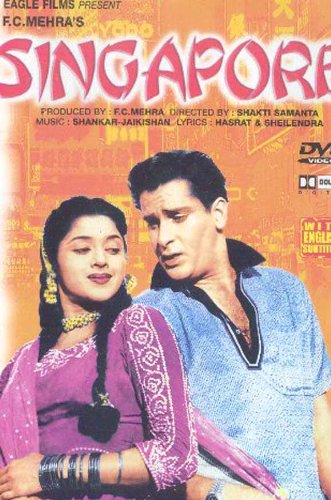
Singapore may not be one of Shakti Samanta’s best films, given the gaping plot holes and rather slow start, but his first film with Shammi Kapoor still entertains with plenty of good songs and a competent support cast. Like many of Samanta’s early films, Singapore is a mystery thriller with the usual assortment of criminals willing to kidnap and murder to get away with their loot. Where it falls down is in trying to spin together too many threads with the underlying story rather lost beneath the extra flourishes. The additions also defuse much of the tension, which isn’t helped by a distinct lack of chemistry between Shammi and his co-star, with the result that the film initially feels rather flat. However Shammi’s uncharacteristic restraint doesn’t last for too long and there is plenty of his trademark craziness to liven up the final scenes.  Add in a dash of Helen, Shashikala and Padmini, the gorgeous Maria Menada and the exotic locale, and Singapore is worth at least a one-time watch.

The film opens with Ramesh (Gautam Mukherjee) and his girlfriend Shoba (Shashikala) meeting in a club in Singapore. As Shoba happily learns that Ramesh plans to stay in Singapore, their conversation is being closely followed by local gangsters Chang (Madan Puri) and Kapoor (Rajan Kapoor) at a nearby table. Also listening in, by way of a hidden microphone in the lamp is Shoba’s uncle Shivadas (K.N. Singh), but despite all this effort the only information Ramesh gives out is that he has found a treasure map and as a result won’t go ahead with the sale of his boss’s rubber plantation. That boss is Shyam (Shammi Kapoor) and later that night Ramesh finally manages to contact him by phone. However his conversation is interrupted by two shady characters that kidnap Ramesh, although they don’t manage to get their hands on the treasure map. Left to wonder what has happened to his friend, Shyam boards the next plane to Singapore, and the hunt is on!

Samanta does seem to delight in giving his characters rather ridiculous names, and Shyam is met at the airport by his company secretary Cha Choo (Agha) and in the office by the typist Chin Chin Choo (Lilian), which at least does invoke memories of Howrah Bridge. Shyam also meets Lata (Padmini) and initially confuses her with Shoba since he has been told that Ramesh’s girlfriend dances at the New India Club and naturally assumes that the dancer she sees is Shoba.  I’m not sure what the point of the confusion is, other than as an introduction to the family and as a way to ensure Padmini gets to dance. However it’s worth the convoluted storyline as Padmini does look absolutely gorgeous here and really shines when she is dancing.

https://www.youtube.com/watch?v=tb49Ifbjf8A

While in Singapore, Shyam is also pursued by the beautiful Maria (Maria Menada) who met him on the flight from India. Maria seems overly interested in Shyam’s affairs, and since it’s revealed almost from the start that she is involved in the plot to steal the treasure I expected a little more from their relationship. However mostly this is just another complicating plot thread that has a lot of potential that is never fully realised, although Maria Menada is excellent as a villainess.

There has to be a love story of course, and Shyam and Lata fall for each other on their first meeting. There isn’t great chemistry between Padmini and Shammi, but they do have a couple of good songs together where there seems more empathy and at least they seem to be enjoying themselves. I love this one where they dance through a number of shops before Padmini pushes the dancers into the pool at the end, seeming totally delighted as each one drops into the water while Shammi prances along behind her. Oh My indeed!

https://www.youtube.com/watch?v=-tEIUmy7iWk

Meanwhile, Shyam is still trying to find Ramesh and uses the tape recording of their last phone conversation to track down a musical cigarette case which may have the answer. This part of the plot is perfect – naturally Ramesh records all his phone calls, and why wouldn’t a cigarette case in the shape of a Vat 69 bottle also be musical – but once Shyam finds the map things start to get unnecessarily complicated. This slows down the action and the film starts to drag while various embellishments are added to the plot.

Shyam uses the map as bait to try to lure out the kidnappers, and in the ensuing chase has to hide out from some of the gang in a village. Obviously he has to escape their notice and what better way to remain inconspicuous than to dance and sing with Helen? Naturally this is the best way to escape detection!

https://www.youtube.com/watch?v=XBE0DAJj448

Shoba is kidnapped too and there is a convoluted thread involving Shivadas who may or may not be dead, although it doesn’t really seem to matter in the end.  Eventually Shyam infiltrates the gang as an assassin from Kabul, which gives Shammi licence to unleash the crazy and the pace of the film finally picks up. I wish the energy in the last scenes could have been present for the whole film, but at least  the film ends on a suitably chaotic note with the inconsistencies in the plot swiftly swept aside to concentrate on the final action sequences.

The main reason to watch Singapore is of course Shammi, who looks fantastic throughout whether he’s romancing Lata, cavorting around the dance floor in disguise or fighting off numerous villains as required. His Shyam is suave and sophisticated, romancing the ladies while out and about in Singapore and easily charming Lata on one hand while elegantly turning down Maria on the other. At least until his disguise kicks in, when he becomes totally OTT Shammi and revels in his persona as a gun for hire. My favourite kind of Shammi!

The support cast are all solid, despite the erratic storyline and gaping plot holes, and Agha is impressively competent as Shyam’s sidekick.  I can’t remember noticing him much in other films of the era, but here he provides some gentle comedy without disrupting the flow or resorting to slapstick. Padmini looks gorgeous and at least has a couple of good dance numbers even though disappointingly her character has very little to do in the second half. Although Singapore isn’t a film I will watch over and over again like Chinatown, I do like the songs from Shankar-Jaikishan, particularly those included here along with Tum Lakh Chhoopana Chahoge, Tu Kahan Kho Gaya and Dhoka Khayegi Na Yaron Ki Nazar for some classic Shammi dance-floor magic. As I said at the start, not one of Samanta or Shammi’s best films, but there is still enough to enjoy to make Singapore worth a watch. 3 stars.

Funky Bollywood

Funky Bollywood_Cover art

Funky Bollywood – The wild world of 1970s Indian action cinema (A selective guide)

I was chuffed when Todd Stadtman kindly sent me a review copy of his book. Not just because the book is fabulous (What a relief! I don’t have to be polite – it is really well done!), but also because Todd is the reason I first watched Pistolwali. A debt of gratitude of such magnitude is nigh impossible to repay.


Stadtman intends Funky Bollywood to be ‘the “gateway drug” into the world of Indian action cinema’, which is one of my favourite worlds. If you don’t know where to start, Todd’s guide could help you decide how to first dip a toe into the waters. If you’ve been there done that, enjoy the quips and asides as you spend time with some familiar faces.

Saturated with colour and illustrations, dotted with random facts and wry observations, the book has one thing that a masala film can often lack. Logic and structure. Opening chapters give a brief overview of the who’s who of the era, and has an excellent additional feature I would like all DVD manufacturers to adopt post haste; symbols representing recurring themes found in each film.

Funky Bollywood_The Key

Imagine how simple it would make selecting a film if you could pick the one with Helen, a lair and some separated siblings? I know that around 60% of the time you could select ANY 70s Indian action film and get that combination but sometimes I don’t want to take a punt. Amusing and insightful reviews of select film make up the remaining chapters.

Todd’s glee at the best (and not at all the best) films of the era leaps off the page. It’s a little like watching a film with a friend who knows what’s going to happen next and can’t wait to see your reaction. I particularly enjoyed the section on spy films and westerns as they also included a few of my Telugu favourites. There is a persistent spelling error (Telegu for Telugu) that belies the detailed and well researched content, which made me a little sad. But this is clearly a labour of love and a lot of attention has gone into every page.

Funky Bollywood_insightful

Like a really good masala film, Funky Bollywood is wildly entertaining and you might even learn something along the way (probably nothing to do with medicine or science, but other stuff). My cunning plan is to leave it lying around at home and wait for the unwary visitor to pick it up. I’ll have Parvarish in the DVD player before they know what hit them!

If you’d like your own copy, it’s available on Amazon or via the publishers Fab Press. And do pop over to the official Facebook page and say hi to Todd!

Kill Dil (2014)

Kill Dil

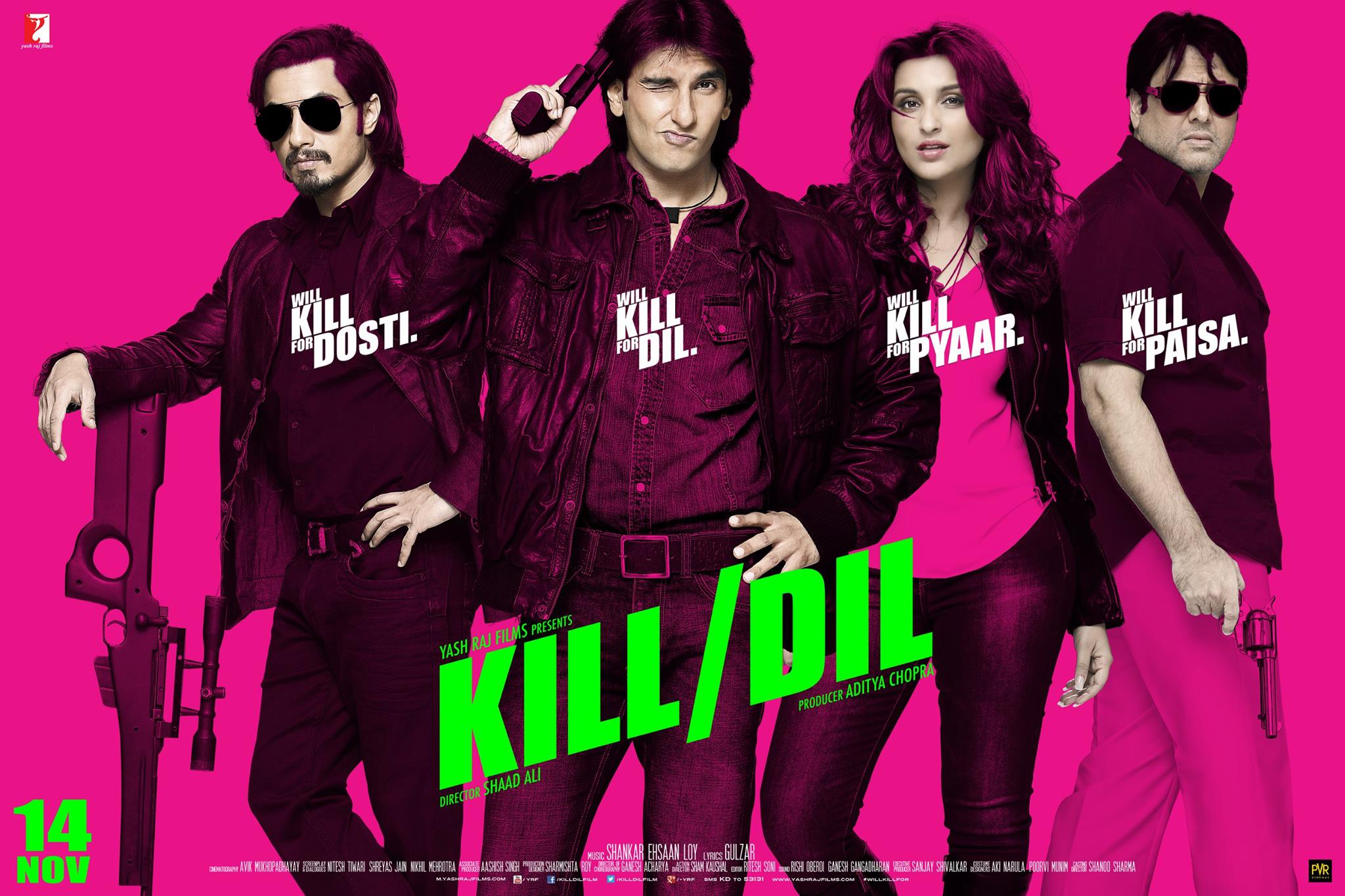
I had high hopes for Kill Dil. I like Ranveer Singh and Ali Zafar. I enjoyed Shaad Ali’s previous films, even the fairly nonsensical Jhoom Barabar Jhoom, and hey – Govinda! So, surely all these elements would be great together? Well, not so much. Kill Dil isn’t terrible, but it just isn’t as good as it should have been, mainly due to the shallow and poorly developed story. I don’t have a problem with the 70’s style masala plot, or with the Urban-Western style of Kill Dil, but I do prefer to have some plausibility in a romance and at least a smidgeon of logical possibility in the storyline. Both are conspicuously absent here. At least Ranveer, Ali Zafar and Govinda are all very watchable, while Shankar-Ehsaan-Loy’s exuberant songs are a definite plus, so even if the sum isn’t as great as all of its parts, Kill Dil is still worth a look  if you just sit back, leave logic at home and watch the spectacle.

The story starts with shades of Gunday as Bhaiyaji (Govinda) finds two babies in the rubbish and decides to raise the kids himself, despite the fact that he’s a gangster who kills people for a living. Somehow the orphans manage to survive, although they learn how to shoot a gun almost before they can walk and both drop out of school to work for Bhaiyaji as assassins for hire. Tutu (Ali Zafar) is apparently the elder, although how Bhaiyaji worked that out is anyone’s guess. He’s the quiet, less flamboyant and more brooding one who seems a little more aware of the risks but still seems content in his work. Dev (Ranveer Singh) is more exuberant, and with his bouffy hair and leather bomber jacket he’s actually a bit of a dork. The two brothers live together, work together and party together, but still have a lack of worldliness when it comes to anything outside of murder.

While out clubbing one night, Dev saves the life of Disha (Parineeti Chopra), a millionaire who gave up her degree in medicine to help rehabilitate criminals. Um – what? Disha is portrayed as the quintessential  rich party girl and the idea that she works as some kind of social worker is ludicrous. Yet it becomes even more ridiculous when Dev falls in love with Disha and is inspired to give up his life of crime for love.

The question is will his life of crime, and specifically Bhaiyaji, be willing to give up Dev?

Although the film starts off with both Dev and Tutu having roughly equal amounts of screen-time, as the story unfolds, Dev takes centre stage. Ranveer Singh is excellent and veers between annoyingly hyperactive, sweetly naïve and ultra-cool, often during the same dialogue. Although his transformation from gangster Dev to insurance salesman Dev is by the numbers, Ranveer is charming and charismatic throughout, even as his look becomes ever more conservative. He is brilliantly energetic in the songs, despite some truly dreadful styling, and if the song placements are often abrupt and odd, there are at least plenty of them, which keeps the amusement level relatively high.

Ali Zafar’s Tutu is the stoic friend who warns Dev about the possible consequences of Disha discovering his past and who is left to try and pacify Bhaiyaji when Dev is off romancing. Unfortunately, he’s not particularly successful at either task. However the relationship between Dev and Tutu is well portrayed and Ali Zafar and Ranveer Singh do have good chemistry together, even if it doesn’t get close to the Shashitabh ideal of bromance. Parineeti Chopra on the other hand has one of the most pointless and nonsensical characterisations I’ve seen, which is not helped by a complete lack of chemistry in her romance with Dev. She’s portrayed as a shallow character and is not just an unbelievable persona, but her style of behaviour makes her character essentially unattractive. Ultimately Disha seems an unlikely partner for Dev in every possible way and apart from this one fantasy song (which is still more about the styling and Ranveer’s increasingly unfortunate coiffure), the romance is fairly limp and ineffectual. It’s frustrating, since Parineeti looks fantastic and seems as if she is capable of so much more, if only she’d been given a chance!

As an occasional relief to all the posturing, Govinda is refreshingly straightforward as Bhaiyaji. He doesn’t do anything particularly gangsterish, apart from hand over pictures of the next victim to Dev and Tutu, but he does growl and look appropriately menacing when required. Even better, he does get to break out his dance moves and proves that he hasn’t lost any of his old mojo. However not even Govinda can breathe some fire into the flimsy story by the end, and Bhaiyaji’s response to Dev’s defection is disappointingly weak.

Kill Dil then is a bit of a disappointment. While the cast all try as hard as they can to look cool, and do look as if they had a great time during filming, they are let down by poor character development and the unreasonable story. However despite feeling frustrated by the character of Disha and annoyed by the paucity of scenes involving Govinda, I still did (mostly) enjoy the film. Ali Zafar and Ranveer Singh are very cool dudes here, and I liked their partnership. The songs are also improved by the colourful choreography and Ranveer Singh’s energy and joie de vivre is contagious. Perhaps one more for the fans, although it is worth a look for even just the brief glimpse of Govinda back in top form.