Billa (2009)

Billa is a remake of Billa (Tamil) which is a remake of an earlier Rajnikanth film of the same name which is a remake of the Amitabh Bachchan classic Don (Salim-Javed are credited for the original story). I’ve seen all of them, plus the more recent Hindi Don starring Shah Rukh, so I didn’t expect the unexpected and largely this is faithful to those predecessors. Meher Ramesh adheres to Telugu film conventions requiring happy endings and righteous heroes so there are a few changes. I enjoyed the total disregard of inconvenient logic and budgetary challenges. It is a modern, slick film with a dash of B movie and the spirit of making do for the sake of entertainment.

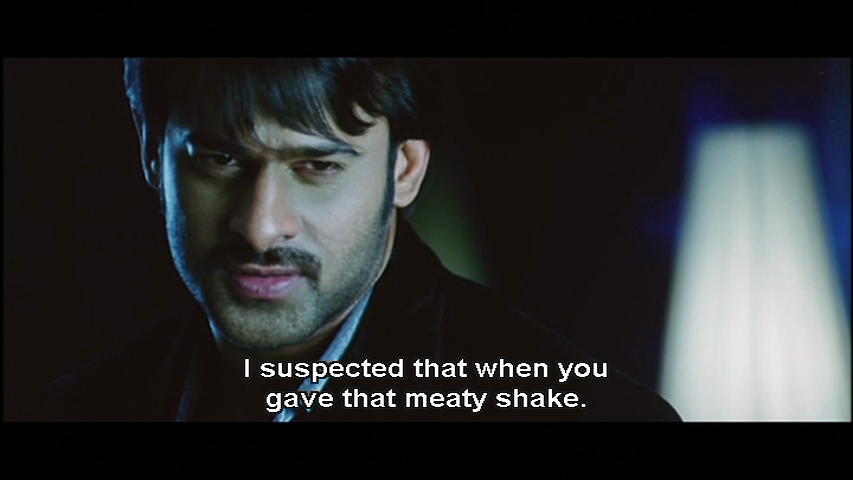
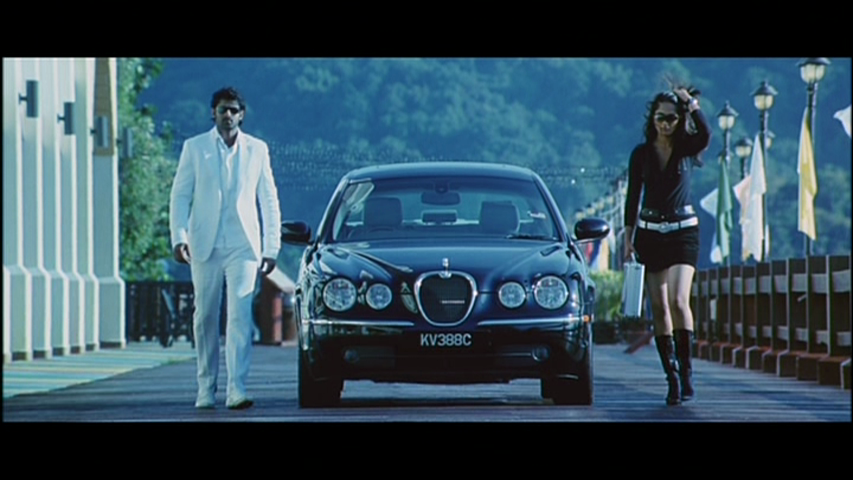
Prabhas plays the title role of Billa – a gangster with a puzzling penchant for black satin and three piece suits. In the tropics. No wonder he was always so irritable. The chafing must have been a nightmare.

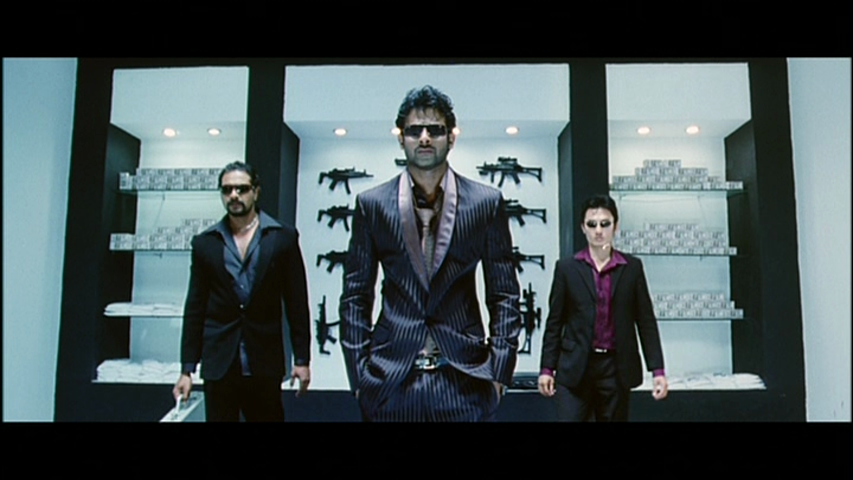
Billa works for ‘Devil’ and seems to be a model employee. He is out to eliminate the competition and stay ahead of the law while selling arms, drugs and who knows what else to villains all over South-East Asia. He lives a luxurious lifestyle on his private island where he continues to overdress for the beach.
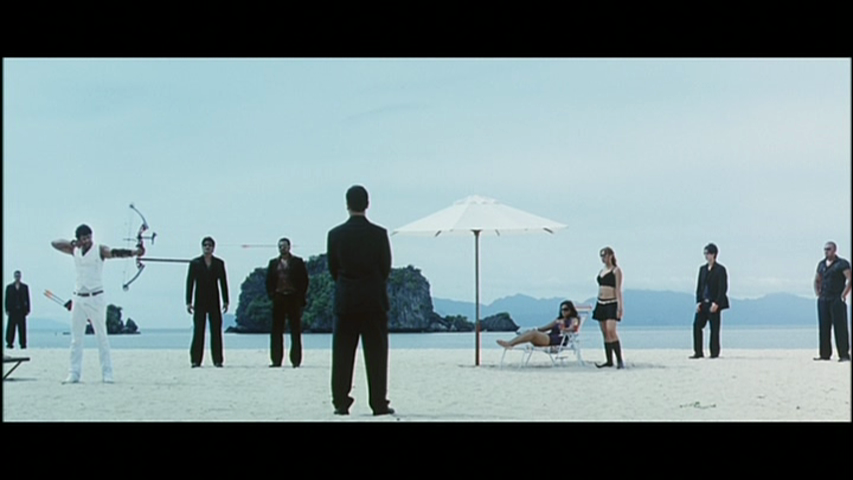
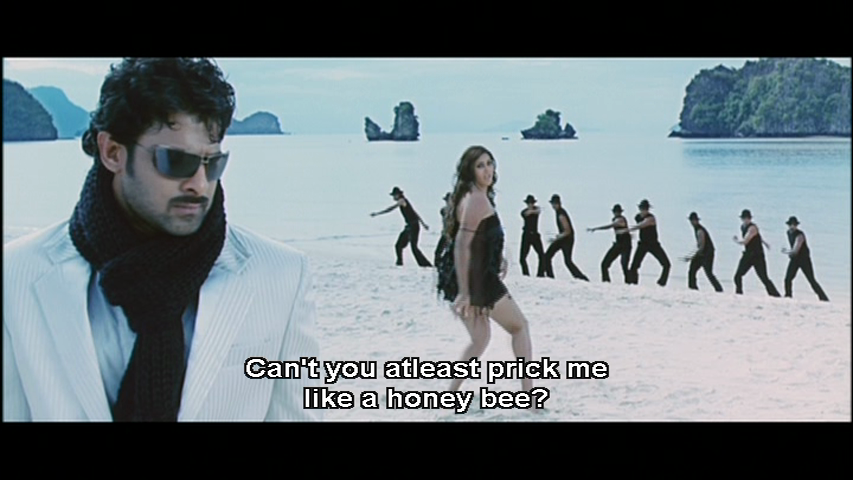
He is a cranky intolerant man, and Prabhas does well to be so unlikeable and dour. I did like Billa’s catchphrase ‘Trust no one. Kill anyone. Be only one”. It was a bit reminiscent of Highlander.

The English dialogues were often very funny though I am not sure the level of cliché was intended.  The subtitle team made their mark too.
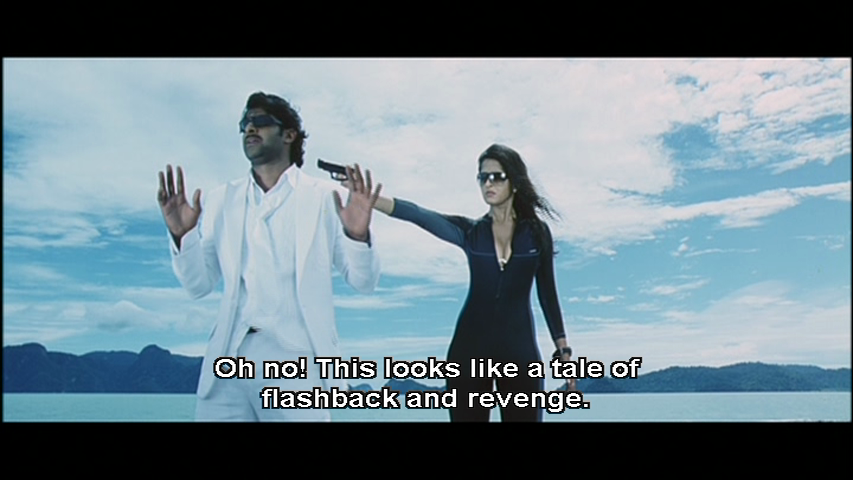


Prabhas also plays Ranga – a naive thief and layabout who has a heart of gold. Ranga is Billa’s duplicate and when Billa is out of circulation, the police use Ranga to infiltrate the gang. This role is a better fit for Prabhas as his likeable goofy side is given more rein and he is more expressive.

Ranga is sympathetic without being overly complex. Prabhas gets an opportunity to play up the confusion as Ranga impersonates Billa but his characterisations are so broad that there is no ambiguity at all.

Ranga has a far more colourful inner life than Billa, so that allowed for some variation in the song treatments.

Subbaraju makes an all too short appearance as Vikram, the gang member who tries to leave Billa for love.
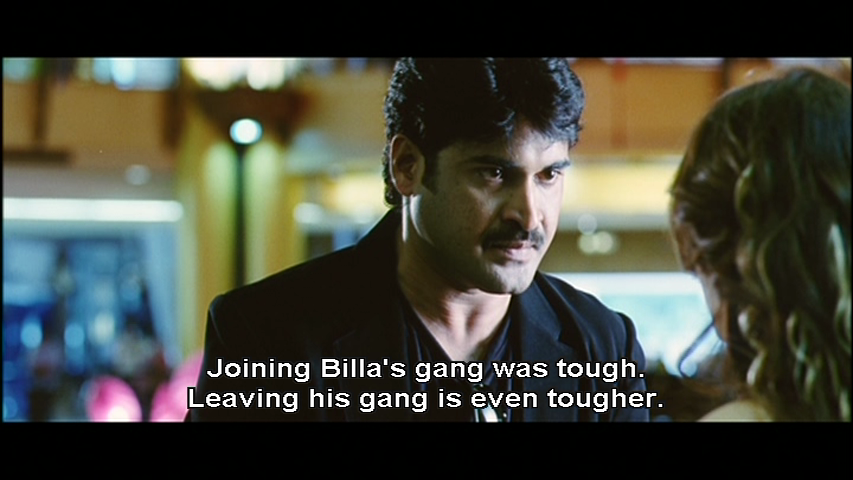
Once I realised he was marked for death I was a bit sad. But I cheered up when Hansika (his love interest) was hit by a truck. Seriously – casting Hansika for the role requiring a seductive dance? What were they thinking? Her costumes don’t help; a floor length evening dress (for clubbing, of course) is replaced with cut-off denim shorts and an oversized jumper. It was all quite daft and compared to Helen … well. Say no more.

Vikram’s sister Maya (Anushka) goes undercover to avenge her brother and his flattened fiancée.
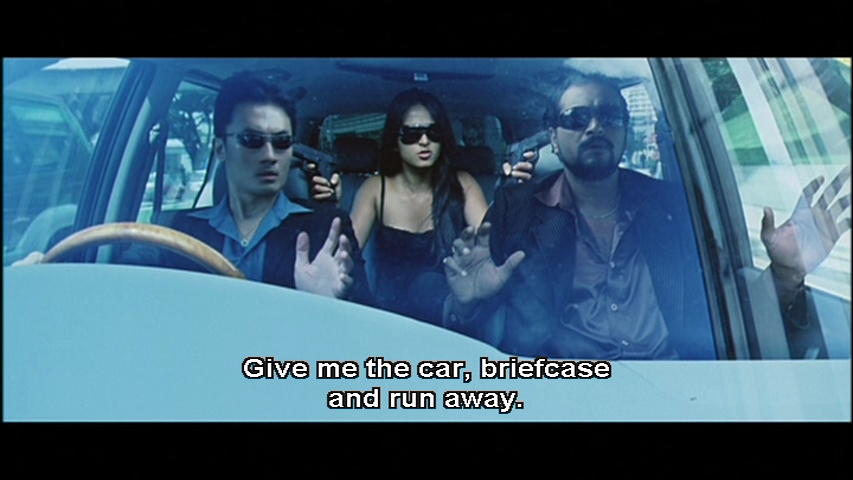
Anushka is not exactly wasted in this role but despite being a strong personality, Maya is not all that integral to the action. The swimming pool has a more important role as it is the means of getting the heroines into their skimpiest outfits. Maya vies with Lisa (Namitha) for Billa’s attention and there is more chemistry, albeit toxic, between the ladies than there is with the hero.

I liked that Lisa was allowed to fight to get rid of her competition, and surprised to see that her repertoire included a fencing bout.

The action scenes by Stun Siva (what a great name!) are a blend of impressive fight choreography and some quite lame stunts. I could see the inspiration for a few scenes was directly lifted from Farhan Akhtar’s Don (2006) but it felt as though they got to the location, realised they didn’t have the budget or know-how and just went for it anyway. Prabhas seemed much more at home in the high adrenalin action scenes than with the dialogues he was given as Billa. The action scenes are sometimes quite creative.

Every good hero/anti-hero needs a good villain and Kelly Dorjee’s character Rashid is flamboyant and slightly unhinged. Krishnamraju (Prabhas’ uncle) is the dedicated policeman after Billa, and gives a nicely balanced performance. Adithya is a cop under suspicion of collaborating with the baddies and is effective and understated. Rehman is Dharmendra, the Interpol agent in charge of hunting down Billa. The supporting gang members are a mixed bag, including Supreet as Ranjith, Billa’s 2IC. Ali has a significant role that is not a comedy distraction. He is a good character actor so I wish he would do more roles that contribute to the story instead of distracting from it.

The music by Mani Sharma is disappointing despite being closely linked to the drama. It was all quite uninspired and only the performers and costumes made any of the picturisations very memorable. Anushka isn’t a very enthusiastic or accomplished dancer so I found the work-arounds in this clip quite amusing.

The costume designers had a fine time and the look developed for Billa and gang was quite consistent and fitted the overall visual flavour.

Namitha and Anushka seemed to have clothes designed by a 20 year old boy with raging hormones but they wore it all well. I have to say that if I am to be afflicted with half naked skanks swanning around, it is nice to see more curvy and natural shapes than a stick insect with implants. But was it necessary? What do you think. To be fair, there was a lot of shirtless Prabhas on display so there was almost equal opportunity for eye candy regardless of your interest.


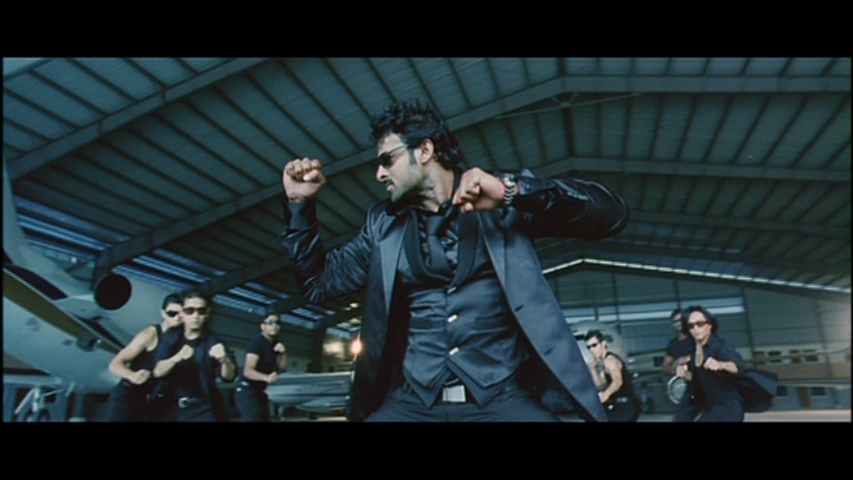
Quite apart from the endless parade of shiny suits, I lost count of the montages of sour-faced Billa flexing and/or staring enigmatically.

I found Billa very entertaining. I pretty much knew where the story was going, but I liked the spirited and fast paced dash through all the shenanigans. Prabhas is in good form, the support cast do well with their material and the film looks great. It was a fun timepass and watching it again recently, I enjoyed it all over again. 3 ½ stars!

Heather says: Faran Aktar’s  Don is one of my favourite Hindi films which may be one of the reasons why I couldn’t appreciate this Telugu version. The opening scenes where Billa does his stuff as the king-pin of the drug organisation were painful to watch as the actors indulged in some of the most stilted acting and dialogue delivery that I’ve ever seen. Billa’s English phrases, in particular his ‘Can, can’ were dreadful and made him sound like a total idiot, while it was hard to watch Prabhas impersonate a chunk of wood when he’s normally a much better actor. It wasn’t just the terrible direction in this section that didn’t work for me, since the stunts and effects were just as bad. It appeared as if Meher Ramesh thought that a film about gangsters needed plenty of fast cars, helicopters and motorbikes, which I agree is not a bad idea, but then couldn’t work out how to use them in the story. So we ended up with completely implausible situations which seemed contrived just so that another over the top stunt could be stuck into the screenplay. And for goodness sake, if Billa was trying to escape in a Ferrari there is no way that anyone would have been able to keep up!  Plus it’s not exactly the best car for an unobtrusive getaway, but I guess that really wasn’t the point. Thank heavens for Subbaraju who did help me get through the first few scenes, along with Hansika as a comedy side-plot, since I couldn’t do anything but laugh at her character.

The film picked up immensely once Prabhas was allowed to exert his natural charm as Ranga, and despite the continuing forays into pointless special effects it was much more entertaining. I enjoyed Ali’s role for a change, and Anuskha and the other supporting actors were all good enough to keep their characters interesting. I just wish Billa had been less of an escapee from a Goth fashion parade (clichéd model personality included) and more of a vicious but possibly more interesting killer. 2 ½ stars.

Panjaa

Panjaa’s opening titles are in bold graphic novel style with a 3D effect. Eye catching and intriguing, the confident visuals match a slick modern underworld thriller where characters are not always what they seem and life is lived in shades of grey.

There is nothing really new in the conflict at the heart of the plot, but Vishnuvardhan has tweaked things just a little and saves the film from being too familiar. I saw this in the cinema, without subtitles, when it released. While the basic plot and motivations were clear, I enjoyed seeing it again on a subtitled DVD as some of the characters’ thought processes were more accessible.

Most of the film looks to have been shot on location and it adds a note of authenticity in terms of the buildings, the lighting and the sense of place. I particularly liked the ornate architecture of Kolkata, as well as the lush green of the countryside. The colour palette is subdued and the style is pared back and modern. There is nary a plaid shirt in sight!

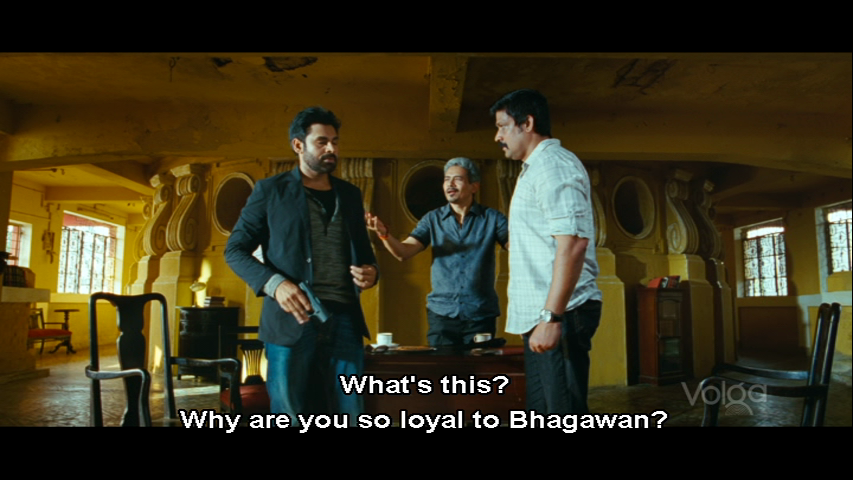
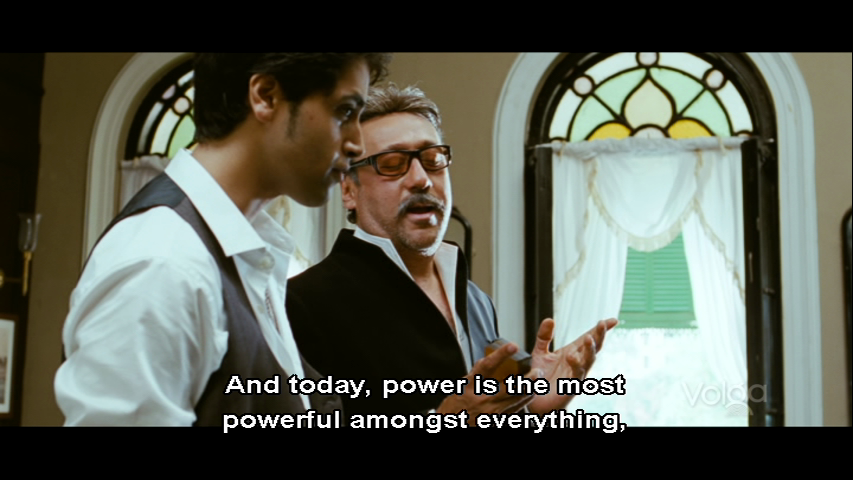
Jai (Pawan Kalyan) is the enforcer for Bhagawan (Jackie Shroff). He is a shadowy figure, always a step ahead and coolly efficient in his execution. Jai has a strong moral sense and acts according to his own notion of right and honour. He serves Bhagawan because when his mother and sister were assaulted, Bhagawan gave him justice and a refuge. But when Bhagawan’s son Munna returns from overseas, it is clear that Munna is not the kind of man Jai could tolerate, let alone support. Things escalate as Munna takes full advantage of being his father’s son.  Jai struggles between loyalty and his own code, and the need for more in his life.

Jai also struggles with the ladies. The one he wants makes him shy and tongue tied. The one that wants him is very assertive but he isn’t interested. I’m not convinced Janvi (Anjali Lavania) was necessary to the story, but it was nice to see the bad girl get to talk and think for herself. Unfortunately she ran into the brutal Munna on a bad day so it was shortlived. I like a good skanky item and this is certainly skanky.

Pawan Kalyan is a hero but Jai is almost an anti-hero. He is moral by his own lights but he is a professional killer. He is nice enough but not a good guy as such. He isn’t a dashing romantic hero although women fancy him and he doesn’t really win anything other than his own life. The final scene is ambiguous enough that it could be a vision of the future or a memory of the past so it’s not a resoundingly happy ending. Pawan Kalyan is very good as Jai. He draws the eye in all his scenes, using stillness and silence more than histrionics. His acting range easily spans Jai’s story from laid back comedy to high tension drama.

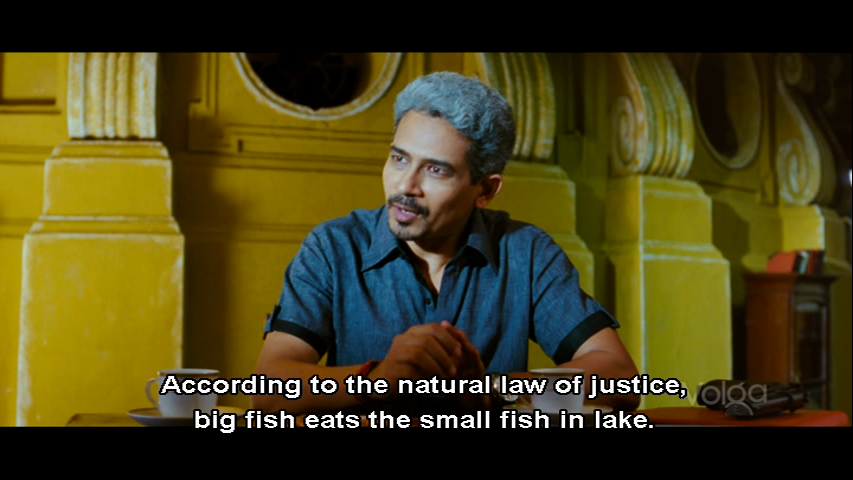
The casting is excellent. Having said that, I really do not understand the recent fad for Jackie Shroff in South Indian films. He doesn’t bring anything unique to the kind of roles he is playing, but he is adequate as Bhagawan. Munna (Adivi Sesh) is Bhagawan’s son, an overly entitled sadistic nutter. His performance is over the top but Munna needed to be hateful and I was certainly sick of the sight of him! Atul Kulkarni is excellent as rival crook Kulkarni. He conveys an intensity and intelligence that made Kulkarni seem plausible as a successful ‘businessman’. The relationship between Bhagawan, Kulkarni and Jai is revealed over time and the reactions and decisions of the main characters are consistent with what we know about them. The second tier of gangsters is represented by Tanikella Bharani as the slippery Guruvaiah and Sampath Raj as Kulkarni’s right hand, Sampath along with Amit Kumar and others in support. The interactions are well written and fairly restrained so it is possible to believe these guys can function in the real world. There are glimpses of family and other concerns that build a picture of this slice of the underworld.

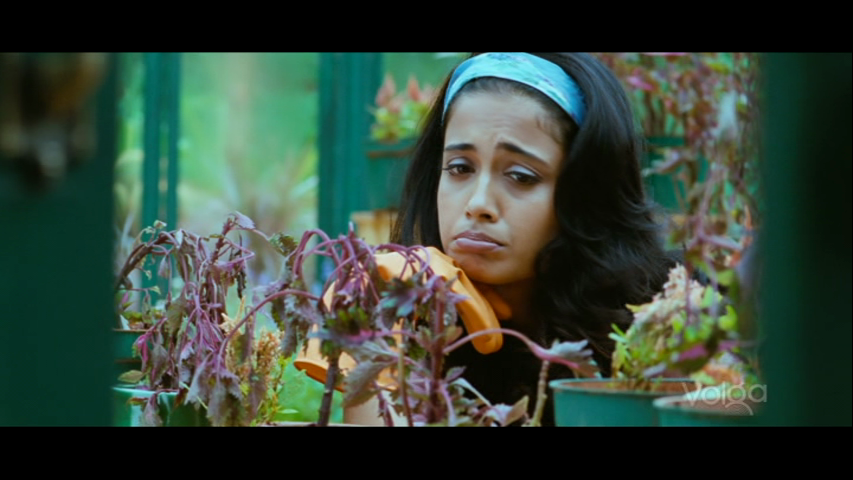
Sarah-Jane Dias is Sandhya, a tree hugging good girl who turns up to work in Jai’s nursery. Yes. Jai is a complex man and has diversified his investments into a plant nursery he runs with Chotu (Ali). Jai is drawn to Sandhya and she likes him. Their relationship starts with superficial attraction and develops through time and proximity. She has a bit more going on in her life than just waiting for Jai, but she is primarily the love interest. I liked their scenes more on the second viewing as the dialogues helped show her character as smarter than her prancing around in gumboots lead me to think (although I appreciated the work appropriate clothing). Just as things looked promising, Sandhya returns home suddenly to see her sick grandmother.

The timing coincides with Jai’s need to get out of town. The rural setting puts him back in touch with his childhood self. He is looking for love and a home, the things he lost when his family was torn apart. But his past is a threat to himself and anyone close to him so he needs to resolve that while still keeping the promises he made.

The country sojourn introduces more of the excellent support cast including Subbaraju as Sandhya’s brother Ashok and Brahmanandam in amusing form as an inept local cop. I loved that this song is essentially a tirade against the greedy and cowardly policeman Paparayudu, accompanied by uninhibited dancing and some jiggly-bellied tiger men.

Ashok is a protective brother, henpecked yet determined to remain a bachelor, and no match for the smooth townie Jai or for local rowdies. He is frantic when Sandya comes home unannounced as he knows troubles from the past will be stirred up again and he wants to keep her safe.

Subbaraju gets to show off a bit more of his acting range than normal, and when he isn’t beating up baddies he has some fun scenes with the women of the household. Ashok and the rest of the family are vivid characters and very much part of Sandhya’s life.  Back in town, Chotu (Ali) was in trouble and believe it or not, I was sad to see his predicament. Despite these being small roles, the details are nicely drawn and the actors all deliver good performances. That kind of attention and care makes Panjaa quite satisfying viewing.

The comedy is not too intrusive. Pawan Kalyan doesn’t mind playing for laughs and I really enjoyed the Mega Tribute as Jai was persuaded to pose with cut-outs for a photo. Brahmi and Ali are in character roles and their shtick is part of the story so it stays on track. The fight scenes orchestrated by Shyam Kaushal are brutal but not too bloody, and highlight Pawan Kalyan’s strengths. The editing and composition of the action sequences is top notch. Everything flows quite well and there is a consistent look and feel to the whole film.

There are some flaws. The romance between Jai and Sandhya is a bit laboured and she does far too much marvelling at blades of grass and cooing at flowers. The first half takes a while to go anywhere. ‘Paparayadu’ excepted, Pawan Kalyan looked a bit lacklustre in the dancing but the choreography wasn’t that exciting either. The soundtrack by Yuvan Shankar Raja is average and the song picturisations are quite predictable but don’t detract from the film. Overall, the positives greatly outweigh these niggles.

Panjaa is a well made thriller with good performances and a cohesive story. It’s not dazzling or wildly original, but I never found it dull. It’s a quality effort and well worth a watch, especially if you’re a fan of the genre. 3 ½ stars!

Gabbar Singh (2012)

Pawan Kalyan fans in Melbourne seem to be the loudest, the most enthusiastic and to prefer shredding rather than recycling their newspapers. The air was full of strips of paper right from the opening moments of Gabbar Singh and the paper storm continued well into the second half. A packed cinema, cheerleaders up the front to lead us in our favourite Pawan Kalyan chants as everyone pushed and shoved their way in and plenty of whistles and cheers meant a great start to another adventure without subtitles.

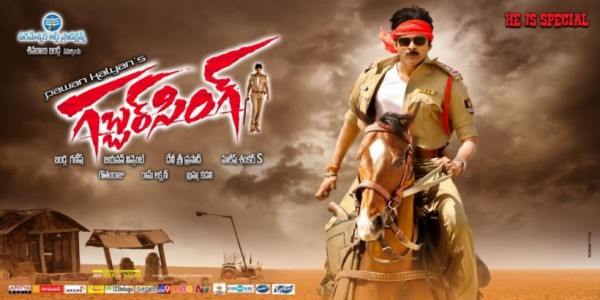
It’s a novelty to watch a Southern remake of a Hindi film since so often the shoe is on the other foot and after Osthe in Tamil, Gabbar Singh is the Telugu version of Dabangg. The film follows the same basic plot, but many of the other roles have been limited to allow more focus on Pawan Kalyan’s character. It’s his film the whole way through and while he has the charisma and capability to carry it off, the story loses much of its focus by dropping the back stories of Gabbar Singh’s wastrel brother and the conflicts within their family.

We start with young Venkat Ratnam Naidu and his stormy relationship with his adopted father Naidu (Nagineedu) who had married Venkat’s mother Suhasini after she was widowed. Naidu prefers his own son and makes no secret of the fact which gives Venkat a huge chip on his shoulder and a somewhat argumentative personality. Venkat ends up running away from his family, but returns years later as a police officer with the assumed name of his childhood hero, Sholay’s Gabbar Singh. He returns in style, renaming the police station after himself and single-handedly annihilating a gang of bank robbers after chasing after them on horseback so it seems safe to say that he’s not mellowed in the intervening years.

It’s not long before Gabbar Singh clashes heads with local rowdy Sidappa Naidu (Abimanyu Singh) and the feud between the two forms the plot for the rest of the film. In between all the gunfights and general mayhem, Gabbar Singh falls in love with Bhagya Lakshmi (Shruti Hassan) but her role is even more reduced than that of Rajo in Dabangg and Bhagya only appears briefly in a few scenes and a couple of dance numbers. Her friend, ably played by Gayatri, has almost as much screen time and judging by the audience reaction, seems to get the better lines too. Kota Srinivasa Rao pops up as Bhagya’s father but again the role has very little scope and he barely has any input.

Sidappa has political aspirations and Gabbar Singh disrupts his attempts to fund his career through various robberies and corrupt deals. Sidappa’s response is to have his henchmen beat him with clubs which is rather extreme but doesn’t really have too much of an effect on his arch nemesis. Abhimanyu Singh’s Sidappa is a typical Telugu goon and doesn’t have any of the flamboyance or appeal of Sonu Sood’s Chhedi Singh so the villain of the story is rather disappointing. As too is the item song. Although Malaika and the backing dancers did their best, Kevvu Keka just isn’t as catchy as Munni Badnam. I was also very disappointed that Ajay as Gabbar Singh’s brother only made a very brief appearance since he’s one of my favourite actors and I was hoping for more from him.

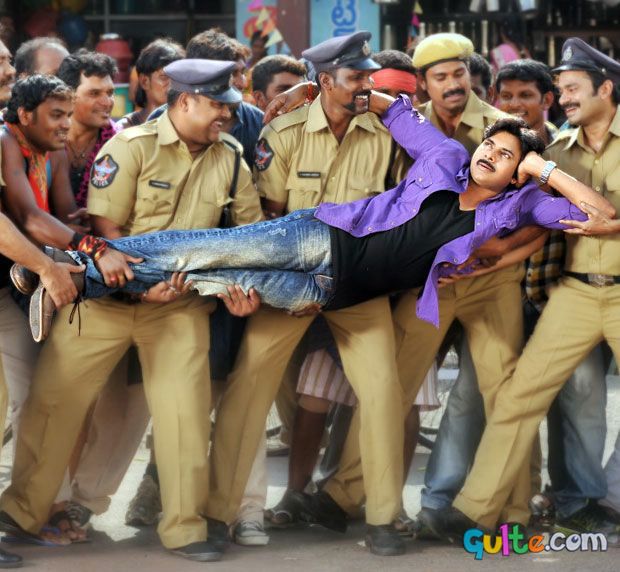
However the film was made totally worthwhile by a scene where Gabbar Singh forces the usual crowd of rent-a-goons to participate in a session of antakshari. This has to be the funniest piece of cinema I have seen this year and it had the crowd on their feet cheering for more! Generally the dialogue seemed to be of high quality since many of the lines had the audience applauding and both Ali and Brahmi’s comedic roles got plenty of appreciative cheers. Since I didn’t understand the dialogue I focused on the myriad of excellent details instead, such as the gun hood ornaments on Gabbar Singh’s 4WD and the incredibly happy and enthusiastic backing dancers. There is a reason why men in flak jackets are not often seen dancing and it’s a point well illustrated in the first song. Generally though the songs are good and Devi Sri Prasad’s music suits the feel of the film.

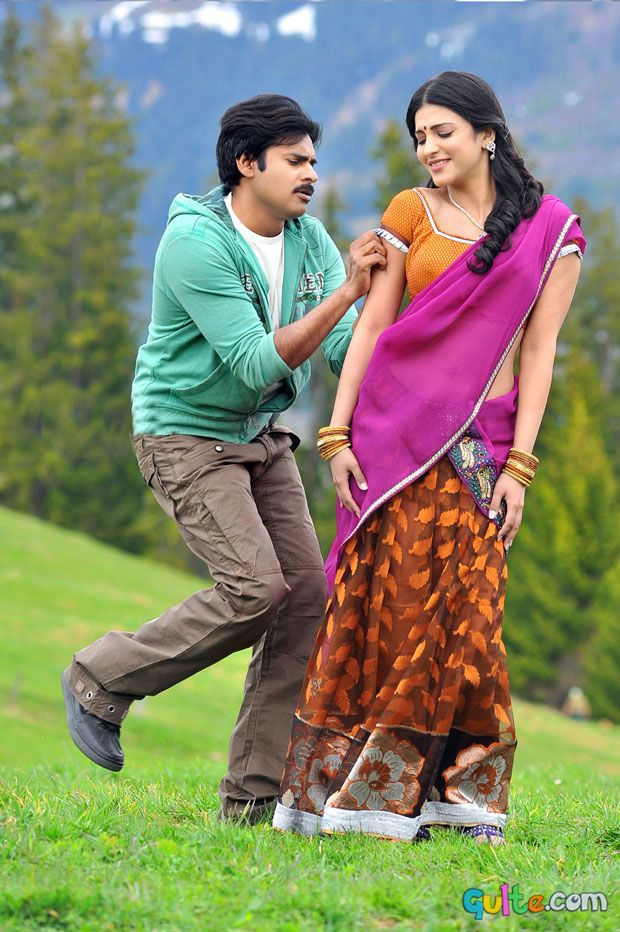
There is very little of Chubul Pandey in Pawan Kalyan’s Gabbar Singh. None of the mannerisms are there, although Gabbar Singh has plenty of the same chutzpah. The sunglass tricks are reserved for Brahmi apart from an opening scene where Gabbar Singh tosses his sunnies onto a colleagues face with impressive accuracy.  There are a few moments in one song in Switzerland where the normally smooth and co-ordinated Pawan Kalyan does seem to be channelling Salman Khan’s dance style, but thankfully not for long. I did feel sorry for Shruti Hassan dancing in the snow in sandals though.

The reason that Dabangg was such a hit was that it was a Southern style film incorporating plenty of the masala elements which have sadly been missing in Bollywood for some time with a hero who suited the part. Once that novelty element is removed and the film changed to a Southern locale and hero, the story is similar to most other Telugu films. The impact is further lessened by the South’s familiarity with the use of machetes, 4WD’s that roam in packs and acrobatic fight scenes and so Gabbar Singh doesn’t stand out in the same way as Dabangg, although it is more successful than Osthe. Harish Shankar has changed the screenplay to make the film suit his leading man and Pawan Kalyan is excellent as the unorthodox police officer in a rather more orthodox story. Gabbar Singh is still well worth a watch for his performance and I’ll definitely be looking out for the DVD to finally understand the dialogues and for that brilliant antakshari scene!