Gabbar Singh (2012)

Pawan Kalyan fans in Melbourne seem to be the loudest, the most enthusiastic and to prefer shredding rather than recycling their newspapers. The air was full of strips of paper right from the opening moments of Gabbar Singh and the paper storm continued well into the second half. A packed cinema, cheerleaders up the front to lead us in our favourite Pawan Kalyan chants as everyone pushed and shoved their way in and plenty of whistles and cheers meant a great start to another adventure without subtitles.

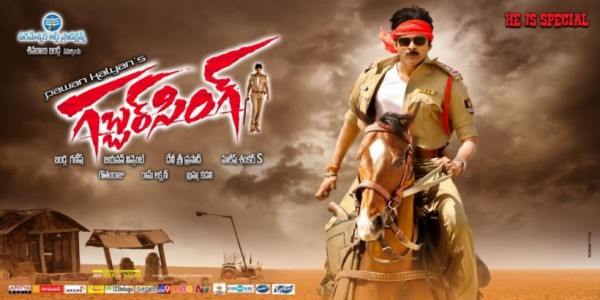
It’s a novelty to watch a Southern remake of a Hindi film since so often the shoe is on the other foot and after Osthe in Tamil, Gabbar Singh is the Telugu version of Dabangg. The film follows the same basic plot, but many of the other roles have been limited to allow more focus on Pawan Kalyan’s character. It’s his film the whole way through and while he has the charisma and capability to carry it off, the story loses much of its focus by dropping the back stories of Gabbar Singh’s wastrel brother and the conflicts within their family.
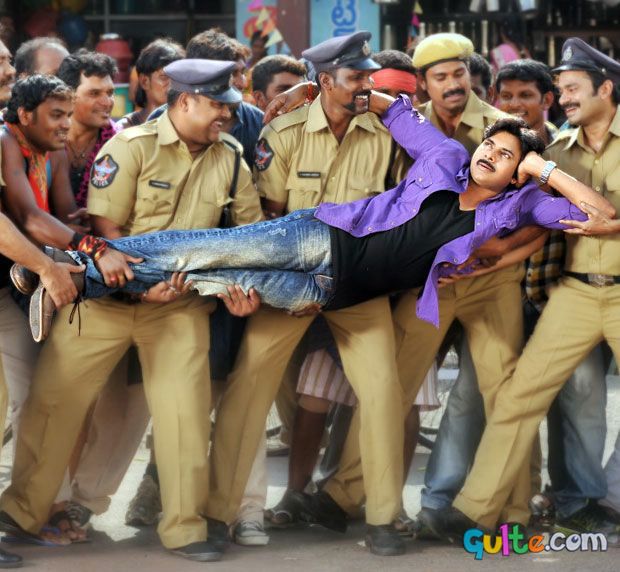
We start with young Venkat Ratnam Naidu and his stormy relationship with his adopted father Naidu (Nagineedu) who had married Venkat’s mother Suhasini after she was widowed. Naidu prefers his own son and makes no secret of the fact which gives Venkat a huge chip on his shoulder and a somewhat argumentative personality. Venkat ends up running away from his family, but returns years later as a police officer with the assumed name of his childhood hero, Sholay’s Gabbar Singh. He returns in style, renaming the police station after himself and single-handedly annihilating a gang of bank robbers after chasing after them on horseback so it seems safe to say that he’s not mellowed in the intervening years.

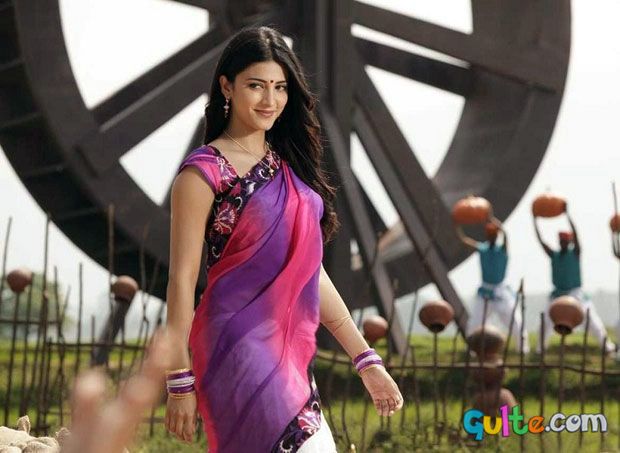
It’s not long before Gabbar Singh clashes heads with local rowdy Sidappa Naidu (Abimanyu Singh) and the feud between the two forms the plot for the rest of the film. In between all the gunfights and general mayhem, Gabbar Singh falls in love with Bhagya Lakshmi (Shruti Hassan) but her role is even more reduced than that of Rajo in Dabangg and Bhagya only appears briefly in a few scenes and a couple of dance numbers. Her friend, ably played by Gayatri, has almost as much screen time and judging by the audience reaction, seems to get the better lines too. Kota Srinivasa Rao pops up as Bhagya’s father but again the role has very little scope and he barely has any input.
Sidappa has political aspirations and Gabbar Singh disrupts his attempts to fund his career through various robberies and corrupt deals. Sidappa’s response is to have his henchmen beat him with clubs which is rather extreme but doesn’t really have too much of an effect on his arch nemesis. Abhimanyu Singh’s Sidappa is a typical Telugu goon and doesn’t have any of the flamboyance or appeal of Sonu Sood’s Chhedi Singh so the villain of the story is rather disappointing. As too is the item song. Although Malaika and the backing dancers did their best, Kevvu Keka just isn’t as catchy as Munni Badnam. I was also very disappointed that Ajay as Gabbar Singh’s brother only made a very brief appearance since he’s one of my favourite actors and I was hoping for more from him.

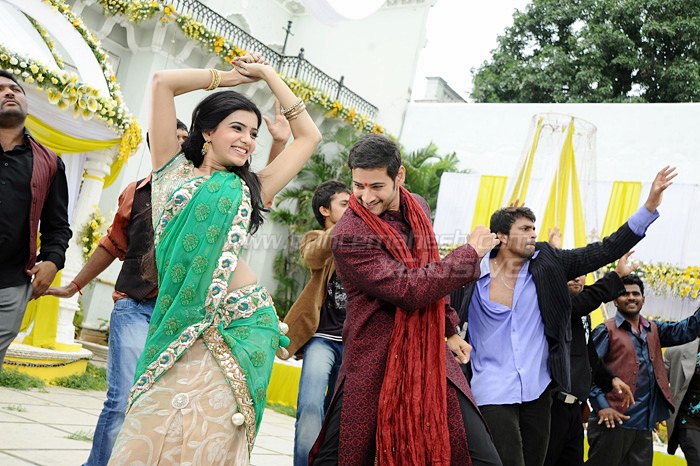
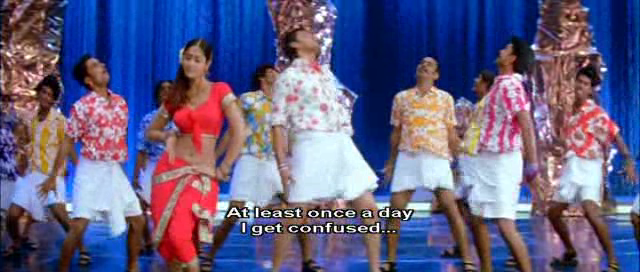
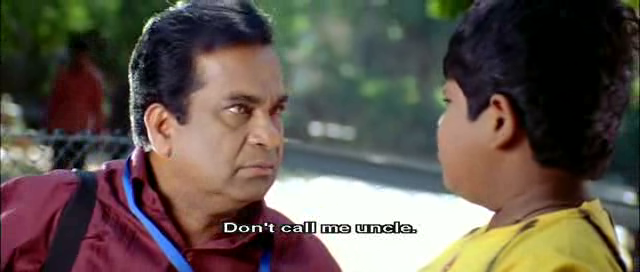
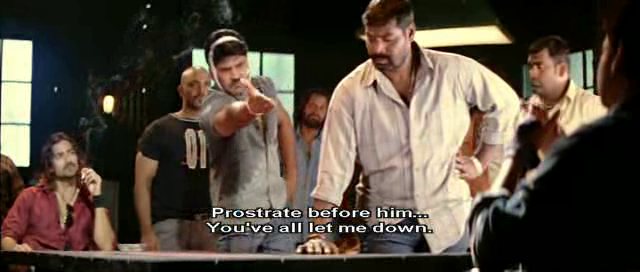
However the film was made totally worthwhile by a scene where Gabbar Singh forces the usual crowd of rent-a-goons to participate in a session of antakshari. This has to be the funniest piece of cinema I have seen this year and it had the crowd on their feet cheering for more! Generally the dialogue seemed to be of high quality since many of the lines had the audience applauding and both Ali and Brahmi’s comedic roles got plenty of appreciative cheers. Since I didn’t understand the dialogue I focused on the myriad of excellent details instead, such as the gun hood ornaments on Gabbar Singh’s 4WD and the incredibly happy and enthusiastic backing dancers. There is a reason why men in flak jackets are not often seen dancing and it’s a point well illustrated in the first song. Generally though the songs are good and Devi Sri Prasad’s music suits the feel of the film.
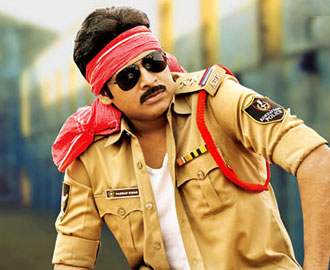
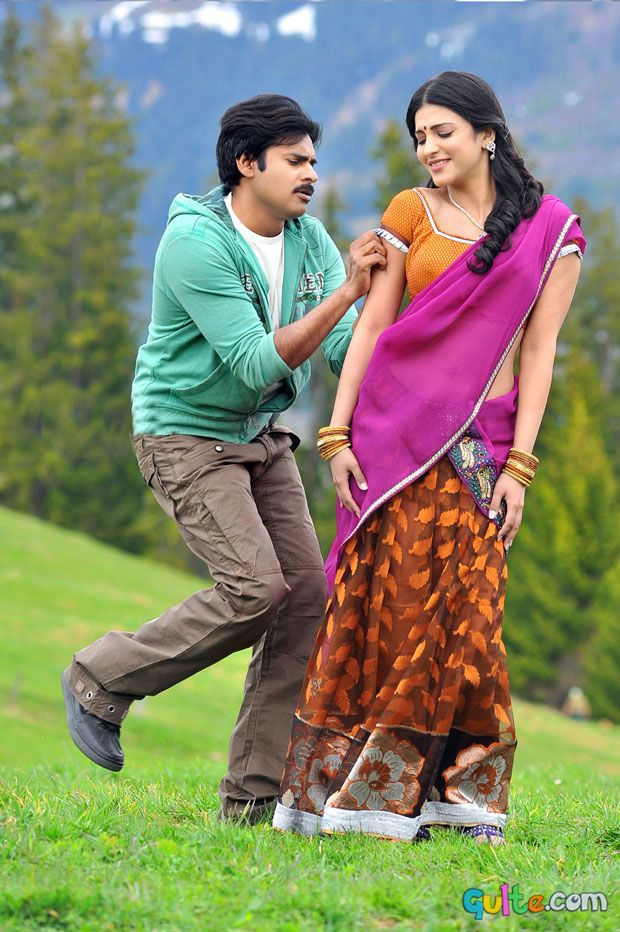
There is very little of Chubul Pandey in Pawan Kalyan’s Gabbar Singh. None of the mannerisms are there, although Gabbar Singh has plenty of the same chutzpah. The sunglass tricks are reserved for Brahmi apart from an opening scene where Gabbar Singh tosses his sunnies onto a colleagues face with impressive accuracy.  There are a few moments in one song in Switzerland where the normally smooth and co-ordinated Pawan Kalyan does seem to be channelling Salman Khan’s dance style, but thankfully not for long. I did feel sorry for Shruti Hassan dancing in the snow in sandals though.
The reason that Dabangg was such a hit was that it was a Southern style film incorporating plenty of the masala elements which have sadly been missing in Bollywood for some time with a hero who suited the part. Once that novelty element is removed and the film changed to a Southern locale and hero, the story is similar to most other Telugu films. The impact is further lessened by the South’s familiarity with the use of machetes, 4WD’s that roam in packs and acrobatic fight scenes and so Gabbar Singh doesn’t stand out in the same way as Dabangg, although it is more successful than Osthe. Harish Shankar has changed the screenplay to make the film suit his leading man and Pawan Kalyan is excellent as the unorthodox police officer in a rather more orthodox story. Gabbar Singh is still well worth a watch for his performance and I’ll definitely be looking out for the DVD to finally understand the dialogues and for that brilliant antakshari scene!

Dookudu

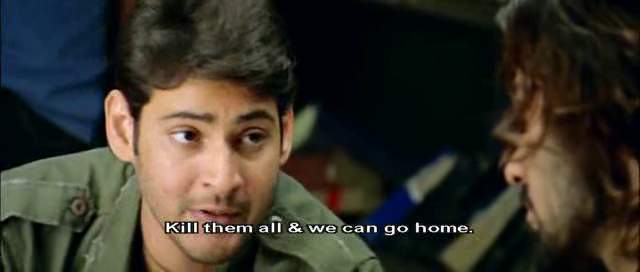
Another Adventure Without Subtitles! Dookudu is the much awaited release for ‘Prince’ Mahesh Babu and we knew it would be huge. We arrived early for the 8.30pm show, which gave us the opportunity to watch the staff deal with the problem of getting the first show crowd out through the 700 or so people crowding into the small foyer. Once people emerged, the waiting audience clapped and cheered them like they were rockstars, and it was a very festive atmosphere. As one lady said  – why come to the cinema unless you’re going to have a good time?

It was about 10pm before the film finally started, not that anyone was complaining. There was plenty of cheering, accompanied by the sounds of tearing newspaper, as everyone got ready for Mahesh’s appearance.  There was discussion about whether there might be the odd flash of elbow (Yes there was, and even a glimpse of princely tummy) and just how many shirts can Mahesh Babu wear and still manage to fight? (There is apparently no limit to what Mahesh can do, or how many shirts he can wear.)

The film starts with politician Shankar Narayan (Prakash Raj) who is so well loved by the people that we know he’s heading for a gruesome end. Sure enough he’s attacked and left for dead by his rivals who include Kota Srinivasa Rao, Sayaji Shinde and various other Telugu film baddies. Somehow Shankar survives, in a coma and hidden in a secret location, and he finally comes round some years later to a changed world. His son Ajay (Mahesh) is a policeman rather than a politician as his father had planned, a number of his friends and colleagues are dead and the family have moved out of their old house. However the doctor instructs Ajay not to shock or distress his father in any way, for example by telling him the truth, as this will be bad.

Mahesh is introduced in full throttle action hero style, complete with title song. He takes on a room full of bad guys with nothing but his comic timing, guns and a whole lot of biffo.  Ajay is a super cop – invincible and fearless. He is also quite prepared to play outside the legal system if that is what it takes. After one such scene we did have a quick discussion about the omnipresent singlet under all the layers of shirts, and whether it was actually bulletproof. Whatever the reason, the bad guys consistently fail in their efforts to eliminate our hero, while he has no such issues dealing with them. Mahesh can convincingly portray a furious rage in a very low key acting style, and he is also more than capable of bantering dialogue with the comedy uncles. It’s a role tailor made for him, and while he wears his police uniform a little on the baggy side the character is a perfect fit.

Ajay does a deal with Brahmi who’s taken over their house and in the process convinces him that he’s taking part in a reality TV show which forms a large part of the comedy in the film. Ajay pretends to be a politician and keeps his life as a policeman secret from his father, while all the time plotting revenge on his fathers attackers. It’s no wonder Ajay is always on a short fuse – he must be exhausted from all the pretending. And the killing.

Ajay finds out through another investigation that mafia boss Nayak (Sonu Sood) was involved in the assault on Shankar. It looks at first as if Sonu is about to reprise his role in Ek Niranjan as the stylish and psychotic villain, but sadly his wardrobe fails to deliver. Despite the nice cravats and the random and occasional application of grey to his hair and moustache, Nayak is a subdued and fully clothed villain who just loves his little brother a bit too much.  We enjoyed the Sheila ki Jawani dance break and we think Sonu did too, but it was shortlived. Most of the posturing is left to his faithful sidekicks played by Ajay and Subbaraju. That’s fine with us since they’re both Cinema Chaat favourites and we did enjoy watching the satin shirted Subbaraju try to mime to his boss that Mahesh was really an undercover policeman. Oh for a pen when you need one…

Along the way, Ajay takes his gang of trusty colleagues to Turkey, apparently just so he can say ‘Operation Istanbul’ as there is no other discernible reason for the location. He meets Prashanthi (Samantha), a fashion designer and, unknown to him, daughter of his clownish boss (Nasser). While Ajay and Prashanthi have the usual confusions before falling in love there is no substance to Samantha’s role and she’s soon side lined. There is little chemistry between Samantha and Mahesh, maybe because they spend hardly any time together on screen. Samantha looks beautiful, and wears whatever the costume department have dreamed up. That seems to be her sole purpose in the film as she doesn’t actually do anything.

There was more comedy with M S Narayana and one very funny skit where he took off a number of films including Magadheera and Robot. A little comedy can go a long way, but here it was integrated into the main story and with Mahesh adding to the comedy dialogue there were parts that were very funny, even to us non-Telugu speakers. The rest of the audience were roaring with laughter throughout the speeches. Master Bharath put in an appearance too. Was he necessary? Probably not. And yes there were some unfortunate stereotypes masquerading as comedy, but for the most it was entertaining.

The supporting cast was very strong, if largely underutilised. Shafi, Tanikella Bharani and Sudha had little to do, and Satya Krishnan was given maybe one line of dialogue. It’s a big budget film when you can hire some of the best and then not do anything with them!

The action sequences are excellent, and it’s hard to go wrong with a good impaling. Sreenu Vaitla has come up with several ways of illustrating the ‘eye for an eye’ concept, all of them extremely gory. The camera work and special effects were great and added impact on top of the already impressive stunts. We enjoyed the flashes of lightning when Ajay was beating Nayak to a pulp, and the changes of tempo in the film speed that underpinned the dramatic tension.

The song picturisations were less successful, and the songs by S.S Thaman are not so memorable on their own. Mahesh can dance reasonably well so it was disappointing not to see more use being made of his skills, and we wondered who decided it was a good idea to give him Abhishek Bachchan’s choreography. Chulbuli Chulbuli was spectacular with plenty of feathers and some enthusiastic backing dancers, although clearly ‘inspired’ by Kilimanjaro. The nightclub song lacked a good item girl but made very good use of the male backing dancers, grinning madly in satin pants and ruffles,  and had a giant guitar shaped light-up floor so that was pleasing. We must also congratulate the set designer for the impressive selection of chandeliers and lamps, especially the chandelier in the hospital ward.

Dookudu has a charismatic hero in a strong if silly storyline, and it is a technically excellent film in the mass entertainment style. It might not be the greatest film ever made, but it was  really fun to watch, especially with the awesome Melbourne audience.

Pokiri

Pokiri is my favourite Mahesh Babu film, along with Athadu. I’ve seen the Tamil remake Pokkiri, and endured Wanted in Hindi (for completeness) and neither of them holds a candle to the original. Puri Jagannadh combines a strong story with striking visuals to make a gory, suspenseful action masterpiece. The story is set in the murky world of cashed up property developers, corrupt cops and parasitic crooks (the ‘land mafia’). Justice seems to reside outside of the legal system, but it isn’t immediately clear where.

We first see Pandu (Mahesh Babu) when he lures a gang out of their own territory and beats them to a pulp after kindly offering to leave a door in the shed open so they could run away if they got scared. He celebrates with a dance in which he beats people up. He then hooks up with the gang who he has just beaten up, including Subbaraju, employed by off shore crimelord Ali Bhai. Jyothirana as Mona shows an interest in Pandu that is not purely professional, and I can see why she might have been disappointed in his answer.

Pandu has all the typical hero attributes – the vestigial mullet hairdo, he’s invincible, he just has to break into dance and everyone around him joins in, he never gets lost or stuck in traffic and he is never stuck for a one liner. Despite his refusal to injure women and children, he will kill without remorse and his intensity in explaining how bad he is seems to indicate perverse pride in his achievements. Pandu is an anti-hero and there is no pretence made that he is really a good guy although of course he has a back story that explains much once it is revealed. Mahesh’s performance is totally committed to the crushing action scenes, and he is expressive in the emotional moments. Pandu is a baby faced killer with few if any scruples, although he seems to have caring friends (including Ajay) and occasional flashes of levity.

But I really had to question if someone who solved all their problems with such brutality would be any easier to deal with if he was motivated by love rather than anger. Dead is dead after all. But it’s Mahesh, so Pandu was never going to be left painted as a complete villain for the whole film.

Pandu is attracted to Shruthi and knows they are all wrong for each other. Oh God, what to do?

Ileana is Shruthi; young, pretty and pouty. Her storyline justifies wearing midriff-baring lycra as she is an aerobics instructor, and the sole breadwinner in her family. She still has the very flexible working hours and extensive wardrobe a film heroine needs. Slimy S.I Pasupathi (Ashish Vidyarthi in a creepy performance) hits on her and her mother, and pays rowdies to stage a fake rape to ruin her and prevent her marrying.

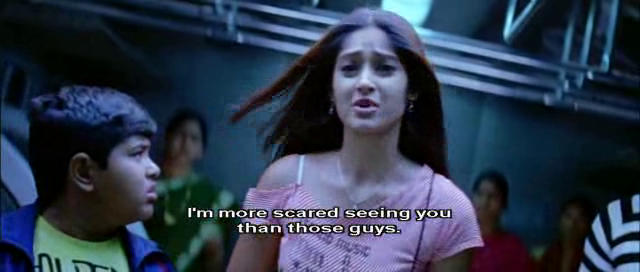
When Pandu finds out he pursues the perpetrators and none of them walk away from the encounter. But Shruthi isn’t grateful or smitten as a result – she is more fearful of her own lack of judgement in pursuing Pandu.

She struggles with her attraction to Pandu and her revulsion at what he does, especially following a squelchingly bloody fight set at Golconda. Ileana is given dialogue that illustrates Shruthi’s strength of character and should show this inner conflict but almost everything emerges as either a simper (I love him!) or a teary whine (he’s so mean!) and she missed the mark. Perhaps it was a question of maturity – she played Shruthi as a girl rather than a young woman which I think this needed.

The songs by Mani Sharma are highly enjoyable and so are the picturisations, possibly not always for the intended reasons. Who needs a comedy sideplot when you have those lanky pale legs in a lunghi?

The romantic duets look less successful as I don’t think there is sufficient chemistry between the couple, or enough actual dancing in their songs together. But I love the backing guys in this.

Brahmi is the neighbour who dresses 30 years too young and keeps cracking on to Shruthi. Mercifully he is mostly quarantined in a sideplot with Ali and Venu Madhav so they torture each other and I ignore it. It’s not really that bad as comedy sideplots go, but I fast forward in their scenes. I would like to suggest that comedy uncle types from all film industries should held in a secure facility on a remote island. There should be a strict ‘one in, one out’ policy that would keep their screen presence manageable. Sunil would be free to roam as he pleases because I find him funny.

Prakash Raj is the shadowy don, Ali Bhai. He is menacing from a distance, but seems less calculating and more self obsessed when he joins the mainstream of the drama. He has some fancy shirts and nasty habits that sometimes tip Ali into caricature.

Ultimately it is Ali Bhai who drives the final showdown. He humiliates and kidnaps the daughter of the ACP to have a bargaining chip. Once again the police are shown as powerless – forced to lie about an arrest to prevent political interference – and working outside the law to deal with this criminal.

Rape is a common threat against the women in Pokiri. It is treated as something serious, although in a very filmi way.  But then Puri Jagannadh shows a rapist’s father demanding to know why his son’s reputation is being ruined. The fact that his son filmed himself raping the girl doesn’t seem to worry him as much as seeing the footage on the TV news. There is also criticism of the tabloid media who glorify and collude with criminals for the sake of sensation and ratings yet demand law and order. Mona sells the rape film to the press and Pandu asks if she is a woman to be able do that to another woman. No such question to the guys in the gang – maybe we aren’t meant to expect morals from them. And of course, that old Telugu film chestnut; if a good person kills a bad person, was it really a crime? Behind all the blood splatter and gunfire there were some interesting notions floating around but they were never going to get in the way of the action.

The climax is brilliant. A slight twist is revealed – when will senior policemen learn not to tell their kids about top secret operations? All the bad guys converge on Binny Mills and Pandu wreaks havoc. There are dismemberments, impalements and all manner of gore, in a beautifully choreographed and filmed sequence that takes full advantage of the location and film technologies. I think there’s a bit too much slo-mo glass smashing, but I can forgive the excited over-use of new technology toys. Vijayan created some iconic set pieces in the fights and they really are stunning.

The support cast are there largely to contribute to the body count although Sudha as Shruti’s mother and Master Bharath as her little brother have some key scenes. Ajay and Subbaraju make the most of their roles and both exude menace and a dark comedic edge. Nasser has a small but crucial part in the drama. I liked Sayaji Shinde, the ACP, in his more restrained scenes. Mumaith Khan turns up too for the obligatory item number.

I think this is Puri Jagannadh at his best. He has the strong visual sense and a knack for picking up interesting concepts, which in Pokiri is meshed with an engaging story and some good performances. If you don’t mind your action bloody and unapologetic, this is for you. 4 ½ stars – a small deduction for Ileana’s snivelling.

Heather says: This was my first Mahesh Babu film, and what an introduction! I think Pokiri has one of the best hero entrance scenes when, after plenty of running feet and leg shots, there is that wonderful moment when Mahesh finally bursts onto the screen surrounded by flying vegetables and chillies. Brilliant! It’s definitely one of Mahesh’s best films where his acting and the action element all come together perfectly to create the total package. I saw the Tamil version Pokkiri with Vijay first and although I think that’s also great, the original Telugu film is definitely much better.

I like the way Pandu transitions from the total action hero and baby faced killer (who is not a nice guy at all), to the devastated son later in the film. There seem to be more shades of grey in the character of Pandu than in some of Mahesh’s other roles and it makes him much more interesting – especially as the film progresses and we learn more of the back story. He does still have an astonishing ability to be able to defeat an average of 20 opponents all by himself which seems to be pretty much obligatory for any Mahesh character. And there’s nothing wrong with that at all!  Pokiri does have some excellent action and fight scenes, and some of the methods used to dispose of various villains are very clever indeed. Full marks to Vijayan for some smart action segments and memorable fight choreography. It’s not just Mahesh who excels in Pokiri though. I’m a big fan of Ajay and his presence in any film always makes it just that little bit better. He’s great here as Pandu’s friend and as usual has some wonderful expressions, particularly as Pandu and Shruthi clash.

I like Ileana here too, as she is convincing as the girl who falls in love with the bad guy despite all her reservations.  Her acting in the scenes where her family is threatened is good and although her reaction to the thugs who burst in on her is a little too weepy for me it does come across as right for her character. I enjoyed the interactions between Pandu and Shruthi although there wasn’t too much chemistry between the lead pair. I put this down to the fact that it would be hard to be very romantic with a guy who spends most of his time systematically slaughtering his way through the various gangs in Hyderabad and Shruthi’s revulsion for Pandu’s lifestyle tends to comes across more clearly than anything else. However they do look good together in the songs and the romance works well enough. The various villains are all excellent although Prakash Raj is perhaps a little too much of a caricature in his role as Ali Bhai. Ashish Vidyarthi deserves special mention for being particularly disturbing as the corrupt cop, and Sayaji Shinde was also good as the police commissioner.

The only downside to the film is the terrible comedy track, although it’s actually better here than in the Tamil version with Vadivelu. While I don’t mind Brahmi’s amorous landlord persona, the scenes with the beggars played by Ali and Venu Madhan are incredibly annoying and just slow down the action. Get rid of that and this would be as close to perfect as it gets. As it is it’s still a fantastic watch for all-out Mahesh action – 4 stars.