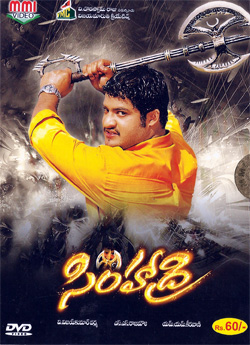
Simhadri

A story told in two parts, Simhadri is uneven. The things I love, I love. And the things I don’t, I really don’t. Rajamouli is always worth watching however, and it is kind of fun to look back at his earlier efforts even when the execution is a little laboured. Tarak is likeable enough, although his acting has improved greatly since 2003.

Simhadri (Tarak) is an orphan living in the household of Ram Bhupal Varma (Nasser) and his wife (Sangeetha). Simhadri is intensely loyal and has anger management issues, and his violence in service of the family is seen as endearing and almost a joke. Anyway, as they keep saying, it’s OK to kill or be killed if it is for the good of people. Tarak and Nasser have some nice badinage and their relationship does seem rock solid and a reasonable motivation for much of what follows. Simhadri is irresistible to women, especially Kasthuri (Ankitha), the daughter of the house. But he spends a lot of time and money with childlike Indu (Bhumika Chawla), and that becomes an issue when Kasthuri finds out. Apparently Simhadri’s style of beating people is medically identifiable and frequently lethal…Or at least that is what a visiting doctor from Kerala says happens when Singamalai beats someone up. But is Singamalai the same person as Simhadri? Why do truckloads of people with many and varied motivations turn up looking for him? Is he leading a double life?

Tarak gets one of the best hero entrance scenes ever, and a quite impractical yet very impressive weapon of choice. The action scenes are crunching and generally humourless, with varying degrees of gore. And he really is delightful in the songs where he is the bumblebee of dance – it seems he shouldn’t be able to move like that but look at him go!

M.M Keeravani’s soundtrack has a dreary orphan song, some cheesy duets, and offers Tarak a range of opportunities to bust a move. It even includes that romantic Indian classic – Cotton Eye Joe!

But Simhadri has to participate in comedy disease shenanigans, and wear some very unpleasant headbands not suited to the hamster-cheeked gent. The obligatory scenes paying homage to the senior NTR are a little overdone, as well as suffering from early 2000s technical limitations. Seeing the younger actors try to leverage their family name while appeasing the inherited fan base and also create their own image is quite interesting to me.

The relationship between Simhadri and Indu is troubling given her childlike mentality. The portrayal is a little flirtatious or at least uses filmi romance visuals which is creepy. Even Simhadri’s family immediately assume she is a prostitute, despite her little girl braids and outfits. And I was appalled by her horrible neighbours. Orphanism isn’t contagious! But despite all this rich material, that renowned wet dishrag of an actress Bhumika uses at most two three facial expressions. The relationship between Simhadri and Kasturi is equally perplexing, although for different reasons. Apparently the way to spark romance is to either scare a man or be scared in front of him. So dropping an ant down your bra and all the following shrieking and jiggling makes perfect sense then. I was kind of glad Ankitha is terrible in this as it would have been sad seeing a good actress enduring the stupidity of the script.

Despite his dubious interpretation of the female psyche, Rajamouli did win a few “you go girl!” points for casting Ramya Krishnan as an item girl.
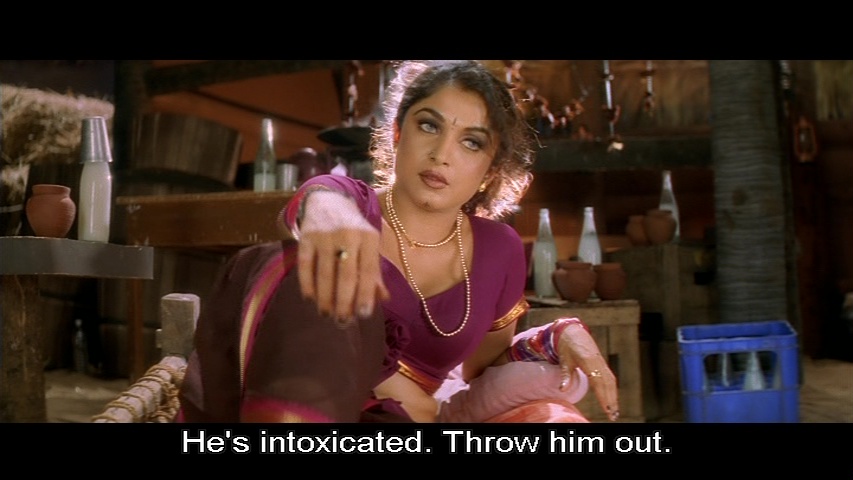
I found it highly amusing that the song is pretty much along the theme of “do you want fries with that”. But seriously, I am so impressed she has managed such a long and varied career and has made some super films along the way.

The support cast is rich with talent and recognisable faces. Nasser is all reasonable and understanding until someone disagrees with him, then it is “my way or the highway”. He is a great foil for Tarak. Mukesh Rishi is vile and compelling as Bhai Sahib, the big bad gangster. Rahul Dev is slimy Nair, who sparks about an hour of graphic violence including rape and torturing children. Sharat Saxena is the ultimate useless policeman who abdicates all responsibility to the vigilantism of Simhadri. Bhanu Chander has a small but pivotal role that relies on him never making a sensible decision. All of these actors are good, but all their characters need at least one tight slap or maybe a whack with the fancy significant weapon. You know I am close to despair when I can say truthfully that Brahmi and his character is one of the highlights. I also liked Rallapalli and Ragini as Indu’s carers, and Hema as the cheeky maid and confidante to Kasturi.

While the pace is a bit draggy, Rajamouli shines in the action sequences where he uses creative visuals to heighten the drama. Simhadri leaps over the threshold and is then seen landing on the road on a motorcycle. When Simhadri takes on Nair’s gang the fight is intercut with a religious festival, reinforcing that he is doing godly work and getting the adrenaline flowing. The final fight scene has Tarak moving at normal speed but the rowdies in slomo, which was an effective treatment compared with just speeding it all up.

There are some issues with the story, but this is not one to overthink the plot. I mean I can think of several other and better ways to solve the old “bomb in the suitcase” problem…but who wants the sensible masala version?

See this for all the mass tricks, a hero on his way to becoming a genuine star, and a director who backs himself to be playful with the big ticket elements. 3 ½ stars!
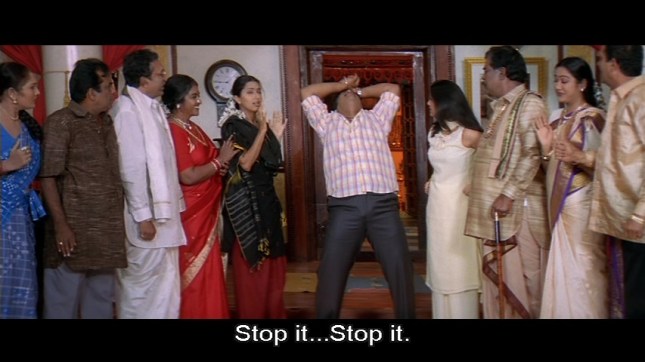
Simhadri-last word

Rangoon (2017)

Rangoon poster

Rajkumar Periasamy’s debut film is a crime thriller that mixes gold smuggling and kidnapping with friendship and betrayal to tell the story of Venkat (Gautham Karthik) and his two friends Kumaran (Lallu) and Tip Top (Daniel Annie Pope). The film moves between the lush landscapes of Myanmar with vibrantly green fields, sparkling water and gigantic gold Buddhas, to the crowded backstreets of Chennai and the Burmese area of the city near Sowcarpet. There is plenty of fascinating detail about the Burmese Tamil population that adds more layers into a story made engaging by numerous twists and good action sequences. Rajkumar Periasamy packs a lot into the run time of just over 2 hours and with the stunning scenery and excellent soundtrack it’s definitely well worth a watch.

The story starts with a young Venkat as he makes the move with his mother and sister from Myanmar to India, where his father has found work. The year is 1988 and the family move to a mainly Burmese Indian area of Chennai where the food is familiar and the locals all have a similar story to tell. Venkat immediately makes friends with Kumaran when he sees him playing Venkat’s favourite game of Chinlone and the two quickly become inseparable, especially after Venkat’s father is tragically killed shortly after their arrival in the city. Venkat grows into a fairly typical unemployed young man who worries his mother and amuses his friends, but there is little work in his area and his disillusionment means he jumps at the chance of a job when Kumaran introduces him to local gold merchant Gunaseela (Siddique).

However, all is not as it seems and in reality Gunaseela is a gold smuggler who is impressed by Venkat’s enthusiasm and business skills. Gunaseela slowly draws Venkat into the business by taking him to Singapore and showing him the basics of the smuggling trade. Venkat is given the responsibility of looking after his own shop and Gunaseela uses Venkat’s sense of responsibility and loyalty to further draw him into the illegal business. However, despite the shady method used to get the gold, the responsibility turns out to be the making of Venkat and he runs his shop as ethically as he can under the circumstances. It’s the small details Periasamy adds that make this part of the film so convincing, such as the way money is transferred to the dealers in Singapore via a totally unrelated shop and the various methods by which Gunaseela’s gold biscuits are smuggled into the country. The brashness of the smugglers and their nonchalant attitude to the police also ring true while a gold traders association where Gunaseela is a member is as dodgy as they come.

Where the film falls down though, is in the introduction of Natasha (Sana Makbul) as the love interest whose attractions are such that Venkat vows to turn respectable and give up the smuggling trade for good. Natasha is a singer and Venkat notices her when she sings the first lines of her song in Burmese. But Natasha’s background isn’t explored in any detail, and instead, as is usual for heroines in Tamil film, once she is established as the reason for Venkat’s decision to change his career, she is rapidly side-lined and only appears to act as a voice of conscience whenever one is needed. Venkat’s friends too get little in the way of character development which becomes something of a problem later on when the three head to Myanmar for one last big deal. Their motivations for coming on the trip are rather murky and some of the reactions don’t ring true, mainly because it’s hard to decide how they should be reacting, given the little that has been shown of their personalities. However, although most of the characterisations are superficial, both Venkat and Gunaseela fare rather better, and their relationship in particular is nicely explored with enough emotion to make it feel authentic and plausible.

There are some excellent twists in the second half but the fast-paced action takes centre stage and the film loses some coherence as characters appear and disappear before their relationship to the plot is established. However, the action is exciting and often unpredictable while the fight scenes are well choreographed, even if very much in the usual ‘hero beats unlimited number of attackers despite being unarmed’ style. The chase sequences where the police and Directorate of Revenue Intelligence attempt to catch Venkat and his friends are also excellent and the tension rises nicely as Venkat starts to run out of time to solve his problems, and his friends and family start to suffer as a consequence. The plot twists are well handled too, and are frequently unexpected, almost shocking at times, which adds to the tension of the second half.

Gautham Karthik really is good here and gets his emotional reactions just right, particularly when he returns to the land of his birth. His confusion and despair later on is perfectly done and fits well with his character’s loyalty and determination to ‘do the right thing’. He does have a voice-over which is occasionally annoying as the dialogue doesn’t relate well to the action taking place onscreen, although that may be a subtitle issue (I’m not convinced though, as generally the subtitles for Rangoon were excellent and included English idioms and slang terms appropriately). What works best is his relationship with Gunaseela and the father/son rapport they develop. This is helped by the jealous reactions of Gunaseela’s right hand man who lingers in the background as an ever-present threat, while Siddique is smooth and supportive right up until things don’t go his way.

The rest of the cast are good and although Lallu and Daniel Annie Pope don’t get a lot to do until the second half, once they get a chance both are impressive despite their limited dialogue. The background music and songs from Vishal Chandrasekhar and Vikram RH fit well into the film while Anish Tharun Kumar does an excellent job with the cinematography ensuring an exotic feel to the portions set in Burma and Singapore while keeping a local and more homely feel to Chennai. Plus there are lots of shots of the food which looks amazing!

Rangoon

The story of Rangoon is excellent and the action well integrated into the screenplay, but the film really didn’t need the romance which comes across as a commercial gimmick without adding anything important other than a couple of good songs. The support characters too needed more time onscreen together to develop their relationships with each other and the major characters, but the two main characters of Venkat and Gunaseela more than make up for these minor flaws, while the film’s various twists keep it entertaining right up to the end. I really enjoyed Rangoon with its mix of drama, action and thrills, and the different landscapes and detailed settings kept the background interesting and realistic. Recommended for the twisty plot, good performances and fast-paced second half.

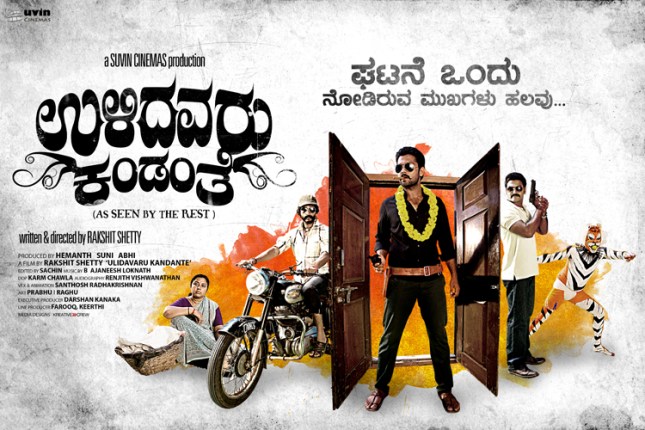
Ulidavaru Kandanthe

Ulidavaru Kandanthe-Poster

Not content with making a name for himself as an actor, in 2014 Rakshit Shetty turned writer and director with his foray into neo-noir crime drama in the excellent Ulidavaru Kandanthe. The English translation of the title is “as seen by the rest”, which refers to an incident seen from a number of different viewpoints that makes up the story of the film. Except it’s not quite as simple as that since the incident itself isn’t revealed until near the end, and even then, it’s not clearly defined. The inspirations are obvious, from Pulp Fiction to Sin City and many more gangster films in between, but it’s the way that Rakshit Shetty has (almost) seamlessly introduced a Rashomon style plot into a very Indian scenario that makes Ulidavaru Kandanthe an instant classic of the new-wave sweeping Kannada cinema.

The film takes the form of chapters based on a series of newspaper articles being written by Regina (Sheetal Shetty) where each interview she conducts gradually reveals more information about the characters and the incident itself. The plot revolves round an unseen MacGuffin that’s stolen by one of the main characters, although to be fair the entire incident is itself a MacGuffin since it’s the characters themselves and the random details of their lives that are the real focus of the story. As Regina interviews the people who were peripherally involved in the incident, we meet a cashew nut seller, a tiger man, a young boy and various gangsters who all have their own views of what occurred on the day in question. It all starts with an old story about 12-year-old Richi who stabbed another boy to death 15 years ago in defence of his friend Raghu. Richi was sent to a remand home for 8 years while Raghu disappeared, but one Krishna Janmaashtami, Raghu comes back.

The story unfolds in a non-linear fashion as each interviewee adds their perception of events. However, rather than just seeing a particular day, what Rakshit Shetty does is show the usual day-to-day events for that person going about their normal life. As far as the action goes, it’s the interactions with key players that inform us as to each major character’s role in subsequent events, but what we really get is an idea of the characters, their thoughts and beliefs and their own impressions of the people involved in the incident. This is partly why the film is so intriguing, as there is no clear-cut description of what actually happened on the fateful day. All we have are impressions, and eye witness accounts of parts of the day, but no-one knows exactly what happened and as the audience we are left unsure as to which version we should trust.

A number of events are shown more than once from different viewpoints, and the more times I watch the film, these repeated scenes throw up more and more questions! I love that my opinion changes slightly each time depending on whose testimony I decide to trust and that I still want to re-watch the film to see if I can spot any other clues. In fact, it’s not until the second watch that much of the film does start to become clear, and once the outcome is known, it’s possible to pick out foreshadowing and significant dialogue that seemed totally innocuous the first-time round.  It’s clever, but not so clever that the film is baffling first time round. It’s more that it becomes richer and more layered with subsequent viewings, and the subtleties of the writing are more easily seen.

The performances too are excellent and contribute to the film’s appeal. Rishab Shetty’s Raghu is somewhat subdued, but then he has escaped Bombay after stealing from his smuggling gang in a stark sequence very reminiscent of Frank Miller’s Sin City. His need to lie-low but desire to contact his mother are well portrayed and in the reunion scenes he is appropriately hesitant and unsure. Tara as Raghu’s mother Ratnakka is outstanding when she meets her son again after 15 years, but she is just as good when gossiping with her friends or selling fish around Malpe. Ratnakka’s story is a short film in its own right, and it allows us to fully appreciate her character and understand her reactions. Not that these are anything beyond what is expected – even down to the usual motherly insistence that her son have something to eat, but throughout Tara conveys Ratnakka’s feelings perfectly and does an excellent job in bringing her character to life. I like the way that Rakshit has given her a life outside of being a mother which gives her character more veracity and empathy.

While Raghu has returned in secret, Richie never left Malpe but instead has made a name for himself as an enforcer for local gangster Shankar Poojary (Dinesh Mangalore).  As Shailesha (Raghu Pandeshvar) puts it so succinctly when he meets Raghu in Bombay, Richie is still a bully and Rakshit Shetty plays him with all the swagger and bravado of a typical Hollywood gangster. It’s often a worry when a director plays a pivotal character as there is a tendency for everyone else to get pushed aside, but that’s not the case here. Rakshit is excellent and his Richie slumps into cars, hitches up his stolen police belt and ensures his reputation for violence is upheld while still ensuring that the rest of the cast are just as important to the story. However, Richie is still the centre of events as he interacts with all of ‘the rest’ from the title, including Regina herself who first saw him as a young by at the remand home. His two sidekicks Dinesha (Pramod Shetty) and Sudhi (Arun Prakash Shetty) have less to do, but each has enough small moments to ensure we have a good idea of their general characters and how they fit into the events of the incident.

My favourite characters though are Munna (Kishore) and Democracy (Master Sohan) who both have significant roles to play in the events of the day. Munna works on the boats as a mechanic, although he gets roped in to painting tigers as apparently that’s very similar to painting boats! Munna spends most of his afternoons following fish seller Sharada (Yagna Shetty) with whom he has fallen hopelessly in love. However, Munna never approaches her and is content to sit behind Sharada on the beach and follow along behind as she walks along the road. His romance adds a lighter note to the film, as does the character of Democracy and his friends who bring energy and life into the film.

I did mention tiger painting, and as part of the festival, one of the other main characters, Balu (Achyuth Kumar) is dancing as one of the tiger men. Achyuth is excellent in his role and the ambiguity of his character is one of the clever touches that Rakshit Shetty has added in to make the story even more captivating. Making Balu a tiger man was inspired and along with the Yakshagana drama ensures the film retains a uniquely South Indian flavour while incorporating many Hollywood themes.

My only issue with the film is that Rakshit Shetty tries to tie everything up neatly by linking events in Malpe to the item stolen by Raghu. I don’t think this works as well and almost seems superfluous given that it’s ultimately not as important as the characters themselves. However, that’s a small quibble and given how much I enjoyed the rest of the film, I’m happy to ignore the unrealistic coincidences and concentrate instead on the characterisations, dialogue and wonderful soundtrack.  It took me a while to track down a copy of Ulidavaru Kandanthe with English subtitles but it was definitely well worth the wait. This style of neo-noir may not be to everyone’s taste but for fans of the genre this is an excellent début from Rakshit Shetty and one I highly recommend. 5 stars!