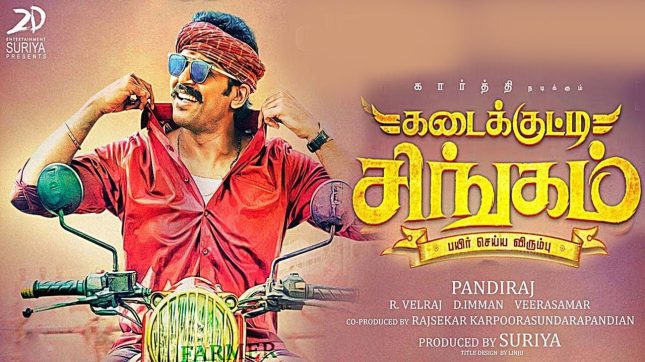
Pandiraj’s latest film is a village-based family drama with an extended cast and surfeit of relationships that ends up feeling more like an over-stretched soap opera. The story focuses on the only son of Ranasingam (Sathyaraj) but it’s his various sisters, their husbands and Ranasingam’s two wives that make the most impact in the rather wandering screenplay. The film includes a number of social messages and the story tends to disappear under the requirements to include the benefits of a career in farming and a myriad of moral issues associated with ‘traditional’ village life. However, Karthik does a good job with his role, the support cast are excellent and the film is full of colour and light, even if it does have an overly melodramatic finale.
The film starts with the story of Ranasingam and his quest for a son. His first wife Vanamadevi (Viji Chandrasekhar) has four daughters which leads to Ranagingham casting his eye about for a second wife. He ends up marrying Vanamadevi’s sister, Panchamadevi (Bhanupriya) who promptly also has a daughter, but before Ranasingam can marry for a third time, Vanamadevi falls pregnant again, and this time the baby is a boy. By the time Gunasingam (Karthi) has grown up, his five sisters have all married and two have grown up daughters of their own. The expectation is that Gunasingam will marry one of his two nieces, but when he sees Kannukiniyal aka Iniya (Sayyeshaa) he is immediately smitten, making a family marriage seem unlikely. Luckily for Gunasingam, Iniya reciprocates his feelings and the two happily embark on a relationship. However, there are a few obstacles to overcome, such as Iniya’s politician uncle Kodiyarasu (Shatru) and Gunasingam’s sisters who all vociferously object to the match.
What works well here are the relationships between Gunasingam and his sisters, and between his sisters and their various husbands. Mounika, Yuvarani, Indhumathi, Deepa and Jeevitha play the five sisters who all have distinctly different personalities, and are all convinced that they know what is best for their younger brother – that’s marriage to either Aandal (Arthana Binu) or Poompozhil (Priya Bhavani Shankar) and a life spent running the family farm. Gunasingam has no problem with the latter half of that plan as he’s proud to be a farmer, and makes a point of announcing his monthly salary (1.5 lakhs) and giving expensive gifts to his family. However, Gunasingam only thinks of his nieces as ‘family’ and he’s determined to marry ‘soda-girl’ Iniya, so-called because she runs a soda business. These parts of the story are well nuanced and I like that Iniya has a successful life by herself and isn’t just on the look-out for a husband to take the place of her Uncle Kodiyarasu. Apparently Iniya’s family follows the same uncle/niece marriage idea, but that’s mainly a method for Kodiyarasu to irritate Gunasingam. Kodiyarasu is a politician, but he’s firm on the idea of caste and involved in an honour killing which leads Gunasingam to report him to the police. The feud between the two men seems mainly to be an excuse to include the message that casteism is bad, and of course, the obligatory masala fight scenes.
While the arguments with Kodiyarasu go on in the background, Gunasingam attempts to deal with his sisters who try everything in their power to break his relationship with Iniya. Being family, they know exactly where to attack for the most impact, and eventually the argument leads to a schism in the family. Added to the rift between the sisters, Panchamadevi leaves Ranasingam, but unfortunately, despite being potentially the most interesting thread in the drama, this gets only brief screen time and isn’t fully developed, presumably because there is so much else going on at the same time. Much of the writing here is excellent, and it’s a shame that the rather more predictable ‘villain’ thread keeps intruding into the more compelling family drama.
The romance between Iniya and Gunasingam mainly takes place during a song, which is probably enough time given that it’s the fall-out from their relationship that is more interesting. Although Sayyeshaa looks somewhat out-of-place in a Tamil village drama, she is otherwise fine in the role. Her Iniya has plenty of charm and personality despite limited time on-screen, and her romance with Karthik is plausible. Karthik too is good as a confident and dedicated farmer who buckles under pressure from his family. He’s energetic in the fight scenes and dance numbers, and his various speeches about how wonderful it is to be a farmer aren’t as pompous and patronising as expected. He also has good rapport with the various members of his family and gets his inner conflict across well. His best relationship is with his nephew (who is roughly the same age) Sivagamiyin Selvan (Soori), which is used to add light-hearted comedy that’s mostly relevant to the story. Soori is actually very good here and he handles the role intelligently which helps add more depth to Karthik’s character.
Kadaikutty Singam Movie HD Stills
I enjoyed the songs from D. Imman which are catchy enough in the cinema, although not particularly memorable. The film looks good too, and cinematographer Velraj captures both the colours of the countryside and the warmth of the community. A word too about the subtitles from Rekhs and team, which are easy to read and in proper grammatical English – yay! Rekhs has also subtitled any significant written signs which is a delight and really does help with understanding the story.
Overall Kadaikutty Singam has too much going on to be truly successful. It’s also let down by an overly dramatic finale that fizzles just when it should be starting to heat up. However, the family relationships are well done and I love the realistic interactions between the sisters and their husbands. There are a few too many moral messages too, although it’s hard to complain given that they fall into the – ‘girls can do anything’ and ‘caste isn’t a barrier to relationships’ baskets that still need more promotion in cinema. It’s also good to see farming portrayed in a more positive light with a nod to the importance of the people who feed the nation. Worth a one-time watch for Karthik, Soori, the excellent support cast and the well-written family relationships.
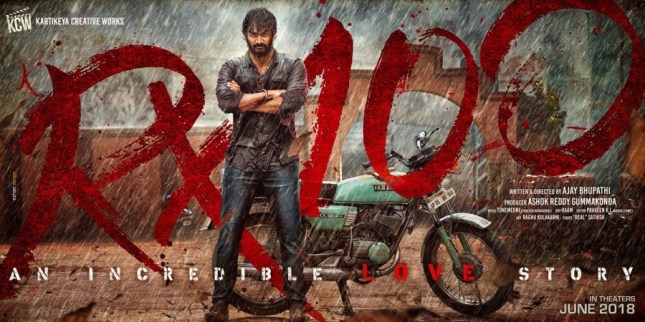
There is an interesting story lurking behind all the violence and sex in Ajay Bhupathi’s directorial debut, but it’s frequently hidden behind a rambling approach and a lax attitude towards editing. The story of a young man driven to drugs and alcohol by the loss of his ‘one-true-love’ also leads to comparisons with Arjun Reddy and Devdas, but the village-based Rx 100 has none of the epic scale or attention to detail seen in these films. However, there are some good points and Ajay Bhupathi has made a real attempt to deliver something different, even if he does falter somewhat with the execution.
Rx 100 is basically a love story (although perhaps not quite as ‘incredible’ as advertised), with various diversions into standard masala-style village-based politics. Where the film takes a different route is in the development of the romance between Shiva (Kartikeya Gummakonda) and Indu (Payal Rajput), and the events that happen after the couple are separated by Indu’s father, Vishwanadham (Rao Ramesh). The first half sets up the background, introducing Shiva as a violent and unpredictable man who beats up one of Vishwanadham’s men in front of a remarkably unresponsive crowd in the local market. The police are reluctant to press charges despite Shiva’s reputation,although the inspector threatens action if Shiva’s guardian (Ramki) fails to control his excesses in future. Despite oddly being called Daddy by all the villagers, Shiva’s guardian is mostly well respected but politics and Shiva’s relationship with Indu have soured his friendship with Vishwanadham, leading to a general rivalry between the two men.
The film moves into flash-back mode to explain how Shiva ended up addicted to alcohol and cannabis, roaming around the village on an Rx 100 Yamaha bike threatening Vishwanadham’s men, destroying his property and generally interfering in his business as much as one drunk can. The flashback starts with Vishwanadham’s win in the local elections and the subsequent celebrations, which just happen to coincide with the return of Vishwanadham’s daughter Indu.
Shiva isn’t particularly impressed by Indu when she arrives back in the village after finishing her engineering degree, mostly because she is rude and disrespectful to her grandmother, but she’s also just not a particularly appealing character. Indu has a sophistication and modern taste in fashion that is completely at odds with her more traditional family, but it’s her approach to romance that really sets her apart. She sees Shiva shirtless during the celebration and instantly falls in lust, leading her to bully her way into his life and basically act like any typical Telugu filmi hero in order to gain his attention. While it’s refreshing to have the tables turned and the girl carry out the stalking, I wonder if it’s really likely that Shiva would be quite so innocent and naïve as he is portrayed here?
Indu teaches Shiva how to kiss, how to smoke and eventually how to have a full-blown love affair as she sneaks away from home and the two head out to the fields on Shiva’s trusty Rx 100. Sadly for the two lovers, their idyllic summer can’t last and just when Indu seems to be ready to speak to her father about the romance, Vishwanadham announces her marriage to an NRI from America. So far apart from the fairly explicit (for a Telugu film) sex scenes and the girl chasing the guy dynamic, the story seems to be following a well-trodden path.
However, it’s the fallout from what happens next that sets the story off on a completely unexpected trajectory, with Shiva spending the next three years pining for his lost love and attempting to seek revenge on her father after Indu leaves for the USA. When Indu finally does come home the revelations that follow alter life irrevocably for both families, ending with a shocking and mostly novel finale.
While the story picks up in the second half, sadly the execution never quite reaches the level needed to make Rx 100 compelling viewing. It’s a real mishmash of good and bad – often in the same scene. For example, when Shiva is dragged from the wedding, he is badly beaten up by Vishwanadham ‘s men and locked in a barn. While it’s refreshing to have a hero who doesn’t have the strength of a thousand men and who stays down after being realistically thrashed, the problem here is that after the first beating, the gang return and do it again. And again. While this may be a nod to the ‘real-life’ story supposedly portrayed by the film, it’s simply unnecessary at this point in the film, and simply drags out the scene for no gain in the story. The same problem occurs with the love-making scenes which seem to be more an opportunity for Kartieya to take his shirt off (again), and for Payal Rajput to show plenty of skin. It’s part of the story up to a point and then it just becomes gratuitous and voyeuristic. Also problematic is the climax which seems to absolve Shiva of responsibility for his excesses while blaming everyone else and generally Ajay Bhupathi tells the story as a flat narrative without much depth or insight into the characters behaviour.
What does work well is the relationship between Vishwanadham and Daddy, with the two veteran actors providing a solid backbone to the story. Both Ramesh Rao and Ramki fit perfectly into their roles and give the film some much needed structure and balance, while of the support cast, Lakshmam is notable in his role as Daddy’s right hand man. Payal Rajput too is excellent, and her portrayal of Indu as an opportunistic and callous personality with few redeeming features is well done. In particular her performance in the finale is fantastic and provides a good contrast to Kartikeya Gummakonda’s rather excessive scenery chewing. For the most part Kartikeya veers between a good representation of a rather naïve and gullible young man and an exaggerated idea of desperation. When he’s not overdoing the emotion, he’s good but dialling back on some of the excesses would have made for a more polished performance and overall a more entertaining film.
Other good points include a polished background score from Smaran and enjoyable songs from Chaithan Bharadwaj along with excellent cinematography from Raam including some quirky shots that bring to mind Mysskin’s obsession with the view at floor-level. The novel approach to a love story is also a selling point, but there is too much dressing and not enough foundation to the story which reduces the impact. Rx 100 may not be an incredible love story, but it is interesting and if you can cope with the uneven delivery it does pay off in the end. If nothing else it leaves you wondering just what Ajay Bhupathi will come up with next.





 Cinema Chaat