NOTA (2018)

NOTA

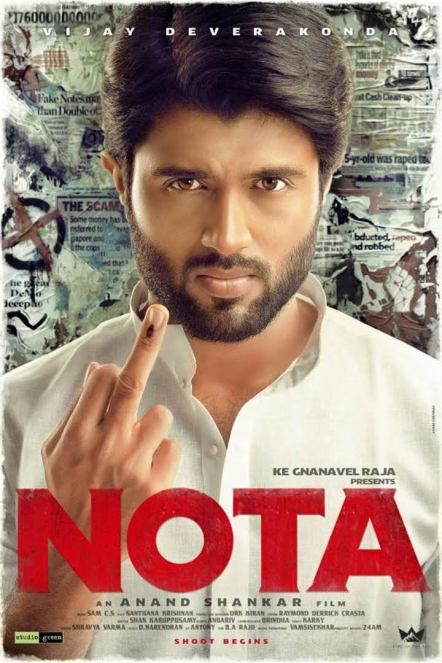
NOTA is a bilingual political /coming of age drama that ends up a step above routine thanks to Vijay Deverakonda’s engaging performance as a reluctant CM. It also helps that director Anand Shankar adds a number of real-life events to Shan Karuppusamy’s story which gives the film more impact. I watched the Telugu version as there were limited shows in Tamil here in Melbourne, and the switch from Tamil Nadu to Telangana didn’t make much difference despite most of the incidents deriving from known political issues in Chennai. The main let-down is the villain of the piece who is poorly realised and under-utilised, however there is enough here to make NOTA worth at least a one-time watch.

The film starts with a song and a drunken pool party for Varun’s (Vijay Devarakonda) birthday. Varun is a video-game designer based in London, but is home to celebrate his birthday and to visit an orphanage he supports. However, on the way back from the party his car is pulled over by the police and rather than being booked for a drink driving offence, instead Varun is rushed home. Varun’s father Vasudev Subramanyam (Nassar) (Vinothan Subramani in the Tamil version) is the Chief Minister for Telangana, but he is stepping down after being prosecuted in a corruption case. Now as an Australian I’m very used to the top political position changing hands frequently, but here the party makes the choice of the new leader. The situation is different in India where the CM gets to choose his successor and Vasudev picks his own son who is intended to be simply a place-holder until the court case is finished. Varun has no interest at all in politics and just wants to be able to head back to London and his life there, but his general fear of his father ensures that he stays in India and does as he’s told.

Mainly this means Varun stays at home, out of the public eye, and signs whatever documents various faceless party men place in front of him. This he does, without even sparing a glance at the documents he’s signing, until everything suddenly comes crashing down after Vasudev is found guilty of corruption. Suddenly it’s no longer a game and real lives are at stake, pushing Varun out of his complacency and bringing him into direct conflict with the party, and his father. This is where a number of those real-life events are brought into the film, such as the Chennai flood, scandals over the fixing of labels to donated meal packets and politicians treated to a stay at a resort. But there are clichés too. Varun gets pulled into the murky world of politics after a riot where a young girl is killed in a bus fire and her mother’s sooty hands leave symbolic marks over his clean white shirt. His response is an impassioned speech which is overly theatrical and to some extent banishes the authentic feel that Anand Shankar manages to create for some of the earlier scenes between Varun and his political mentor, journalist Mahendran (Sathyaraj). For most of the film however, the dialogues and scenarios are appropriate and create a believable character in Varun.

Vasudev Subramanyam was an actor before moving into politics (of course!) and Nasser does an excellent job with his character. Initially it appears that Vasudev is the ‘bad guy’ as he keeps his family under rigid control, but later events paint him in a more ambivalent light which adds interests to the story. Also good is Sanchana Natarajan as Kayal Varadarajan, Varun’s political rival. Her father is the leader of the opposition party and Kayal is determined to bring down the man she dubs the ‘rowdy CM’ by any means possible, regardless of their previous friendship in college. Thankfully Anand Shankar doesn’t burden the film with an unnecessary romance between the two, but instead gives Sanchana free rein to make her character charismatic and a real challenge to Varun, as might be expected in real life.

Sathyaraj is excellent, as is M.S. Bhaskar as Vasudev Subramanyam’s right hand man, only ever referred to as Bhai. What works well here is Bhai’s adherence to the party line and his uncritical support of Vasudev even though he disagrees with his choices. Also telling are the numerous ‘yes-men’ who all abase themselves in front of Vasudev and act much the same way with his son. However a side-plot involving a financial swindle doesn’t fit well into the plot and the entire thread involving the ‘God-man’ who is manipulating Vasudev behind the scenes is clunky and poorly written into the main action. Inevitably these side excursions start to drag down the rest of the film, and despite some good dialogue between Varun, Mahendran and Vasudev, the second half feels stodgy and is hard to digest. Which is a shame as there is much to like in the underlying political story. Varun’s coming of age within the political system is handled well, and his rivalry with Kayal works well to initiate Varun into the dirty side of politics.

There are only 2 songs in the film and both are modern dance numbers, one for Varun’s party and the second at a nightclub where Varun has been drugged.  C.S. Sam’s music is fine but doesn’t particularly stand out and the generic background dancers add even less to the choreography. I’ve added the Telugu version as this is the one I saw in the cinema, but the link to the Tamil version is here.

If the film has stuck more closely to the political issues then this could have been a very good story indeed. Instead the various sub-plots dilute the impact of the political scenes and it’s only the strong performance from Vijay Deverakonda that prevents his character from becoming just another mass movie hero out to save the world. Thankfully there is more backstory and just enough intrigue to make NOTA worth a look, while the real-life political situations do add another level of realism to the plot. The excellent support cast are also well worth catching as they all do justice to their roles. Overall, not a bad début for Vijay Deverakonda in Tamil cinema and another interesting choice for an actor who only seems to be getting better with each film.
Pari (2018)

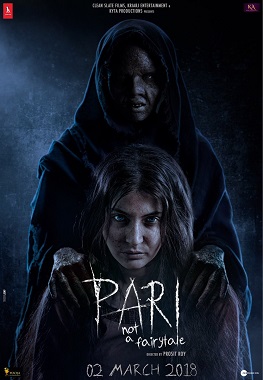
Arnab (Parambrata Chatterjee) and his parents are returning from meeting a prospective bride. Distracted and in heavy rain, nobody sees the old lady on the road until it is too late. They discover a girl chained up in the old lady’s house. Rukhsana (Anushka Sharma) is her granddaughter but there is no explanation for why she is chained up. She is certainly odd but seems able to live independently to some extent. A tattoo on the corpse freaks out one of the morgue attendants who was checking her for valuables. He calls Professor Qasim Ali (Rajat Kapoor), a man obsessed with eradicating all traces of a cult dedicated to spreading an ifrit’s bloodline. He has been looking for Rukhsana, the last of the ifrit’s children, for years. Meanwhile Arnab has taken pity on Rukhsana and has grudgingly allowed her to stay in his home. They fall into a cosy domesticity but there are signs that something bad is coming. Who is she? What is she?

Pari was suspenseful in that I wanted to see what happened, especially to Rukhsana. And there are some good jump scares. But Prosit Roy positions too many things as a fact within this film world rather than building the suspense of “is it real or ?”. Rukhsana shows some signs of mental illness, but Roy makes it clear something supernatural is at work. Having said that I liked a lot about the film, particularly Anushka’s performance.

Rukhsana isn’t a child but some childish things like cartoons take her fancy. Arnab brings home little gifts like clothes and art supplies and teaches her how fridges work, how to dunk a biscuit, and things like that. She’s not interested in learning to cook but she is obsessive about clipping her very fast growing toenails. Anushka does great expressions as Rukhsana starts to open up to the possibility of enjoying her life. Rukhsana realises she can eat fresh white rice and food that is abundant and just for her. She enjoys her new clothes and makes paper jewellery, delighting in how it feels to do something pretty and frivolous. She bonds emotionally with Arnab, and after seeing a cheesy romantic scene on TV one day her feelings for him suddenly go beyond friendship.

Anushka has to switch sharply between the mild, girlish, Rukku and her more damaged and aggressive side. Rukhsana has excruciating stomach cramps, and hides away from Arnab – he assumes it is her period and leaves her alone. But she climbs the wall outsider her room and walks down the street, still in pain. She sees a little dog she had befriended. And kills it suddenly and silently after kissing it affectionately. Face smeared with blood and tears, she is clearly distressed but the pain is gone. She is jealous of Piyali and loses control in front of Arnab. How long can she hold on?

Parambrata Chatterjee is a good fit for the emotionally repressed Arnab. He doesn’t say a lot but is still quite expressive. He doesn’t know what to do about Rukhsana but he feels responsible for the accident. Once they grow closer, he finds excuses not to send her away, and hides the truth from Piyali. He is ambivalent about that engagement but Arnab is the type to try and keep the peace. Rukhsana becomes possessive of Arnab and wants him to break off his engagement with Piyali. But he betrays both women and goes into hiding. Arnab is a bit of a weasel, at best he lacks conviction. But he is the least malignant man in the film so there is that.

Rajat Kapoor is unsettling as the fanatical professor. He genuinely believes he is doing the right thing, and he may be right about Rukhsana, but he is a sadist. He lingers over her demise and wants her to suffer. It’s not a complex character, but the performance is fairly restrained, and creepy.

Ritabhari Chakraborty does what she can with her character. Piyali is generally ignored or forgotten by Arnab but some of their conversations have an impact and she prompts him to think about things from a different perspective. She is open in discussing, and the emotional burden of past relationships. They are chalk and cheese. Piyali doesn’t exist just to make Arnab a better man, although she does seem to have that effect, and she would be perfectly fine without him.

The film is beautifully atmospheric, and lighting and sound are used well. I liked the small world of Arnab’s apartment and the contrast with noisy, bustling, Kolkata.

While not completely successful as a horror movie, Pari also works as a kind of parable. For me Rukhsana also spoke to how women generally have to pay the price for male pleasure. She is the result of a rape, and a man insists she must die because she is an abomination. She never chose to be born but she has a life. Without Arnab’s protection, despite her inherent power, she has no voice in society. He castigates her as if it was all her fault they had sex. The professor and his band of weirdoes don’t just want her to die a clean death, they want her to suffer to pay for existing. There’s also a glimpse of just how quickly people can start to see someone as different and justify inhumane behaviour to them. While the climax of the film is violent and messy, that’s more or less what I expect from this genre. I’d be more perplexed if the evil creatures or the doomsday cult decided they’d had enough and quietly moved on without telling anyone. In the end though, it is a very human gesture that dissipates the threat.

See this for Anushka’s performance in a competent and not so clichéd genre film. Not the scariest thing I’ve ever seen but probably not one for just before bedtime either. 3 ½ stars!

Vada Chennai (2018)

Vada Chennai

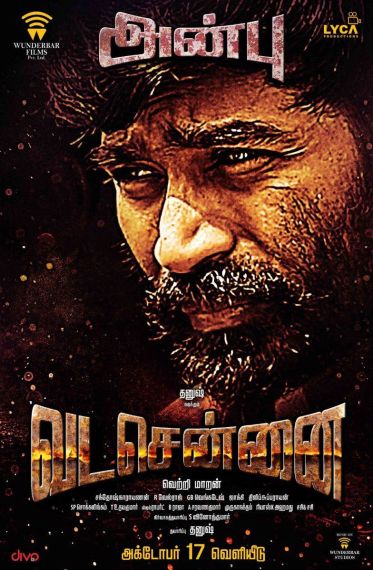
Vetrimaaran’s Vada Chennai is an excellent gangster film and a promising start to his planned trilogy. As with his earlier work, Vetrimaaran’s characters here are complex and their relationships with each other are tangled and multilayered, while the action is more straightforward although often brutally violent. The film lays a solid base for the character of Anbu (Dhanush) but also provides a detailed introduction to a multitude of other characters, all of whom contribute to Anbu’s development and his gradual fall into rowdyism. However, this isn’t a film solely about Anbu, but rather a story about an area of Northern Madras and the people who live in ‘the hood’, which ensures the film delivers more of an impact and gives a larger canvas to develop the main players. With an exceptional cast, detailed characters including strong female roles, and the exemplary performance of Dhanush, Vada Chennai is a compelling story that has all the elements to be a classic of the genre.

The first half of the film switches back and forth in time as various key characters are introduced and their background story revealed in a series of ‘chapters’. Anbu wants to be a carrom player, and Vetrimaaran plays on this throughout the film, using the analogy to show that every small action starts a reaction, the impact of which start yet more reactions, and so on in an ever-widening ripple effect. From that perspective it’s hard to say where the story of the film starts. Is it at the beginning of the film where there is a gruesome murder, or where Anbu saves one of Senthil’s men from being knifed during their registration at Chennai prison? Or is it when Anbu meets Padma (Aishwarya Rajesh) during a thieving spree when a riot breaks out after Rajiv Gandhi’s death? The constant throughout is Anbu’s reluctance to enter into the violence he sees all around, and his desire to succeed as a carrom player, although his ambition seems doomed almost from the start.

Initially the film revolves around the rivalry between two gangsters, Senthil (Kishore) and Guna (Samuthirakani). Both are out to kill each other and they each control separate wings in Chennai prison. However, they don’t start out as enemies and the beginning of the film shows Senthil and Guna along with Velu (Pawan) and Pazhani (Sai Dheena) collaborating in a murder. In a particularly grisly moment, they throw their blood-stained weapons, still festooned with goblets of flesh, onto the table in a restaurant before discussing the recent death of MGR and the likelihood of Jayalalitha replacing him as Chief Minister. After the murder, Guna and Velu go to jail, expecting to be swiftly bailed out by Senthil, but when this isn’t the case, their rivalry is quickly escalated to an all-out war between the two factions.  Vetrimaaran brings politics into the story early, showing that the gangsters are canny enough to use the politicians for their own ends, but also as a foreshadowing that politics; local, gangster and state are behind much of the skulduggery later in the film.

Anbu enters this atmosphere in the prison and after a number of incidents finally manages to fall under the protection of Senthil, with whom he shares a common bond in their love of carrom. Anbu is almost an ‘accidental gangster’ having grown up in a shady area of North Chennai and associated with various gang members for all his life. But it’s after he meets Padma and the two begin their relationship that his problems really start. When local rowdies start to give Padma a hard time, Anbu is moved to protest their actions. One thing leads to another, and Anbu is suddenly running for his life along with Padma’s brother (Saran Shakthi). From here Anbu continually tries to get back to life as a carrom player, but it turns out that the gangsters have another role for him to play.

The rich detail in every part of the film ensures that every character is realistic and the various events occur organically within the plot. Every aspect of prison life seems to be captured by the camera, including the method used by the inmates to smuggle drugs in and out of the jail, while life in the slum area of North Chennai is just as intimately shown. Each character is built up from numerous different interactions along with the flashbacks that add depth and a rationale for their behaviour. Ameer is brilliant as Rajan, a smuggler and gangster who was also a protector of the people and who stood up to the local politicians when they wanted to clear the entire area for their own money-making projects. Rajan is the man who first encouraged Anbu to take up carrom and his influence is felt across the story, although he doesn’t appear until late in the film.

Also excellent are Samuthirakani and Kishore as Guna and Senthil, while Daniel Balaji is another standout in his role as Thambi. In contrast to Vetrimaaran’s previous films, he has two strong female characters here who also have important roles to play in the story. Aishwarya Rajesh’s Padma bursts onto the screen as a foul-mouthed thief, but her interactions with Dhanush are brilliantly done, with the romance between the two always feeling realistic and plausible. The scene where Anbu goes to ask her father for her hand in marriage is a rare spot of comedy in a generally dark film, but it still fits well into the narrative, as does Padma’s insistence that Anbu shaves before his wedding. Unfortunately the gangsters intervene and it seems as if Padma will also take a second place with her husband.

Andrea Jeremiah is also superb and has an almost Shakespearean role as first Rajan’s and then Guna’s wife, Chandra. She has a godmother who interprets various omens and predicts the future, most notably proclaiming Anbu as ‘the one’, while Chandra herself is a complex character whose dialogues always seem to have a number of meanings. Andrea Jeremiah initially seemed out of place, but as the film develops and her character evolves she ends up fitting perfectly into the role and her initial aloofness makes perfect sense. Dhanush is perfect as Anbu and completely fulfils the role of a gentle man, driven to violence by events outside his control. He easily slips into the role of a teenager but his real strength lies in the more complex older Anbu who has to deal with his time in prison where everyone seems out to get him. The gradual development of Anbu’s character over the course of the film is brilliantly done and Dhanush captures each facet of his personality and slowly allows the persona to develop. It’s another masterful performance and it’s only at the very end where the change from gangster to ‘voice of the people’ seems rather too abrupt, perhaps because the rest of the characterisation has been so slow and detailed in development.

This rushed feeling at the end is really the only downside to the film. In interviews Vetrimaaran has said that he initially had over 5 hours of film which he has condensed to 164 minutes, which may account for the hurried feeling and the final fast metamorphosis of Anbu. However, despite this, the detail included in the film is comprehensive and the layering of events and characters is a major plus that works to build the entire world of North Chennai inhabited by the characters. There are also some stand-out action scenes in the midst of all the character development. A fight that breaks out at a carrom competition in the jail is beautifully filmed as the protagonists battle it out while simultaneously holding up the shelter over their heads. The initial murder, which is shown in detail later on, is also excellent with a brilliant build-up of tension in the moments leading up to the actual attack. Velraj perfectly captures all the action and despite the dark tones, his cinematography paints a surprisingly colourful picture of life in the area, while some scenes, such as a pursuit though lines of hanging washing are excellent in their picturisation.

Although there are a number of songs in the film, these are used only in short bursts to highlight a particular scene, but Santhosh Narayanan’s background score is perfect and thoroughly enhances the film without being intrusive. Some of the melodies are beautiful and it seems a shame that they aren’t heard in full in the film, but there really is no opportunity for any love songs or dance numbers and with so much else in the film, they really aren’t missed.

After working together on Polladhavan and Aadukalam, Vetrimaaran and Dhanush have again produced another excellent collaboration in Vada Chennai. As the first part of a trilogy there is inevitably a lot of time spent on setting up the story, but here that is so detailed with numerous interwoven threads, that the film is almost complete in itself. The strong cast and compelling storyline ensure that even at almost three hours the film doesn’t feel overlong and the final scenes deliver plenty of anticipation for the next instalment. Hopefully there won’t be too long to wait!