Teri Meri Kahaani

At the opening of the Indian Film Festival last week in Melbourne, Kunal Kohli promised us a simple but funny love story in his latest film, and I think that Teri Meri Kahaani keeps that promise. It’s a shame that he was here with Shahid Kapoor and Priyanka Chopra last week rather than for the world premiere in Melbourne last night, but there was still plenty of anticipation and excitement in the totally sold out theatre. I have to admit that I wasn’t expecting too much from the film given that most recent Hindi releases have been disappointing and yet another love story seemed unlikely to tread new ground. My main hope was that there would be at least one song where Shahid would actually get to dance, but as it turned out there were two great dance numbers, some wonderful costumes and scenery, and the film was really sweet and enjoyable.

Teri Meri Kahaani combines three love stories which all have a common theme but take place in three different decades.  Shahid Kapoor and Priyanka Chopra are the couple who fall in love each time but in all three stories there are complications which threaten to destroy their happiness. There isn’t anything outstanding or even very different in the love stories, but each reflects the era in which they are set and the variation in style keeps things interesting.

The film opens in sixties Bombay and the period has been wonderfully recreated with the help of computer graphics and some lovely rickety old trams. The recreation is explained in the end credits for anyone who is interested and it does looks very realistic to me, although I don’t really have any idea of how Bombay did look in the sixties.

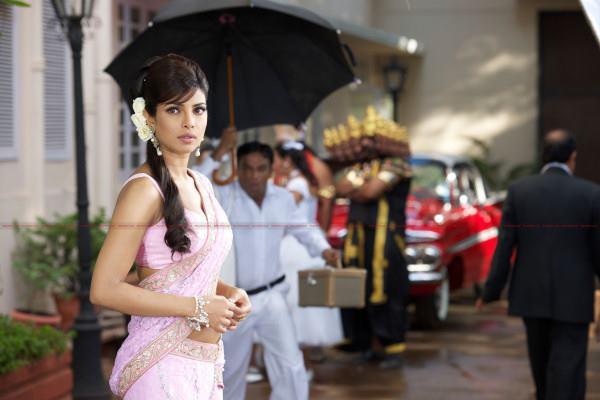
Shahid plays Govind, a musician who has come to Bombay to find a job in the movie industry. Along the way he meets up with the latest rising star, Ruksar (Priyanka) and the two have an immediate connection. While Govind channels Shammi Kapoor and mooches around the studios looking for employment, he also finds time for romance – which in true sixties style he does by means of a song. Watch out for the backing dancers who totally throw themselves into the shimmy and shake!

Apart from the scenery, this whole section does feel very sixties with musical stings and lots of big brass sounds along with the rock and roll. The camera angles recall some of the classic sixties films and Shahid looks very dapper and dashing. Priyanka looks stunning and is a perfect fit as the typical sixties heroine in some very beautiful sparkly costumes. Prachi Desai has a special appearance and makes the most of her short time on-screen, although she really doesn’t have very much to do. It’s all very glamorous and the focus throughout is firmly on the lead couple who exude modern sixties style. But the course of true love never runs smoothly and just before the film moves to the present day, Ruksar and Govind look destined to part forever.

The film then moves to 2012 where Krish (Shahid) is a student based in Stratford-upon-Avon where he meets fellow student Radha (Priyanka) who is on a day trip with friends to the birthplace of Shakespeare. Again the couple have an instant connection and start an online relationship after Radha moves back to Nottingham. There are many, many references to Facebook and Twitter and this did get rather wearing, as surely they could have phoned each other occasionally rather than just sending endless pictures and updates to each other? But maybe that’s just a sign of my age and perhaps that’s really what young couples do these days. This still was the least satisfying of the three stories – Priyanka wasn’t very convincing as a student and neither character had much development beyond the romance. There were various friends of the pair, but they never got to say any more than a word or two to say, and again the story focused primarily on the two leads. Neha Sharma has the special appearance here but doesn’t have much of an impact. On the plus side, I used to live in  Nottingham, and it was good to see different parts of the UK instead of perennial favourite London.

The final story starts just before the intermission and it’s both funny and sad. It’s interesting that Kunal Kohli chose to have his couple studying in England and then immediately follow that with a story which deals with opposition to British rule in India, and features stereotypical heavy-handed English soldiers. It’s such a tired old chestnut and it would be really nice to see this handled in a different way for a change, but instead the British characters follow the usual formula although they do only appear peripherally.

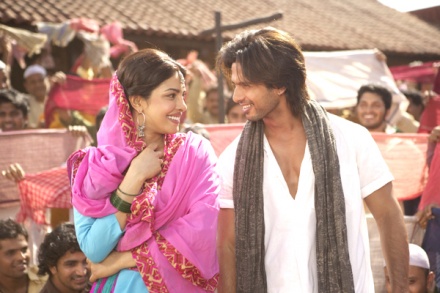
This story is set in a village near Lahore in 1910 and is another change of style and a total change of pace from the previous two romances. The support cast do have more of a role to play here and it helps makes this the best of the three tales with more back story and development of the two main characters. Shahid plays Javed, a womanising layabout who introduces himself as God’s gift to women – literally! He’s a Muslim, while Priyanka’s character Ardhana is the daughter of a local Sikh activist, so already there are problems with the idea of any marriage between the two. Javed has some of the best lines in the film, and while many of them are really corny, the way that he speaks them in couplet form makes them seem funnier than they really are. His appreciative friends add to the humour and even Ardhana gets a few punchy lines as she berates Javed for his unsavoury reputation. Shahid’s costumes here were long kurtas which made him appear very chunky, but the unshaven look and scruffy hair did suit his character, and I liked his arrogant but relaxed manner as Javed. Priyanka again looked beautiful in some wonderfully colourful costumes and was totally charming in her village-girl role. Throughout the film, Priyanka and Shahid had sparkling chemistry together, but it was probably at it’s best and most apparent in these scenes.

Teri Meri Kahaani’s three love stories seem to hearken back to the films of Yash Raj with their focus on simple stories, lavishly made sets and beautiful costumes – perhaps not surprising since that is where Kunal Kohli started his career. The film depends heavily on the performances of the two main leads and both Shahid and Priyanka deliver, making a convincing couple each time. Sajid-Wajid’s music suits each era and it’s great to have a couple of big dance numbers where Shahid gets to strut his stuff and Priyanka at least looks as if she is enjoying herself. I loved the costumes and the sets and while the film is basically light and fluffy romance it’s cute and funny without being sickly sweet. I am a huge Shahid Kapoor fan and that probably does make me just a little biased, but this is definitely one of his better films in recent times. Kunal Kohli has gone back to basics and it works! Definitely worth watching if you are a fan of either of Shahid or Priyanka or just want a non-taxing enjoyable night out at the movies.

Bhookailas


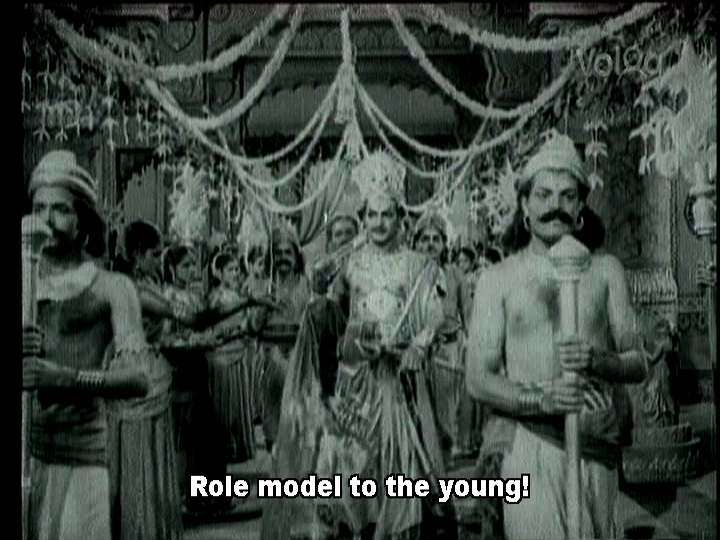
Bhookailas is replete with all the necessary elements for fine entertainment; great actors, beautiful music, lots of excellent dancing, fabulous sets and most important, a good story. It’s not just a fluffy fairytale or fantasy though as there is some philosophy underneath the gilding. But more than anything, it is a great entertainment and a pleasure to watch. (The Volga DVD has good subtitles and the picture quality is fine on screen although poor in screencaps.)


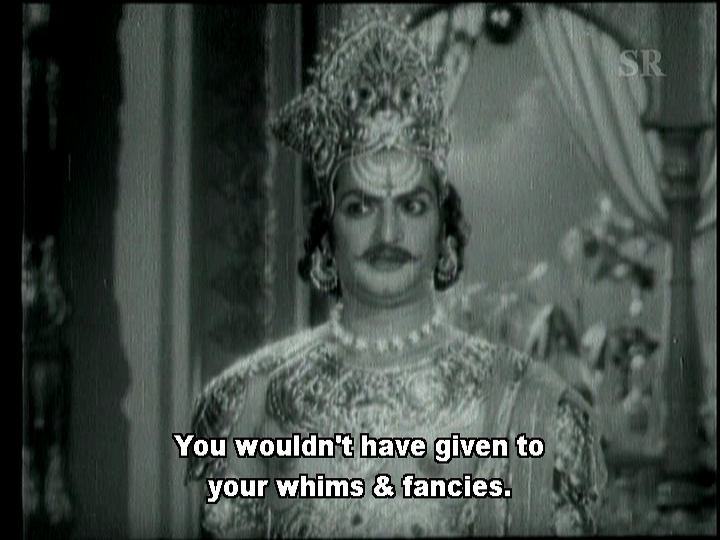
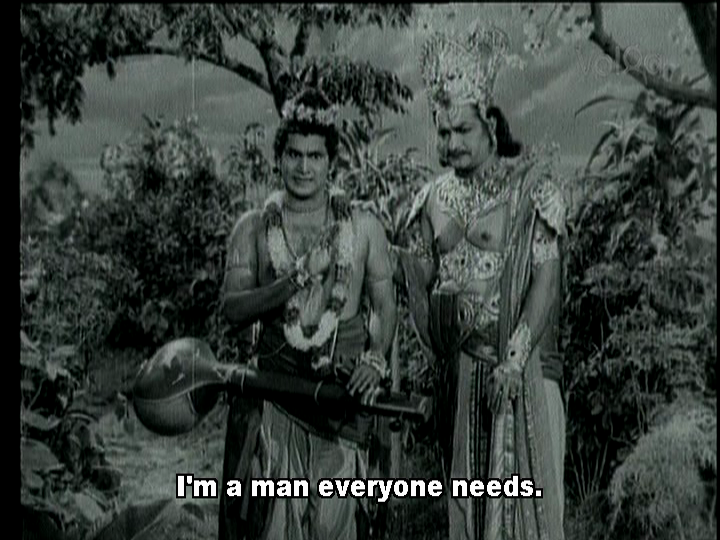
Ravana (NTR) has conquered the human world and is at a loose end. Being a magnanimous ruler, he asks his brother demons what they want as a reward for this victory. His generals suggest a sleeping festival (excellent!), peace and justice for all, and finally that he declare war on heaven as the gods are worthy opponents for demons, not like frail humans. In order to avert this war which Ravana will likely win, the sage Narada (ANR) starts conniving and scheming to keep Ravana from invading.


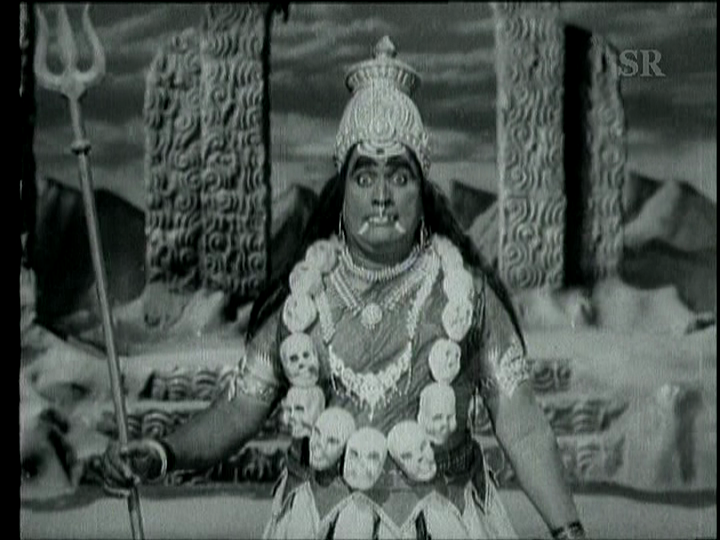
Ravana is brave, intelligent, principled but very impulsive and has little self control. NTR is in his element as the larger than life Ravana. He creates a sympathetic character but one whose flaws are all too evident. The character spans broad comedy, doe eyed romance and the aggressive assurance of unchallenged leadership. Ravana is easily manipulated by Narada, Vishnu, Parvathi, his own mother and Ganesh among others.

His lack of insight and self awareness brings him undone when he has the potential to rival the gods should he focus his will. So he is like lots of men we all know- asked to bring back one specific item from the shops, and coming back with either nothing or something completely random.


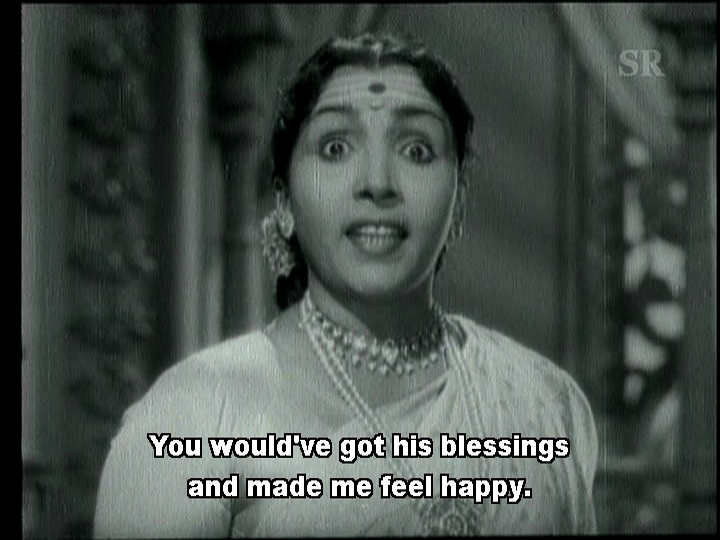
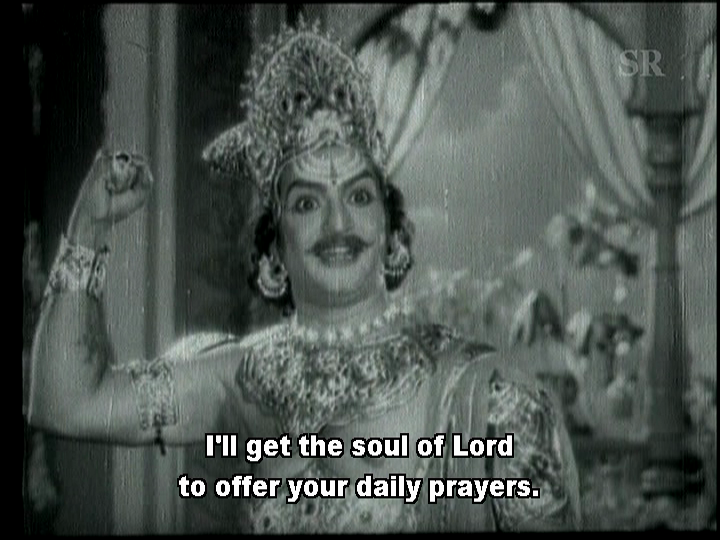
Ravana’s mother Kaikasi (Hemalatha) is a devotee of Shiva. When her prayers are disrupted to stop her gaining Shiva’s benediction, she charges Ravana with making Shiva answer her prayer. He is a total mummy’s boy. He takes it one step further and promises to bring back Shiva’s atmalingam, his soul, for her to pray to. When he decides to beseech Shiva through rigorous penance, not even Helen can distract him.

But he loses this focus and falls under an illusion that sends him off on a tangent. Ravana’s quest to win back that blessing from Shiva takes many detours thanks to Narada.


Narada (ANR) is intent on maintaining the status quo. He plays on the susceptible Ravan and the change resistant gods. He puts the wind up heaven with dire predictions about what will happen should Ravana succeed. He stirs up Ravana’s impulsive and suspicious nature to manipulate him. ANR’s performance is lots of fun with a supercilious eyebrow here, a self serving whinge there, and a whole lot of economy with the truth. He sabotages Ravana’s request for a boon from Shiva, using illusion to persuade Ravana to ask for Parvathi as his reward. But the plan doesn’t play out exactly as Narada hoped, and he scrambles from drama to catastrophe and back again with only his wit and sophistry to help him navigate between the gods and demons. The gadfly tactic manoeuvres the protagonists, sets up conflict and also provides some of the more comedic moments.


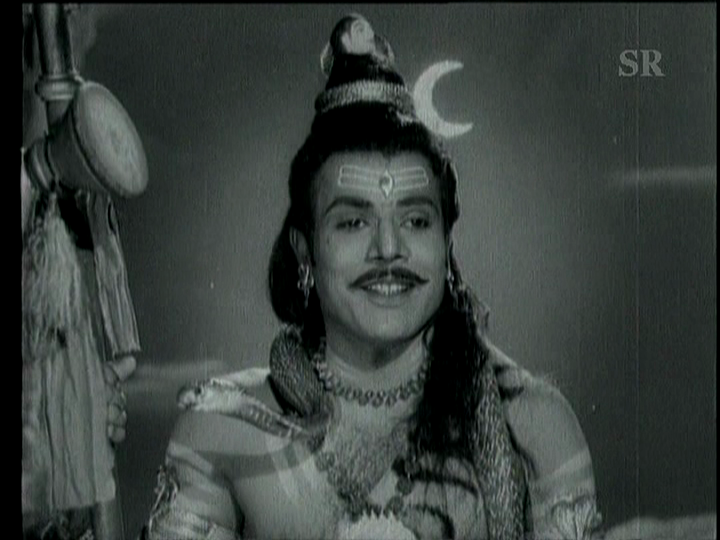
Shiva’s alert and active snake companion was a highlight. The snake is quite interested in the proceedings. I was picturing the person responsible for snake directing and the bag of tricks they must have employed. Occasionally the snake would have a snooze and seemed to be waiting for someone to do something entertaining. Nagabhushanam portrays Shiva in a more paternal style, taking an indulgent approach to his devotees most of the time.

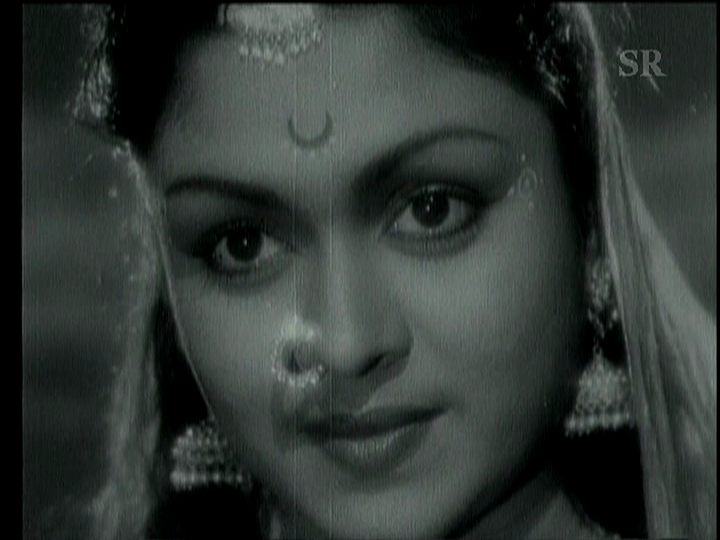
Parvathi (B Saroja Devi) is beautiful and stately and her role requires little more than that. Parvathi is used as a pawn in the game Narada is playing with Ravana, and despite her power she finds herself being carted around from pillar to post. But finally after prompting from the ever helpful sage, she uses her own power of illusion to break free. Apparently Ravana couldn’t see her inner beauty.

Mandodari (Jamuna) is Mayasura’s daughter, and persuades herself to fall for Ravana. Jamuna is lovely but she looks a little too mature and knowing to be totally convincing as the young and inexperienced princess. Her handmaidens joke about how Ravana will be a bucktoothed crosseyed hunchback and then tease her when they see she has feelings. Mandodari is very privileged and enjoys the finest things in her father’s lavishly decorated aquatic themed underwater kingdom.

But she has a hard time of it when she gets the husband she wants and discovers he was under the impression he had married the goddess Parvathi. Mandodari is another unwitting player in Narada’s plan to keep the three kingdoms in their proper place.

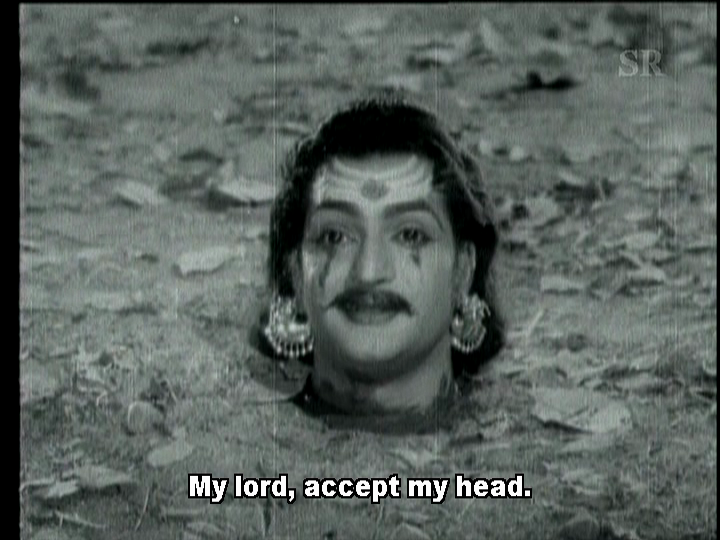
After all the trickery and deceit, Ravana offers penance in very dramatic style, cutting off his own head. It makes the acts of contrition my school priests used to dish out look pathetic. Ravana wins forgiveness but fails to triumph thanks to his inability to stay on task. Again. He neglects an instruction, disregards a warning and jeopardises the very thing he had struggled for.

His flaws were his undoing and they were all things he could control or learn to manage. Luckily his failure created something very special for the human world, so the film ends on a cheery note.


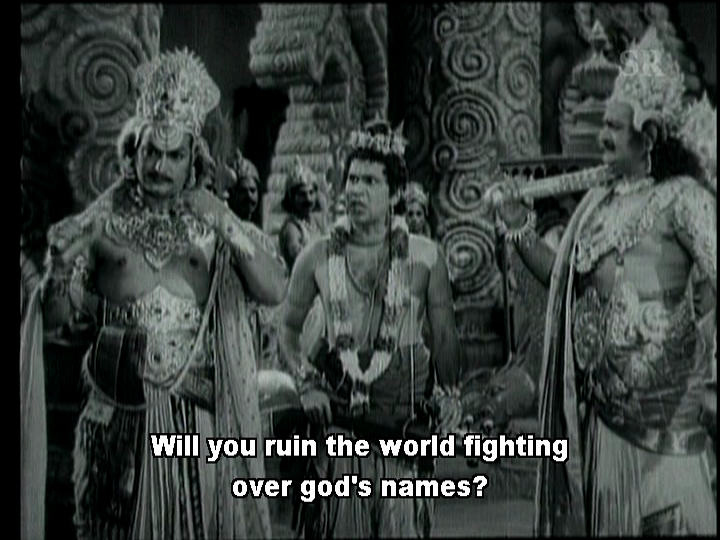
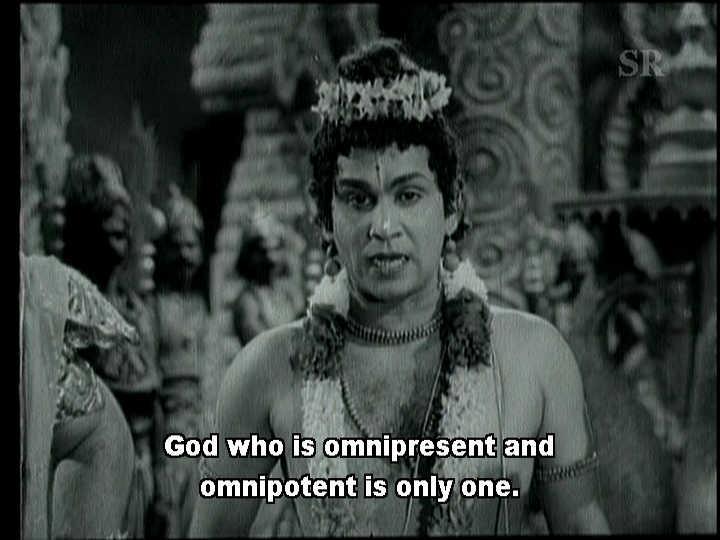
The animosity between would-be in-laws Ravana and Mayasura (an ebullient S.V Ranga Rao) is due to their worship of different gods – Shiva and Vishnu. There are some very pointed references to this, including Narada rebuking them for not realising that god is one and omnipotent. I wondered if this speech was in response to current day issues or purely part of the story. It seemed to be directed straight down the barrel of the camera which made me think it was at least partly commentary aimed at the audience.
The songs are particularly enjoyable, even more so with the bonus of excellent dancers. The songs are directly linked to the story so expand on things or underline issues. In Mayasura’s palace Kamala Laxman performs a very elegant dance depicting Vishnu’s avatars, while Gopi Krishna dances in a more wild and entranced style in devotion to Shiva.

The visual effects are simple, and the use is restrained, so they also enhance the atmosphere of a world outside of human reality.
As with many of the devotional, religious and mythological films from the 50s and 60s that I’ve seen, you don’t need to know anything about the main characters as a preqrequisite to enjoy the story. Bhookailas is beautifully self-contained, and K. Shankar has structured it to make the story accessible and entertaining. Watch this for the rattling good story, the wonderful actors and the visual riches. 5 stars!

Heather says: I found Bhookailas to be an interesting film as it shows Ravana from a totally different point of view. NTR’s demon king is depicted more in his ‘devoted follower of Shiva’ character rather than the more traditional ‘Ravana as the embodiment of all evil’ and for most of the film he is heroic and really quite dashing. It’s quite a change as I think this is the first film I have seen where Ravana hasn’t been just the villain that everyone is supposed to hate and it does make for a fascinating story.

NTR is excellent in his role and his depiction of Ravana’s all-conquering and all-powerful king is very believable. His devotion to Shiva is well shown but even better is his colossal arrogance which NTR hits just right, and when Ravana loses his temper there is a real edge which brings out his demonic nature clearly. However, Although I really liked NTR here, the standout performance for me was ANR. He is brilliant in his depiction of the sage Narada, and I think that this is probably the best characterisation of the trouble making sage I have seen. Narada’s frequent nods, winks and knowing looks are very well done, and he excels in causing trouble for trouble’s sake. ANR hits the character perfectly and his mannerisms and facial expressions make his scenes very enjoyable to watch.  The interactions between Narada and Ravana are also very well written, and both actors work very well together to bring their characters to life.

As Temple has mentioned, there is very little scope for any of the female roles here, and Hemalatha as Kaikasi probably has the role with the most substance. I enjoyed her performance and her exasperation at her impetuous son was excellently done. I wasn’t very impressed with Jamuna’s Mandodari and all her simpering, but I did love the underwater palace where she lived. Seeing Helen pop up in a song was a lovely surprise, and I was suitably impressed that Ravana was able to ignore her wonderful dancing as he meditated. Great music, fantastic performances and a thoroughly entertaining story make Bhookailas very well worth watching and I thoroughly recommend it. 4 stars.

Anjathey

Anjathey is just over 3 hours long, tends to veer occasionally into OTT melodrama and only has 3 songs, but still manages to enthral with some good performances from the cast, excellent camera work and an engrossing storyline. Director Mysskin takes a story about two friends and the wedge that drives them apart, and weaves it through a crime thriller without losing any of the intensity he creates in the opening scenes. Its slick, the pace is relentless but the main characters are still clearly drawn and each has a well-defined role to play in the drama. There is so much that is different about Anjathey that it’s annoying when a few clichés do creep in, and the film does suffer from an overly long climax. But despite these few flaws and a truly terrible wig worn by one of the villains, it’s an impressive film and did inspire me to seek out Mysskin’s other excellent movies.


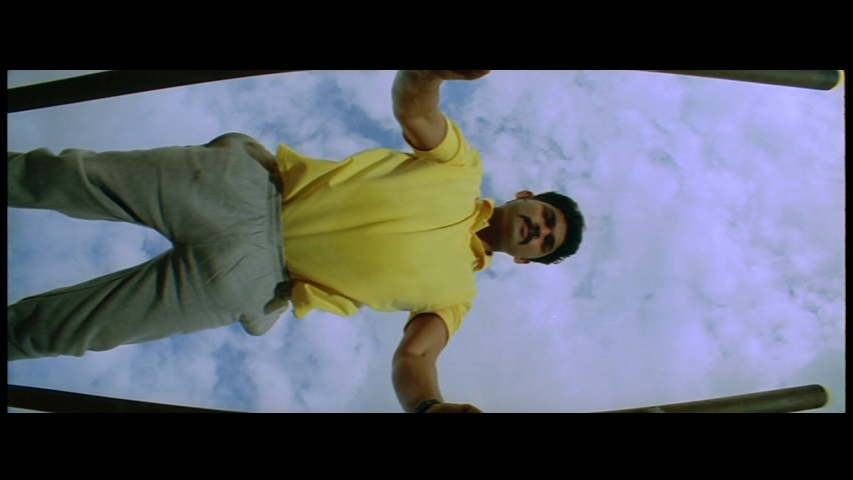
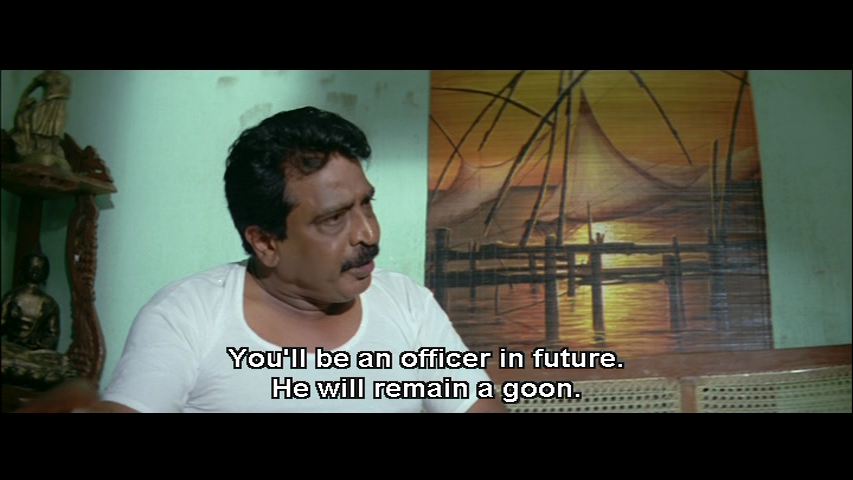
Anjathey starts with shots of the sky and the characters only appear as brief glimpses from an odd angle while the action builds. It’s a different approach, one of many unusual camera angles used throughout the film, and helps to build the characters of the two men by contrasting the first appearance of Kripa (Ajmal Ameer) with that of his best friend Sathya (Narain) who is shot more conventionally. Although the two are both sons of policemen and live opposite each other in the same colony, the similarities end there. Kripa is dedicated to his dream of becoming a Sub-Inspector in the police force and to that end he trains and studies every day. Sathya on the other hand is a drifter with no real aim in life and is happy to spend his days lazing around drinking with his friends. Sathya’s father is not impressed by his son’s lack of ambition and constantly compares him unfavourably with Kripa, which does nothing to improve their already strained relationship. Finally after a very public dressing down at a temple festival, Sathya decides to prove his father wrong and applies for an SI position at the same time as his friend.


The different attitudes and personalities of the two friends are illustrated in the way they tackle the exam and interview; Kripa is tense and eager to excel, while Sathya is laid back and relaxed. He has already arranged for his influential uncle to ensure he gets a place and ultimately he has no real desire to be a police officer, so failure just means his father proves his point once again.


Sathya is accepted as an SI, but Kripa fails the selection process which makes him resentful and bitter. To the dismay of his friends, he turns into a drunken layabout which in this film means a wild hairstyle and a tendency to abuse the local bar staff. Meanwhile Sathya discovers that he likes the deference he gets from the community in his new job and also enjoys the perks, although his early career of brawling hasn’t prepared him for the gruesome reality of life on the force.


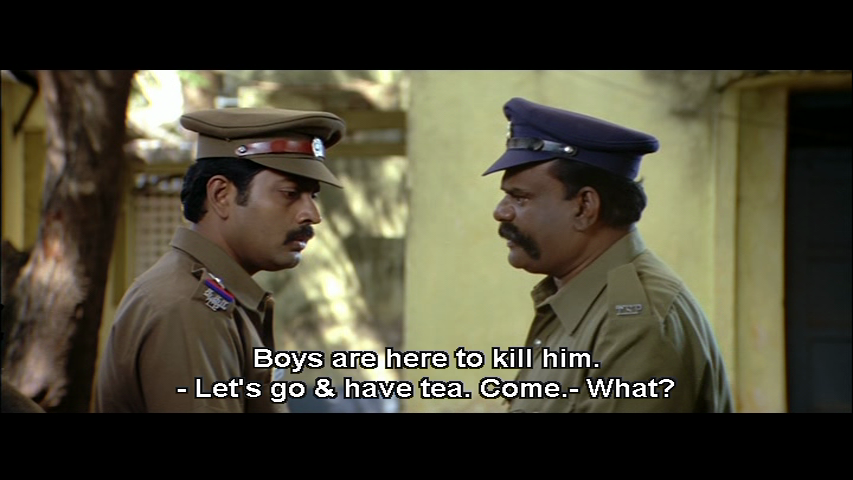
The rather abrupt turnaround by Kripa is a little unconvincing given his early dedication and generally decent persona, but the gradual change is Sathya is well written and Narain portrays his growing pride in his uniform well. However this is also where those clichés start to appear, and Sathya quickly becomes a one man army capable of overcoming armed gangs of thugs with ease. Even more ridiculous is the ‘one by one’ attacking strategy employed by the gang when a concerted rush would have removed Sathya easily – how come the bad guys never know this? However the small details that show Sathya’s concern for his friend and his determination to become a good police officer go some way towards compensating for the filmi hero antics. The local police aren’t so much corrupt as lazy and their preference for the easy way doesn’t fit well with Sathya’s newly discovered ambition. But Sathya isn’t perfect either and the flaws and shading of his character are more in keeping with the realistic style of the film than his occasional forays into crime fighting superhero.


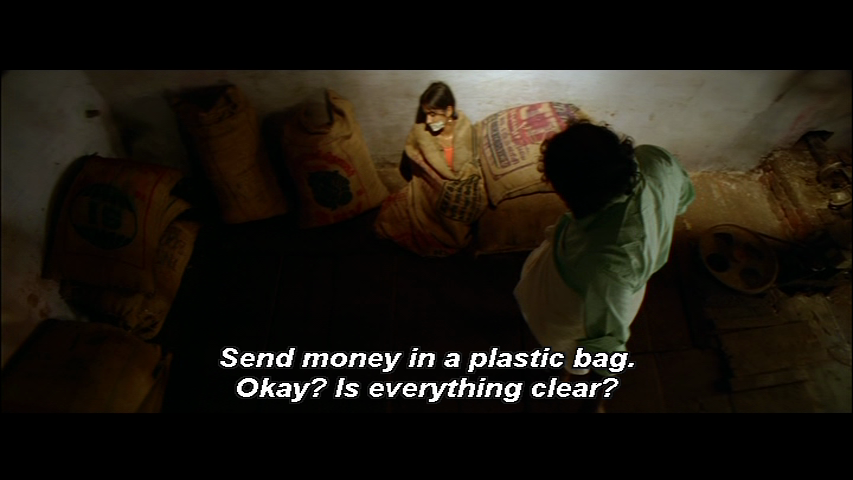
However, where Anjathey really excels is in the depiction of the criminal gang operating a kidnapping ring in Sathya’s area. The gang is strictly small time and there are no mega maniacal big boss scenes or ridiculous schemes to extort money. Daya and Logu, along with a couple of sidekicks, focus on kidnapping young girls who are kept unconscious in sacks before being ransomed back to their families. Their operation is basic but feasible and Prasanna as Daya makes a convincingly creepy villain. Full marks as well for managing to look menacing in that dreadful wig! The interactions between the characters are all very well written to give a sense of the different personalities and their very ordinariness makes their actions all the more chilling.


Pandiarajan starts off well as Daya’s partner in crime Logu, but once the gang are on the run he becomes a whimpering coward and loses some of his credibility. Interestingly one of the other gang members is never shown in any detail and his face is never seen although he does appear frequently and has a major role to play in the gang. It’s one of the strengths of the film that the support cast have well written roles and create an impact even with their short time on-screen. ‘Bomb’ Ramesh who plays Sathya and Kripa’s friend Kuruvi deserves mention for his antics, but the old lady who helps Sathya with an injured man on the street and Vijayalakshmi who plays Kripa sister Uthra are all excellent.


Once Kripa is recruited into their organisation it’s obvious that the film is going to end up with a show down between the two friends, but the journey to get there is kept engaging by the police operation to track down the kidnappers. It’s kept reasonably realistic and there are no overly dramatic shoot outs or suicidal rescue attempts to interfere with what becomes a serious police drama. And I do always appreciate a good white-board moment.

The liberal use of free camera does suit the suspense of the police drama, but Mysskin also uses some odd camera angles and unusual shots. One scene is filmed entirely at a few inches about the floor, and it’s rather bewildering until the last few seconds where with one of the character’s actions it suddenly makes sense. Not all of the techniques work however, and occasionally it feels as if the director was trying out a variety of different styles just to see how they would look rather than to create a specific effect. But the cinematography by Mahesh Muthuswami is excellent and there is good use of shadows and unconventional lighting techniques to add atmosphere and tension to the plot.


There are only three songs in the film and at least two of them seem superfluous. The story isn’t one that needed an item song, or even a romance, although the relationship between Sathya and Uthra is kept very much to the background. However I really like this song featuring the friends’ dancing in the pub and it fits well into the story.

Anjathey is a complex film that  sucessfully combines a number of themes. It’s a story of friendship, a thriller, a crime drama and also throws in a touch of romance. Overall it’s compelling viewing and I recommend it as an entertaining and rather different style of film from Kollywood. 3 ½ stars.