Race Gurram (2014)

Race Gurram

Race Gurram was very nearly a non-starter in Melbourne, but at the 11th hour the distributors managed to find a venue and the race was on!  Better still, there were English subtitles – even for the songs – a first for Telugu cinema here in Melbourne, but hopefully not the last.  So, with a small but luxurious cinema, subtitles and the promise of Allu Arjun for just over 2 ½ hours, was the experience worth all the effort to get the film onscreen? Definitely!  Race Gurram is a mass entertainer that doesn’t break away from standard masala fare, but still manages to leave you laughing at the end.  That’s thanks mainly to strong performances from Bunny and Brahmi, while the usual suspects who make up the rest of the cast are a bit more hit and miss.

Apart from Allu Arjun’s introduction with a herd of horses and a few brief dialogues between our hero and the main villain, I’m not entirely sure why the film is called Race Gurram.  It has nothing whatsoever to do with the race track, and instead is a tale of acrimony between two brothers, Ram (Shaam) and Lakshman (Allu Arjun).

Race GurramRace Gurram


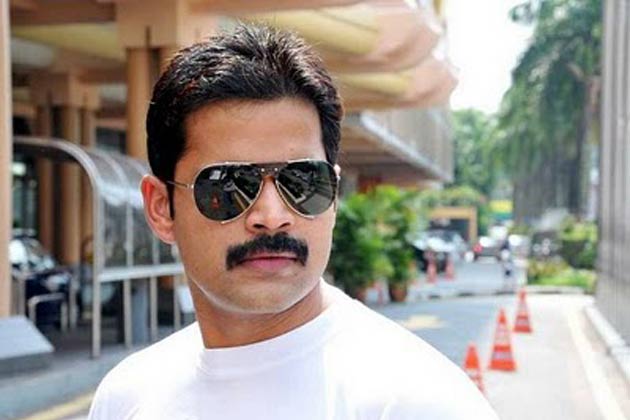
Ram is the elder and more sensible brother. He’s an ACP and is the standard morally upright policeman that Telugu films like to use as a sacrificial lamb.  Lakshman prefers to be called Lucky, because apparently it sounds ‘cooler’, which is probably enough of a clue to his feckless and irresponsible character.  The interactions between the two brothers are one of the strengths of the film and Shaam and Bunny make their exchanges seem natural and realistic.  Their arguments are just petty and immature enough to ring true, and when the situation escalates after a few more personal jibes, Lucky’s response is also in keeping with his personality. The way their relationship develops later in the film is also well handled, even if Lucky’s revelations before the interval do seem a little forced.   The tables are turned when Lucky finds out that someone else is targeting his brother and while it’s OK for Lucky to humiliate and fight with his brother, it’s not on if someone else tries to do the same.  It’s typical boy logic, but at least it gets Lucky on to the right side in the war against goon turned politician Shiva Reddy (Ravi Kishan).

Race Gurram

Shruti Haasan appears as Spandana, Lucky’s love interest, and at first seems to have an interesting role as a devotee of yoga who only shows her emotions on the inside.  But once she hooks up with Lucky, her usefulness to the plot seems to evaporate as her ability to emote increases, and she’s relegated to mainly appearing in the songs.  At least Shruti gets to actually dance rather than just pose and gyrate like Debi Dutta in the unimpressive opening number, and she does look great even if she doesn’t get to say much in the second half.

Another disappointment is Shiva Reddy and the whole plot against Ram and Lucky.  Although there are some good moments, overall Shiva Reddy is too much of a caricature villain to be properly offensive, and his machinations to become a minister are laughably inept. Ravi Krishnan never seems to get his teeth into the role, and mostly plays it for laughs with plenty of grimacing and sneering rather than any real maliciousness.  The knock-on effect is that the fight sequences don’t work as well as they should against such an ineffectual hoodlum and even throwing Mukesh Rishi in as Shiva Reddy’s somewhat nastier father doesn’t improve the situation. However, the usual suspects including Kota Srinivasa Rao, Posani Krishna Murali, Sayaji Shinde and even Prakash Raj as Spandana’s father all add enough to the mix to keep the action moving along well.

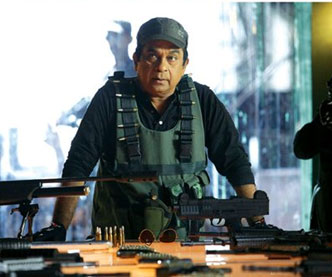
The second half introduces Brahmi as Kill-Bill Pandey, a name which does infer the usual dire slap-stick that Brahmi often relies on for comedy.  But such is not the case – Kill-Bill Pandey has great lines and an actual proper role in the story. And he’s really funny!  Seriously! Bunny and Brahmi work well together too, as Lucky comes to realise just what he has done by releasing Kill-Bill Pandey as head of a special police force on the unsuspecting Hyderabad public.  It makes for a much better ending than expected and has to be one of the best performances I’ve seen from Brahmi in recent times.
Race Gurram

I was expecting great things from the songs despite the fact that the soundtrack didn’t sound too special on first listen, and overall I wasn’t disappointed.  Apart from the first number which appeared out of nowhere without any particular point and had very little actual dancing by Bunny, the choreography was excellent.  Placement was generally odd and mostly there was no effort to place the songs within the storyline, but who really cares when it’s Bunny dancing? The stylish star looked, well, stylish, and as always his dancing was superb, particularly with Shruti Hassan in the larger group routines. Bunny always looks to be having such a good time when he’s dancing and his energy is incredibly infectious, so no matter how ridiculous the sudden appearance of Spandana and Lucky in the snow-covered fjords of Norway seemed, it was impossible not to enjoy the show.

Race GurramRace Gurram

Race Gurram does suffer from a rather rambling screenplay, and at times the film gets bogged down with irrelevant odds and ends that taper off into nothing.  Apart from the feuding brothers, the family moments are a tad cloying and overdone, and a heavier hand with the editing wouldn’t have gone amiss.  However, Bunny and Brahmi together make for a surprisingly entertaining finale that was certainly well appreciated by the Melbourne crowd.   Well worth a watch for their combined antics

Race Gurram

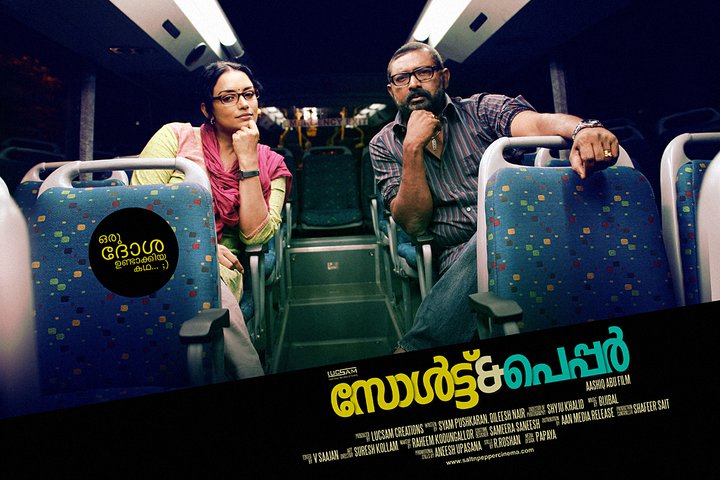
Salt N Pepper

Salt N Pepper poster

I liked Aashiq Abu’s Salt N Pepper for lots of reasons, many being things the film isn’t. It is a romance but it’s not the usual gorgeous young things plunging into insta-love. People have their emotional baggage but no one is so traumatised by rejection or ill fortune that they have to become vengeful killing machines. People cook, eat, and share what is important in their lives. Friends do the wrong thing sometimes, but might also do the exactly right thing and either way, life goes on.

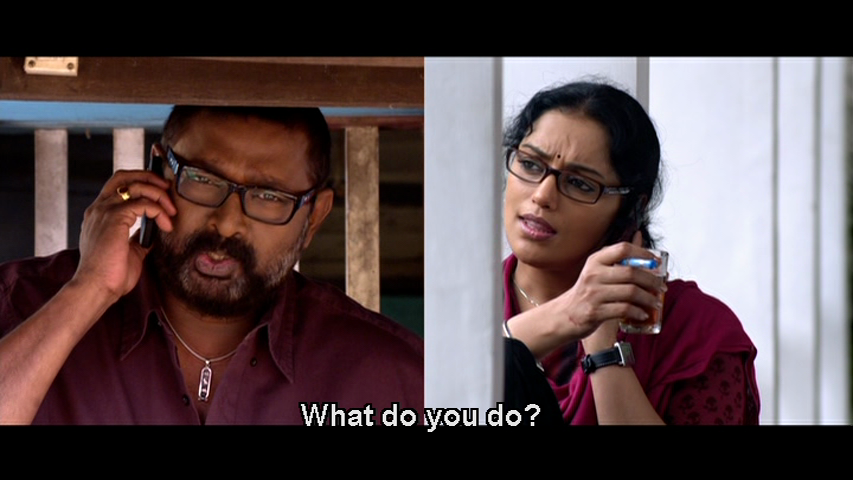
One day Kalidasan (Lal) receives a phone call from Maya (Shweta Menon), who mistakenly thinks she has called a restaurant to order a particular dosa. He cuts the call and when she rings back to chase up her order, he tells her off. Once the rancour settles and the misunderstanding is cleared, Maya and Kalidasan speak often. They are both a little older, have their own lives and careers.  While they each want love and companionship, they lack confidence in their ability to attract and keep a partner.


Salt-n-Pepper-it begins

Both are foodies, and their conversations develop around cooking and local delicacies. Manu (Asif Ali) comes to stay with his uncle Kalidasan. Manu is enthusiastic, likeable and not one to overthink the consequences. Maya’s closest friend is the confident glamour girl Meenakshi (Mythili). When Kalidasan and Maya decide it is time to meet and see if their burgeoning relationship might take off, they both make the same decision, born out of their insecurities. They send stand-ins. Manu and Meenakshi meet, pretending to be Maya and Kalidasan and their chemistry is evident. Manu pursues “Maya” for himself and Meenakshi is keen on him too. So when Maya and Kalidasan each decide to stop the pretence and meet for real, what will happen?

Lal’s performance brings the solitary Kalidasan to life. He is a man who has grown accustomed to his circumstances even though he sometimes wishes there was a bit more to it. Usually a sensible and organised man, his occasional drunken antics range from appealingly silly dances to temper tantrums. Lal puts it all together to add depth and shade to the character, and has bit of teddybear charm behind the growly voice. Kalidasan has some self-awareness and is not afraid to offer a heartfelt apology or reflect on his own behaviour so he remained sympathetic despite, or sometimes because of, his almost adolescent outbursts.  Despite his reserve, Kalidasan has a handful of good friends and he warms to Manu immediately, making him a welcome addition to the household. He seems like a nice, slightly quirky, guy.

Shweta Menon is perfect as Maya, a dubbing artist. Maya cooks partly to connect with her memories of her mother. She connects with Kalidasan when he recounts the story of a cake made to celebrate a soldier’s return to his wife, and they make their own versions. Shweta Menon gives us a heroine who is a woman not a giggling stick insect in minimal clothing. She is articulate, attractive but not glam, and wants love not transient lust. Like Kalidasan she has a few close friends. They sit on the roof terrace and get drunk, telling stories and making plans. Maya usually hides her feelings but sometimes the façade cracks and she is a sensitive, hopeful girl that wants a nice guy to love her as she is. Maya is an independent lady and she navigates the various challenges at her workplace and home every day. She knows she has to do things for herself, even when it seems difficult.

Asif Ali and Mythili are both good in their roles and I liked Manu and Meenakshi despite their occasional selfishness and dimwitted behaviour. I wasn’t as convinced by their relationship developing as I was by Maya and Kalidasan but there was enough substance there to make it seem likely. Maybe my personal preference for not pretending to be someone else and dislike of lying and sneaking around is tinting my view. Manu is a manchild, and Asif Ali had the right blend of innocent enthusiasm and delusions of hotness. I have to say he seems to kiss with the finesse of a St Bernard pup which was a worry. Mythili played up the glam and Meenakshi came across as that girl who had always been pretty and popular and had total confidence. This pair were featured in a romantic duet that not only put them in bed, but also in matching sarees. Or maybe his ‘n’ hers togas.

One of my favourite scenes is Kalidasan going to meet a prospective bride and returning single but with their excellent cook, Babu. Baburaj plays another in that long line of filmi stalwarts, the cook/confidant/general factotum. Babus’ observations give an insight into Kalidasan and while their relationship is often tested by Kalidasan’s demands, the mutual respect and affection shines through. I enjoyed seeing Kalpana as Maya’s landlady Mary. She is one of my favourite filmi aunties and while her role is small, she is expressive and fun to watch. I liked the running jokes that Maya’s moods were a result of the project she had been dubbing for. Apparently family soaps make you child-intolerant. Vijayraghavan plays Kalidasan’s colleague and friend, and doles out some sensible observations at the right time. Everyone has a backstory and enough detail to make them plausible.

There are some refreshingly low key moments. When a director (Dileesh Pothan ) propositions Maya, she makes it clear he is dreaming. He is not a creepy rapey villain, but a guy who likes lairy shirts, fancied a shag, and thought he saw an opportunity. (The subtitles said ‘togetherness’ but my ears heard ‘sex’. I wonder why.) If this was a typical mass film, he would have spent the next hour or so plotting Maya’s downfall, but as it happens he chose a completely different approach.

The film is set in Trivandrum and looks to have been filmed on location. City life permeates the action as Maya and Kalidasan move between the hectic streets and their residences, even unwittingly crossing paths. Kalidasan’s house is gorgeous but fusty, full of family mementoes and old fashioned furniture. His car is a character in her own right (and even gets a credit). Maya has crisp modern textiles and a light airy room, a space she has made for herself. It’s easy to believe in these people and their lives.

I largely enjoyed the humour and the relaxed interplay between characters.  However the whole Mooppan subplot is completely unnecessary and went nowhere. The Joan’s Rainbow cake sequence is one of the few false notes in the film, largely due to the endless simpering by yet another awful European extra. I did like the different cake construction and decorating style that Kalidasan and Maya chose. (If I was judging, Maya’s cake would be the winner.) Ahmed Sidique’s character was annoying and pointless. Considering the film runs under 2 hours, Abu spent too long on these tangents.

There are only a few songs, and they range from the appetising Chembavu which lists food after food, through a few inoffensive ballads (all by Bijibal), to the indescribably naff closing song by Avial. It seems Keralan “alternative rock” is not my thing – although I enjoyed the video for the segments with the actors playing starry versions of themselves.

Director Aashiq Abu has created a film romance that is smart without being too clever, has warmth without excessive histrionics and is populated by likeable people who possess (varying degrees of) common sense. 4 stars!

Kabhi Khushi Kabhie Gham (2001)

Kabhi Khushi Kabhi Gham

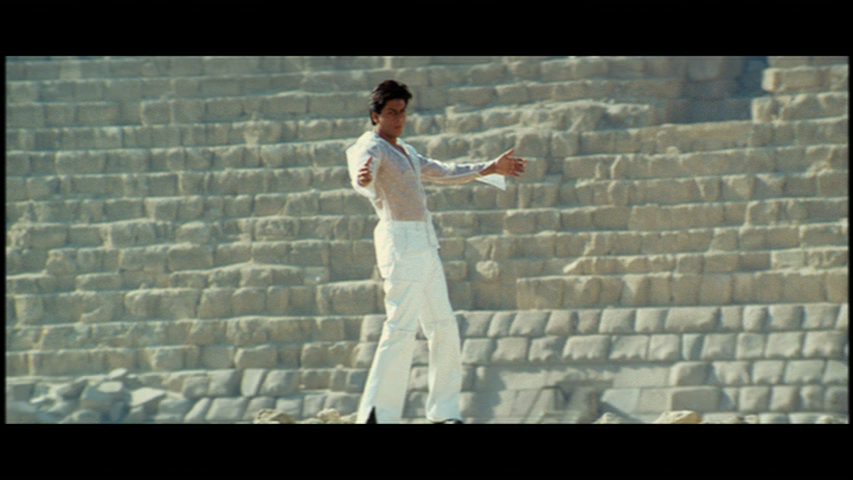
K3G is an indulgence that I only allow myself to luxuriate in occasionally.  While I love the first half of this film, despite all its flaws and typical Karan Johar extravagances, I just wish that the second half came anywhere close to the emotional appeal of the opening melodrama.  Considering the stellar cast it’s particularly disappointing that the whole doesn’t live up to the promise of its parts, but at 3 ½ hours maybe only watching the first half isn’t such an issue.  It also contains my all-time favourite Shah Rukh song with plenty of shots featuring SRK in those lacy see-through shirts, which is probably enough of an explanation for my love of this film, but K3G also brings back memories of learning Hindi and actually starting to understand dialogue without subtitles.  Special for a few reasons then, but this song is still the best part of the film.

For those who haven’t seen K3G, it’s a fairly routine story of your basic multimillionaire family and the ups and downs of their domestic relationships.  The Raichand’s live in a large ostentatious stately home which seems as far removed from India as it is possible to get despite the fact that it’s supposed to be relatively close to a lively market in Chandni Chowk.  It’s the kind of family where running late means having to hop on the helicopter to get home in time for Diwali celebrations, but despite all the lavishness of their lifestyle, it’s a family where there is a lot of love.  This is emphasised in the opening credits as Nandini Raichand (Jaya Bachchan) plays with her young adopted son, but it’s also obvious in the interactions between Rahul (naturally this can only be Shah Rukh Khan) and his father Yashvardhan Raichand (Amitabh Bachchan) as well as in the later scenes with his mother and younger brother Rohan (Kavish Majmudar).

Kabhi Khushi Kabhi GhamKabhi Khushi Kabhi GhamKabhi Khushi Kabhi GhamKabhi Khushi Kabhi Gham


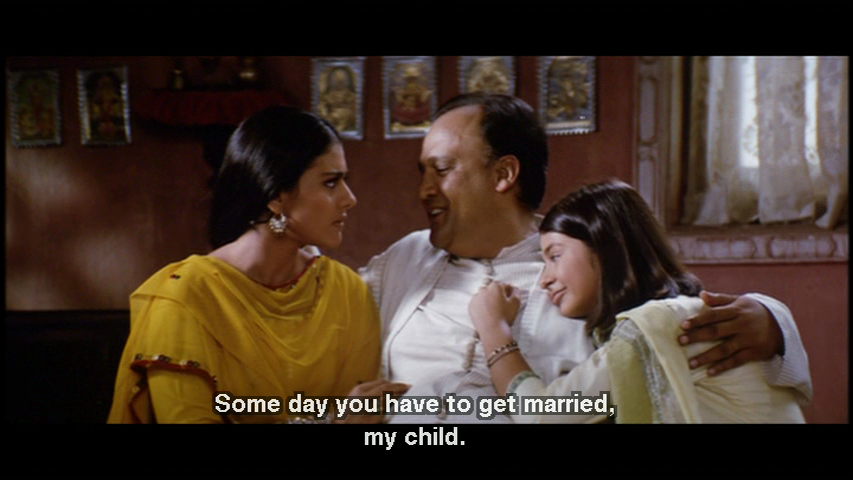
Problems arise when Yash decides that Rahul will marry Naina (Rani Mukerjee) who seems ideal for the position of rich man’s wife entrusted with carrying on the family traditions.  However Rahul has other ideas as he has fallen in love with Anjali Sharma (Kajol), the daughter of a local shopkeeper in Chandni Chowk. Just to keep things in the family, Anjali is the niece of Rohan’s nurse Daijan (Farida Jalal) and has a younger sister Pooja who is roughly the same age as Rohan.  This helps later on in the story, although initially it just seems another way of emphasising the gap between the two families.

Kabhi Khushi Kabhi GhamKabhi Khushi Kabhi GhamKabhi Khushi Kabhi GhamKabhi Khushi Kabhi Gham


The first half of the film sparkles with the romance between SRK and Kajol while the various family relationships add depth and interest to the story.  The two grandmothers, Achala Sachdev and Sushma Seth, ensure a typical Indian family feel despite the Anglicised mansion, while the glaring discrepancies between the Raichand’s home and the (somewhat sanitised) streets of Chandni Chowk are used to good effect.

Kajol is lively and boisterous as Anjali, while SRK is more retrained and less dramatically emotional which helps keep things under control.  There is a smattering of comedy in the romance too, which both SRK and Kajol handle effortlessly, and the appearance of Johnny Lever in comedy uncle mode is thankfully kept to a minimum and doesn’t disrupt the story.  The other characters all fit in too – the young Rohan is petulant and spoilt, just as a rich kid should be, while Anjali’s younger sister Pooja (Malvika Raaj) is bratty and approaching obnoxious at times, which does actually tie in reasonably well with her later persona.

Kabhi Khushi Kabhi GhamKabhi Khushi Kabhi GhamKabhi Khushi Kabhi GhamKabhi Khushi Kabhi Gham


Naturally Rahul chooses love over duty and ends up cast out of the bosom of his family, although he does have Anjali and her sister Pooja as compensation.  Of course, this is a Karan Johar film, so it’s no surprise when we reconnect with Anjali and Rahul ten years later to find that they are living in a large and opulent home somewhere in London, despite the fact that Rahul left with nothing – pretty impressive work!

Kabhi Khushi Kabhi GhamKabhi Khushi Kabhi Gham


But things start to fall to pieces once Kareena Kapoor enters the picture.  This was the first time I’d seen her in a film and it was also the last for a very long time – based solely on this dreadful performance. Hrithik Roshan as the grown up Rohan is also sufficiently unimpressive, seemingly unable to decide between the role of hot and macho student running amok in ridiculously expensive cars, or emotional wreck searching for his brother.  The two completely derail the romance and it’s hard to come up with any reason why Pooja has to dress like a call girl and act like a complete airhead.  The film also dives deep into overindulgent farce as Anjali complains about her son becoming too English (hmm, could this be because they’re living in England and he’s attending an English school?) while Rohan decides that staying with his brother while pretending to be someone else would be a good way to reconcile his father and brother.  Because that would definitely work.

If you can ignore all the self-indulgent weeping from Rohan and the insufferable unpleasantness of Pooja, the rest of the film is endurable, although unbelievably long and drawn out with a ridiculously contrived ending.  Karan Johar goes overboard trying to tug on his target NRI audience’s heartstrings with a rendition of the Indian National Anthem which seems totally out of place, and there are far too many references to ‘loving your parents’.  Even apparently when they don’t love you and repeatedly tell you so.  There are a few moments where the easy flow of the first half is almost recovered, but overall the second half is disappointing at best, particularly after such a good beginning.

Thankfully though there is still SRK, who is as charismatic as always, and the Shah Rukh and Kajol jodi works even while the story around them falls to pieces. If only the whole Kareena Kapoor and Hrithik Roshan storyline had been cut, this would have been a much more enjoyable film, although still not perfect.  Still, I do recommend watching right up until the interval – after that it’s at your own risk!   4 stars for the first half, but only 1 for the second.