Kaaviya Thalaivan (2014)

Kaaviya Thalaivan

Kaaviya Thalaivan sounded promising. A character driven drama set in the world of Tamil theatre in the 1920’s should have been exactly my kind of film, but despite excellent performances from all the  actors and A.R.Rahman’s expressive  soundtrack, the story is frustratingly predictable with little of the expected melodrama. The beautiful costumes and period sets cannot compensate for a very pedestrian telling of the rivalry between two actors and the ups and downs of a theatre company in the years before Indian Independence.  However, at least there are great costumes and stunning sets, and even if the story is disappointingly flat there are plenty of moments of brilliance from the individual actors which do make Kaaviya Thalaivan worth a watch.

The film is semi-narrated by Gomathi Nayagam Pillai (Prithviraj) who is sent as a young boy to train as an actor with Thavathiru Sivadas Swamigal (Nasser). During their travels, Sivadas Swamigal takes in a young orphan beggar called Kaali – later to rejoice in the name of Thalaivankottai Kaliappa Bhagavathar (Siddharth). Gomathi and Kaali become friends in a fairly standard ‘protecting from bullies, blah blah blah heard a million times before’ storyline. Now that familiar track wouldn’t matter if their developing relationship was told with any supporting emotion, but Gomathi runs through the story as if it’s a reading exercise in class and the identity of the protagonists is a matter of great indifference to him. Naturally then, it doesn’t matter to the audience, and Gomathi’s attitude appears more as boastful self-importance rather than genuine compassion for a young orphan.

From children to young men in the theatre company is a matter of a few moments and the two seem to be at least notionally friends at this point. Their different personalities are defined by a moment in the wings as they watch the hero Bhairavan (Ponvannan). Gomathi voices his desire to be just like Bhairavan while Kaali recognises the flaw’s in both the performance and the man, and instead aspires to be like their guru – Sivadas Swamigal.  It’s not unexpected then when Sivadas Swamigal chooses Kaali to be the hero for the company’s next production, or that this sews the seeds of resentment in Gomathi for his ‘humiliation’ which is really all in his own mind.

Gomathi  seems to take it as inevitable that he should resent Kaali for his success, without having any better reason to do so  than his own sense of self-importance. That could have worked as motivation if it had been developed in any way, but instead the rivalry is treated as a given and no further explanation is necessary. While Gomathi is silently angry, Kaali is blithely oblivious and embarks on a ridiculously straightforward romance with Rangamma (Anaika Soti), the local lord’s daughter. Kaali has little difficulty accessing Rangamma’s rooms, which should realistically been a little more heavily guarded, and no-one other than Gomathi seems to suspect anything, despite the heavy-handed flirting that goes on between the two during stage performances.  At least finally there is some passion and vitality to the characters, although not so much between Kaali and Rangamma but rather in an excellent scene where Sivadas Swamigal confronts Kaali about his love affair. Both Nasser and Siddharth are over-emotional and sufficiently melodramatic to suit the story at this point, while Prithviraj gets a chance to be nastily spiteful. However it’s a small oasis of theatricality, and the story quickly reverts back to a more plodding pace once Rangamma is out of the picture. That’s actually a shame since Anaika Soti does well with the limited role and looks beautiful in the songs. I would have liked to see more of her, but Kaali needs to have a reason for his life to turn pear-shaped and losing Rangamma works relatively well.

The final character in the drama is Ganakokilam Vadivambal, aka Vadivu (Vedika), a dancer and singer who joins the company and replaces the more traditional male actors in the female roles. Vadivu is in love with Kaali, but he only has eyes for Rangamma, while Gomathi pines in the wings for Vadivu who barely seems to notice him. It’s a situation that should be full of jealousy and passion but is instead treated clinically without any of the emotional drama that would have made the characters more effective. Again there is no justification for Vadivu’s ever more extreme devotion to Kaali, and although there is a little more substance behind Gomathi unrequited love, it doesn’t seem realistically likely to survive in the face of Vadivu’s determined rejection. However both Vedika and Prithviraj are good enough actors to generate some plausibility in their relationship and the tension between the two does become somewhat more palpable as the story develops. Without Prithviraj this really wouldn’t have had anything like the same impact, but he really does do a good job with very limited dialogue and little opportunity to demonstrate exactly why he feels the way he does.

Vasanthabalan also adds in a Nationalist thread to the plot which seems to be an unnecessary complication when more detailed development of the story and more in-depth characterisations of the three protagonists would have worked just as well, if not better. Once Kaali becomes a Nationalist, that too in a matter of moments while in prison, his fate is sealed and the ending is as predictable as expected. As Kaali, Siddharth comes away looking the best of the cast, partly because his character has more scope and inherent drama, but mainly because he really does an excellent job with the role. His performance is flawless and particularly in his scenes with Nasser there is a definite sense of the arrogance and self-confidence that underlies Kaali. Siddharth also nails the hurt and despair when Kaali is let alone in the world and his scenes with Nasser are superb. More of these and less of the bland romance would have been much better. Prithviraj and Vedika do as best as they can  within their limited roles and there are times in the second half where both get more of an opportunity to show more depth, but they are hampered by a lack of motivation for their characters actions which makes them too one-dimensional to be truly effective.

It’s perplexing that a film set in and all about theatre could end up so lifeless and devoid of melodrama, but that is exactly the problem with Kaaviya Thalaivan. I really wanted to like this film as I appreciate the attempt by Vasanthabalan to tackle something different,  but I just couldn’t engage with the characters and was completely frustrated by the lack of any reasonable justification for their actions. I know that’s my usual rant but it is so very noticeable here in a film where the motivation really should be key to developing the drama. However, the film looks amazing, Siddharth is fantastic and the music and songs are excellent. It’s a visual feast even if there is no substance to the spectacle and for that alone the film deserves to be seen and at least once.
Bangalore Days

Bangalore Days

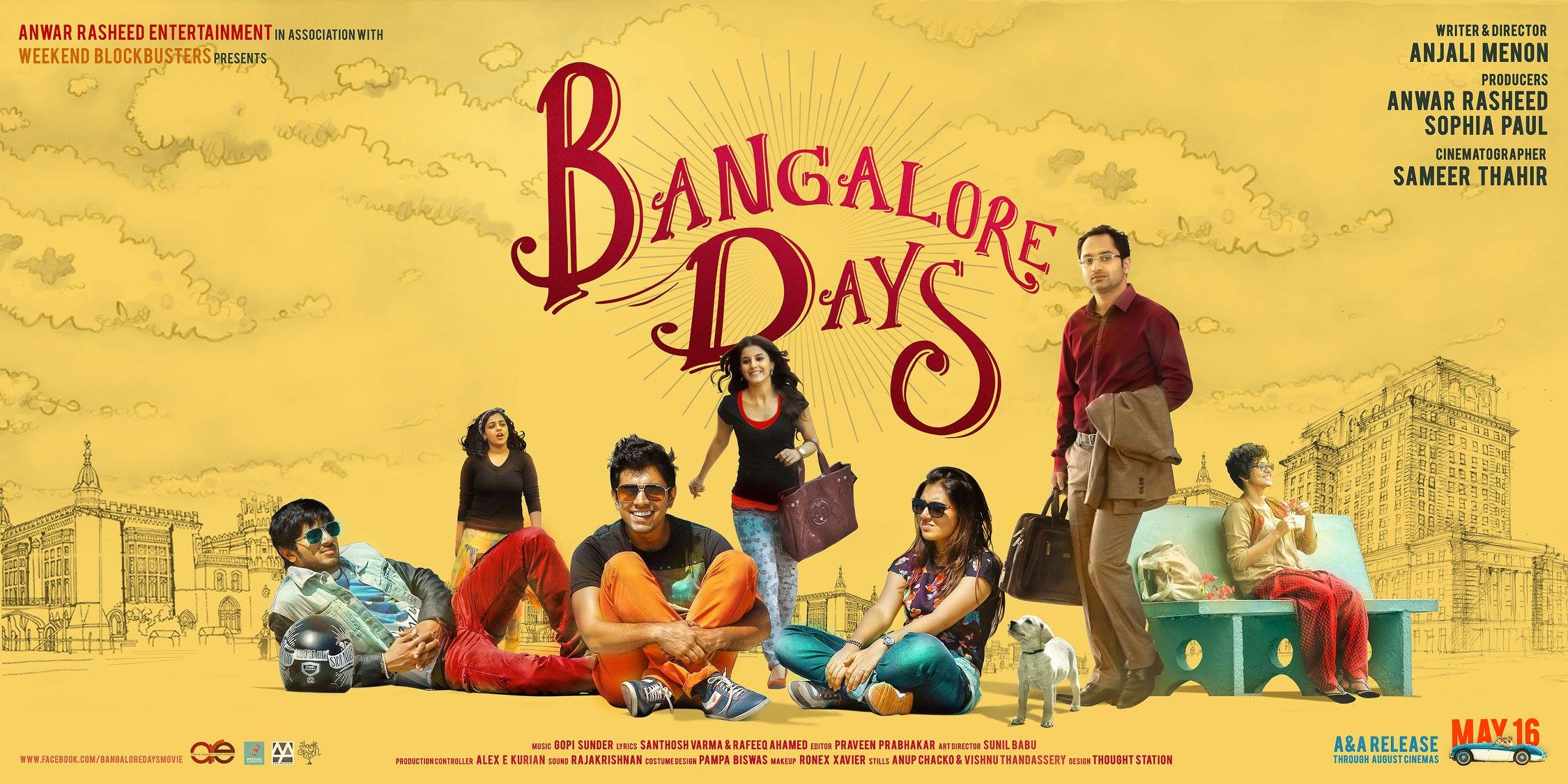
Bangalore Days is a gem of a film, written and directed by Anjali Menon, who was also responsible for the excellent Ustad Hotel. The film follows the lives of three cousins after they each move to Bangalore for different reasons and despite the almost three hour run time, it’s a completely absorbing watch. The young actors are the highlight, but the plot for each is perfectly developed and fits neatly into the overall story, so that there is a ‘fly on the wall’ feeling of watching real lives unfold. Even the slightly clichéd drama that forms the final climax is compelling, although the ending is never really in any doubt. Beautifully developed characterisations, a clever storyline and gorgeous cinematography all add up to make Bangalore Days a must watch film.

The three cousins, Krishnan PP aka Kuttan (Nivin Pauly), Divya (Nazriya Nazim and Arjun (Dulquer Salmaan) have been friends since they were children when they spent their summers together in the family’s ancestral home. Divya is a good student who has dreams of completing an MBA while Kuttan achieves his desire of escaping rural Kerala when he lands a job as a software engineer in Bangalore. Meanwhile Arjun seems content to drift, working at night as a graffiti artist and using his mechanical skills to work on motorbikes. As the film unfolds, more of Arjun’s past comes to light, including his unhappy childhood following his parents’ divorce. All of this has made him something of a rebel and disinclined to settle in any one spot or profession.

Divya’s parents decide to get her married quickly to counteract an inauspicious horoscope, firmly ending her dreams of study although the prospect of moving to Bangalore after the marriage is an enticing incentive. But things don’t appear too favourable when the prospective groom Das (Farhadh Faasil), reveals he was in a previous serious relationship and isn’t sure if he is over it. Divya’s main reason for going ahead seems to be the family dog’s acceptance of Das, and to be fair, I can completely understand her reasoning. Surely anyone who is a dog-lover cannot be a bad person? Throughout the film Anjali Menon small touches like this to successfully develop the characters and illustrate small traits that become important later. It’s simply done, but very effective and adds to the realistic feel of the characters.

The songs by Gopi Sundar are another highlight and this one sums up the different personalities and the relationship between the cousins perfectly.

Needless to say when Divya moves to Bangalore  with her new husband the situation does not improve and it’s not long before she is bored and resentful. Luckily Arjun has also moved to Bangalore to complete the confluence of cousins and is working for a Motocross bike team. With her husband’s indifference as motivation, Divya spends her days and nights out with Arjun and Kuttan, further increasing the distance between her and Das.

At the same time Kuttan has found what may be the love of his life in the form of air hostess Meenakshi (Isha Talwar). Although it’s completely baffling as to why she would be interested in the conservative Kuttan, she quickly takes him in hand, giving him a total make-over in the process. As to be expected, it doesn’t end well, but there is some lovely comedy and genuine warmth in the relationship which allows Kuttan to explore his less conservative side. Arjun is also in love, first of all with the voice of RJ Sarah (Paravathy Menon) and her positivity, but this quickly develops further once he sees her in person. There is a lovely moment where, after Sarah accuses Arjun of following her, which to be accurate is exactly what he has been doing, he eventually responds that rather than following, he would like to walk with her. It’s very sweet and the relationship between Arjun and Sarah develops into a full scale romance with plenty of sparkage between the characters.

What makes the film work so well is the excellent casting and the outstanding performances from all the actors. Nazriya Nazim is perfect in her role and even more impressive here than she was in Raja Rani. Her reactions and emotions are perfectly nuanced and her easy camaraderie with her cousins is well portrayed. Farhadh Faasil is also excellent as her distant husband with an unresolved past and his emotional delivery as his character gradually thaws is superb. Perhaps because the two actors are partners in real life, the depiction of their marriage is also very well done and the relationship is completely believable throughout.

Even better though is Dulquer Salmaan who gets his portrayal of a rather bitter but still compassionate man spot on. His relationship with his cousins is perfectly casual with plenty of chemistry that really makes them seem like a family. His expressions and body language speak more than the dialogue when he is with Sarah and he makes Arjun a more sympathetic character than I expected given his opening montage.  Dulquer’s character is well written but his performance takes it to the next level and I think this is the best I have seen him so far. Nivin Pauly has a more difficult job since Kuttan is self-restrained, almost staid and nowhere near as exciting as Arjun. However he still does a fantastic job with the character, particularly in the interactions with his father (Vijayaraghavan) and mother (Kalpana), both of whom are also excellent and perfectly cast. There are many levels to his character and to his relationship with both his cousins and the rest of his family that I don’t think I fully appreciated on my first watch, but become more apparent on repeated viewing. Kuttan’s character provides most of the comedy, but his serious nature is a perfect foil to the more impulsive Divya and rebelliousness of Arjun.

Although the film focuses on relationships, family, community and the three love stories, there is plenty more happening in the background. The film interposes the traditional values of rural India with the reality of modern city life, starting with the idea that community is lost in the city. However the complexities of this idea are further developed as Divya makes her own community wherever she goes, while Das carries his loneliness around with him as a shield. All the characters are looking for their own form of escape, some more literally than others, and all have personal challenges to overcome before reaching their goal. Anjali Menon develops the narrative through the different personalities and their attitudes, allowing the characters themselves to become the story and relegating the action to second place for much of the film.  It works beautifully well and it’s refreshing to have a film about marriage and relationships that is ultimately so optimistic and hopeful. Bangalore Days is an easy film to enjoy and I thoroughly recommend it as a modern tale of relationships. 4 ½ stars.

Kill Dil (2014)

Kill Dil

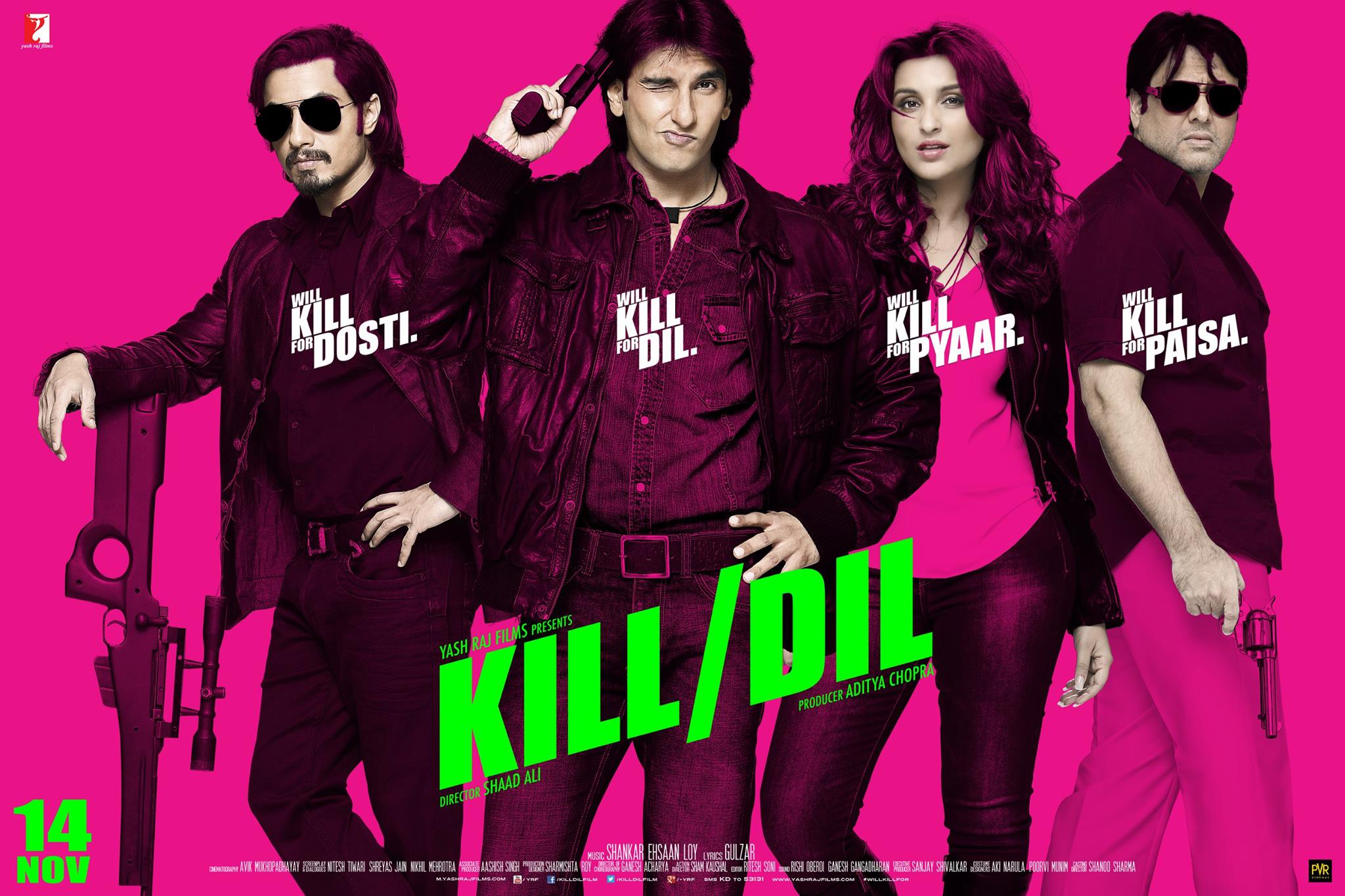
I had high hopes for Kill Dil. I like Ranveer Singh and Ali Zafar. I enjoyed Shaad Ali’s previous films, even the fairly nonsensical Jhoom Barabar Jhoom, and hey – Govinda! So, surely all these elements would be great together? Well, not so much. Kill Dil isn’t terrible, but it just isn’t as good as it should have been, mainly due to the shallow and poorly developed story. I don’t have a problem with the 70’s style masala plot, or with the Urban-Western style of Kill Dil, but I do prefer to have some plausibility in a romance and at least a smidgeon of logical possibility in the storyline. Both are conspicuously absent here. At least Ranveer, Ali Zafar and Govinda are all very watchable, while Shankar-Ehsaan-Loy’s exuberant songs are a definite plus, so even if the sum isn’t as great as all of its parts, Kill Dil is still worth a look  if you just sit back, leave logic at home and watch the spectacle.

The story starts with shades of Gunday as Bhaiyaji (Govinda) finds two babies in the rubbish and decides to raise the kids himself, despite the fact that he’s a gangster who kills people for a living. Somehow the orphans manage to survive, although they learn how to shoot a gun almost before they can walk and both drop out of school to work for Bhaiyaji as assassins for hire. Tutu (Ali Zafar) is apparently the elder, although how Bhaiyaji worked that out is anyone’s guess. He’s the quiet, less flamboyant and more brooding one who seems a little more aware of the risks but still seems content in his work. Dev (Ranveer Singh) is more exuberant, and with his bouffy hair and leather bomber jacket he’s actually a bit of a dork. The two brothers live together, work together and party together, but still have a lack of worldliness when it comes to anything outside of murder.

While out clubbing one night, Dev saves the life of Disha (Parineeti Chopra), a millionaire who gave up her degree in medicine to help rehabilitate criminals. Um – what? Disha is portrayed as the quintessential  rich party girl and the idea that she works as some kind of social worker is ludicrous. Yet it becomes even more ridiculous when Dev falls in love with Disha and is inspired to give up his life of crime for love.

The question is will his life of crime, and specifically Bhaiyaji, be willing to give up Dev?

Although the film starts off with both Dev and Tutu having roughly equal amounts of screen-time, as the story unfolds, Dev takes centre stage. Ranveer Singh is excellent and veers between annoyingly hyperactive, sweetly naïve and ultra-cool, often during the same dialogue. Although his transformation from gangster Dev to insurance salesman Dev is by the numbers, Ranveer is charming and charismatic throughout, even as his look becomes ever more conservative. He is brilliantly energetic in the songs, despite some truly dreadful styling, and if the song placements are often abrupt and odd, there are at least plenty of them, which keeps the amusement level relatively high.

Ali Zafar’s Tutu is the stoic friend who warns Dev about the possible consequences of Disha discovering his past and who is left to try and pacify Bhaiyaji when Dev is off romancing. Unfortunately, he’s not particularly successful at either task. However the relationship between Dev and Tutu is well portrayed and Ali Zafar and Ranveer Singh do have good chemistry together, even if it doesn’t get close to the Shashitabh ideal of bromance. Parineeti Chopra on the other hand has one of the most pointless and nonsensical characterisations I’ve seen, which is not helped by a complete lack of chemistry in her romance with Dev. She’s portrayed as a shallow character and is not just an unbelievable persona, but her style of behaviour makes her character essentially unattractive. Ultimately Disha seems an unlikely partner for Dev in every possible way and apart from this one fantasy song (which is still more about the styling and Ranveer’s increasingly unfortunate coiffure), the romance is fairly limp and ineffectual. It’s frustrating, since Parineeti looks fantastic and seems as if she is capable of so much more, if only she’d been given a chance!

As an occasional relief to all the posturing, Govinda is refreshingly straightforward as Bhaiyaji. He doesn’t do anything particularly gangsterish, apart from hand over pictures of the next victim to Dev and Tutu, but he does growl and look appropriately menacing when required. Even better, he does get to break out his dance moves and proves that he hasn’t lost any of his old mojo. However not even Govinda can breathe some fire into the flimsy story by the end, and Bhaiyaji’s response to Dev’s defection is disappointingly weak.

Kill Dil then is a bit of a disappointment. While the cast all try as hard as they can to look cool, and do look as if they had a great time during filming, they are let down by poor character development and the unreasonable story. However despite feeling frustrated by the character of Disha and annoyed by the paucity of scenes involving Govinda, I still did (mostly) enjoy the film. Ali Zafar and Ranveer Singh are very cool dudes here, and I liked their partnership. The songs are also improved by the colourful choreography and Ranveer Singh’s energy and joie de vivre is contagious. Perhaps one more for the fans, although it is worth a look for even just the brief glimpse of Govinda back in top form.