Bajirao Mastani

Bajirao Mastani

Sanjay Leela Bhansali’s latest epic is another triumph for the set designers, costume makers, make-up artists and jewellers of whom there must have been legion. It’s not just visually spectacular either, with impressive performances from the main leads and a beautiful soundtrack and background score. In fact the story turns out to be the weakest link in an otherwise lavish spectacle since for an epic love story, the film is strangely lacking in romance. However the film still makes an impact and with strong female characters, glittering scenery and plenty of Ranveer Singh, it’s definitely well worth watching in the cinema if you can.

The opening scenes are imperially ornate and immediately set the scene for an epic tale of daring do and palace intrigue. Unfortunately there is subsequently rather less of the daring do, with few scenes of battle and the palace intrigue hinted at doesn’t come to anything either. Bajirao (Ranveer Singh) wins the post of Maratha Peshwar with some rather nifty archery, and immediately heads back to battle to continue the expansion of the Marathi kingdom. While out on campaign he comes to the aid of the King of Bundelkhand and after rescuing the kingdom from an army of invaders, Bajirao falls for the King’s daughter by his second Muslim wife, Mastani (Deepika Padukone).

Mastani is a warrior too and manages some impressive sword work herself, which is presumably why Bajirao falls for her. But what happens in Bundelkhand should stay in Bundelkhand and the trouble starts when Mastani follows Bajirao back to Pune, where Bajirao lives with his wife Kashibai (Priyanka Chopra) and his mother Radhabai (Tanvi Azmi). Radhabai is incensed that her family line should be polluted by a foreigner’s blood, particularly since Mastani is Muslim, and she deliberately humiliates Mastani at every opportunity. Radhabai is an interesting character with a little more depth that just a standard outraged matriarch and Tanvi Azmi is excellent as the embittered widow who feels she is fighting for her family’s honour. She is ably supported in her machinations by Bajirao’s younger brother Chimaji Appa (Vaibbhav Tatwawdi) and his eldest son with Kashibai, Nana (Ayush Tandon). Her outrage and vehement opposition to Mastani is perfectly vindictive and beautifully balanced by her warm relationship with Kashibai and her devotion to her son.

Ranveer Singh does a fantastic job as Bajirao to the extent that I don’t actually like his character much – impressive when I usually love every character he portrays. Here he is consumed by desire and mostly oblivious to the pain he causes others, making him too arrogant to be a completely likeable character. Bajirao is certainly a fearless warrior, but Ranveer gives him a compassionate side and also allows glimpses of insecurity through his relationship with Mastani.  However he doesn’t see the contempt with which his family views Mastani and seems oblivious to the threats against her life. He is more concerned with his role as Peshwar until he lets his desire for Mastani overcome his sense of duty and allows his obsession with her to rule his life. Ranveer shows little of the swagger and attitude from Kil Dil and Gunday, but transforms himself into an eighteenth century warrior with plenty of imperial remoteness and stately reserve, which may partly explain the lack of warmth in his relationships. Unfortunately Bhansali doesn’t show many battles, and in the few fight scenes Ranveer mainly sits on a horse and swings his curling sword, although he does manage a few good grimaces as he rides to battle. Maybe I watch too many SI films but I was disappointed at the lack of battle scenes and would have loved more action rather than the relatively bloodless clashes here.

As Mastani, Deepika is mesmerizing when she snarls her way through battle but she becomes flat and lifeless once she transforms into the love of Bajirao’s life, losing all her sparkle.  I find Bhansali’s depiction of Mastani in love as insipid and overly compliant. Where did all her passion go? There is definite chemistry between Ranveer and Deepika, but there appears to be little joy in the relationship and I’m not sure that smouldering looks and declarations of’ acceptance’ are enough to explain why Mastani submits to the many indignities heaped on her admittedly capable shoulders. A love that is strong enough to withstand such determined and murderous opposition should be grand, overwhelming and all-encompassing, but that just doesn’t come across in the relationship between Bajirao and Mastani, and that is the most disappointing aspect of the film.

The best of the main leads is undoubtedly Priyanka Chopra as Bajirao’s first wife. She has the passion and joy in her relationship with Bajirao that is lacking in his relationship with Mastani and gets to show all her rage and humiliation when she discovers Bajirao’s infidelity. Priyanka is brilliant here in a perfectly nuanced performance that gives her the opportunity to show passion, despair, hate and compassion and she gets it right every time. Kashibai is the more interesting character and with grace and beauty Priyanka makes the most of the opportunity given to her in a faultless depiction of a betrayed wife.  She gets to dance too, and if Pinga doesn’t quite reach the choreographic heights of Dola Re Dola, Priyanka and Deepika are both beautiful dancers and look absolutely stunning too.

I didn’t know the story of the warrior Bajirao and his second wife Mastani before watching the film, and I’m not sure that I know much more about them afterwards either.  Bhansali takes moments from Bajirao’s life (although for a film about a great martial leader there are few glimpses of this side of his character) and intersperses them with behind the scenes action in his household, but the narrative jumps hours, days and then years without any clear indication, resulting in a disjointed timeline. Each scene is individually good, but doesn’t always totally gel with the preceding or subsequent action, while the lack of passion and joy in the relationship between Bajirao and Mastani is disappointing. However the opulent sets and overall grandeur of Bajirao Mastani are of the overall high quality expected from Sanjay Leela Bhansali and ensure that the film is worth watching even if it’s not as engaging as I would have liked. I’d recommend watching for the visual impact and for the excellent performances from all the cast, especially Ranveer and Priyanka.
Thanga Magan (2015)

Thanga magan

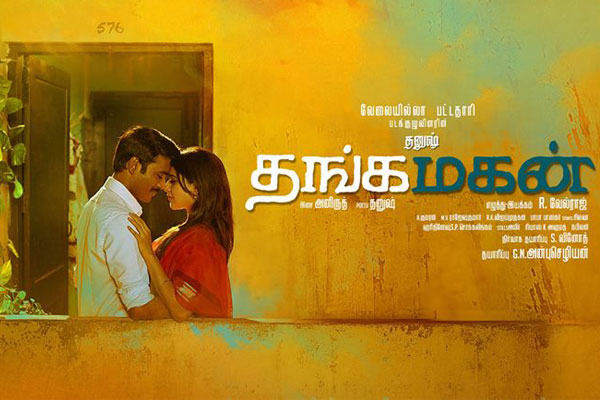
I was rather apprehensive about watching Velraj’s new film, given that VIP was such a huge hit, and follow-up films from new directors can be rather hit and miss. However with Dhanush on board again surely things couldn’t go too badly wrong? Well, no, at least not completely. Thankfully Velraj doesn’t simply try for a VIP 2, but instead starts with a rather different atmosphere and a more mature and responsible hero, although he does venture back into more familiar territory as the story reaches resolution. He’s also enlisted a generally excellent cast who keep the film entertaining even if the story does falter somewhat in the second half. Still, for a follow up film it’s not a bad attempt and Dhanush is as good as always ensuring Thanga Magan is worth a watch.

The opening scene is possibly one of the best in the film, and works well to raise questions and draw the audience into the story. As the rain pelts down, Thamizh (Dhanush) shepherds his pregnant wife Yamuna (Samantha) and his mother (Raadhika Sarathkumar) into a small and rather grimy house, ably assisted by his friend Kumaran (Sathish). By everyone’s depressed and miserable faces, it’s clear that something terrible has happened and that this is a major step downwards for the family, reinforced by Thamizh immediately setting out to look for a job.  That’s the cue for an extended flash back sequence that explains why Thamizh is unemployed and his family have had to relocate and downsize into such an undesirable location.

The flash back starts with a young Thamizh roaming around Chennai with his two friends Kumaran and Aravindh (Adith Arun). The three students spend all their time together until the day Thamizh sees a girl at the temple and instantly falls in love. Hema D’Souza (Amy Jackson) is an apparently intelligent, modern Tamil woman who has some very definite ideas about what she wants from life. She’s a student too, studying architecture, and isn’t afraid to berate Thamizh when she thinks he is following her. But after such a strong beginning, Hema becomes more of a caricature, drinking beer and allowing a mildly physical intimacy that ensures she isn’t going to be the one leaving with the guy – Hema is much too liberated to get a happy ending in a Tamil film!

Dhanush does his usual thing of managing to appear much younger than he really is, and as the relationship between Thamizh and Hema is fairly typical of young and infatuated lovers he doesn’t have to stretch for the role. In comparison Amy Jackson seems rather out of place and despite all the physical intimacy she has little chemistry with Dhanush leading to a relationship that never appears realistic on her side. Amy looks older than Dhanush too, which doesn’t help, but at least when they do finally split it’s reasonably plausible with his immaturity at odds with her ambition finally leading to the separation.

After the break-up Thamizh falls in line with his mothers’ wishes, getting a job working in the tax office with his father and agreeing to an arranged marriage with Yamuna. Yamuna is the ideal traditional wife; quiet, shy and happy staying at home all day to help her mother-in-law. She’s a complete contrast from Hema, but in her own way Yamuna is just as much of a caricature, following the description of classic filmi wife to the letter. Samantha is a much better actress than the character of Yamuna requires, but she still manages to shine despite her rather one-dimensional role. At least she has plenty of chemistry with Dhanush and even if the relationship is an old-fashioned and clichéd version of marriage they do seem to have a mutual respect and a partnership that was lacking between Thamizh and Hema.

The first half works well and Dhanush is on top form as dutiful son, young lover, then husband and father-to-be. He transitions from one to the other very naturally and it’s good to see him have a happier relationship with his family than he usually portrays in his films. Samantha is also excellent here and both K.S. Ravikumar and Raadhika Sarathkumar provide solid support as Thamizh’s parents. The love stories are both sweet in their different ways and there is some good and funny dialogue too which ensures that all the drama doesn’t get too overpowering.

The second half is where things start to go a bit pear-shaped when the story moves on to the problems with Thamizh’s father (K.S. Ravikumar) and his boss Prakash Kumar (Jayaprakash). There is a missing file, possibly some missing money and the flimsy storyline has very little substance but plenty of artifice. It’s a credit to the actors involved that the film still entertains even though large parts of the story don’t make much sense and there are too many large plot holes. The villain of the story is Aravindh who was neglected and left out of everything while Thamizh and Satish were off romancing Hema and her friend – apparently that’s enough of a reason to make you a total jerk and a criminal to boot.  However Aravindh is an ineffectual adversary and suffers from his absence in the first half of the film, leaving him without any real depth to his character. Adith does as well as he can with a very sketchy role, but it’s not enough to make Aravindh a plausible opponent. On a plus note though, Amy Jackson reappears and is much better in this part of the film, while Dhanush is excellent at depicting Thamizh’s growth as a dependable husband and supportive son as he investigates what really happened with his father. Even though the story needs a large suspension of disbelief, there is still some good dialogue and the relationship between Thamizh and Yamuna is well developed and beautifully pictured.

The main problem I have with Thanga Magan is the end. Unfortunately after spending two hours establishing Thamizh as a kind and thoughtful son and husband, the climax suddenly sees him turn into the swaggering, mass-dialogue spouting fighting machine last seen at the end of VIP. Perhaps Velraj couldn’t think of how else Thamizh could win the day, but the abrupt transition is at odds with the rest of the film and seems unnecessary. Thamizh could have achieved the same result without all the posturing and fighting, particularly since the fight scenes aren’t particularly well choreographed and the dialogue is clunky and more suited to a battlefield than a discussion in an office. Dhanush still manages to carry the mass-hero dialogue and posturing well of course, but the film deserves a more satisfying climax that meshes better with the rest of the film.

Although Thanga Magan doesn’t deliver as well as VIP, particularly in regards to the storyline in the second half, the performances are very watchable and Dhanush is simply excellent. He has the ability to show his character’s growth and maturation throughout the film, while still telling the story and ably supporting the rest of the cast. He always appears very natural, whether he’s playing a young student or a more matured married man, and never seems to be obviously ‘acting’. Sathish too does a good job, fitting the role of Thamizh’s ‘side-kick’ while he shares a natural rapport with Dhanush which ensures the comedy between the two works well. Samantha is the other standout performer and even if her role of a submissive wife is rather clichéd, she still plays it with grace and dignity and a good sense of humour. Anirudh supplies the music and it works well for the songs although none are as instantly catchy as I’ve come to expect from his previous soundtracks. I was also a little disappointed by the lack of dancing in the picturisations, as most of the songs are montages to show the two romances. They are all appealingly shot and look good, but I do miss watching Dhanush dance! Worth watching at least once for Dhanush, Samantha and Sathish and an amusing and entertaining first half.


Dilwale

Dilwale_Poster

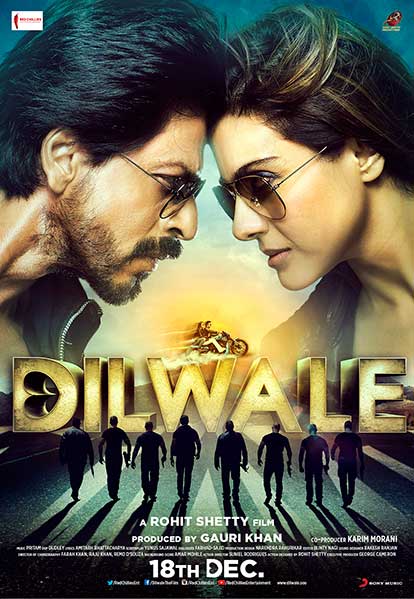
Kaali (Sharukh) and Meera (Kajol) fall in love. Kaali tells Meera he is a gangster, son of don Randhir (Vinod Khanna). Meera tells Kaali she is an artist and they do lots of picturesque and cutesy romancing. But Kaali finds out there is more to Meera than being a simple artist. Eventually they part and go their own ways. Fifteen years later, Veer (Varun Dhawan) meets Ishita (Kriti Sanon) and they fall in love. Veer is Kaali’s little brother, although Kaali now calls himself Raj and is a simple mechanic and car modifier. Ishu’s big sister? Yeah. Will Veer and Ishu ever get together in the face of such strong family opposition? And why did neither Kaali nor Meera ever move on and marry someone else?

My love for Shahrukh goes way, way back, and I was not disappointed at all by him in Dilwale. I’ve always liked him most in roles where he is not too sugary sweet. I particularly liked the moments when, as Raj, he let the calculating menace of Kaali show through. He seemed completely at home in his character’s skin without looking like he’d phoned this one in. The fight scenes showed Kaali as a relentless and brutal machine. Careful angles and editing made it seem as though Shahrukh was doing all his own work in the action sequences so there was no break in the dramatic tension. I’m sure his stunt guy was working overtime but I think they’ve done a great job when it is hard to pick who is who.

His stylist also did a great job of making the 15 year gap between timelines seem believable. Plus I enjoyed the double layered linen shirts, sometimes matching or in a monochrome mix, and always with a hint of cleavage. Well done, that person.

And after Janam Janam, all I can say is “move over Mr Darcy”. (Plus, as far as I know, Colin Firth has not fixed a VW Beetle in the rain while dancing and wearing his Mr Darcy puffy shirt.)

Like Kaali there is more to Meera than meets the eye, and Kajol is fantastic. She looks great and gives Meera a tough femininity that really works. Of course she has amazing chemistry with Shahrukh, and I think the film should have concentrated on their story. Kaali and Meera were like Romeo and Juliet who had survived and moved on in life, if not emotionally. I was more interested in what they had been up to since they last met, how they went legit, and what would happen next, than I was in Veer and Ishu’s sincere puppy love. One thing that I really liked is that the women drive the pace of developments in their relationships. Raj/Kaali told Meera she had got him all wrong. She didn’t budge just because he looked sad (and hot), but when she was ready she investigated further and she listened to the evidence.

Varun is pleasant, can dance, is good in action, but his dialogue delivery was odd. It sounded Shatneresque. Mumbled! And! Like! He! Spoke! With! An! Exclamation! He seemed to be pushing to make his action bigger, but instead it looked like his timing was off. His best moments were one on one with Shahrukh as the brothers dealt with the rocky road to true love. In one scene they are laughing through tears and it was genuinely touching, and then later a grim looking scene turned to sheepish laughter. I’d like Varun to do more action centred roles as I think he’d be great in that genre.

Kriti Sanon seems to be eminently qualified to be a romantic lead by virtue of not wearing much. Her acting is not offensively bad, but like Varun her shortcomings were all the more evident for the contrast. She fares better in scenes with either Shahrukh or Kajol as maybe she had something more to work off where Varun was a bit patchy.

Vinod Khanna and Kabir Bedi played Kaali and Meera’s respective fathers. They were charming and pragmatic, loving their families and hating their enemies with equal vigour. The stuff revenge sagas are made of.

Dilwale-flash cars

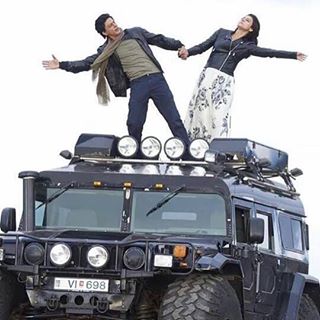
Shetty’s taste is hit and miss for me. The audience I saw this with was in stitches at the excruciating wordplay from Oscar (Sanjay Mishra). I loved the montage of lies that Anwar (Pankaj Tripathi) and Shakti (Mukesh Tiwari) spun, using snippets from what was on TV, to cover up Raj’s past. Veer cheekily does the SRK arms flung wide and lean when he needs help, channelling his inner filmi hero, and knowing that pose never ever fails. But when Mani (Johnny Lever) turned up in a fro, lungi, and mesh vest, masquerading as a South Indian thug I couldn’t understand why Shetty thought it was OK in Dilwale when he’d largely avoided such nonsense in Chennai Express. Boman Irani has settled comfortably into a half-arsed overacting groove that belies his abilities. There are lots of little references to DDLJ and other films from Love, Actually to Dude, Where’s My Car, and some laugh out loud lines so it pays to pay attention.

I was dying to see Gerua. I’ve recently been to Iceland and had visited several of the locations, not knowing Dilwale had been shooting there earlier in the year. I can assure you that the countryside really is THAT spectacular. Janam Janam is lush and full of longing, and showcased Kajol and Shahrukh’s chemistry with some age appropriate choreo. Varun got the best intro with the colourful Manma Emotion Jaage. Tukur Tukur plays over the end credits so if your audience is as annoying as mine was, you’ll probably just see a line of people’s butts shuffle past! The difference in style between Kajol and Shahrukh and Kriti and Varun is really evident as the youngsters act at the camera while the established stars know exactly where the camera is, but also know it will find them so they just do their thing.

This is definitely a good bet for the SRK or Kajol fans, but for others maybe not so much. I do think Dilwale delivers on the promise of being (fairly) entertaining, gorgeous to look at, and with loads of energy, but it falters when the film moves away from Raj and Meera. One I’d watch again on DVD and make judicious use of the fast forward button!