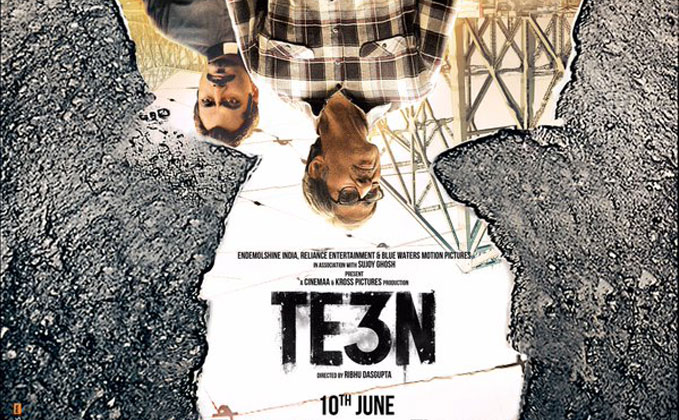
Te3n

te3n-poster

Ribhu Dasgupta’s Te3n is an official fully credited remake of South Korean thriller, Montage (2013, dir Jeong Geun Seop). I’ve seen the original so I was more interested in the how than the who or the what. Te3n is a solid remake of a decent film, so I still enjoyed it despite a couple of changes that I don’t think were at all necessary from a film or narrative perspective.

John Biswas (Amitabh) is an old man haunted by the death of his granddaughter Angela. She was killed in a botched kidnapping 8 years go, and the perpetrator was never caught. He spends his days haunting the police station and has nothing else in his life to sustain him. His wife Nancy (Padmavati Rao) is wheelchair bound and never leaves the house. John seems forgetful and vague, giving no energy to his present day and dwelling on the past. But when another child is kidnapped in exactly the same way, he believes he can catch the criminal and get justice (and revenge) for Angela. Sarita (Vidya Balan) has inherited the Biswas case file, and is leading the investigation into the latest crime. Sarita is smart but unimaginative when it comes to solving a complex problem. She will follow the leads and interpret the evidence in a logical and common sense way, not questioning whether she is being lead down the garden path. Martin Das (Nawazuddin Siddiqui) was the original investigator but he left the police force to become a Christian priest. He feels the guilt of his previous failure and the damage done to the Biswas family, and can’t keep away from the new case when Sarita starts her investigation. Although he used to do a fair job of evading John who only wanted to talk about the old crime. Martin’s zeal is less about John or Angela and more about his own personal guilt and need to atone.

It is almost a shot for shot remake of the original despite the new location, so I can’t really say much about Dasgupta’s directorial style. There were changes made in terms of which character did what. (In Montage, the mother of the first little girl is the one who purses the investigation and the police characters are a little different.) I feel that needed some more solid rewriting which didn’t quite happen. And because the film elevates Amitabh above all else, it ultimately buckles a little under the weight of a Star in what is otherwise a solid thriller.

Amitabh shows the best understanding of his character and the genre. I really liked his performance, and thought he built up the layers in John’s character well. There are scenes where he just becomes an old man, bewildered and a little out of step. As he steps up his own investigation, he sharpens up and seems to come into focus more. Because I knew that the original was slightly different, I was looking closely at the changed characters to see if the alterations were for the better. They really added nothing, except maybe funding, as I suppose it is still easier to get money for your movie if the Big B is your star than if Vidya is. But it also made me ask if women are overlooked in society the same way old people are. Maybe since they were both invisible to the people that mattered it actually did make sense.

I never fully understood why Martin had taken vows or why Sarita was a bit flirty with him, but I didn’t feel I needed to know all the details to appreciate the present circumstances. It felt like they split the original ex detective character a little between Martin and Sarita, and added some more emotional baggage for the sake of it. Both Vidya and Nawazuddin have garnered huge audience and critical support for their undeniable talents, but the material here lets them down a little. Their characters were sketchy despite their best efforts to add nuance and a sense of connection.

The story translated well to Kolkata. Pardon my saying so, but the Indian police and legal systems are not exactly a byword for judicial excellence so the scenes where things went wrong seemed almost inevitable. The bureaucracy and sheer time spent in nothing much happening also seemed quite realistic. Sarita was surrounded by mountains of old files and new ones, everything showing that the Biswas case was just one of many. The streets and old houses added to the mood with hints of things happening under the surface, out of sight. Despite the huge city setting, the characters all live their lives in quiet little pockets of their own making. The neighbourhoods and houses are lived in and have a sense of history and context that we are just glimpsing as we skim past.

The use of sound was excellent except for when a song like Grahan was forced into the mix. I did like the recurring use of Kyun Re during montages of uncertainty. I don’t know that the Amitabh version was needed as it was subtle as a sledgehammer, but it suited the moment. The ambient sounds and silences were far more powerful than the pretty generic musical stylings.

The investigations – John’s and the official one – are both quite logical and it all makes sense. Korean and Indian movies often share a sense of outrage at the lack of justice for victims of crime, and then go looking for that reparation outside of the system.

See this for a fairly restrained big budget take on an indie film subject, and for the well structured plot. It’s not the usual high level histrionics and it does showcase late career Big B in a role that lets him comfortably play to his strengths.

Mythri (2015)

Mythri

There have been a number of good films released recently where the main protagonists have been children or juveniles, and Mythri is another one to add to the list. B.M Giriraj’s bilingual film follows a young Siddarama (Aditya) as he ends up in juvenile detention and makes it onto the TV show ‘Who wants to be a Millionaire’. There are shades of Slumdog Millionaire given that much of the film revolves around the TV show, but Mythri follows a rather different path. Here Siddarama is a big fan of Puneeth Rajkumar who hosts the show and it’s the plight of the young prisoners and their rehabilitation – or rather lack of rehabilitation that becomes the focus of the story.

Siddarama (Aditya) is a smart kid but he makes some poor decisions and ends up in jail after throwing stones at a passing police officer. His mother is out of her depth and to get her young son out of jail she approaches Gudi Pratap (Ravi Kale), a womanising thug and aspiring politician who runs drug and child trafficking rings on the side. Although he does deliver and gets Siddarama released, Gudi demands reparation for his services and it’s obvious that Siddarama’s mother is going to get the worse end of the bargain.

Once free, Siddarama is lucky enough to meet his idol, film star Puneeth Rajkumar (as himself) when he comes to their area to shoot a scene for his latest movie. Siddarama makes an impression on Puneeth with his scrapbook about the actor and his excellent general knowledge but fails to make the final cut of the scene when he rushes away before the end of the shoot. It isn’t until much later that the reason for Siddarama’s quick exit is revealed and the next time we see Siddarama he’s incarcerated in a juvenile detention centre.

Siddarama is one of the younger and more vulnerable boys, so it’s no surprise to find he is being victimised by a group of older youths who are unimpressed when he dobs them in to the warder Raviprakash (Atul Kulkarni). Despite his small stature and obvious dislike of violence, Siddarama fights back when the bullies gang up against him, and in doing so he earns the admiration of Jhonson (Jagadish), another young thief in the remand home. Jhonson is a serial offender, and the warders keep him chained up at all times to ensure he can’t steal anything further – unsurprisingly not a successful tactic! However, Raviprakash has firm views on how the young offenders should be treated and believes that strict discipline is the only way to teach the criminals how to behave. The harsh treatment of the boys and the poor condition of the detention centre are shocking and it’s understandable that most of the inmates either reoffend or become drug addicts after their release. Even the most basic of care is lacking and the warder meets violence with more brutality and an almost casual disregard for the boys’ welfare.

Atul Kulkarni is excellent here in the role of the strict and uncompromising warden. His interactions with the boys are frighteningly realistic and his reaction to a visit from the movie star is a perfect blend of admiration followed by condescension when Puneeth questions his regime. The rationale for his stance is one that seems logical – he came from a similar poverty-stricken background and didn’t turn to crime, so the youngsters in his care have no real excuse. This is one of the strengths of the film that such social clichés are shown to be inaccurate and too simplistic a view of more complex issues. Additionally the point is clearly made that education rather than punishment is the solution most likely to turn the young offenders’ lives around.

The film moves on to the TV show Karunada Kotyadipathi when Jhonson discovers Siddarama can answer the test questions for a children’s version of the show. With a lot of sneaking around behind the warden’s back, Jhonson manages to enter Siddarama as a potential candidate but it all hangs in the balance when the producers request a guardian for Siddarama. Raviprakash decides to let Siddarama go ahead – perhaps to demonstrate to Puneeth that his methods do work but also because he is impressed by Siddarama’s knowledge and is even a little proud that one of ‘his boys’ is clever enough to compete on the show. Again the decisions seem plausible despite the theatricality of Puneeth’s involvement, helped by Adithya’s portrayal of a young boy almost overwhelmed by the whole experience.

There is an odd twist to the tale when Mahadev Godke (Mohanlal) appears and tries to stop Siddarama from competing. This part of the film is inconsistent with the realism of the earlier scenes and the persona of Mahadev Godke is a little too contrived to fit easily into the narrative. However Mohanlal is good, his story helps to fill in the gaps and it also allows B.M. Giriraj to use a rather literal interpretation of the lifelines used by the show.

Mythri succeeds due to the excellent performances from the main leads and a well-developed storyline. Aditya is great as the young Siddarama, appropriately whiney and sorry for himself as expected for a kid his age, but also suitably resigned to his fate and more adaptable than even he realises. It’s a very good performance from the young actor and he holds his own well against the likes of Atul Kulkarni, Mohanlal and Puneeth Rajkumar.  Jagadish too is good as the recalcitrant thief and the other kids in the remand home all play their parts well. Puneeth Rajkumar has a relatively easy time of it since he just has to be himself, and perhaps it’s inevitable that he comes across as basically a nice guy – considerate and thoughtful. However at no point does he seem self-indulgent despite being shown as altruistic while his philanthropy and basic decency seem genuine. The only part which does seem somewhat forced is the movie within a movie where Puneeth is shown filming an over the top action sequence that ends with a rather cheesy message. It’s rather B-grade compared to the rest of the film, but maybe that’s the point.

Ilaiyaraaja provides the music and although there are only a few songs they are used effectively and suit the overall feel of the film. My favourite is Chandranenu Chenda, but the energy and exuberance in the title song is infectious and always makes me smile.

Overall Mythri is an intelligent and entertaining film with a social message that comes across clearly without becoming depressing or preachy. Despite the rather dire situation the kids in the remand home are facing, they still enjoy themselves and completely get behind Siddarama and his attempt to win the competition on TV. It’s a more upbeat film than the opening sequences would suggest and the combination of a well written story with polished performances makes Mythri well worth a watch. 4 stars.

Brahmotsavam (2016)

Brahmotsavam

Srikanth Addala’s Brahmotsavam is a real mishmash of a film, where random family scene follows random family scene with the emphasis on feel-good values and upbeat emotions rather than anything inconvenient like a storyline. This is one film where the subtitles didn’t seem to help at all and much of the dialogue made absolutely no sense, but a few other audience members explained that not only were the subtitles inaccurate, but that the script was fairly random too and they were just as confused. It doesn’t help that most of the characters don’t have actual names but are called brother, brother-in-law or sister-in-law (and there are a lot of them), making Brahmotsavam less of a celebration and more of a memory test. Mahesh is always watchable and the strong cast are all charismatic, but with nothing much actually happening over more than two and a half hours, Brahmotsavam is sadly uninspiring.

The film starts with a family celebration, which I think was a wedding but could have been almost anything – maybe just breakfast – given the families propensity for breaking into song and dance at any moment.  Whatever the occasion, Sathyaraj likes to ensure that the whole family celebrate it together – that’s all his brothers, their wives, children and his brother-in-law Rao Ramesh. Everyone is sickeningly happy all the time except for Rao Ramesh who suffers from intense (but understandable) familiyitis and resents Sathyaraj’s success with the paint factory he runs. Naturally everyone in the family works at the paint factory when they’re not singing and dancing around the family home, and they’re all deliriously happy to be working there too. It’s actually a little odd to see Mahesh in such ultra-happy family mode for most of the film, but when he sheds the happy and has to show a range of emotions he really is excellent. More of this would have made for a better and more enjoyable film.

Just to add to his individuality a small animated figure appears to speak to Rao Ramesh any time he is particularly exasperated with his brother-in-law. Since most of the time this imaginary figure berates him for his lack of appreciation for Sathyaraj and the family gatherings this has the effect of making Rao Ramesh even more miserable and less willing to participate. After the first 15minutes I was totally on Rao Ramesh’s side and could completely understand how the continual en masse family gatherings could very easily make anyone want to run screaming for the hills as fast as possible. Rao Ramesh is much more tolerant however and manages to last almost until the second half before he snaps and leaves the family group.

As part of the celebrations, Kajal arrives from Australia for a few months and her father decides it would an excellent idea if she stayed with Sathyaraj and his family rather than spend the time with her own relatives. She’s gorgeous and confident, and Mahesh is smitten the moment he sets eyes on her. However, since she lives in Australia where the accepted practice if you like someone is to tell them you’re interested, Kajal is rather taken aback by someone staring relentlessly at her at every available opportunity without speaking. Living in the same house makes it ridiculously easy for Mahesh to stalk Kajal without appearing to do so but after a few uncomfortable moments Kajal seems intrigued by her silent admirer. The romance progresses as expected but despite Mahesh and Kajal seeming to get on well together, Kajal decides that she wants more from life than to be the wife of a paint manufacturer and decides to move on. She has ambition and is prepared to sacrifice what’s basically a holiday romance for her in order to ensure her dreams come true. I like this assertiveness in her character and Kajal is appropriately confident in the role, while still remaining respectful to the family and her father. It’s a good performance and I like this more mature and sensible Kajal.

Luckily for Mahesh, Samantha turns up in slightly manic friendly overdrive mode and the pair set off pair set off around India in the search for Mahesh’s roots. One of the first family members he meets is the hapless Vennela Kishore and the couple decide to drag him along with them on their road trip. It seems strangely unnecessary but at least Vennela Kishore and Samantha speak to each other which does help to make sense of the second half. Samantha is just a little too zany to be convincing but her energy does help lift the second half. The problem here is a lack of definition for her role and a fluffy backstory that does little to establish her character.

The biggest issue with Brahmotsavam is the addition of too many random scenes which are only peripherally connected to the main ‘plot’ (such as it is) and don’t serve any purpose. For example, at one point Mahesh and his parents are talking by video connection to his sister in the UK. His mum is showing off various sarees while Mahesh teases his sister and the talk finally comes round to how much they miss her and wish she was there. Big family moment – lots of tears, virtual hugs and emotion. And then that’s it – she’s never mentioned again. So much of the film starts with an apparent purpose and then fizzles out without ever going anywhere, making it difficult to work out what (if anything) is relevant.

The first half is also very song heavy with most of the songs coming one after another with little reprieve, including one where Mahesh and his backing dancers frantically try to get insects out of their clothes. That is definitely one of the high points and got the most cheers from the fans in the audience, but possibly not for the choreography. The second half settles down to a standard road trip and there are fewer songs which makes this part of the film flow more smoothly. It’s still a series of random encounters, but at least that does fit in more with the idea of a journey to find yourself while Samantha keeps everything moving along nicely.

There are a few positives to the film. The songs by Mickey J Meyer are good if oddly placed, and Gopi Sundar’s background music is generally effective and not too intrusive. The film looks beautiful and R Rathnavelu’s cinematography captures the warmth of the family home and the stunning landscapes as Mahesh and Samantha travel around India. All the main leads are fine, if somewhat incomprehensible for much of the film, and Mahesh certainly delivers in terms of emotion but the star of the show is undoubtedly Rao Ramesh with his grumpy and often bewildered demeanour. However, the lack of a comprehensible storyline and the random pointlessness of many scenes means that Brahmotsavam is probably best enjoyed on DVD where it’s possible to skip the vague dialogue, watch the songs and admire the beautiful scenery without worrying about the deficiencies in the story.