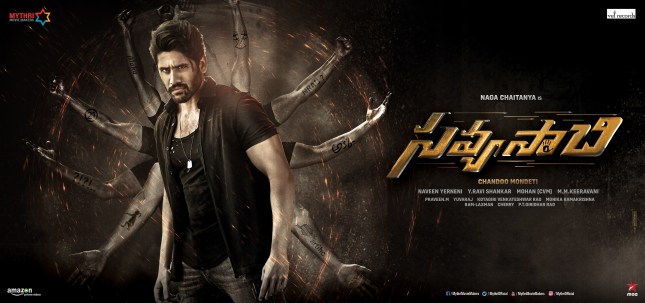
Savyasachi

Savyasachi

I have a theory that Indian screenwriters search medical texts for the most bizarre sounding diseases which they then change out of almost all recognition, blend them together and then use this bizarre hybrid as the plot for a film. That might at least go some way to explaining why Vikram (Naga Chaitanya) is introduced as the surviving half of a ‘vanishing twin’ pregnancy, the inaccurate explanation of which is only one of the fantastical medical diagnoses described in the film. That may not have been a bad move if the idea of a separate parasitic twin living through his brother’s left hand was better explored, but Savyasachi doesn’t seem to know if it’s a romance, a thriller or a comedy about alien hand syndrome, and by the end I was no wiser either.

Naga Chaitanya does his best with a terrible script, Madhavan overacts like crazy and it’s not a good sign when the best characterisations come from Vennela Kishore, Bhumika Chawla (who is excellent as Vikram’s sister) and child actor Dishita Sehgal. The other major problem with Savyasachi is truly terrible subtitles which I would ascribe to using Google Translate except that there are many spelling errors. This makes it even more difficult to work out exactly what is going on, when even the actors don’t appear to have any idea. With so much wrong is there any reason to watch Savyasachi? Well, yes. The songs are good, the flash-back and family scenes in the first half are better realised, and even if Madhavan chews the scenery excessively his exploits as a villain are generally entertaining. So not terrible then and given the general incomprehensibility of the subtitles, probably a better watch if you understand more Telugu than I do.

Vikram is the surviving twin while his brother Aditya was ‘absorbed’ into Vikram during their mother’s ‘vanishing twin’ pregnancy. Aditya still lives on as a few neurones in Vikram’s brain and is able to express himself by independent movement of Vikram’s left hand. All this is described in detail by Vikram’s doctor (Rao Ramesh) and his mother Mahalakshmi (Kausalya) which is just as well as this mishmash of a number of different conditions does need a lot of explanation. However, apart from a habit of slapping buttocks and faces, Aditya doesn’t do much else until Vikram is threatened, when Vikram’s left hand suddenly develops uncanny spatial awareness and super-human reaction speed along with the ability to thrash innumerable villains. So, basically the usual hero ability to fight his way out of any given situation. Vikram even manages a bit of hero-style action himself, beating a group of students during a flashback scene at University, with his left hand tied behind his back. Just in case there was any suggestion that Vikram isn’t just as capable as his intangible twin.

The film starts with a bus crash that causes the death of everyone on board, apart from Vikram, and then promptly ignores this initial mystery for the entire rest of the first half. Instead, writer/director Chandoo Mondeti concentrates on developing a romance between Vikram and businesswoman Chitra (Nidhhi Agerwal), who has employed Vikram’s ad company Artihc to promote her company. Vikram is assisted in making his films by his best friend from school Kittu (Vennela Kishore) and Tenali (Satya) who are aware of Vikram’s ‘vanished’ twin and make allowances for the occasional bizarre behaviour of Vikram’s left hand.

Vikram and Chitra have a history together from their time in college which is shown in a series of flashback scenes. While at college, the two gradually begin a relationship, first as friends, but just as it seems to be developing into something more and Vikram was about to declare his love for Chitra, something happened and he vanished from college, never to be heard from again. Until rocking up to make an ad many years later. Despite this long separation, his sudden reappearance doesn’t generate too much reaction from Chitra, and after accepting Vikram’s rather lame excuses for dropping out of touch, the two rekindle their old romance. There isn’t much chemistry between Vikram and Chitra, but to be fair they don’t have many scenes with just the two of them together, and there is a fraction more sparkage in the college flashbacks. In fact, most of the actual romance happens during M.M. Keeravani’s catchy songs.

The first half also deals with Vikram’s relationship with his sister Siri (Bhumika Chawla) her husband (Bharath Reddy) and daughter Maha (Dishita Sehgal). This part of the film is better, and the family dynamic is well developed as Siri becomes annoyed and objects to Vikram spoiling Maha, allowing her to do whatever she wants, while at the same time appreciating the reasons behind her brother’s affection for her daughter. Bhumika Chawla is excellent as Siri, particularly in later scenes as her character has to deal with a considerable amount of complex emotion.

After all the family background and romance in the first half, the second half of the film totally shifts gear when Vikram returns from a trip to America to find his family has been targeted and his sister in hospital. Suddenly the pace picks up as Vikram struggles to find out who is attacking him, and what has happened to his family. Madhavan is rapidly identified as the villain here, but he plays Arun Raj with such cheerful bonhomie that it’s difficult to take him seriously. Arun also has an oddly weak reason for his behaviour that further undermines his villainous stature, so in the end I felt little investment in the outcome of their struggle. However, Arun does have uncanny ability to be able to find and follow Vikram which is explained by various cloning, cloaking and other electronic wizardry, which at least is slightly more probable than Vikram’s pop-up twin brother’s abilities.

Although the story struggles to keep everything moving forward together, the action sequences work well and there is plenty of energy in the confrontations between Vikram and Arun. While Vikram’s rogue left hand does take over for most of these scenes there is enough variety and challenge to keep them interesting, at least until Arun runs out of disposable henchmen to throw at Vikram. Chaitanya does well to keep his character even vaguely on track, but the uneven mix of comedy, action and paranormal doesn’t blend well, making Vikram appear like a fish out of water for much of the second half. Madhavan’s Arun is too one-dimensional to be anything other than a caricature and his scenery chewing plays into the cartoonish nature of the character. However, Arun is entertaining even if he doesn’t appear particularly villainous and the interactions with his servant (Thagubothu Ramesh) are amusing. On the other hand, Nidhhi Agerwal has little to do and really is just ‘the love interest’ while Vidyullekha Raman and Vennela Kisore play their usual type of characters proficiently and effectively.

I really liked Chandoo Mondeti’s previous film Karthikeya which had a much better mix of action and supernatural, but Savyasachi just doesn’t have a strong enough story and the various side-plots detract too much from the central action. This could have been a better film if the story had stuck to the idea of alien hand syndrome with a better realised villain or a more involved romance rather than trying to add both. This is one probably better watched on DVD or Netflix when you can forward past the slow and confusing set-up and get straight to the action.
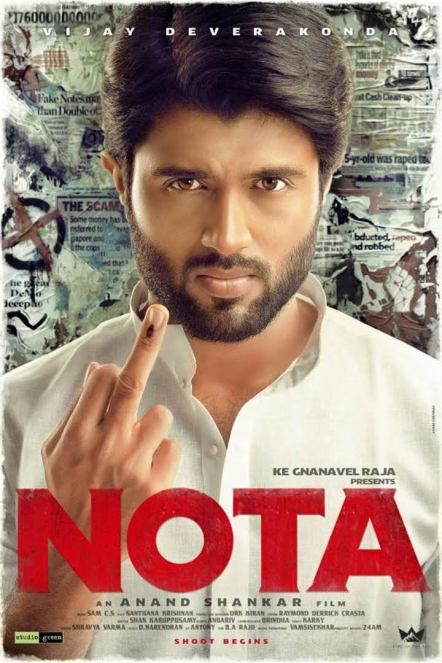
NOTA (2018)

NOTA

NOTA is a bilingual political /coming of age drama that ends up a step above routine thanks to Vijay Deverakonda’s engaging performance as a reluctant CM. It also helps that director Anand Shankar adds a number of real-life events to Shan Karuppusamy’s story which gives the film more impact. I watched the Telugu version as there were limited shows in Tamil here in Melbourne, and the switch from Tamil Nadu to Telangana didn’t make much difference despite most of the incidents deriving from known political issues in Chennai. The main let-down is the villain of the piece who is poorly realised and under-utilised, however there is enough here to make NOTA worth at least a one-time watch.

The film starts with a song and a drunken pool party for Varun’s (Vijay Devarakonda) birthday. Varun is a video-game designer based in London, but is home to celebrate his birthday and to visit an orphanage he supports. However, on the way back from the party his car is pulled over by the police and rather than being booked for a drink driving offence, instead Varun is rushed home. Varun’s father Vasudev Subramanyam (Nassar) (Vinothan Subramani in the Tamil version) is the Chief Minister for Telangana, but he is stepping down after being prosecuted in a corruption case. Now as an Australian I’m very used to the top political position changing hands frequently, but here the party makes the choice of the new leader. The situation is different in India where the CM gets to choose his successor and Vasudev picks his own son who is intended to be simply a place-holder until the court case is finished. Varun has no interest at all in politics and just wants to be able to head back to London and his life there, but his general fear of his father ensures that he stays in India and does as he’s told.

Mainly this means Varun stays at home, out of the public eye, and signs whatever documents various faceless party men place in front of him. This he does, without even sparing a glance at the documents he’s signing, until everything suddenly comes crashing down after Vasudev is found guilty of corruption. Suddenly it’s no longer a game and real lives are at stake, pushing Varun out of his complacency and bringing him into direct conflict with the party, and his father. This is where a number of those real-life events are brought into the film, such as the Chennai flood, scandals over the fixing of labels to donated meal packets and politicians treated to a stay at a resort. But there are clichés too. Varun gets pulled into the murky world of politics after a riot where a young girl is killed in a bus fire and her mother’s sooty hands leave symbolic marks over his clean white shirt. His response is an impassioned speech which is overly theatrical and to some extent banishes the authentic feel that Anand Shankar manages to create for some of the earlier scenes between Varun and his political mentor, journalist Mahendran (Sathyaraj). For most of the film however, the dialogues and scenarios are appropriate and create a believable character in Varun.

Vasudev Subramanyam was an actor before moving into politics (of course!) and Nasser does an excellent job with his character. Initially it appears that Vasudev is the ‘bad guy’ as he keeps his family under rigid control, but later events paint him in a more ambivalent light which adds interests to the story. Also good is Sanchana Natarajan as Kayal Varadarajan, Varun’s political rival. Her father is the leader of the opposition party and Kayal is determined to bring down the man she dubs the ‘rowdy CM’ by any means possible, regardless of their previous friendship in college. Thankfully Anand Shankar doesn’t burden the film with an unnecessary romance between the two, but instead gives Sanchana free rein to make her character charismatic and a real challenge to Varun, as might be expected in real life.

Sathyaraj is excellent, as is M.S. Bhaskar as Vasudev Subramanyam’s right hand man, only ever referred to as Bhai. What works well here is Bhai’s adherence to the party line and his uncritical support of Vasudev even though he disagrees with his choices. Also telling are the numerous ‘yes-men’ who all abase themselves in front of Vasudev and act much the same way with his son. However a side-plot involving a financial swindle doesn’t fit well into the plot and the entire thread involving the ‘God-man’ who is manipulating Vasudev behind the scenes is clunky and poorly written into the main action. Inevitably these side excursions start to drag down the rest of the film, and despite some good dialogue between Varun, Mahendran and Vasudev, the second half feels stodgy and is hard to digest. Which is a shame as there is much to like in the underlying political story. Varun’s coming of age within the political system is handled well, and his rivalry with Kayal works well to initiate Varun into the dirty side of politics.

There are only 2 songs in the film and both are modern dance numbers, one for Varun’s party and the second at a nightclub where Varun has been drugged.  C.S. Sam’s music is fine but doesn’t particularly stand out and the generic background dancers add even less to the choreography. I’ve added the Telugu version as this is the one I saw in the cinema, but the link to the Tamil version is here.

If the film has stuck more closely to the political issues then this could have been a very good story indeed. Instead the various sub-plots dilute the impact of the political scenes and it’s only the strong performance from Vijay Deverakonda that prevents his character from becoming just another mass movie hero out to save the world. Thankfully there is more backstory and just enough intrigue to make NOTA worth a look, while the real-life political situations do add another level of realism to the plot. The excellent support cast are also well worth catching as they all do justice to their roles. Overall, not a bad début for Vijay Deverakonda in Tamil cinema and another interesting choice for an actor who only seems to be getting better with each film.

Aravindha Sametha Veera Raghava

Trivikram’s Aravindha Sametha Veera Raghava is a bit of a throwback to the factionist rowdy fests of yore, albeit with a bit of a difference. How much of a real difference though?

Veera Raghava Reddy (NTR Jr) returns to his village after studying abroad. His father Narappa Reddy (Naga Babu) is delighted to see his boy back at home although he is worried by a recent escalation in a decades old feud with Basi Reddy (Jagapathi Babu). Predictably enough they are ambushed on the drive home. What does a good son do when he is the heir to conflict? Is killing and mayhem the only way? Or can a Telugu mass film hero broker a lasting peace based on doing what is right for the people?

There was some character development for Raghava, if not for anyone else. It was good to see him learn from both experience and from wise counsel, and then apply those learnings. Raghava struggles with the community’s expectation that he will be a carbon copy of his father. NTR Jr is excellent and can show restraint and slow burning rage as well as going for the big emotional notes. We get to see Raghava in shock after a very traumatic incident, and his ensuing grief. He’s not superhuman although of course he has the usual kit of gravity bending tricks up his sleeve. This is a film where the hero is often seen simply sitting and thinking. He can dial a conflict down to a terse conversation as well as firing up at the villainous Basi Reddy. He has goals and makes his decisions in light of the objective. At key times people tell him that the man that prevents a war is a great man. Raghava also believes the man that wants peace has to have the strength to win a war. The hero must win, but maybe not in exactly the way usually predicted in this style of film.

Aravindha might be a bit princessy but as she says to Raghava, nobody is only what they appear to be. She tells him straight up what she expects from a partner. She also tells him women think hard about which man they will be best suited to while men see a pretty face, hound her ‘til she gives in, then leave her at home and bugger off to do whatever. When he considers the example of his own parents it makes him realise that he needs to change if he wants to be with Avi. He still decides to go win his war but promises once that is over, he will concentrate on her from that moment onwards. Which is a bit of an each way bet but as this film is kind of about compromise and negotiation it is fitting. Pooja Hegde is stunning, and while Avi is perfectly happy to get by on looks when it suits her, she has a sharp mind and a healthy dose of self-awareness. They have a nice rapport and I liked that the film took the time to show them talking, helping each other with little things, and feeling their feelings.

Jagapathi Babu is quite the villain de jour in Telugu films. I loathed Basi Reddy but kind of loved the boots and all commitment to making him despicable. There’s no subtlety in the character but the performance has some beautifully modulated beats and peaks that add an edge. Sunil was effective as the decent guy who helped Raghava out, mercifully not bogging the plot down in Comedy Uncle mode. Naresh and Srinivasa Reddy were tedious and time consuming. Rao Ramesh and Subhalekha Sudhakar added another element as the crafty career politicians who have drifted away from representing the people and were caught up in winning for the sake of winning. And many That Guys flew across the screen, bleeding, screaming, crying, and suffering for their art.

Eesha Rebba also had a tiny role with not much to say for herself, but her expressions were perfect for an irritated younger sister. Supriya Pathak and Sithara both deliver some strong dialogue on the folly of men indulging in constant bloodshed and who pays the price. Easwari Rao and Devayani play silent wives of warring men, but both can pack a punch without saying a word. Which is just as well since Trivikram silences them just at the moment when they should have been heard. It is telling that when the hero is delivering a big speech about what he learned from the women in his life that none of the women, who are all present, gets to speak for herself. So everyone ignored what the women said until the biggest baddest strongest man repeated their words, then everyone listened to him. Again, nice idea but didn’t quite land the execution.

I’m not saying this is a totally sensible version of a mass film. Who sets up a high security meeting complete with metal detector at the entrance and then leaves a nail gun lying around! The percussion of the BGM matched Tarak ferociously beating his opponents with sticks. And Trivikram gets Raghava’s shirt off in perfect mass style in the midst of raging carnage. The device by which Trivikram got Veera Raghava Reddy into Aravindha’s home as driver/bodyguard Raghava could only aspire to be called flimsy. And there are the usual 50 to 1 fighting odds when our hero takes on truckloads of armed rowdies and emerges with nary a blemish despite the unbridled enthusiasm of the Fake Blood Department.

The upbeat songs were most successful in their picturisations. Peniviti was made unintentionally funny with all the stringed instrumentalists getting soggy in the rain. Tarak is amazingly talented and looks like he is having a ball when the music kicks in and he can go for it. Pooja Hegde doesn’t really try and keep up with him but she puts a lot of energy into Reddy Ikkada Soodu and does some excellent face.

There are some minor similarities with the recent Rangasthalam, like the setting and a hero who takes on a sociopathic Jagapathi Babu character. Unfortunately one also seems to be the dodgy subtitles.  Is gizzard curry really a sign of love? What are cooling glasses and when should one wear them? Does administering Celine really cure a fever? How much chaos is required before your shirt buttons pop off? Ladies, would you be carried away by a man who says he looks like a sword with a moustache? It’s sad to see scrimping on something like the subs which shouldn’t be an afterthought, and would help capitalise on the success of other Telugu films with new markets.

Trivikram has tested the water for a new kind of hero but ultimately falls back on the old standards. Tarak is really coming into his own as an actor and makes the most of the range he’s given here, and the female ensemble cast was exceptional. See it if you like epic revengey films and have a high tolerance for gore.