Aditya 369

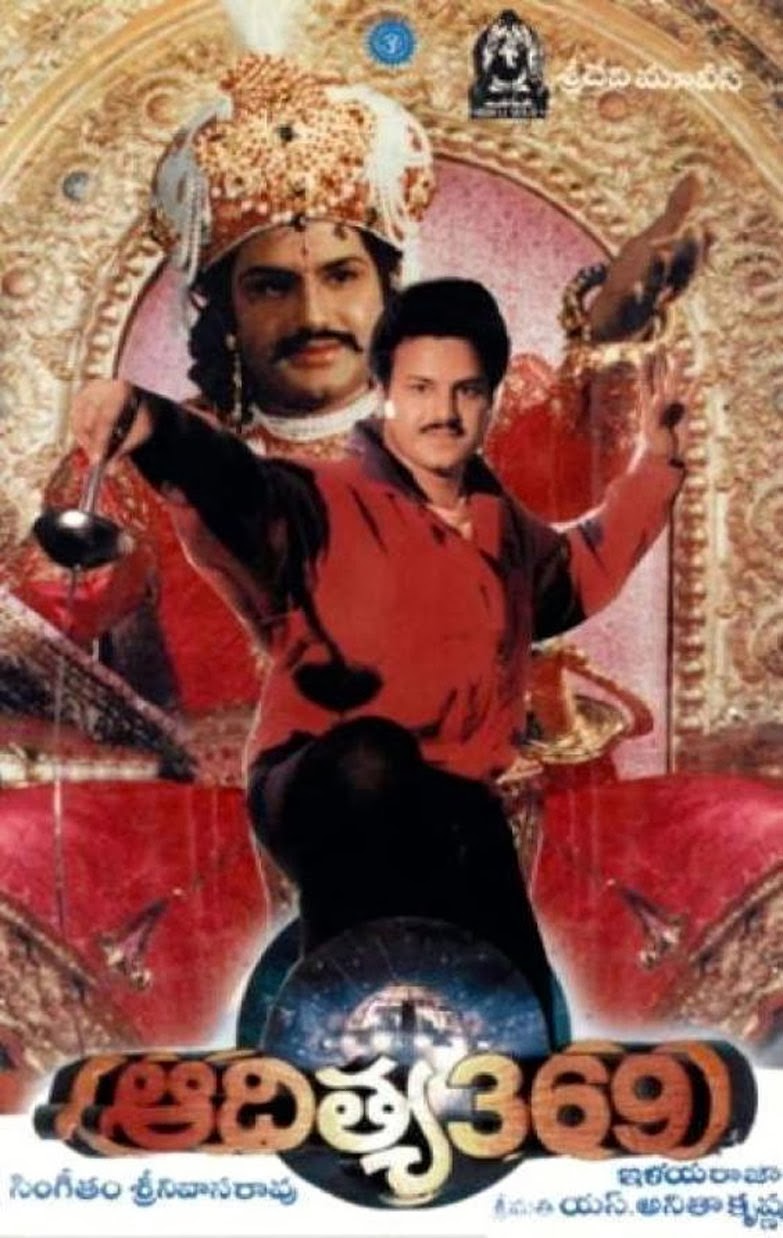
Aditya 369-Poster

When I heard Singeetham Srinivasa Rao’s Aditya 369 described as ‘historical science fiction’ I was immediately curious.  It is less about science or history and more about the outfits and derring-do, but that isn’t necessarily a bad thing. The film is on Youtube without subtitles and there is a diverting but not very helpful plot summary on Wiki should you wish to swot before taking the journey. But no one in the film prepares, so please do not feel obliged.

Aditya 369-time machine

The plot goes something like this. Professor Ramdas (Tinnu Anand) is an eccentric inventor, but apparently does well enough for himself that he can support a large house and workshop and keep his daughter Hema (Mohini) in stylish polyester outfits. His life’s work is a time machine called Aditya 369. The professor takes a low key approach to security and intellectual property, allowing just about anyone to come and have a look at the machine.
Aditya 369-Amrish Puri

Raja Verma (Amrish Puri) is a crook with a particular interest in historical regalia and diamonds. He arranges to steal a golfball sized diamond from the local museum and replace it with a fake. Now, if you call one guard with obsessive rule observance a diligent approach to security, then this museum was world class. Young Kishore (Master Tarun) is accidentally locked in,  witnesses the theft and has to be rescued when he tries to outrun the thieves.
Aditya 369-Balakrishna and Master Tarun

He confides in his saviour Krishna Kumar (Balakrishna) who decides to investigate.  Kishore decides to take his fellow plucky orphans on a spin in the time machine, is rescued by Krishna,  and Krishna and Hema are sent back to the past where they rescue Silk Smitha and meet Sri Krishna Deva Rayalu (also Balakrishna) and learn about the Golfball Diamond.

You know how in lots of time travel fiction the first rule is don’t change anything and don’t use modern stuff and cause ruptures in the fabric of time? When I saw the two emergency suitcases stashed in the time machine I assumed historically appropriate costumes. Well, at least the inhabitants of 1526 got an eyeful of fine 80s fashions. And listened to a boombox.

I disliked Krishna once he had landed back in time. In the presence of poets and scholars he had only ever read about, he couldn’t help but stick his oar in and go for a bit of one-upmanship. It was really tiresome and just made no sense. The dialogue seemed to go along the lines of “As you know Jim, I have an electric shaver” “Wow! Please, unknown man who says he is from another time but based on those clothes may be a nutter, tell us what to do”.

Following that sojourn in the glorious past, the crew is catapulted into the future where they nearly die from radiation before being given their own shiny space suits. To be fair to Krishna and his lax approach to historical contamination, the future people didn’t seem to have any qualms about revealing significant details that characters would not yet have experienced. But while I could understand the future people knowing their history,  I expected a bit more curiosity from the people in that past. The final scenes bring hero, villain, professor and know-all child into conflict as things almost literally spin out of control as Krishna has to rescue his friends and save the world.

Balakrishna offers his usual high energy performance. He could never be accused of slacking off, except maybe in the dances where he often relies on a slow disco strut interspersed with vigorous flailing. Krishna doesn’t have any hidden depths so what you see is what you get. The character tried my patience and I found myself looking at the sets and backgrounds rather than caring about what was happening to the people. There were a couple of sickening stunts involving horses so that further tarnished the heroics.

Aditya 369-Mohini

Mohini is adequate as Hema given that for most of the film she is just part of Krishna’s baggage.

Aditya 369-walk like an Egyptian

Amrish Puri does his usual villain thing with flair. Raja Verma is a bit obsessed with things that are original and authentic which may explain his Faux-gyptian style robe.  The diamond was supposed to link all the times together but that part of the plot seemed like an afterthought.

There are comedy uncles but no one else gets much of a look in with Balakrishna in a double role so that is another positive for the film. Suthivelu plays a hapless policeman who gets dragged along on the time travels, and Brahmi makes a small appearance as a scientist.
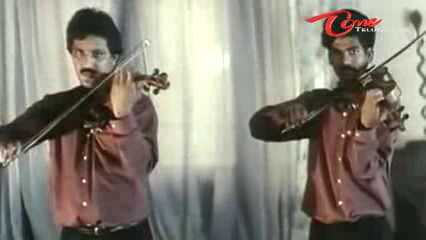
Aditya 369-henchmen

I really enjoyed Raja Verma’s gang of purple shirted thugs who carried guns in violin cases, and then played violins as background music in an interrogation scene. I think that is the first time I’ve heard the violence/violins pun in an Indian film. Tinnu Anand seems to have his own personal wind machine in all his scenes, maybe to stop him overheating from overacting.  Annapurna is Krishna’s mum although she doesn’t get to do much apart from marvel at his awesomeness.

Illayaraja’s background score is lovely. The theme over the opening credits is lush and a little eery. The songs are melodic although mostly a bit random. I did like the dance off between Silk Smitha and Mohini to settle the matter of Krishna’s honour. Well, I did until of course Krishna decided he could play all the instruments AND do the dancing.

The production design has a retro charm that sometimes made me nostalgic for TV series like Lost in Space. Terminator 2 was released in the same year and the difference in technical capability is enormous.

The “ye olden days” segment was what I would expect from any Telugu film, but the futuristic episode was more remarkable for the efforts of the wardrobe department to really feature antennas and silver lame.

Apart from that, as noted earlier, the costumes were mostly 80s mainstream fashion – lots of high-waisted denim, synthetic fabrics and big hair. And the women didn’t fare much better.

There are more things in heaven and earth than are dreamt of in your philosophy and Telugu films are a great place to find them. See this for the curiosity value of the Telugu mass hero formula applied to a different genre and for the low tech effects that have their own appeal. 3 stars!

Sahasam

Sahasam-Telugu-Movie-Poster

Who doesn’t love a good treasure hunt and adventure? Chandrasekhar Yeleti and the team who made Sahasam, that’s who! Well, at least they certainly haven’t made such a film so I have to wonder. Loosely drawing inspiration from Hollywood blockbusters like the Indiana Jones franchise and Telugu forebears such as Mosagallaku Mosagadu, this had the potential to be a highly entertaining tale. I expected better from the director of one of my favourites, Anukokunda Oka Roju.

The story centres on a simple and superstitious man who dreams of great wealth. When he finds his grandfather’s old papers he realises there may be a hidden family treasure. Unfortunately for Goutham (Gopichand) the treasure is stashed near his ancestral home in what is now Pakistan (shown in a flashback with Suman as the grandfather). And Pakistan, according to this film, is populated exclusively by terrorists. Even good characters think nothing of abducting people at gunpoint. Goutham crosses paths with Sreenidhi (Taapsee), a religious girl who is organising a pilgrimage to – guess where. He inveigles his way on to the trip and off they go. The second half of the film is the treasure hunt as Goutham tries to find the diamonds before Sultan (an, er, unbridled Shakti Kapoor) and his sidekick Dilawar (Raj Singh Arora) can get their hands on the loot.

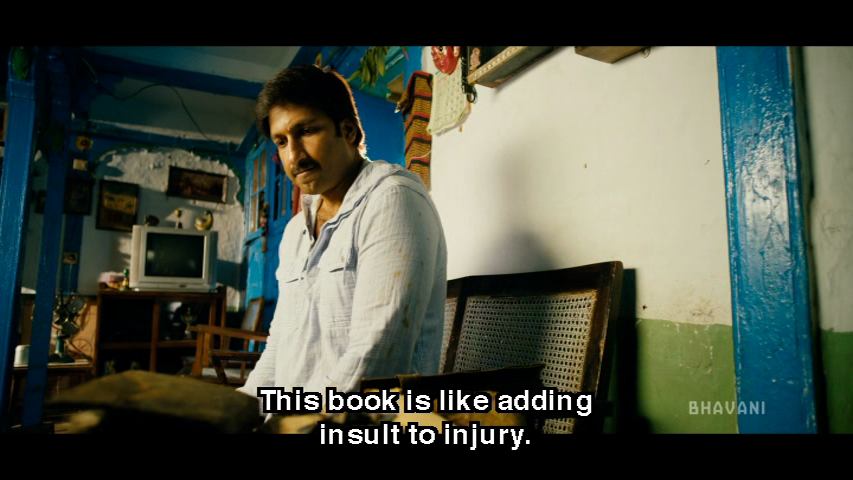
Sahasam-the book

Gopichand has the requisite skillset for a Telugu film hero, but the material here is thin at best. The first hour or so is spent proving that Goutham is a bit dim and quite unlucky. You would only need so long to understand that if you were dumber than Goutham. The fight scenes are very athletic (the fake blood budget was fully utilised in many, many dismemberments) and Gopichand was clearly in his element in the thick of the action. Post interval Goutham becomes something of a puzzle solving killing machine with photographic recall which was moderately more entertaining. Goutham’s catchphrase is that he won’t take anything that isn’t his, but if it is his he will never give it up. And that sums him up as a dogged, dour hero rather than a swashbuckling one.

As Goutham wasn’t motivated by the usual romantic notions, Taapsee had even less to do than might be expected from the heroine. I find her appeal inexplicable so that was an excellent result. She does use both her facial expressions (grimacing and simpering) so I suppose that is something of an achievement. To be fair, her big moment was as a goat substitute in a game of buzkashi so there wasn’t a lot of nuance for her to convey. Zara, an ally in Pakistan, was much more effective as a character and her performance was more appealing.

Ali’s character was supposed to be an Indian security expert living in Pakistan but he gave his usual shtick and Qayamat Raju was just an annoyance. Shakti Kapoor is insanely over the top and while I enjoy a properly nasty villain as much as the next person, he spiralled from cunning and ruthless to stupidly petulant and cowardly and finally outright buffoonery. I would not have bet on seeing a worse actor than Abhimanyu Singh in my lifetime but a new contender has emerged in Raj Singh Arora. His idea of intensity is pursed lips and bug eyed staring which has an unfortunately comedic effect when his glued on beard is taken into account. A villain can be crazy but they have to be a credible threat and imbue the dynamic with some menace. Otherwise they are just a jumped up comedy uncle.

If I may name drop, earlier this week I attended a masterclass by the amazing Suhasini. Among other things, she spoke about the difficulty of capturing the expression and spontaneity of the live scene when dubbing dialogues. The sound team in Sahasam decided to get around this by ignoring such details. At one point the dubbing is so bad that the screaming goes on long after Gopichand has shut his mouth, and minutes later vigorous fight noises are dubbed over characters who are doing nothing.

The production design is often excellent, but some clunky CGI does detract from the drama. I liked the scenes set in Goutham’s home as it looked eccentric and colourful but still lived in and real. Ladakh played the role of Pakistan and cinematographer Shyam Dutt used the stunning scenery and harsh light to good effect. Unfortunately Shakti Kapoor and his convoy of thugs are often blocking the view. The ‘olden days’ sequences are blighted by some cheap looking visual effects and inconsistent approach to things like light sources in underground chambers. I found myself being distracted by the similarity of all the spiderwebs in all the caves and wondered if they were bought in bulk.  And apparently the ‘terrorists’ use special bullets that can kill a man but not penetrate a car windscreen. Then there are the other special bullets that can destroy masonry but not harm Gopichand. Sigh.

There are five writers credited (including Chandrasekhar Yeleti) and I wonder if that contributed to the lack of cohesion in the story. There are several tangents that fail to develop into anything substantial or credible and the mood sometimes changes abruptly. The pacing is never quite right and there is no tension leading up to the final scene despite all the ingredients being present.  I read an interview with the director and he mentioned that he felt obliged to change things a bit to suit Gopichand’s image. Perhaps the film would have benefited from some more consideration as to how to incorporate the action hero elements.

The songs by Sri are average and not very memorable. The hero introduction has some visual flair but the songs don’t contribute to the story and the picturisations are nothing special.

It was like watching two really bad movies rolled into one. Sometimes that results in a guilty pleasure that is So Bad It’s Good. Sahasam is only halfway there if you catch my drift… 2 stars!

Sahasam-fugitives

Race Gurram (2014)

Race Gurram

Race Gurram was very nearly a non-starter in Melbourne, but at the 11th hour the distributors managed to find a venue and the race was on!  Better still, there were English subtitles – even for the songs – a first for Telugu cinema here in Melbourne, but hopefully not the last.  So, with a small but luxurious cinema, subtitles and the promise of Allu Arjun for just over 2 ½ hours, was the experience worth all the effort to get the film onscreen? Definitely!  Race Gurram is a mass entertainer that doesn’t break away from standard masala fare, but still manages to leave you laughing at the end.  That’s thanks mainly to strong performances from Bunny and Brahmi, while the usual suspects who make up the rest of the cast are a bit more hit and miss.

Apart from Allu Arjun’s introduction with a herd of horses and a few brief dialogues between our hero and the main villain, I’m not entirely sure why the film is called Race Gurram.  It has nothing whatsoever to do with the race track, and instead is a tale of acrimony between two brothers, Ram (Shaam) and Lakshman (Allu Arjun).

Race GurramRace Gurram


Ram is the elder and more sensible brother. He’s an ACP and is the standard morally upright policeman that Telugu films like to use as a sacrificial lamb.  Lakshman prefers to be called Lucky, because apparently it sounds ‘cooler’, which is probably enough of a clue to his feckless and irresponsible character.  The interactions between the two brothers are one of the strengths of the film and Shaam and Bunny make their exchanges seem natural and realistic.  Their arguments are just petty and immature enough to ring true, and when the situation escalates after a few more personal jibes, Lucky’s response is also in keeping with his personality. The way their relationship develops later in the film is also well handled, even if Lucky’s revelations before the interval do seem a little forced.   The tables are turned when Lucky finds out that someone else is targeting his brother and while it’s OK for Lucky to humiliate and fight with his brother, it’s not on if someone else tries to do the same.  It’s typical boy logic, but at least it gets Lucky on to the right side in the war against goon turned politician Shiva Reddy (Ravi Kishan).

Race Gurram

Shruti Haasan appears as Spandana, Lucky’s love interest, and at first seems to have an interesting role as a devotee of yoga who only shows her emotions on the inside.  But once she hooks up with Lucky, her usefulness to the plot seems to evaporate as her ability to emote increases, and she’s relegated to mainly appearing in the songs.  At least Shruti gets to actually dance rather than just pose and gyrate like Debi Dutta in the unimpressive opening number, and she does look great even if she doesn’t get to say much in the second half.

Another disappointment is Shiva Reddy and the whole plot against Ram and Lucky.  Although there are some good moments, overall Shiva Reddy is too much of a caricature villain to be properly offensive, and his machinations to become a minister are laughably inept. Ravi Krishnan never seems to get his teeth into the role, and mostly plays it for laughs with plenty of grimacing and sneering rather than any real maliciousness.  The knock-on effect is that the fight sequences don’t work as well as they should against such an ineffectual hoodlum and even throwing Mukesh Rishi in as Shiva Reddy’s somewhat nastier father doesn’t improve the situation. However, the usual suspects including Kota Srinivasa Rao, Posani Krishna Murali, Sayaji Shinde and even Prakash Raj as Spandana’s father all add enough to the mix to keep the action moving along well.

The second half introduces Brahmi as Kill-Bill Pandey, a name which does infer the usual dire slap-stick that Brahmi often relies on for comedy.  But such is not the case – Kill-Bill Pandey has great lines and an actual proper role in the story. And he’s really funny!  Seriously! Bunny and Brahmi work well together too, as Lucky comes to realise just what he has done by releasing Kill-Bill Pandey as head of a special police force on the unsuspecting Hyderabad public.  It makes for a much better ending than expected and has to be one of the best performances I’ve seen from Brahmi in recent times.

Race Gurram

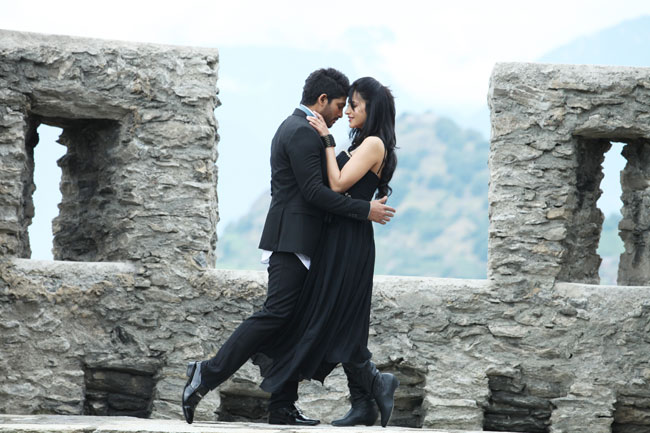
I was expecting great things from the songs despite the fact that the soundtrack didn’t sound too special on first listen, and overall I wasn’t disappointed.  Apart from the first number which appeared out of nowhere without any particular point and had very little actual dancing by Bunny, the choreography was excellent.  Placement was generally odd and mostly there was no effort to place the songs within the storyline, but who really cares when it’s Bunny dancing? The stylish star looked, well, stylish, and as always his dancing was superb, particularly with Shruti Hassan in the larger group routines. Bunny always looks to be having such a good time when he’s dancing and his energy is incredibly infectious, so no matter how ridiculous the sudden appearance of Spandana and Lucky in the snow-covered fjords of Norway seemed, it was impossible not to enjoy the show.

Race GurramRace Gurram

Race Gurram does suffer from a rather rambling screenplay, and at times the film gets bogged down with irrelevant odds and ends that taper off into nothing.  Apart from the feuding brothers, the family moments are a tad cloying and overdone, and a heavier hand with the editing wouldn’t have gone amiss.  However, Bunny and Brahmi together make for a surprisingly entertaining finale that was certainly well appreciated by the Melbourne crowd.   Well worth a watch for their combined antics

Race Gurram