Simple Agi Ondh Love Story

Simple Agi Ondh Love Story

The story of Simple Agi Ondh Love Story is one familiar from a number of Hollywood romances, but it gets a new treatment here from director Suni. He’s stuck to a minimal cast and limited shooting locations but included riddle-like dialogues and snappy comebacks to add interest to the screenplay. The film describes a romance between Kushal (Rakshit Shetty) and Kushi (Shwetha Srivatsav) with the narrative taking place one wet monsoon day when the two first meet. It’s a slow-paced film which does drag somewhat in the middle, but is redeemed by a good beginning and an excellent ending. Not a film for everyone perhaps, but worth a look as an example of new, independent cinema in Karnataka that seems to be just a little bit quirky.

The film starts with an RJ Rachna (Rachana) telling her audience a story about her brother Kushal. He is off to Kodagu area in Coorg to meet Rachna’s fiancé’s sister Ithihasini. The hope is that a romance might blossom between the two since Rachna feels she cannot go ahead and get married while her brother is still unattached. I cannot imagine that her listeners would have been in any way interested in the story, particularly since she annoyingly starts each sentence with ‘Actually…’, but as a method of introducing the actors it works well. Kushal directs advertising films and is also a keen photographer, so his interest is drawn when he sees a girl out in the monsoon rain taking photographs. Naturally when he turns up at the house to meet Ithihasini, she turns out to be the girl he has seen in the rain, and just to keep the clichés going he immediately decides then and there that he has found the girl for him. However unusually then the two are left to their own devices for most of the rest of the film. Rachna has called Ithihasini to let her know that Kushal will be there, but the rest of the family have gone to visit a temple for the weekend, leaving Ithihasini to entertain Kushal by herself.

There is a lot of fast banter between the two as Ithihasini quizzes Kushal about his reasons for wanting to meet her and Kushal tries to get past Ithihasini’s evasions when asked about herself. The dialogues often seem in the form of brain-teasers, or maybe they appear as strange questions due to the subtitling, but Suni seems to mix old-fashioned similes and sayings with modern speech giving a rather more unusual dialogue. It sometimes makes the interactions between the two difficult to understand and I found I had to pause the film to re-read some of the subtitles to get a clearer sense of what the characters were trying to say.

As a way to get to know each other, the two share their previous love stories, which are shown in the form of flashback episodes. However the same actors play the roles of each other’s previous partners in these flashbacks which backfires to some extent as the film becomes monotone and flat as a result. There is little differentiation between the characters as they are themselves and their appearance as the ‘ex’. Although there is some attempt to make them at least appear different – Jarin for example has long hair (complete with manband) and a beard compared to Kushal’s short hair and shaven chin, the personalities appear identical and the dialogue retains the riddle pattern, adding to the similarity. The love stories themselves are also rather dull, although the dialogue is often quite funny and the few songs do help lift the mood. However, by the end of the flashback sequences Kushal seems a bit of a wimp and Ithihasini appears even more immature and irritating than before.

Ithihasini’s actions seem a little odd and her responses to Kushal’s questions all avoid direct answers so it’s not really a surprise when Kushal’s sister calls to tell him that the girl he has been spending time with is not Ithihasini at all. When confronted the fake Ithihasini comes up with a number of different stories, but Kushal finds her even more intriguing as a result and declares his love for her despite not knowing who she actually is, although he does finally discover her real name is Kushi.

The final part of the film is better, adding suspense with the mystery around Kushi and the reasons for her confusing actions. The end has a surprising twist and makes up for the dreary middle section, particularly as both actors finally begin to react more to each other in a more natural way. There is genuine emotion and the overly complicated dialogue is replaced by more spontaneous sounding exchange. The different approach gives the ending more impact and made me wish there had been more of this honesty and emotion earlier in the film.

For new actors, Rakshit Shetty and Shwetha Srivatsav do a good job with their roles, particularly given that the action focuses solely on just them for most of the film. Shwetha’s Kushi is particularly irritating at times, which I think is the whole point, and does provide a good contrast to Rakshit’s more sensible Kushal. Shwetha does however come into her own into the last scene and also has some great facial expressions throughout the film. Rakshit has a little more to work with earlier in the film and is also excellent in those moments where he has to show more emotion. Although most of the film is shot in the same house with the ever-present monsoon, cinematographer Manohar Joshi captures the different moods of the rain and the subtle changes in lighting well. There is also a good contrast in the romance between Kushi and Jarin which is set on the beach in the summer and is a pleasant change from all the rain.

What I like about Simple Agi Ondh Love Story is that’s an attempt at something a bit different. The decision to use minimal locations and only a few actors may possibly have been driven by budget considerations, but it does keep the story simple and focus attention on the dialogue. A little more editing in the flashback sequences would have helped but overall I enjoyed the romance and liked the characters. Simple Agi Ondh Love Story is an unusual style of film that is definitely worth a watch provided you are a fan of the romance genre and don’t mind a minimalist approach. 3 stars.

Rana Vikrama

Rana-Vikrama-poster

Time for another adventure without subtitles; this time the Puneeth Rajkumar starrer Rana Vikrama that released earlier this year in India and showed this weekend in Melbourne. Written and directed by Pavan Wadeyar, it’s an action movie that follows a fairly predictable path but is kept moving along by the Power Star’s charismatic presence and some good action sequences. Throw in some better than average songs, a dash of comedy, and Rana Vikrama is a more entertaining watch than the opening scenes would suggest.

The story starts with a rather over the top British Officer in the last days of the British Raj. As expected, the Viceroy (Vikram Singh) is obnoxious, controlling, vindictive and just plain evil, although since Vikram Singh overacts and has been inexplicably dubbed by someone with an East European accent he ends up more comical than villainous. Unfortunately he’s not the only victim of the poor dubbing as a number of later scenes supposedly set in London feature reporters and lackeys also badly dubbed into grammatically incorrect and oddly accented English. Skipping over these technical issues, Vikram Singh chews the scenery for a while and eventually attempts to kill upstart villager Vikrama (Puneeth Rajkumar). Naturally he is no match for the tough local who wins the day despite being beaten, weighed down by chains and shot. Twice. Take note Hollywood – that’s how hard it is to kill a real hero!

The film then flashes forward to the present day where Vikram (Puneeth Singh again) is an aspiring police officer. Despite his obvious physical fitness, he is rejected by the enrolment officer time and time again however Vikram is determined to succeed, somewhat against the wishes of his fiancée Paaru (Adah Sharma) who would prefer him to stay with her. Vikram is thrown a lifeline by the Home Minister (Girish Karnad) who appoints him as a police trainee and sends him off to investigate a missing reporter somewhere in the border between Karnataka and Maharashtra. After a few hiccups Vikram finds the spot where workers in chains are toiling away in what appears to be an open cast mine, and makes short shrift of the numerous thugs and villains overseeing the project in classic filmi hero ishstyle.

The village has been keep secret for many years due to the nefarious dealings of none other than the British Viceroy’s descendant and the richest man in Britain, Jonathan (Vikram Singh again). He’s just as prone to overacting as his grandfather but with less reason, since he’s supposed to be a successful if rather unscrupulous businessman. However once Jonathan discovers that his secret has been discovered he jets in to India and prepares to get rid of Vikram once and for all.

Before we can get to the ultimate showdown however, there is a flashback sequence which explains the opening scene and also exactly why Jonathan’s family wants the land. Vikrama is married to Gowri (Anjali) for this sequence and the couple share good chemistry making this a better pairing than Puneeth Rajkumar and Adah Sharma in the present day. Anjali also gets to swing a sword and her feisty nature fits well into the storyline making her a more memorable and likeable character. I love this song featuring Gowri and Vikrama, which has the added benefit of a gigantic drum as a stage for Vikram’s dance moves. There is always something very special about oversized musical instruments in a dance number!

Generally the songs from V. Harikrishna are catchy and the choreography and picturisations are effective with some excellent costumes and imaginative settings. The songs also fit well into the narrative, something which is often more hit and miss in an action film, but they do work well here. If only such attention to detail had carried over into the dubbing and present day Anjali’s make-up to turn her into Vikram’s grandmother. This basically doesn’t work, and casting an older actress instead would have been a better option given that Gowri has little to do in these sequences other than look old and frail (which she doesn’t) and point dramatically at significant moments in the story. There is also a heavy reliance on clips of TV news reports which dulls the impact of some of the more dramatic scenes, although overall S. Vaidhy’s cinematography is impressive.

Although the film doesn’t cover any new ground and the heroic antics are far-fetched and fairly improbable, Rana Vikrama is still fun to watch. The action sequences from Ravi Verma are well thought out and the Power Star perfectly fits the role of a rough and tough police officer. It’s Puneeth Rajkumar’s film all the way and he does an excellent job of holding the story together despite the caricature of a villain and the rather OTT final sequence. I would have liked a little more care with some of the more technical aspects, but it’s still an entertaining film and one definitely worth catching on the big screen if you can.

Nagadevathe (2000)

nagadevathe-poster

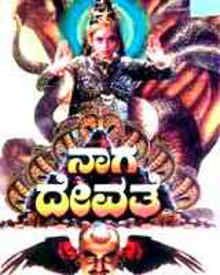
Sai Prakash’s 2000 film Nagadevathe is snakecentric, packed with special effects, and Soundarya and Prema are more than capable of shouldering the lead roles. The film is available on Youtube in Kannada, Tamil and Telugu so you can choose your own adventure without subtitles, and it has also been dubbed into Hindi under the title Naag Shakti.

The story as I believe it to be goes something like this. Gauri is regarded as a bad luck omen in her village, possibly just because she is barren. She and her husband offer hospitality to Shiva and Parvati who are pretending to be travellers. The gods tell Gauri why she is infertile – she accidentally killed a clutch of snake eggs and has been cursed. But they tell her how to stop them from continuing to punish her. Soon after, Gauri discovers she is pregnant. A difficult labour nearly ends badly but a glowing mystical snake appears and turns into Nagamma (Soundarya), who ensures a safe birth. There is a backstory involving a man who foolishly kills a snake and is cursed, his household goods transforming to snake mounds. He and his family do penance and after giving the deceased snake a proper funeral, his home is restored. Nagamma moves in to the termite hill to keep an eye on them or something. A shrine is built around the main snake mound and over time, more and more people come to pay their respects to the snake goddess. Nagalakshmi is born to be a devotee of Nagamma, and they have quite a warm and personal bond right from Nagalakshmi’s birth. Grown up Nagalakshmi (Prema) meets Shivaji (Sai Kumar) and love blossoms. There is some kind of conflict between their families and I couldn’t work out if it was an old feud, the rich boy poor girl thing, or just garden variety mother (deliberately turning her son into an evil possessed snake) issues. Nagamma tries to protect her favourite humans, and they could all benefit from some better decision making. Things get worse before they can get better, and the effects team are kept busy with magical healings, snake assists, helpful talking parrots, attack vultures, heaven, hell and the kitchen sink.

I enjoy the snake film genre for a few reasons. Often the female characters are more prominent and powerful or more nuanced, or both, and that makes me happy. There is usually a pervading sense of right in the film’s world as the snakes are able to enact justice that is missing for the masses. Snakes may act out of common sense or compassion, unlike many non-magical humans. Snakes are alert to every opportunity to get their groove on, with varying degrees of success along the scale from Jeetendra to Sri Devi. And the outfits are frequently a bit special. On many levels, from the very shallow to only slightly less shallow, Nagadevathe delivers.

I think Soundarya is lovely and in this film she maintains an air of benevolent authority in even the most trying times. Given that she often only has her face to act with (the rest of her having been replaced by a giant CGI snake), she does very well.

In one scene reminiscent of Ammoru, Nagalakshmi has summoned guests to eat at a special pooja. They are turned back by the Evil In-Laws but Nagamma calls on her sister deities to come along. She gets the undivided attention of the effects and saree teams as she personifies water, wind, earth, fire and more.

I admit to some disappointment that despite a most excellent spangly body suit, the obligatory “nagin assailed by been-wielding baddies” scene resulted in a disappointing dance. More like she was rolling around on the floor looking for a lost (blue) contact lense at times.

I liked Prema a lot in Devi, and her performance is solid. She has a flirty but down to earth tone with Sai Kumar, and a nice rapport with Soundarya. Prema is tall and elegant looking but has an energy that lends equally well to comedy and romantic shenanigans. Nagalakshmi has the strength and faith to stay on task and Prema really showed the power and intensity of her determination as well as her softer side. I could see why the snakes would want to chip in at her wedding. She was a good friend and fundamentally nice without being a pushover. Nagalakshmi knows what’s what and once she finds out the truth of her situation she takes steps to protect her loved ones and engage some divine assistance to sort out the problem. I recalled musing on the toxicity of Chiru’s bodly fluids in Punnami Nagu, and Shivaji also appears to have a lethal, um, bite. I have never been so glad to see so many silly interruptions of a wedding night.

Sai Kumar is Shivaji. He seems so nice and yet… When his snake nature dominates he is predatory and poisonous. Now I was confused as to how a snake goddess could be unaware her favourite disciple was marrying a serial killer faux snake, but maybe there are cosmic rules about that kind of snake-by-venomous-inoculation. Shivaji was unaware of his snakey activities and oblivious to the black magic worshipping going on around him. Nagalakshmi was often in peril and I was quite worn out from yelling at the screen for her husband to either wake up to himself or to get away from her. I’m more used to seeing Sai Kumar as a villain or an elder statesman so seeing him as a romantic lead was novel. Even if the effects team did seem to take too much pleasure in distorting his face into a snakelike mask.

The support cast includes stalwarts Babu Mohan, Tanikella Bharani, and other familiar faces doing familiar shtick. I couldn’t put names to all the faces but I was largely able to place which characters were Good and which were Not Good.

I did get a little confused at times since without the benefit of subtitles, I rely on the visual cues. Thankfully the signs are generally clear and umabiguous. Nagamma’s arch enemy is an evil mystic who favours an eagle motif and prances about in a shiny red outfit with a fluttering black cape. I liked that his cape was attached to the sleeves of his onesie as that helped ensure some vigorous and character appropriate flapping. The effects team worked themselves into a lather of laser eyes, snake shaped shadows, nasty afflictions, sparkly things, space monsters and of course giant multi-headed cosmic snakes.

Some key scenes are very similar to ones from Devi (1999) or even Ammoru (1995). Although this time around Prema was not the cosmic snake, and Soundarya was the powerful goddess. The story is laden with a bit of everything and the commitment to the theme is unquestionable. I can’t say the commitment to logic is equal.

See this if you like to see competent actresses take centre stage and if you enjoy a bit of a spectacle en route to a good comeuppance. 3 ½ stars!