Geeta Mera Naam

Geeta-mera-naam

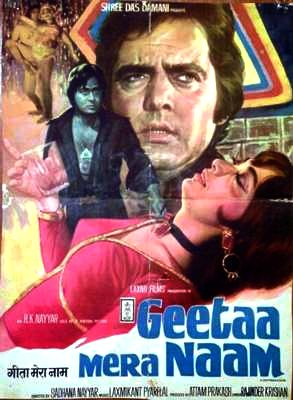
Sadhana’s Geeta Mera Naam is masala with an added dimension of weird.  The cast includes Sadhana, Sunil Dutt and Feroz Khan; all veteran stars with a diverse portfolio of work. Add in the usual suspects like Helen, Rajendranath, Keshto Mukherjee and even Jr Mehmood and you’ve got the ingredients for entertaining excess at your fingertips.
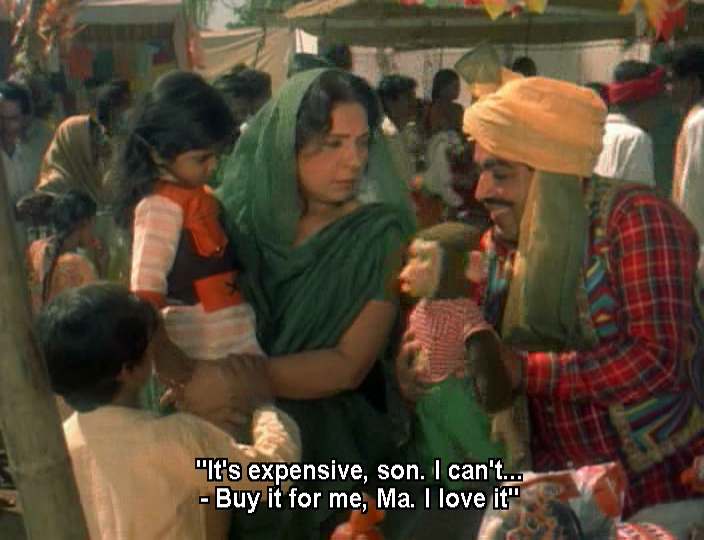
Geeta-Mera-Naam-monkey 1

Widowed Ma Saraswati (Achala Sachdev) takes her four children to the fair. Experienced masala watchers know that any visit to any amusement with a child is bound to end in tears and separation. Bandits raid the fair, as they do, and in the ensuing mayhem Saraswati keeps hold of Geeta but loses her twin Kavita. The boys are swept away before their matching tattoos could be completed, leaving Chandu with half a monkey on his forearm. If only some people had worn short sleeves in key scenes. Suraj is taken by the bandit leader as a replacement for his dead son while his brother is adopted locally. Years pass. Geeta (Sadhana) is a petty criminal, in and out of the cells at the police station run by her(unknown to either of them) long lost brother Inspector Chandu (Ramesh Deo). Kavita, now called Nita (also Sadhana), is a nice girl who teaches orphans in her spare time.  Nita’s adoptive parents sell her to Mohanbabu who wants her for a few months, or until he loses interest. Then they can sell her again. As she fights to escape someone kills Mohan. Nita sees a shadowy figure in a hat but the police charge her with the murder. And what of Suraj? Now called Johny (Sunil Dutt) he is a successful smuggler with a gang and a pretty good lair and a masala death trap and … a man called Sheroo who whips him, and a toy monkey, his memento of that day at the fair. Johny’s best friend (other than the monkey) and lieutenant is Raja (Feroz Khan), equally ruthless and pragmatic about the business at hand but with more of an eye for the ladies.
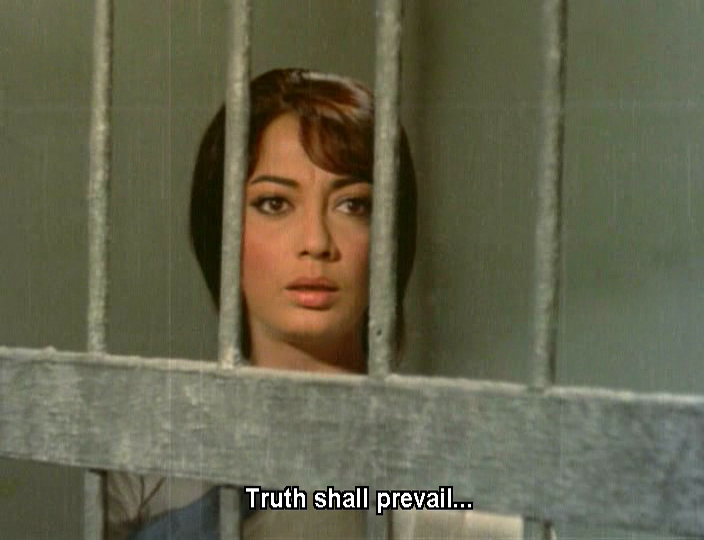
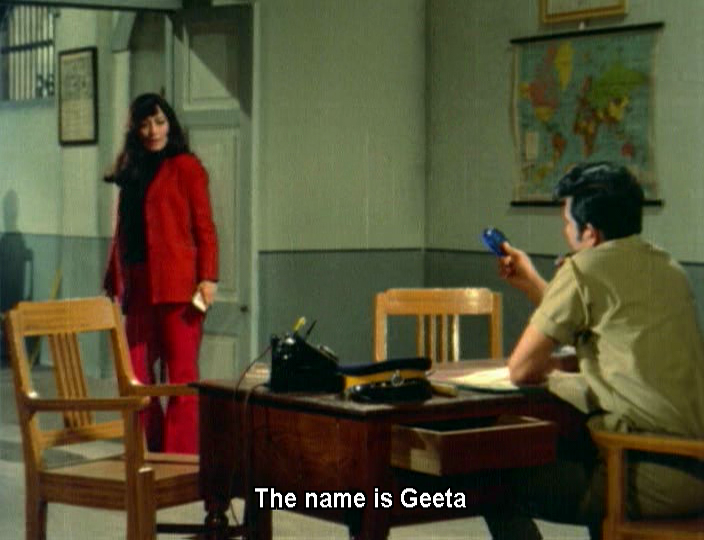
Geeta-Mera-Naam-NitaGeeta-Mera-Naam-Geeta

Sadhana didn’t exactly challenge herself with a double role as Nita, the good twin, is only seen for a short time and Geeta does all the heavy lifting. But Geeta is a great character. Feminine but independent and strong, she insists on being seen as an individual not someone who answers to “hey girl”. Sadhana’s clothes as Geeta were quite mid 70s frumpy and not what I expected from such a fashion icon. Geeta discovers her sister Nita in jail and decides to find the real killer. Learning that Johny did the deed, she infiltrates the gang through Raja.

Geeta uses her fearless attitude, kickarse fighting skills and feminine charms to gain his interest and for some reason, her feelings are also engaged, making vengeance a little more complicated.

Sadhana is a very capable actress but I found her direction more interesting than her performance. The film is a bit darker and more low key than the average masala flick, and there is an undercurrent of violence and power. Johny kills with tear filled eyes, then atones for his murders by having Sheroo flog him as penance. He is obsessed with rules and justice and blood in the sense of blood ties. Blood doesn’t recognise blood, but people do recognise their long lost identical twins and significant tattoos and remember where they were lost, all of which is handy. Geeta uses sex or at least the promise of sex to lure men but she has right on her side. She takes a strong stand against Johny partly to save her sister but also because she just doesn’t believe in his rules and why Raja feels bound by them. And his bad jokes should not be encouraged. I’m used to the first view of the heroine being restricted to various body parts, but Sadhana tries to level that playing field by having Sunil Dutt’s butt be his introduction.  Common masala themes of redemption, family, moral righteousness and the law are explored through characters struggles and insights. The standard masala requirements of separated siblings, elaborate death traps, convoluted revenge and audacious yet pointless criminal gangs are all present and accounted for.

Feroz Khan, or Fur-Roz as I mentally called him throughout, plays Raja with minimal facial expression but maximum wardrobe impact. I think there was some kind of battle raging in the costume department as he spends about half the film shirtless and the remaining half in puffy shirts. Raja is Johny’s most loyal friend but of course, once you add in such elements as a gold heist and Helen as the woman scorned, things get tricky. I’m not a fan of Feroz the actor but he did make some interesting films even if I am not always completely on board. Raja is not a very developed character but he does have presence and it is easy to believe in his authority within the gang.
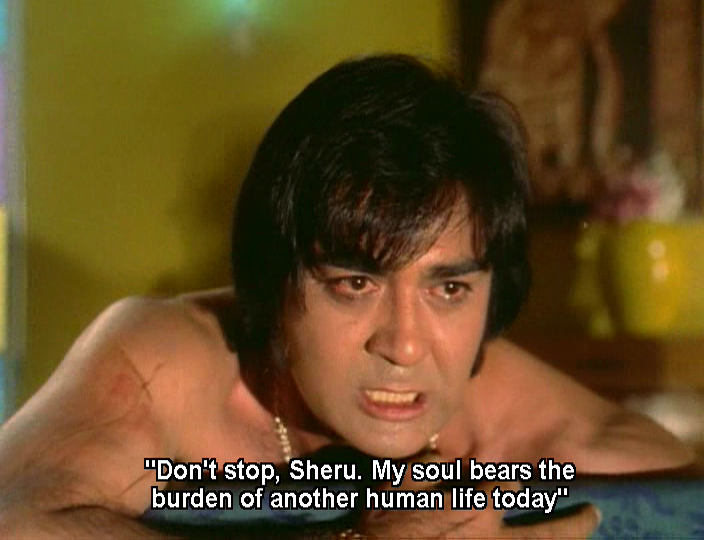
Geeta-Mera-Naam-tormentGeeta-Mera-Naam-Sheroo at work

Geeta-Mera-Naam-Johny and gangGeeta-Mera-Naam-insight

Sunil Dutt turns in a solid performance although I would not say it is his finest moment. His portrayal of Johny is over the top but he does give a sense of the troubled person under the trappings of villainy (and the pleather outfits).
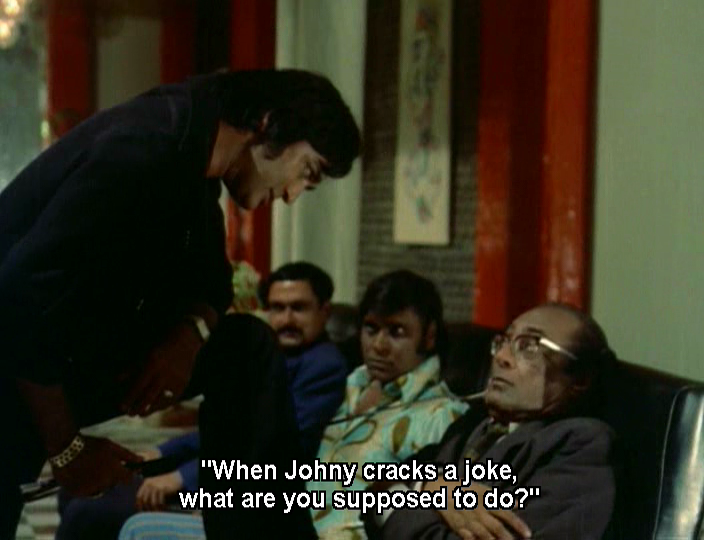
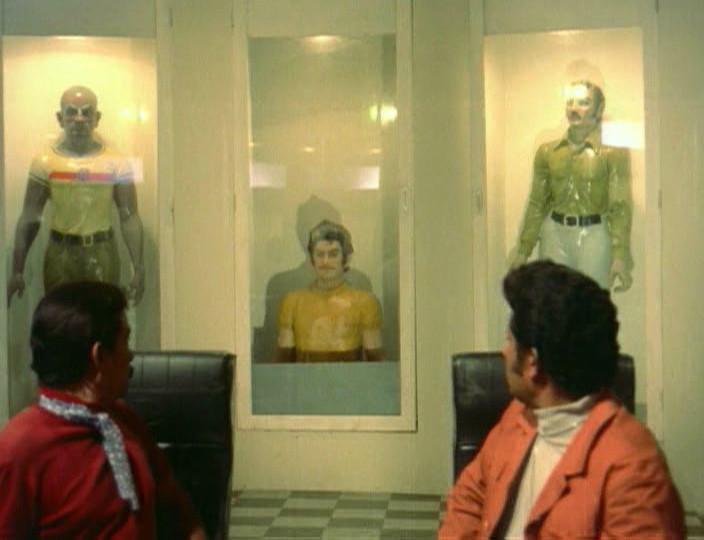
Geeta-Mera-Naam-jokesGeeta-Mera-Naam-lairHe and Feroz are in a race to see who can get their teeth into most of the scenery first but considering Johny disposes of disappointing employees by turning them into his own version of Madame Tussauds, realism was never on the cards. I did like that he didn’t play Johny as obviously crazy.
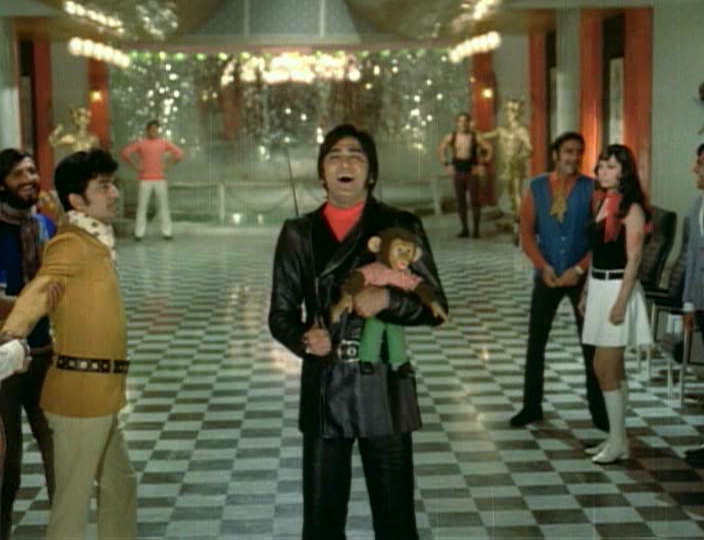
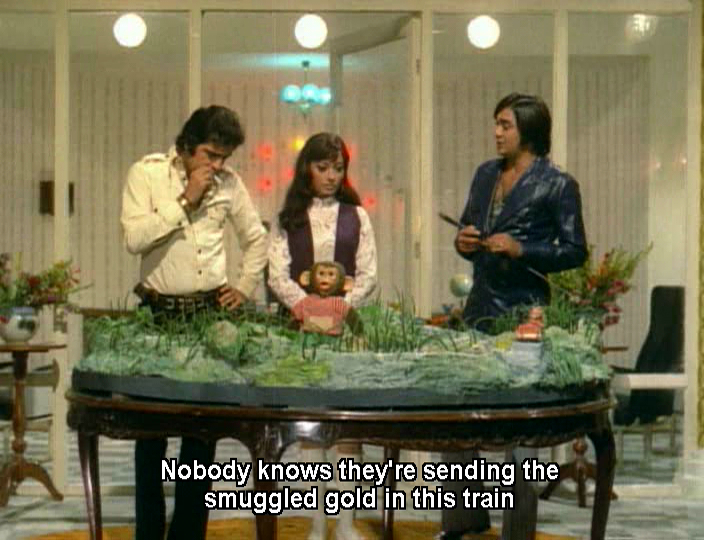
Geeta-Mera-Naam-evil laughGeeta-Mera-Naam-a cunning planDespite the occasional evil laugh, the peculiar behaviour was shown in a matter of fact way, so Johny seemed like a credible threat. He was capable of friendship despite his inner demons. Sure, the gang must have had rules about things like “Never mention the monkey” and “Don’t ask Sheroo where he buys his corsets”.

The background score is fantastic and I loved the punchy brassy tracks as well as the forays into surf rock and swing. Laxmikant-Pyarelal’s  featured songs are far less interesting although they do further the narrative somewhat. Helen plays Raja’s girlfriend and finds herself dumped for Geeta. She gets one big dance number, the incredibly strange and eyeball searing Mujhe Maar Dala. Geeta intends to sacrifice herself to save Raja who wants to save Geeta as Helen gleefully gyrates in a bubble filled water feature with Oscar, singing about pain, suffering and love.

Poor Oscar. A flesh coloured onesie is difficult for anyone to carry off, and the black belt doesn’t have the slimming effect that may have been intended.

Geeta-Mera-Naam-Helen and OscarGeeta-Mera-Naam-teeth

And I’d like to give Helen a special acting award for the bit where she unzipped Raja’s jacket with her teeth. There was not a flicker of expression on her face to indicate how traumatic it must have been as his fuzzy torso was revealed.

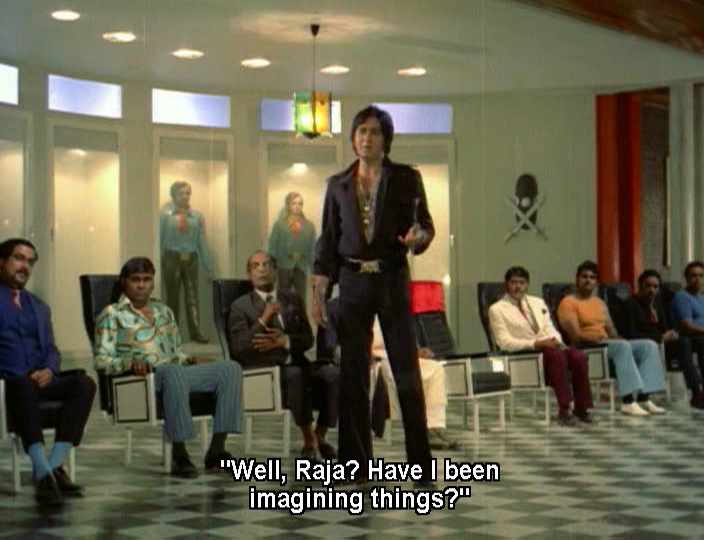
Johny’s lair is part suburban living room, part gallery and part obstacle course.
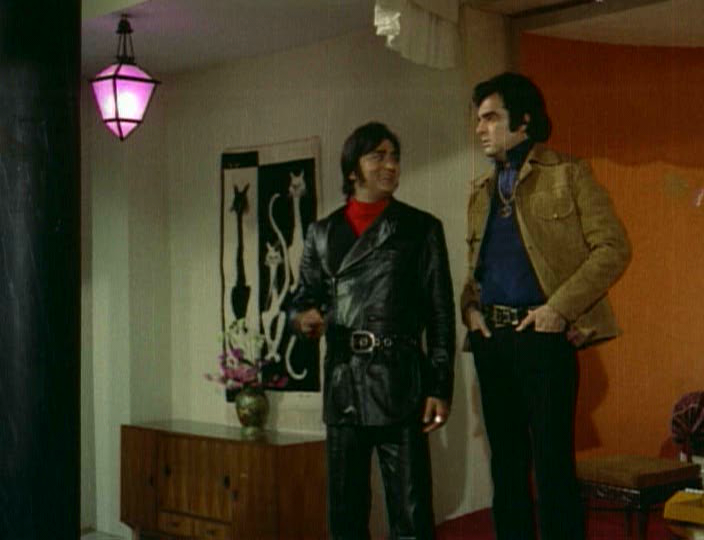
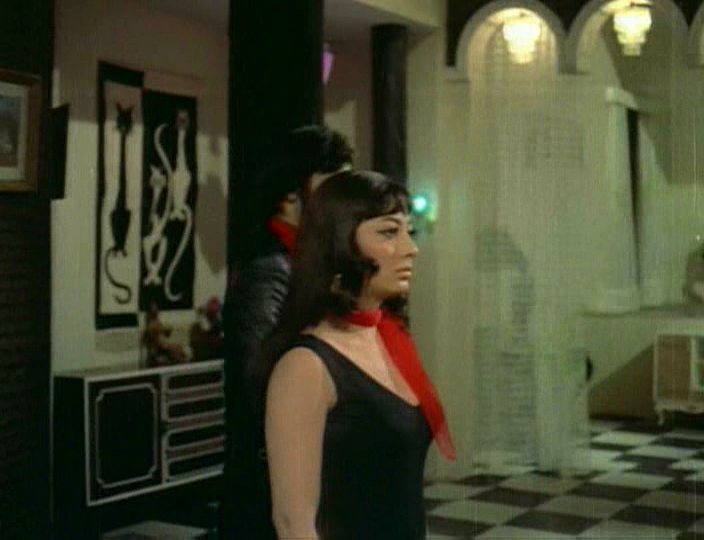
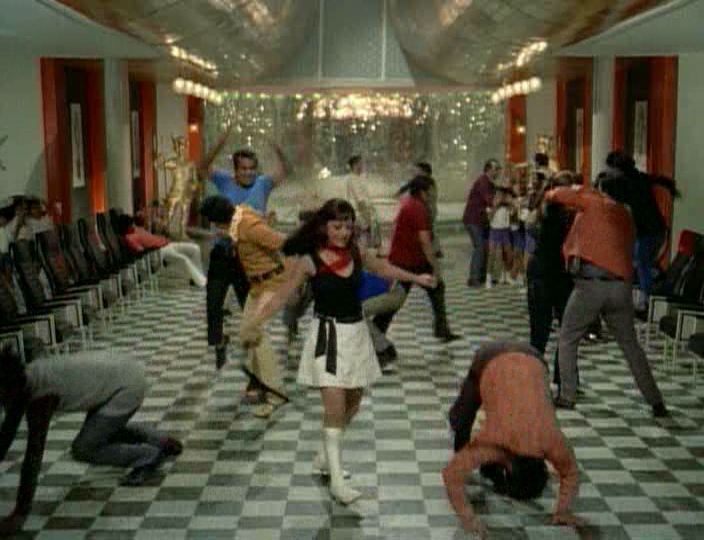
Geeta-Mera-Naam-Feroz and SunilGeeta-Mera-Naam-the other cat wall hangingThe famous Cat Wall Hanging appears. Raja’s apartment is the height of 70s bachelor style, complete with round rotating bed. Johny ends up with a cast of thousands in his relatively modest abode for the grand finish.
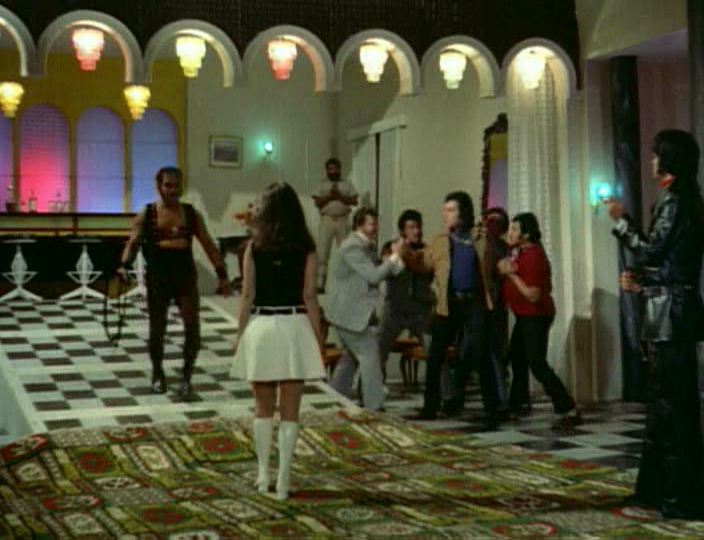
Geeta-Mera-Naam-carpet

I was amused to see some carpet placed over sections of the tiled floor and wondered if it was due to health and safety concerns for the actors, or reflected Johny’s experience of having to get bloodstains off the marble.

This is unlike most other 70s masala in terms of the psychology of the characters and the prominence of the women within the story. Sadhana chose Geeta Mera Naam as both her comeback and a farewell, wanting to go out as a memorable heroine.  I wish she had directed more films as this is highly entertaining and all the elements are well balanced.  3 ½ stars!
Geeta-Mera-Naam-Mayhem

R…Rajkumar (2013)

R...Rajkumar

Prabhu Dheva (where did the extra ‘h’ come from?), the dance guru, directing Shahid Kapoor, one of the few Hindi actors who can dance – surely that has to be a good thing?

R...Rajkumar

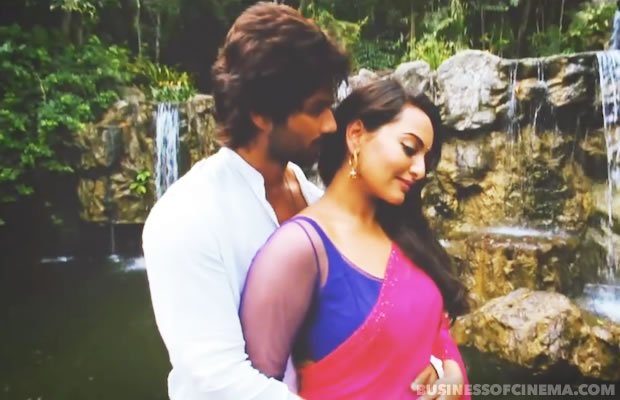
Well… the premise is there, but in delivery R…Rajkumar is not as good as expected.  While the dancing is excellent (and it is fantastic to see a director make full use of Shahid’s talents in that respect), there are a few too many distasteful misogynistic moments to make this film anything other than just OK.  Shahid makes a reasonable attempt at masala served southern style, and his goofy shirts, dreadful hair and love struck Romeo are entertaining if somewhat reminiscent of Siddharth in Nuvvostanante Nenoddantana.  Although Shahid does his best, the story is standard fare, and adheres strictly to the usual Telugu formula complete with cartoonish fight scenes and ineffectual heroine.  It’s such a shame when all the ingredients are there to make a much better film, if only a little more thought had gone into the screenplay.

R...RajkumarR...Rajkumar

Romeo Rajkumar turns up in a small town where two rival gangs are battling for control of the opium trade, managing to arrive just at the right time to save Chanda (Sonakshi Sinha) from a stray bullet. Simultaneously he falls deeply in love with her after just one brief glance – so deeply in fact, that the mere sight of his ‘lollipop’ (gah!) is enough to halt him in his tracks.   And I do mean completely stop – no matter what – even when taking part in an assassination or when driving the getaway car after another attack on a rival gang. Much hilarious comedy ensues. Well, to be fair, it is funny the first time or two, but it just gets repeated a few too many times.

Rajkumar signs up with Shivraj (Sonu Sood) and soon becomes one of his top men in the fight against rival gang boss Parmar (Ashish Vidyarthi) becoming good friends with Qamar Ali (Mukul Dev) in the process.  The first half is full of outrageous shirts, bad hair and some amazing dance moves from Shahid along with a brief appearance from Prabhu Deva himself.

R...Rajkumar

But while Shahid is blowing kisses and generally making an idiot of himself, there are darker scenes such as an apparent rape in the police station which is treated as an everyday occurrence and not worthy of further mention.  Further threats of violence and rape against the heroine are also treated as comedy and while some of the lewd dialogue is funny, most is offensive rather than comical.

R...RajkumarR...Rajkumar

Sonakshi Sinha starts off as a feisty village girl with great attitude as she beats up a gang of louts who dare to wolf-whistle at her and her friends. She berates Rajkumar for his unwanted attentions repeatedly, until she manages to overcome her aversion to eighties hair and loud shirts and decides that maybe Rajkumar isn’t so bad after all. But that’s the end of any personality for Chanda, who rapidly becomes vapid and useless, totally unable to defend herself against her uncle and his plans for her marriage, and completely helpless in the face of Shivraj’s attempts to seduce her. It’s a role Sonaskshi Sinha has done many times in the past but she has less conviction in her character here, and it shows.  There is no energy in her performance and zero chemistry with her co-star which makes me wonder why Prabhu Deva didn’t pick someone like Trisha or even Charme Kaur (who turns up in a song) who surely would have brought more oomph to the role.

R...RajkumarR...Rajkumar

Equally disappointing is Sonu Sood who is less menacing and more buffoonish than expected as a gang boss.  Ashish Vidyarthi is even more of a caricature as his rival, while Asrani is actually rather restrained in his role as spiritual advisor to Shivraj.  It’s bitter sweet to see Srihari appear here as the über villain Ajit Taaka, in one of his last appearances.  Generally he’s fine in spite of a rather unconvincing storyline and one rather bizarre scene where he appears gyrating with some bikini clad women on top of a hotel in (supposedly) Hong Kong. Best to just ignore and move along – when did masala ever have to make sense?

What does work well in the film are the songs by Pritam.  Prabhu Deva does an excellent job with the choreography, as for example here in Saree Ke Fall Sa where he uses the backing dancers and a few basic props to good effect.  The only exception is the last item song with Ragini Dwivedi and Scarlett Wilson which is shambolic with much less of a southern feel.

While the film initially feels like a series of short comedy sketches, everything slows down in the second half and becomes a little more serious with more fight scenes and fewer songs.  The inevitable final showdown is good, although I don’t think Shahid is quite as convincing in ‘back-from-the-edge-of-death’ recoveries as, for example, Shahrukh in Chennai Express, which does make the last fight scene funnier than I think it was meant to be. The film could definitely do with fewer rape references, and a more socially responsible hero would have made for less uncomfortable viewing.  Still, Shahid puts in a good performance and seeing him dance up a storm southern style, makes R…Rajkumar worth a watch, even if it doesn’t quite reach the heights I expected.

R...Rajkumar

Goliyon Ki Raasleela Ram-Leela

ram-leela-poster

Goliyon Ki Raasleela Ram-Leela* is mostly what I expected from Sanjay Leela Bhansali. It’s visually lush, with opulent sets, stunning landscapes, gorgeous costumes and lovely people to wear them. The movie opens with a looong stream of credits for Bhansali (producer, writer, director, editor, music director) including acknowledgement that Ram-Leela is inspired by Shakespeare’s Romeo and Juliet. Knowing the story and probable ending in advance raises the question – will the journey be worth it? Well, yes. I was pleasantly surprised to find myself entertained and interested most of the time.

Ram gives Ranveer Singh the opportunity to play both the prancing peacock and the traumatised young man who has been immersed in violence all his life. He makes a Rajnikanth-esque entrance, and springs straight into Tattad Tattad.

The choreography is disappointing – a friend calls it the Dandruff Song because of all the hairography. But based on audience reaction, they got the amount of shirtless shimmying about right. And his chest-oiler must have been working overtime, yet they were not named in the end credits which seems a sad oversight. Ram is obsessed with sex, with enjoying his life (especially sex) and has a cunning plan to take revenge on the enemy Sanedas (by having sex with their womenfolk). He admits that his thinking apparatus may be located in his pants. But Ram is also the one voice asking whether his side, the Rajadaris, should try to stop the cycle of killing. He is a mercurial creature, a natural leader but one with an unpopular message. I really liked Ranveer’s energy, his slightly self-mocking delivery of the deliberately cheesy lines, and his passionate sincerity when he confronted Leela.

Ram Leela Deepika

Deepika Padukone looks stunning and she has also crafted a good performance. This story is very familiar and requires logic suspension which means that the chemistry has to glide over any plotholes. I’ve often felt she struggled to show warmth with some co-stars, not so here. Sparks fly from Leela’s first sight of Ram in a rain of colours at Holi to the verbal sparring as they trade rhyming couplets. Leela is as interested in pursuing this relationship as he is, and she is not afraid to initiate intimacy or sort him out when he misbehaves. She also seems a bit smarter than Ram, and more cognisant of long term consequences. Deepika is convincing throughout, whether playing the giddy Leela falling in lust, dancing her heart out, or as the saddened serious young woman confined by the past.

The minor roles are interesting, especially the key female characters. Supriya Pathak is impressive as Baa, Leela’s mother and the leader of the Sanedas. Ultimately she is the one who will have to decide for the future, and she is a powerful, brooding presence. Richa Chadda plays another of her smart women in a regressive male dominated world (think Fukrey, Gangs of Wasseypur) and she is excellent as Leela’s sister-in-law Raseela. Barkha Bisht plays Ram’s sister-in-law Kesar, and she is equally good. The sisters-in-law give voice to the emotions of both sides. Both are widowed in the same stupid macho incident, and both women remain integral to the story long after their husbands are gone. Sharad Kelkar and Gulshan Devaiah round out the more significant male support roles. I was delighted to see Raza Murad as the Sarpanch even though his role was largely to provide ‘As you know Bob …” exposition. Abhimanyu Singh’s career mystifies me. He’s a terrible actor. He even overacts when he is supposed to be dead! And seeing Priyanka Chopra’s lacklustre item number made me grateful Deepika got the lead.

Ram-Leela Holi

The costumes are not just gorgeous, they reveal something about the characters. Leela wears a modern lehenga but the underskirt is a traditional patterned fabric. Kesar’s dark shawl signifies her position, but it’s lined with a light patterned fabric. Baa wears masses of ostentatiously heavy jewellery, showing her wealth and the strength to hold on to it.

ram leela guns everyhwere

Ram wears floral shirts edged with multi-coloured mini pom-poms and his holster is brightly embroidered. And there are guns EVERYWHERE. Like Leela, he carries his heritage with him. Many of the dances are garba style (showing off the excellent costumes) and most centre around religious celebrations (more colourful folkloric costumes). Everyone lives in old style houses but all the ladies whip out phones to film Ram strutting his stuff.  There is a sense of the ‘modern’ world invading this village where families have feuded for 500 years.

Ram Leela set design

Despite being less hidebound in their views, it doesn’t take much to make Ram and Leela each accuse each other of being a typical Rajadari or Saneda, just like ‘them’ as things turn sour. You don’t have to scratch the surface too hard to reach the inculcated mistrust and stereotypes. But after a cracking start, Bhansali loses control in the second half where the repetition of crisis and non-resolution becomes a little tedious.

I can’t help comparing this to Sunil Dutt’s stunning Reshma aur Shera and Baz Luhrmann’s excellent Romeo + Juliet, and while I like Ram Leela it comes up well short of both. Dutt expressed the tragedy and beauty of a doomed love in Rajasthan with fewer filmi tricks and greater emotional impact and maturity. Luhrmann stuck closely to Shakespeare and was still playful and original. Bhansali gestures towards Romeo and Juliet, mostly in the balcony scene which he recreated quite closely down to the dialogue. But he refers to iconic scenes in his own films as much as he does Shakespeare. He needs to curb the self-indulgence, and to edit with more eye to the story.

I’d definitely recommend seeing this in a cinema for the beauty and visual impact. The songs alone are worth a look and I had fun guessing which choreographer did which. I expected this to look great, and often that is all I get from Bhansali films as I just don’t connect with them. I didn’t expect Ram-Leela to be quite so entertaining and engaging.

*None of the marketing material or cinema listings here in Australia seem to have been changed so the film is still listed as Ram Leela. 

What? You want to see the colourful embroidery and outfits in detail? Here you go. Because I care.

Ram Leela everyone needs a smartphone

Heather says: I wasn’t expecting to enjoy this as much as I did. Sure, I knew it would be beautiful and I’ve been enjoying the soundtrack, but the performances from all the actors put this a notch above the usual SLB film.  Deepika in particular was a revelation and she seems to have been steadily improving with each film.  I used to find her wooden and somewhat tedious, but she really sparkles here in a role that gives her scope to show a number of different emotions as well as the smoking hot chemistry with Ranveer that Temple has mentioned. Phew!  I’ve only seen Ranveer once before and from his initial appearance in  Tattad Tattad I was expecting him to be woeful, but such is not the case.  He rises to the occasion (cough, cough) and is so much better than the 70’s porn star outfits suggest.  His swagger and bravado are just part of his persona and his Ram is full of passion and joy. Best of all though are the support female characters played by Supriya Pathak, Barkha Bisht and Richa Chadda.  As Temple has described, all had meaty roles that allowed them to be real people with varying emotions and motivations which gave more layers to the film.

However, as with every SLB film I’ve seen, Ram Leela could have done with a heavier hand with editing and the last hour had moments where it really did start to drag.  Still – the costumes are sumptuous, the scenery is beautiful and the performances were of a high enough standard that I completely agree with Temple that this is one to see on the big screen.  Ram Leela was much more entertaining than I expected and I thoroughly recommend it as one of the better Hindi films I’ve seen this year.